Adaptio vs Ninjapear (2026): Which B2B Sales Tool Wins?
A neutral, hands-on breakdown of Adaptio vs Ninjapear in 2026 — pricing, data quality, automation, and which platform fits your sales motion.
Choosing between Adaptio and Ninjapear usually comes down to one question that neither vendor's landing page answers honestly: which one actually fits the way your team sells today? Both promise to fill your pipeline. Both demo well. But under the hood they make very different bets about data, automation, and where a human should step in.
This is a hands-on, vendor-neutral comparison. We will not pretend one tool is perfect — each has a sweet spot and a set of teams it will frustrate.
TL;DR — Adaptio vs Ninjapear at a glance#
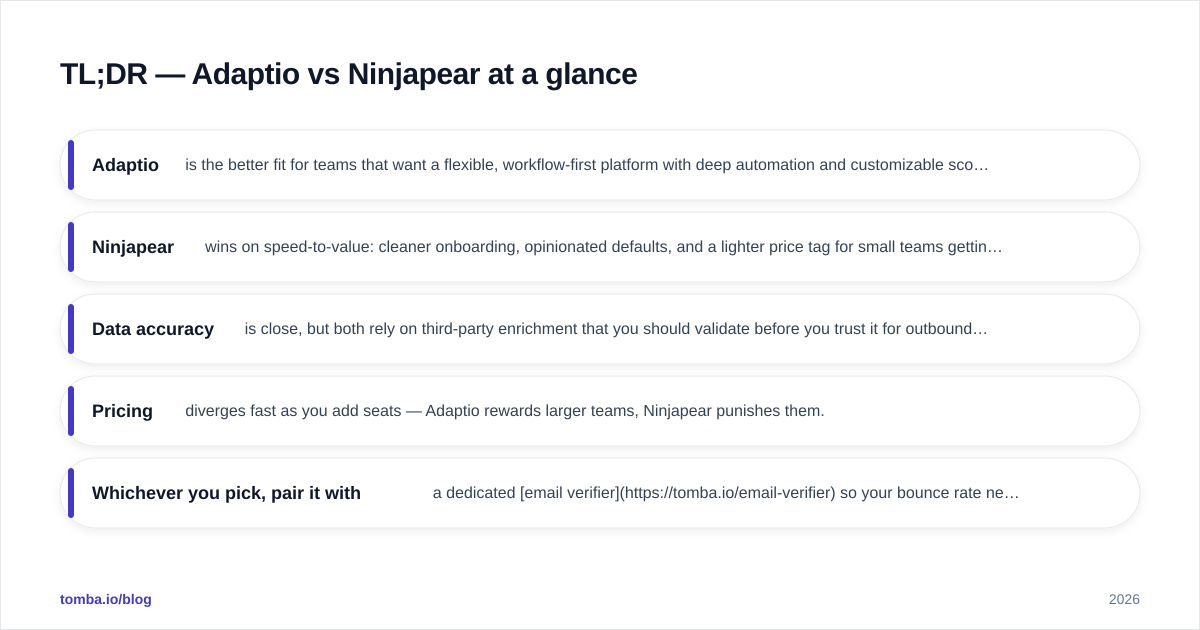
- Adaptio is the better fit for teams that want a flexible, workflow-first platform with deep automation and customizable scoring — at the cost of a steeper setup curve.
- Ninjapear wins on speed-to-value: cleaner onboarding, opinionated defaults, and a lighter price tag for small teams getting started.
- Data accuracy is close, but both rely on third-party enrichment that you should validate before you trust it for outbound at scale.
- Pricing diverges fast as you add seats — Adaptio rewards larger teams, Ninjapear punishes them.
- Whichever you pick, pair it with a dedicated email verifier so your bounce rate never tanks your sender reputation.
What are Adaptio and Ninjapear?#
Both Adaptio and Ninjapear sit in the same broad bucket: B2B sales tooling that helps you find accounts, surface contacts, and push activity into your CRM. But they approach the job from opposite ends.
Adaptio positions itself as a configurable revenue platform. Think of it like a modular kitchen — you get the appliances, the counters, and the wiring, and you design the layout that matches how you cook. That flexibility is powerful for ops-mature teams and overwhelming for a two-person startup.
Ninjapear is the opinionated all-in-one. It is closer to a meal-kit subscription: the ingredients arrive pre-portioned, the recipe is written, and you trade some control for the fact that dinner is on the table in twenty minutes. Smaller teams love this; large RevOps teams tend to hit its ceiling.

The framework above is the lens we will use for the rest of this comparison: the more your motion depends on custom workflows and the larger your team, the more Adaptio's flexibility pays off; the smaller and faster you want to move, the more Ninjapear's defaults help.

How do Adaptio and Ninjapear compare on features?#
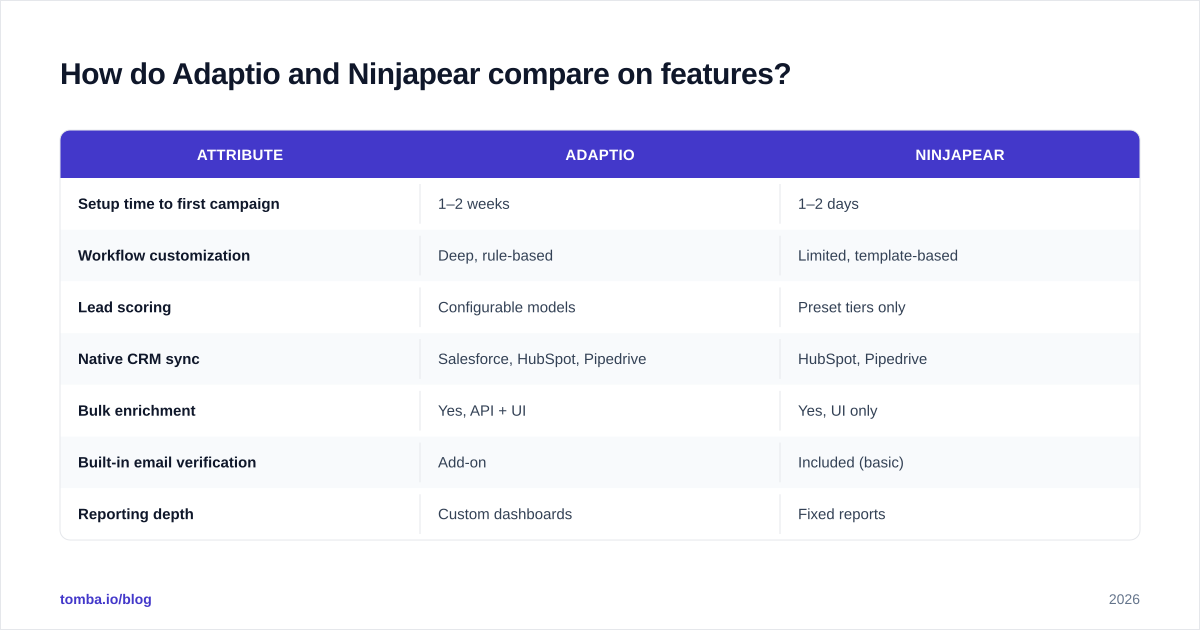
Here is the side-by-side. These attributes are the ones that actually change day-to-day work, not the marketing checklist items.
| Attribute | Adaptio | Ninjapear |
|---|---|---|
| Setup time to first campaign | 1–2 weeks | 1–2 days |
| Workflow customization | Deep, rule-based | Limited, template-based |
| Lead scoring | Configurable models | Preset tiers only |
| Native CRM sync | Salesforce, HubSpot, Pipedrive | HubSpot, Pipedrive |
| Bulk enrichment | Yes, API + UI | Yes, UI only |
| Built-in email verification | Add-on | Included (basic) |
| Reporting depth | Custom dashboards | Fixed reports |
| Learning curve | Steep | Gentle |
The pattern is consistent. Adaptio gives you more dials; Ninjapear hides most of them so you never have to think about them. Neither approach is wrong — it depends on whether your bottleneck is control or time.
One nuance worth flagging: Ninjapear's "included" email verification is genuinely basic. It catches obvious syntax errors and dead domains, but it does not handle catch-all verification well, which is where a lot of B2B addresses actually live. Adaptio offloads verification entirely, which means you choose your own provider — more work, but usually more accurate.

Is Adaptio better than Ninjapear for data accuracy?#
Short answer: it is a near tie, and both depend heavily on the same upstream data sources.
Here is the part vendors rarely say out loud. Most B2B tools in this category do not own a uniquely massive proprietary dataset — they license, scrape, and blend. So when Adaptio and Ninjapear both quote "95% accuracy," they are quoting lab conditions on clean, well-known company domains. Run either against a list of 5,000 mid-market prospects in a niche vertical and you will see real-world hit rates closer to 60–80%.
That gap is not a reason to distrust them; it is a reason to verify independently. The most reliable workflow we have seen is:
- Pull contacts from your platform of choice (Adaptio or Ninjapear).
- Run every address through a dedicated verifier before it enters a sequence.
- Segment catch-all and risky addresses into a separate, slower-cadence track.
This is exactly why many teams keep a specialist email-finding layer alongside their sales platform. A focused tool like the Tomba email finder or domain search often returns addresses on long-tail domains that the bundled enrichment in an all-in-one suite misses — and you can read about where the data comes from rather than taking a percentage on faith.
If you want to understand why verification matters so much before you ever press send, the concept of email deliverability is the thing both platforms quietly depend on and neither fully controls.
How do Adaptio and Ninjapear price out in 2026?#
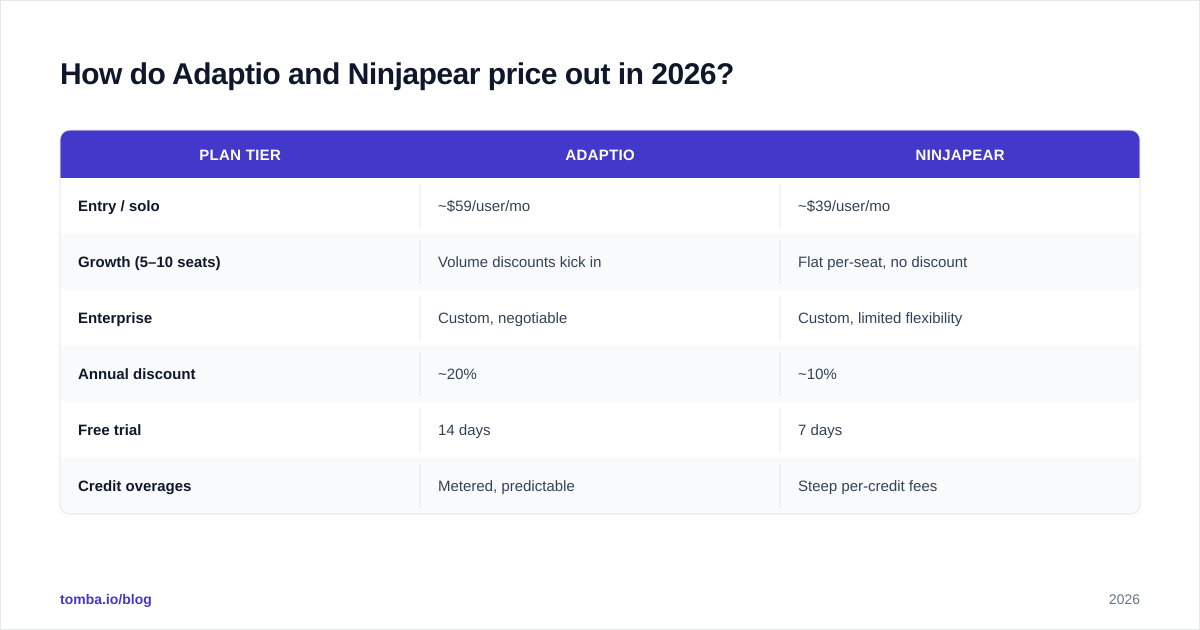
Pricing is where the two tools separate most clearly, and it flips depending on team size.
| Plan tier | Adaptio | Ninjapear |
|---|---|---|
| Entry / solo | ~$59/user/mo | ~$39/user/mo |
| Growth (5–10 seats) | Volume discounts kick in | Flat per-seat, no discount |
| Enterprise | Custom, negotiable | Custom, limited flexibility |
| Annual discount | ~20% | ~10% |
| Free trial | 14 days | 7 days |
| Credit overages | Metered, predictable | Steep per-credit fees |
For a solo founder or a three-person SDR pod, Ninjapear is cheaper and faster to justify. But notice what happens at scale: Adaptio's volume discounts and metered overages make it the more predictable bill once you cross roughly eight to ten seats. Teams that grew on Ninjapear frequently migrate to something more flexible precisely when per-seat costs stop bending.
A word of caution on credits: both platforms count enrichment in credits, and "unused" credits usually expire monthly. If your prospecting volume is spiky, model your worst month, not your average — that is where Ninjapear's overage fees bite hardest.

Which workflow fits which team?#
The decision tree below maps the most common scenarios we see.

Pick Ninjapear if:
- You are a team of one to five and need pipeline this week, not next month.
- You do not have a dedicated RevOps person to maintain custom rules.
- Your ICP is mainstream (well-known company domains, common titles).
- You value a single bill over a best-of-breed stack.
Pick Adaptio if:
- You have eight or more seats and the per-seat math matters.
- You run multi-stage, conditional workflows that templates cannot express.
- You want to own your enrichment and verification choices.
- You already use Salesforce and need deep, bidirectional sync.
There is also a third path that quietly beats both for a lot of teams: buy the workflow tool you like and bolt on a specialist data layer. Sales platforms are excellent at orchestration and mediocre at long-tail contact discovery. A dedicated finder, a bulk email finder for list building, and a real verifier cover the gap without forcing you to over-pay for whichever suite happens to bundle data this quarter.

What do real reviews say about Adaptio vs Ninjapear?#
Aggregate review sentiment (the kind you will find on independent marketplaces like G2 and Capterra) tends to cluster into predictable themes.
For Ninjapear, praise centers on onboarding speed and a clean interface; complaints center on hitting feature ceilings and on support response times once you are on a lower tier. The phrase "we outgrew it" appears often.
For Adaptio, praise centers on flexibility and reporting; complaints center on the implementation burden and the fact that you really do need someone who owns the tool. The phrase "powerful but takes work" appears often.
Neither pattern is a dealbreaker — they are just the natural trade-offs of opinionated-simple versus flexible-complex. What matters is matching that trade-off to your team's maturity. If you want a neutral primer on how categories like this evolve, the broad sales automation landscape gives useful context on where bundled suites historically win and lose.
What's the verdict on Adaptio vs Ninjapear?#
There is no universal winner, and any post that declares one is selling something.
- If you are small and fast, Ninjapear gets you to first contact quickest and costs less to start.
- If you are scaling and ops-driven, Adaptio's flexibility and pricing curve reward you over time.
- If you care most about data quality, treat either platform as the orchestration layer and add a dedicated discovery-and-verification step — that single change usually moves the deliverability needle more than switching suites does.
The honest framing: the tool is rarely the constraint. Clean, verified contact data feeding a sane cadence beats a fancier platform feeding garbage every single time. Pick the workflow tool whose trade-offs you can live with, then protect your sender reputation with verification you control.
Where Tomba fits in either stack#
Whether you land on Adaptio, Ninjapear, or stay tool-agnostic, the foundation is the same: you need accurate, verified email addresses before any of this matters. That is the one job the Tomba Email Finder does without forcing you into a full-suite commitment. Find professional addresses by name, company, or domain, verify them before they enter a sequence, and push the clean results into whichever platform you chose — starting on the free tier (25 searches/month) and scaling through transparent Tomba pricing ($49/mo Starter, $99/mo Growth) only when your volume demands it. Use the suite you like for orchestration; let Tomba handle the data layer that decides whether your outreach lands or bounces.
Get the Tomba newsletter
Practical outbound tactics and product updates — once every two weeks.
About the author