Adaptio vs OneMoreLead 2026: Which B2B Data Tool Wins?
Adaptio leans on AI intent and dynamic enrichment; OneMoreLead sells a fixed B2B contact database. Here's which one fits your pipeline in 2026 — and where a verifier still matters.
Choosing between Adaptio and OneMoreLead comes down to one question: do you want a dynamic, AI-scored prospecting layer, or a large pre-built B2B contact list you can export and run? The two tools solve the "who do I email next" problem from opposite ends, and picking the wrong one wastes both budget and sender reputation.
This breakdown compares both platforms on data model, accuracy, pricing, intent signals, and — the part most reviews skip — what you still have to do before any of those records is safe to send to.
TL;DR#
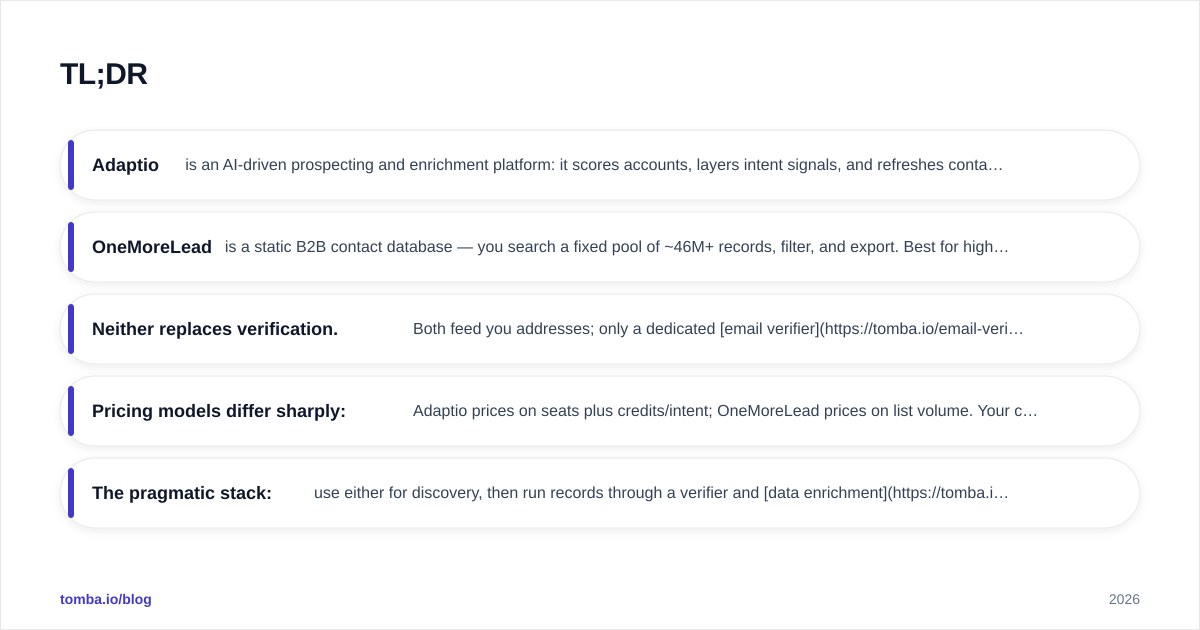
- Adaptio is an AI-driven prospecting and enrichment platform: it scores accounts, layers intent signals, and refreshes contact data dynamically. Best for teams running targeted, account-based outbound.
- OneMoreLead is a static B2B contact database — you search a fixed pool of ~46M+ records, filter, and export. Best for high-volume list building on a budget.
- Neither replaces verification. Both feed you addresses; only a dedicated email verifier keeps your bounce rate under the 2-3% threshold inboxes punish.
- Pricing models differ sharply: Adaptio prices on seats plus credits/intent; OneMoreLead prices on list volume. Your cost-per-usable-contact, not sticker price, is what matters.
- The pragmatic stack: use either for discovery, then run records through a verifier and data enrichment pass before they touch your sequencer.
What is Adaptio?#
Adaptio positions itself as an AI prospecting and revenue-intelligence layer rather than a flat list vendor. Think of it less like a phone book and more like a research assistant that watches the market: it ingests firmographic data, layers buying-intent signals, scores accounts against your ideal customer profile (ICP), and surfaces contacts at the accounts most likely to be in-market right now.
The value proposition is prioritization. Instead of exporting 10,000 names and hoping, you work a ranked shortlist where the model has already weighed company fit, recent signals, and contactability. For teams doing account-based outbound — where you'd rather send 200 sharp emails than 5,000 sprayed ones — that scoring is the whole point.
The trade-off is that AI scoring is only as good as the underlying data and the freshness of the signals. Dynamic enrichment helps, but you are trusting a model's confidence, and confidence is not the same as a validated, deliverable mailbox.
What is OneMoreLead?#
OneMoreLead is a straightforward B2B contact database. You get access to a large pool of business records — the company advertises tens of millions of contacts — with filters for industry, title, location, company size, and similar firmographics. You build a list, OneMoreLead claims its records are pre-validated, and you export to CSV or push into your CRM or email tool.
The model is volume and simplicity. There's no scoring engine to learn, no intent layer to interpret — you define your filters and pull names. For agencies and SMBs that need raw quantity for cold outreach or to seed a B2B database of their own, that simplicity is the selling point.
The honest caveat with any static database is decay. B2B contact data goes stale at roughly 22-30% per year as people change jobs, companies fold, and domains migrate. A "pre-validated" list validated at ingestion is not the same as validated at send time. That gap is where bounces — and blacklist risk — come from.
Adaptio vs OneMoreLead: side-by-side comparison#
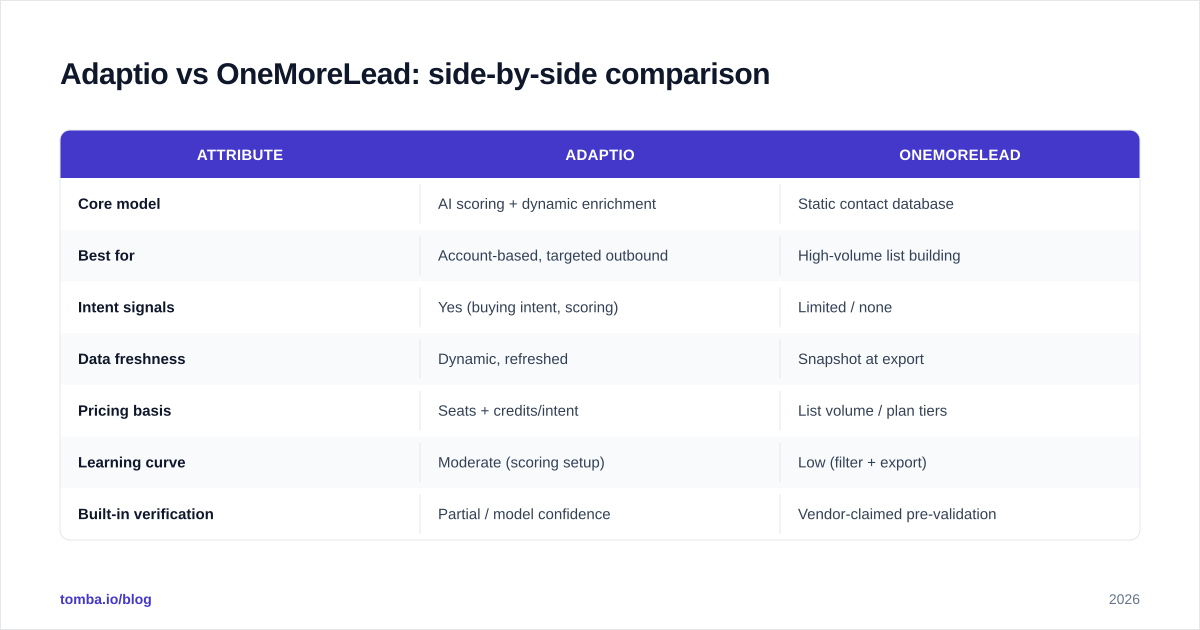
| Attribute | Adaptio | OneMoreLead |
|---|---|---|
| Core model | AI scoring + dynamic enrichment | Static contact database |
| Best for | Account-based, targeted outbound | High-volume list building |
| Intent signals | Yes (buying intent, scoring) | Limited / none |
| Data freshness | Dynamic, refreshed | Snapshot at export |
| Pricing basis | Seats + credits/intent | List volume / plan tiers |
| Learning curve | Moderate (scoring setup) | Low (filter + export) |
| Built-in verification | Partial / model confidence | Vendor-claimed pre-validation |
| Export flexibility | CRM + sequencer sync | CSV + integrations |
| Typical buyer | RevOps, SDR teams, ABM | Agencies, SMB, volume cold email |
The pattern is clear: Adaptio optimizes for precision per contact, OneMoreLead optimizes for cost per thousand contacts. Your motion decides which axis matters.
Which has better data accuracy?#
Accuracy is the wrong single number to chase — what you actually care about is deliverable accuracy at the moment you hit send, not the accuracy the vendor measured at ingestion.
Adaptio's dynamic enrichment gives it an edge on freshness: because it re-checks and re-scores, a contact pulled today is more likely to reflect a current role than a snapshot. But model confidence scores are probabilistic. A 90% confidence flag still means roughly one in ten could bounce or be a catch-all that swallows your message silently.
OneMoreLead's larger static pool gives you reach, but a pre-validated database degrades the moment it's published. If the list was refreshed three months ago, assume a meaningful slice has already churned.
The fix is the same regardless of which tool you pick: never trust a vendor's accuracy claim as your bounce insurance. Run every exported list through an independent email verification pass, and treat catch-all domains specifically with a catch-all verifier so you know whether a "valid" address is actually reachable or just a domain that accepts everything.
How do Adaptio and OneMoreLead price?#
Pricing is where the two diverge most, and where "cheaper" is genuinely misleading.
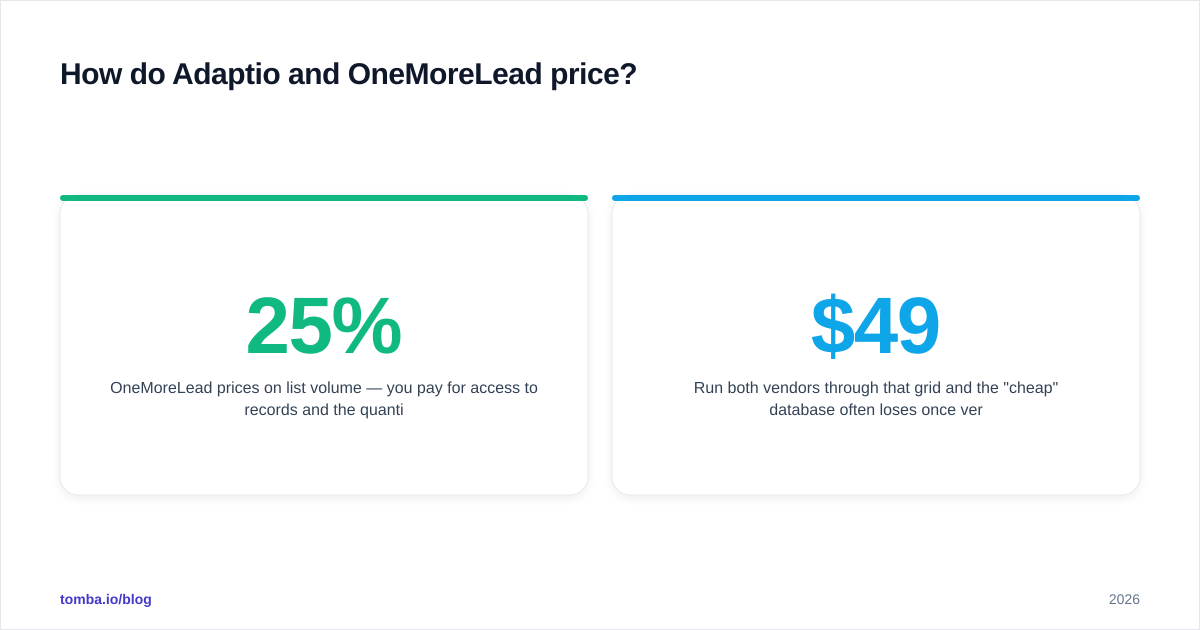
OneMoreLead prices on list volume — you pay for access to records and the quantity you can pull. On paper this looks cheap per contact. But if 25% of those records are stale, your effective cost per usable, deliverable contact is 33% higher than the headline number, before you factor in the reputation damage from sending to dead addresses.
Adaptio prices on seats plus credits or intent access. The sticker is higher, and you're paying for the scoring engine, not just rows. For a small team blasting volume, that's overkill. For an ABM team where one closed deal pays for the year, the prioritization easily justifies the premium.
Here's the calculation that actually matters:
| Cost factor | What to measure |
|---|---|
| Headline price | Monthly/annual sticker |
| Usable rate | % of records deliverable after verification |
| Effective CPC | Price ÷ usable contacts |
| Reputation cost | Bounce-driven domain/IP risk |
| Time cost | Hours spent cleaning bad data |
Run both vendors through that grid and the "cheap" database often loses once verification waste and rep risk are priced in. For reference on what transparent, usage-based pricing looks like, compare against published Tomba pricing — Free (25 searches/mo), Starter $49/mo, Growth $99/mo, Pro $249/mo — where you pay per validated action rather than per stale row.
You can sanity-check any vendor's real-world reputation on independent review sites like G2 and Capterra before committing to an annual contract.
When should you choose Adaptio?#
Pick Adaptio when:
- You run account-based or targeted outbound and prioritization beats raw volume.
- You have a defined ICP and want intent signals to time your outreach.
- Your deal sizes justify paying for precision — a single won enterprise deal covers the premium.
- You have RevOps or ops support to configure scoring and act on signals.
Adaptio is the wrong choice if you just need a big list fast and don't have the motion to act on scored, prioritized accounts. Paying for an intelligence layer you won't use is waste.
When should you choose OneMoreLead?#
Pick OneMoreLead when:
- You need volume at low headline cost for broad cold outreach.
- Your filters are firmographic and simple (title, industry, geo, size).
- You're an agency or SMB building lists for multiple clients or campaigns.
- You already own a verification and warmup workflow, so stale records get caught before send.
OneMoreLead is the wrong choice if you're relying on it as your only quality gate. A static database without a downstream verifier is how good sending domains end up on blocklists.
What both tools miss — and how to close the gap#
Neither Adaptio nor OneMoreLead is a complete outbound stack on its own. Two gaps recur:
1. Send-time verification. Discovery tools find addresses; they don't guarantee deliverability at the moment you send. The single highest-ROI habit in cold outreach is verifying every list immediately before it enters your sequencer. Keeping bounce rate under ~2-3% protects sender reputation, which is the thing inbox providers actually score you on.
2. Filling the holes. Both tools leave gaps — missing direct dials, missing the one decision-maker you need at a target account, missing a verified work email behind a generic info@ address. That's where a focused email finder and domain search earn their place: you find Adaptio's prioritized accounts, then resolve the exact contact and confirm the address, rather than guessing or emailing a role inbox.
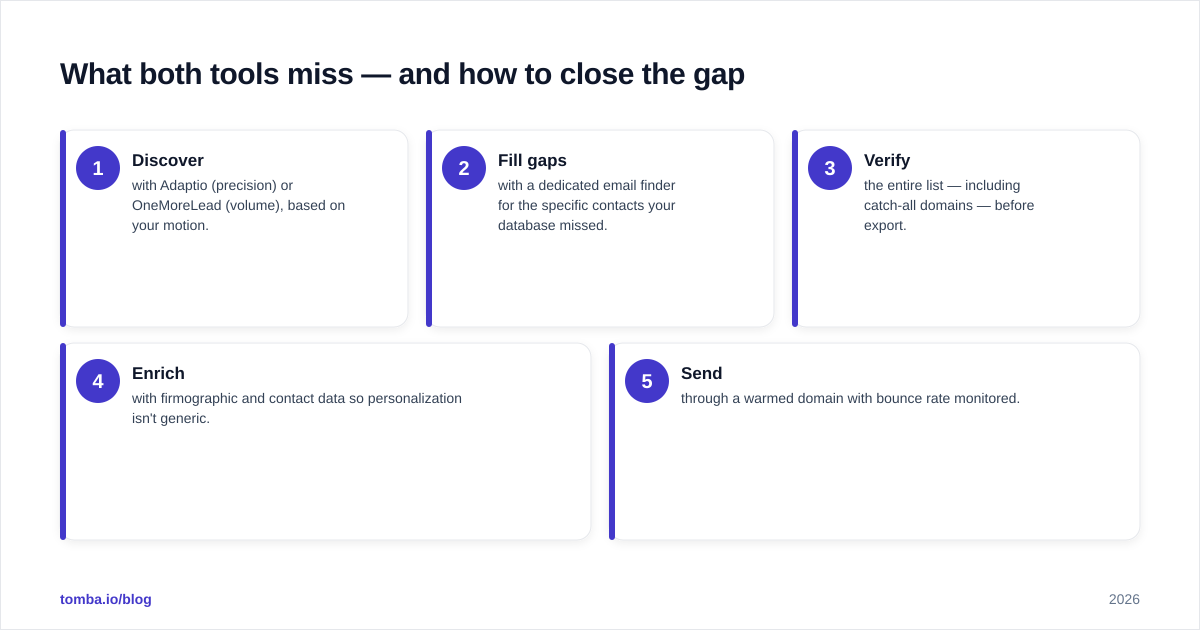
The most reliable setup looks like this:
- Discover with Adaptio (precision) or OneMoreLead (volume), based on your motion.
- Fill gaps with a dedicated email finder for the specific contacts your database missed.
- Verify the entire list — including catch-all domains — before export.
- Enrich with firmographic and contact data so personalization isn't generic.
- Send through a warmed domain with bounce rate monitored.
Skip step 3 and the quality of steps 1 and 2 stops mattering — a great list with a 12% bounce rate still torches your deliverability.
Frequently asked questions#
Is Adaptio better than OneMoreLead? Neither is universally better. Adaptio wins for targeted, intent-driven ABM where prioritization pays off. OneMoreLead wins for low-cost, high-volume list building. Match the tool to your outbound motion, not to a leaderboard.
Do I still need an email verifier with these tools? Yes. Vendor "pre-validated" or "high-confidence" labels reflect data state at ingestion, not at your send time. Always run an independent verification pass to protect deliverability.
Which is cheaper? OneMoreLead usually has a lower headline price, but compute effective cost per deliverable contact after verification waste. The cheaper sticker frequently loses once stale records and reputation risk are priced in.
Can I use both? Yes — some teams use OneMoreLead for breadth and a precision tool plus a finder/verifier to clean and target. Just make sure verification sits between any database and your email tool.
The bottom line#
Adaptio and OneMoreLead aren't really competitors so much as two different philosophies: pay more for AI-prioritized precision, or pay less for static volume. Choose Adaptio if your outbound is targeted and account-based; choose OneMoreLead if you need affordable scale and already own a clean-up workflow.
Whichever you pick, the deciding factor for results isn't the database — it's what happens between export and send. Close that gap with Tomba's Email Finder to resolve the exact contacts your database misses and confirm every address before it ships, then back it with email verification so your bounce rate — and your sender reputation — stay where they should. Start free with 25 searches a month and only pay once the workflow proves itself on your own pipeline.
// get started
Find, verify and enrich your first contacts today
Start on the free plan with 25 searches a month, then scale when your team is ready.
Free plan · No credit card required · GDPR & CCPA
// about the author