Adaptio vs Pipileads (2026): Which Sales Tool Wins?
A neutral, hands-on breakdown of Adaptio vs Pipileads in 2026 — features, pricing, data quality, and which prospecting tool actually fits your sales motion.
TL;DR
- Adaptio is built around AI-assisted LinkedIn outreach and signal-based prospecting — strong if your motion lives on social and you sell to mid-market teams.
- Pipileads leans toward bulk lead generation and list-building — strong if you need volume, broad filters, and CRM-ready exports fast.
- Neither tool is a dedicated email-verification engine, so both pair best with a separate finder/verifier to protect deliverability.
- On raw price, Pipileads tends to undercut on entry tiers; Adaptio charges more but bundles more workflow automation.
- If your real bottleneck is valid contact data — not another sequencer — a focused tool like Tomba alongside either platform beats paying premium for overlapping features.
What are Adaptio and Pipileads?#
Short version: both are B2B prospecting platforms, but they solve the problem from opposite ends.
Think of it like fishing. Adaptio is the angler who studies the water, watches for movement, and casts a precise line where the fish actually are — it's signal-led, LinkedIn-centric, and built to personalize outreach at the moment a prospect shows intent. Pipileads is the trawler: drop a wide net, filter the catch, and move volume through your pipeline quickly.
That framing matters because most teams pick the wrong one. They buy the trawler when they need precision, or the angler when they need scale. The rest of this comparison is about matching the tool to your actual motion, not the marketing page.
Both belong to the broader category of B2B sales tools that sit between your CRM and your inbox. Neither replaces a CRM, and — important — neither is primarily an email accuracy engine.
How do Adaptio and Pipileads compare at a glance?#
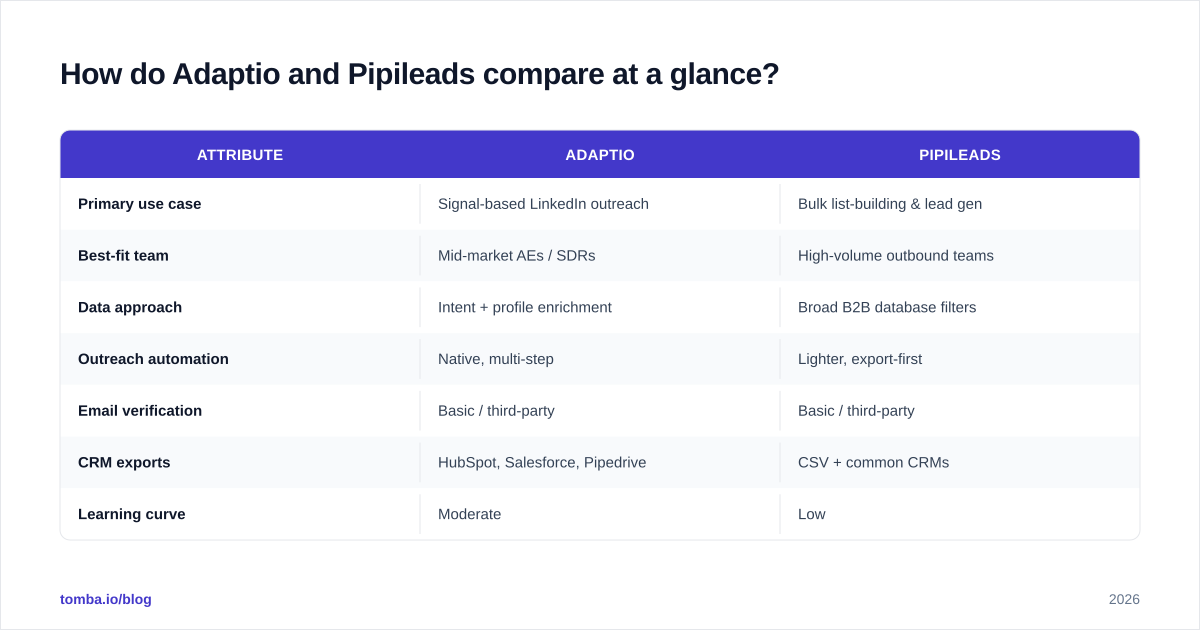
Here's the core comparison. Treat published vendor pricing as directional — both run custom enterprise quotes and frequently change entry tiers.
| Attribute | Adaptio | Pipileads |
|---|---|---|
| Primary use case | Signal-based LinkedIn outreach | Bulk list-building & lead gen |
| Best-fit team | Mid-market AEs / SDRs | High-volume outbound teams |
| Data approach | Intent + profile enrichment | Broad B2B database filters |
| Outreach automation | Native, multi-step | Lighter, export-first |
| Email verification | Basic / third-party | Basic / third-party |
| CRM exports | HubSpot, Salesforce, Pipedrive | CSV + common CRMs |
| Learning curve | Moderate | Low |
| Entry pricing | Higher, workflow-bundled | Lower, volume-bundled |
| Free trial | Limited trial | Limited trial |
The headline pattern: Adaptio charges for orchestration, Pipileads charges for volume. You're rarely comparing identical things — you're comparing two philosophies of how a pipeline gets filled.

Which has better data quality and accuracy?#
Conclusion first: both are "good enough to start, not good enough to trust blindly." Plan to verify either way.
This is the part vendors gloss over. A prospecting platform's database is a snapshot, and B2B contact data decays fast — research across the industry consistently puts professional email and job-change churn at roughly 25–30% per year. That means a list pulled today is meaningfully stale within a quarter, regardless of which logo is on the dashboard.
Adaptio's strength is freshness on active profiles — because it keys off LinkedIn signals, the contacts it surfaces are often people currently in-seat and visibly active. The weakness: coverage narrows outside well-populated professional networks.
Pipileads' strength is breadth — larger filterable lists, more long-tail companies. The weakness is the flip side of scale: more guessed-pattern emails and catch-all domains slipping through.
In practice, neither tool's built-in verification is a substitute for a dedicated pass. Before any list hits your sequencer, run it through an email verifier and a catch-all verifier to strip risky addresses. The cost of skipping this isn't theoretical — a single bounce-heavy send can damage sender reputation for weeks.
If you want to sanity-check the addresses either platform exports, a focused tool like the Tomba domain search lets you confirm a company's real email pattern instead of trusting a guessed format.
Is Adaptio better than Pipileads for outreach?#
For personalized, multi-touch outreach, Adaptio wins. For high-volume, list-first outreach, Pipileads is the more economical engine.
Adaptio's outreach builder is native and multi-step. You can chain a LinkedIn touch, a wait, an email, and a follow-up inside one sequence, with AI drafting variants based on the prospect's profile. If your reps already live on LinkedIn and your win comes from relevance, this removes a lot of tab-switching. It's closest in spirit to a LinkedIn outreach cockpit.
Pipileads treats outreach as a downstream step. Its job is to produce a clean, filtered list and hand it off — to your CRM, your sequencer, your spreadsheet. That's not a weakness if you already own a strong sending stack; it's a deliberate division of labor.
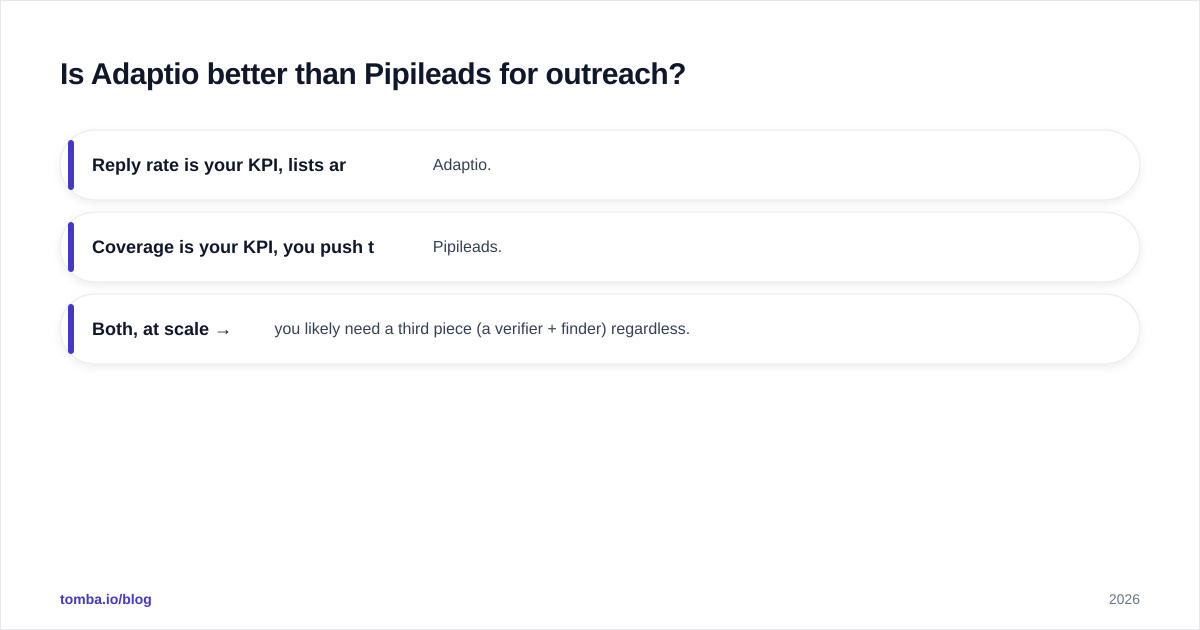
A quick decision rule:
- Reply rate is your KPI, lists are small and surgical → Adaptio.
- Coverage is your KPI, you push thousands of contacts monthly → Pipileads.
- Both, at scale → you likely need a third piece (a verifier + finder) regardless.
How does pricing compare for Adaptio vs Pipileads?#
Conclusion: Pipileads usually wins the sticker-price contest; Adaptio wins on bundled-workflow value if you'd otherwise buy a separate sequencer.
Because both vendors revise tiers often and gate features behind seats and credits, the honest move is to map your numbers — seats, monthly contact volume, and whether you need native sending — against each quote rather than trusting a published table. Watch for three common cost traps:
- Credit rollover. Some plans expire unused credits monthly. If your prospecting is bursty, that's wasted spend.
- Seat minimums. Workflow-heavy tools like Adaptio sometimes price per active seat, which scales painfully for large SDR teams.
- Export limits. Cheaper tiers may cap how many contacts you can export, which quietly throttles volume plays.
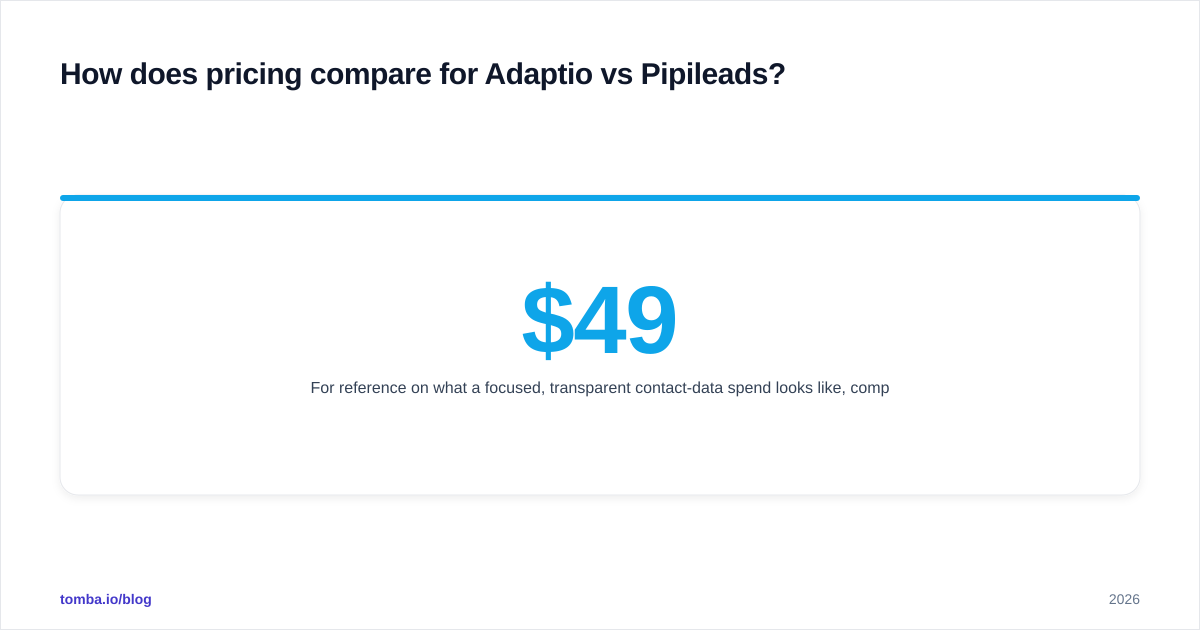
For reference on what a focused, transparent contact-data spend looks like, compare against Tomba pricing: a free tier with 25 searches/month, Starter at $49/mo, Growth at $99/mo, and Pro at $249/mo. The point isn't that Tomba replaces a full prospecting suite — it's that contact discovery and verification shouldn't cost enterprise money when bought as a focused tool.
A useful budgeting frame: prospecting platforms charge you for workflow + data bundled together. When you unbundle — sequencer here, verified data there — you often pay less and get better deliverability, because each tool does one job well.
What are the pros and cons of each tool?#
Adaptio — pros and cons#
Pros
- Native multi-step LinkedIn + email orchestration
- AI personalization tied to live profile signals
- Cleaner data on currently-active prospects
- Good fit for relationship-led, mid-market selling
Cons
- Higher entry cost; seat-based pricing scales fast
- Coverage thins for long-tail or non-LinkedIn-active contacts
- Built-in verification is light — still needs a dedicated pass
- Moderate learning curve for new reps
Pipileads — pros and cons#
Pros
- Lower entry price, strong for volume motions
- Broad, filterable B2B database
- Fast CSV / CRM exports, low learning curve
- Export-first design plays nicely with existing sequencers
Cons
- More guessed-pattern and catch-all emails in raw exports
- Lighter native outreach automation
- Verification is basic — bounce risk without a second tool
- Less suited to deeply personalized, signal-led plays
Can you use Adaptio or Pipileads with other tools?#
Yes — and you probably should. Neither tool is an island, and the smartest stacks treat them as one layer, not the whole sandwich.
Both export into mainstream CRMs. If you're standardizing on HubSpot or Salesforce, confirm the integration depth (field mapping, dedupe, bi-directional sync) before committing — shallow "send to CRM" buttons create duplicate-record chaos at volume. Independent review sites like G2 and Capterra are useful for spotting integration complaints buried in user reviews that vendors won't surface.
The layer most teams under-invest in is the data-quality middle. Whichever platform you choose, route exports through a verification and enrichment step:
- Use a data enrichment pass to fill missing firmographics before the list hits your CRM.
- Verify everything — a clean list protects email deliverability and keeps your domain off blocklists.
- For roles where email alone won't cut it, layer in a phone finder so reps can multi-thread.
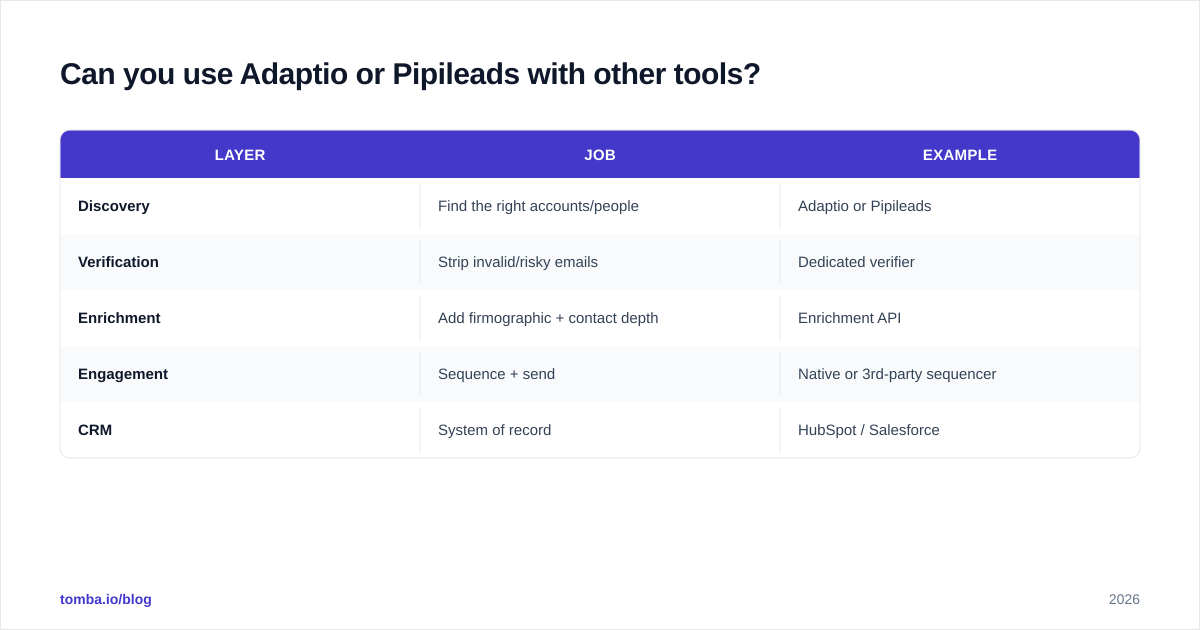
A practical stack looks like this:
| Layer | Job | Example |
|---|---|---|
| Discovery | Find the right accounts/people | Adaptio or Pipileads |
| Verification | Strip invalid/risky emails | Dedicated verifier |
| Enrichment | Add firmographic + contact depth | Enrichment API |
| Engagement | Sequence + send | Native or 3rd-party sequencer |
| CRM | System of record | HubSpot / Salesforce |
The tools in the discovery row are interchangeable. The verification and enrichment rows are where deliverability — and your reply rate — are actually won or lost.
Which should you choose in 2026?#
Decision, stated plainly:
- Choose Adaptio if your selling is relationship-led, LinkedIn is your primary channel, your lists are small and high-value, and you'd otherwise pay separately for a sequencer. You're buying orchestration.
- Choose Pipileads if you run high-volume outbound, you already own a sending stack, and you mainly need clean, broad lists exported fast. You're buying coverage.
- Choose neither as your data source of truth. Both are prospecting front-ends, not verification engines. Whatever you pick, the contact data needs a second opinion before it touches your inbox.
That last point is the one teams regret ignoring. The flashy comparison is "Adaptio vs Pipileads," but the comparison that moves revenue is "verified data vs guessed data." A tool that surfaces 10,000 contacts is worthless if a third of them bounce.
The bottom line#
Adaptio and Pipileads aren't really competing for the same job — Adaptio sells precision and orchestration, Pipileads sells volume and speed. Pick based on your motion, not the price tag, and never treat either platform's built-in verification as the final word on data quality.
Wherever you land, the contact layer is what determines whether your outreach lands in the inbox or the void. That's exactly the gap Tomba fills: start with the Tomba Email Finder to source professional emails by domain, name, or company, then verify before you send. Pair a focused finder with whichever prospecting platform fits your team, and you get the best of both — broad reach and deliverable data — without paying enterprise rates for overlapping features.
// get started
Find, verify and enrich your first contacts today
Start on the free plan with 25 searches a month, then scale when your team is ready.
Free plan · No credit card required · GDPR & CCPA
// about the author