Adaptio vs RampedUp 2026: Which B2B Data Tool Wins?
A neutral, feature-by-feature breakdown of Adaptio vs RampedUp in 2026 — data coverage, accuracy, enrichment, pricing models, and which sales team each one actually fits.
Choosing between Adaptio and RampedUp usually comes down to one question that neither vendor's homepage answers cleanly: do you need adaptive, signal-driven prioritization of accounts you already know, or do you need raw contact and account data to build lists from scratch? They sound similar in a demo. In practice they solve different parts of the go-to-market stack.
This is a neutral breakdown. Where one tool is genuinely stronger, we say so. Where the honest answer is "use a dedicated layer instead," we say that too.
TL;DR#
- Adaptio leans toward adaptive account scoring and prioritization — turning signals into a ranked list of who to work next. It shines when you already have a defined market and want to sequence it.
- RampedUp leans toward B2B contact and account data — building, enriching, and refreshing lists. It shines when your pipeline starts with "we need more accurts and people to call."
- Neither is a pure email-finding engine. Both lean on third-party data, so contact-level accuracy varies by region and seniority.
- For most teams the realistic setup is one platform for prioritization or data, plus a focused email finder and email verifier to keep deliverability clean.
- If your bottleneck is "I can't reliably reach the people on my list," that's a verification problem, not a platform problem — and it's the cheapest gap to close.
What is Adaptio?#
Adaptio positions itself as an adaptive prioritization layer for revenue teams. The core idea: instead of reps deciding which accounts to chase on gut feel, the platform ingests signals — engagement, fit, activity, intent — and continuously re-ranks your book so the highest-probability accounts float to the top. Think of it less like a phone book and more like a recommendation engine for your pipeline.
That framing matters for buyers. Adaptio assumes you already have accounts and contacts loaded; its job is to tell you what to do with them. If you have a clean CRM and a defined total addressable market, that's leverage. If your CRM is half-empty, a prioritization engine just ranks gaps.
What is RampedUp?#
RampedUp is a B2B data platform — contacts, company firmographics, and enrichment. Its value proposition is supply: give it a domain, a persona, or a target market, and it returns people and accounts to work. It also does list-building, data appends to your CRM, and ongoing refresh so records don't rot.
So the natural split is: RampedUp helps you build the list; Adaptio helps you work the list in the right order. A few teams run both. Most pick the one that matches their current bottleneck.
For background on where this whole category sits, Gartner's sales intelligence overview is a reasonable neutral primer, and both tools carry public reviews on G2 and Capterra worth reading before you commit.
How do Adaptio and RampedUp compare head to head?#
The fastest way to see the difference is by job-to-be-done, not by feature checklist. A feature checklist makes every data tool look identical; the jobs reveal where each one actually earns its seat.
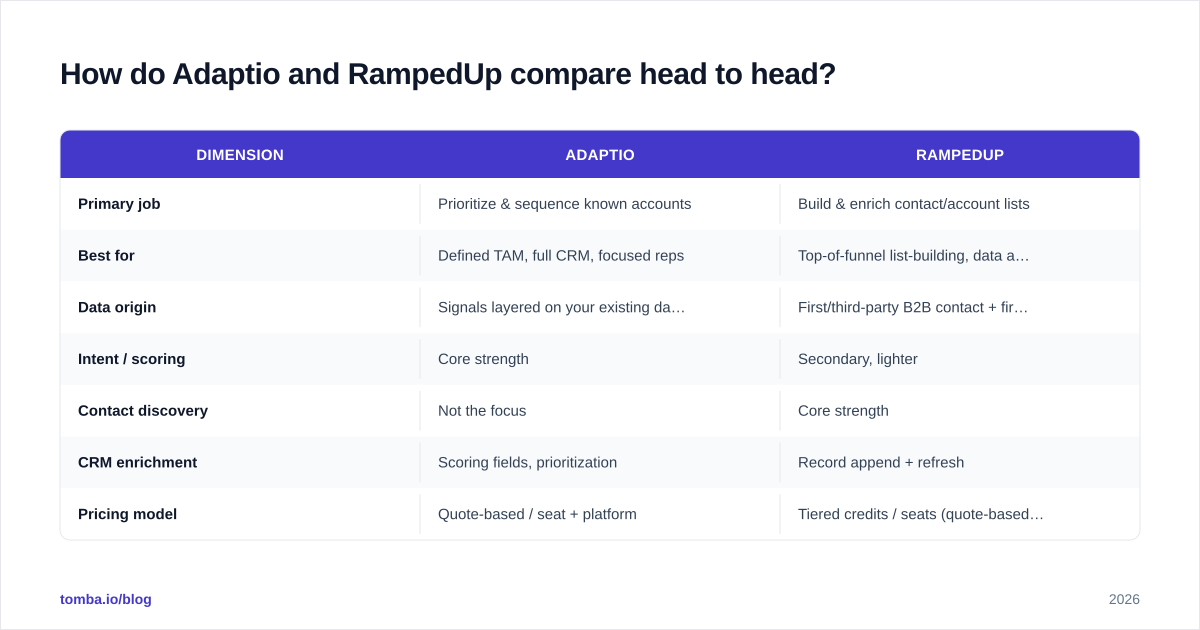
| Dimension | Adaptio | RampedUp |
|---|---|---|
| Primary job | Prioritize & sequence known accounts | Build & enrich contact/account lists |
| Best for | Defined TAM, full CRM, focused reps | Top-of-funnel list-building, data appends |
| Data origin | Signals layered on your existing data | First/third-party B2B contact + firmographic data |
| Intent / scoring | Core strength | Secondary, lighter |
| Contact discovery | Not the focus | Core strength |
| CRM enrichment | Scoring fields, prioritization | Record append + refresh |
| Pricing model | Quote-based / seat + platform | Tiered credits / seats (quote-based at scale) |
| Email accuracy | Inherited from source data | Inherited from source data |
| Learning curve | Moderate (workflow change) | Low–moderate (familiar list UI) |
Two honest caveats on this table. First, both vendors quote enterprise pricing, so "compare the sticker price" is rarely possible without a sales call — budget for that friction. Second, the row that quietly decides ROI is email accuracy, and for both tools it's inherited rather than owned. That's the gap we'll come back to.
Which one has better data accuracy?#
Neither tool manufactures contact data from nothing — both aggregate and license it, like most of the category. That means accuracy is a moving target that depends on:
- Region — North American data is consistently denser and fresher than APAC or EMEA mid-market.
- Seniority — VP-and-above records tend to be more accurate and more stable than IC-level ones.
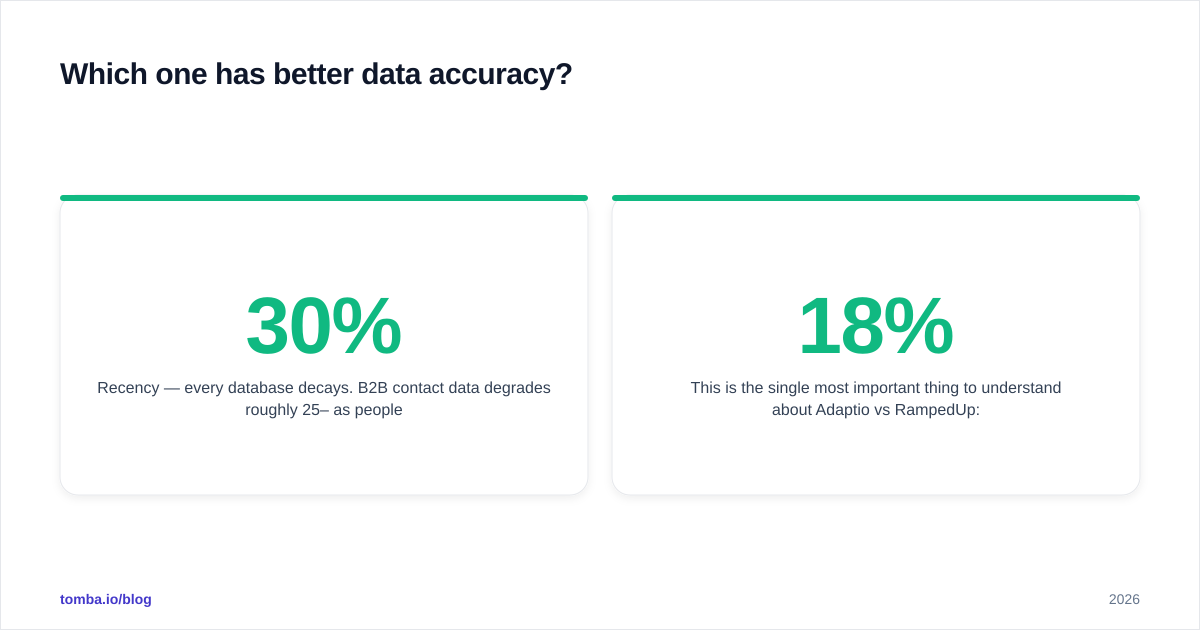
- Recency — every database decays. B2B contact data degrades roughly 25–30% per year as people change jobs, so a "95% accurate" claim is only true on the day the record was captured.
)
This is the single most important thing to understand about Adaptio vs RampedUp: the platform's intelligence is only as good as the contactability of the underlying record. A perfectly prioritized account is worthless if the email on the decision-maker bounces. A perfectly enriched list is worthless if 18% of it is catch-all addresses you can't safely mail.
That's why high-performing teams treat the data platform and the verification layer as separate concerns. You let Adaptio or RampedUp do what it's good at, then you run the contact data through a dedicated email verification step and a catch-all verifier before anything hits your sequencer. It's the difference between a list that looks complete and a list that actually delivers.
What about email finding and verification?#
Here's where buyers most often get surprised. Neither Adaptio nor RampedUp is built primarily as an email-finding engine. They surface emails as part of a broader record, but if your core need is "I have a name and a company, find me the verified work email," a focused tool will out-perform a general data platform on coverage and freshness.
That's the gap Tomba is built for. Rather than ranking your accounts or selling you a static database, Tomba focuses on the contactability layer:
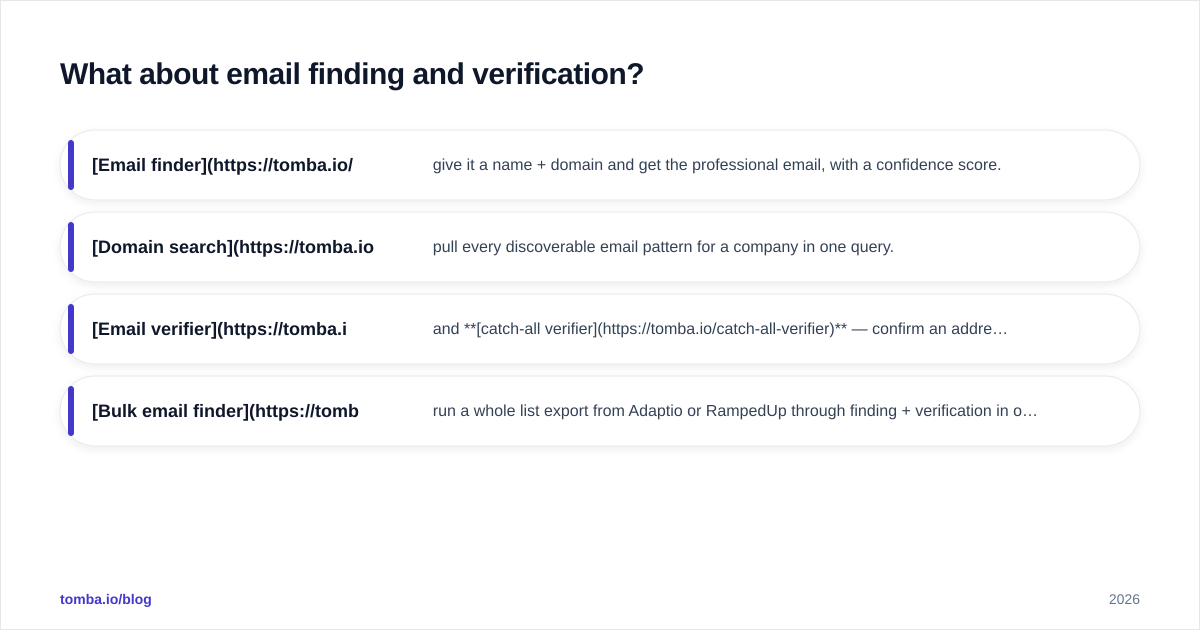
- Email finder — give it a name + domain and get the professional email, with a confidence score.
- Domain search — pull every discoverable email pattern for a company in one query.
- Email verifier and catch-all verifier — confirm an address is deliverable before you risk your sender reputation.
- Bulk email finder — run a whole list export from Adaptio or RampedUp through finding + verification in one pass.
The practical pattern: use RampedUp (or Adaptio's enriched export) to assemble the universe, then route the contacts through Tomba to find missing emails and verify the rest. You stop paying to email addresses that were never going to land.
)
How does pricing compare for Adaptio vs RampedUp?#
Both vendors lean on quote-based pricing once you move past the smallest tier, which makes apples-to-apples hard. Adaptio's value is tied to seats and the platform fee for its scoring engine; RampedUp's is more commonly tied to data credits and seats. Expect a sales conversation, a usage estimate, and an annual commitment at the enterprise end of either.
Where this matters is total cost of contactability. If you're paying a premium platform fee and then losing 15–20% of your sends to bad data, the cheapest fix is rarely "upgrade the platform tier" — it's adding a verification layer that costs a fraction of the seat price.
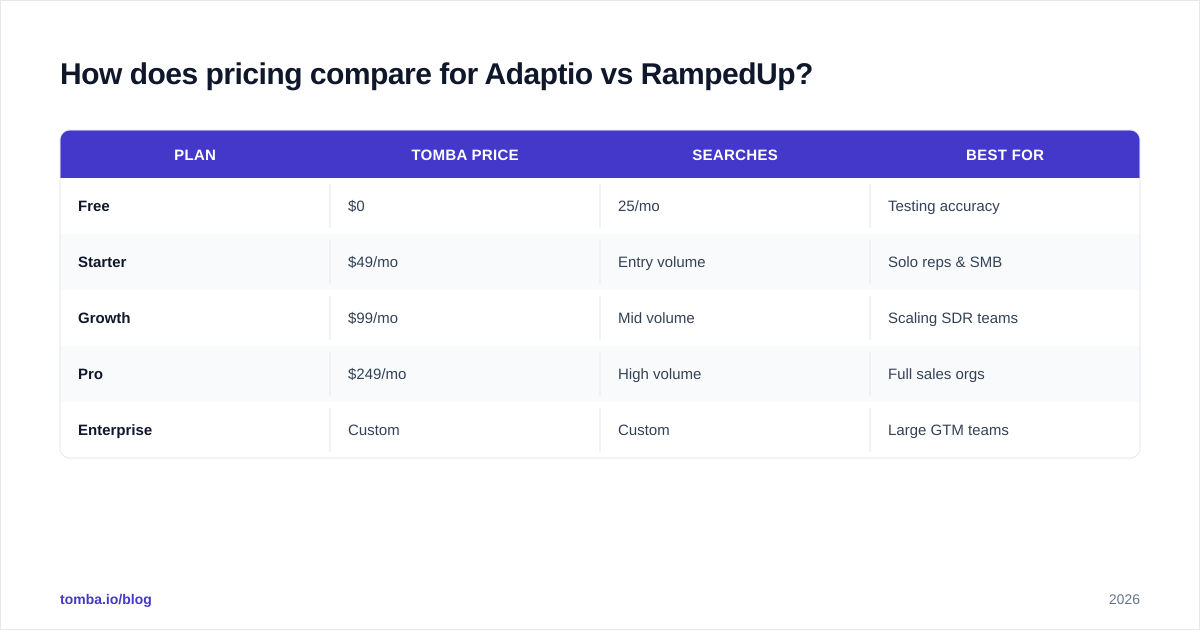
For reference, here's how a focused contactability layer is priced so you can model the all-in cost:
| Plan | Tomba price | Searches | Best for |
|---|---|---|---|
| Free | $0 | 25/mo | Testing accuracy |
| Starter | $49/mo | Entry volume | Solo reps & SMB |
| Growth | $99/mo | Mid volume | Scaling SDR teams |
| Pro | $249/mo | High volume | Full sales orgs |
| Enterprise | Custom | Custom | Large GTM teams |
You can see the full breakdown on Tomba pricing. The point isn't that Tomba replaces Adaptio or RampedUp — it's that the verification line item is small enough that skipping it never makes financial sense.
Which tool should you choose?#
Decide by your dominant bottleneck, not by feature count.
Choose Adaptio if:
- You already have a well-populated CRM and a defined target market.
- Reps waste time deciding who to work rather than how.
- You want intent and engagement signals to drive sequencing automatically.
- Your problem is focus, not supply.
Choose RampedUp if:
- Your pipeline starts empty and you need contacts and accounts to build lists.
- You need ongoing CRM enrichment and record refresh.
- Top-of-funnel volume is the constraint.
- You'd rather buy data supply than a prioritization engine.
Add a dedicated finder/verifier (like Tomba) regardless if:
- You're seeing bounce rates above ~3% on cold sends.
- A meaningful share of your data is catch-all or unverified.
- You export lists into a sequencer and want them clean before launch.
- You care about sender reputation and inbox placement.
The honest conclusion: Adaptio and RampedUp aren't really competitors so much as adjacent layers. Most teams that "switch" between them were actually solving different problems. And almost every team that runs either one still benefits from a separate, accuracy-first contactability layer — because no amount of prioritization or enrichment fixes an email that bounces.
Frequently asked questions#
Is Adaptio better than RampedUp? Neither is universally better. Adaptio wins for prioritizing accounts you already have; RampedUp wins for sourcing and enriching new ones. Match the tool to your bottleneck.
Do Adaptio and RampedUp find verified emails? Both surface emails as part of their records, but neither is a dedicated finder/verifier. For verified, deliverable addresses, pair them with a focused email finder and verifier.
Can I use both together? Yes — RampedUp (or an enriched export) builds the universe, Adaptio sequences it, and a verification layer keeps the contact data deliverable. That stack is common in larger GTM teams.
Why do my bounce rates stay high even with a premium data tool? Because all aggregated B2B data decays. Verifying right before send — including catch-all checks — is what actually protects deliverability.
The bottom line#
Adaptio vs RampedUp is a question of prioritize versus supply. Pick the one that matches your current constraint, and don't expect either to double as a precision email tool. That last mile — finding the right address and confirming it's deliverable — is its own discipline.
If reaching the people on your list is the real bottleneck, start there. Spin up a free Tomba account, run your existing export through the Tomba Email Finder and verifier, and measure how many "good" records were actually unreachable. It's the fastest, cheapest accuracy win in your stack — and it makes whichever platform you choose look a lot smarter.
// get started
Find, verify and enrich your first contacts today
Start on the free plan with 25 searches a month, then scale when your team is ready.
Free plan · No credit card required · GDPR & CCPA
// about the author