Adaptio vs The Data City: B2B Data Platforms Compared 2026
A neutral, hands-on comparison of Adaptio and The Data City — what each B2B data platform actually does, who it fits, pricing signals, and where a dedicated contact-data layer fills the gap.
Choosing between Adaptio and The Data City usually means you have already outgrown a static lead list and you want a data engine that understands companies — not just rows in a spreadsheet. Both platforms sit in the B2B data and intelligence layer of a go-to-market stack, but they answer different questions and serve different teams.
This is a neutral breakdown of what each one does well, where each one struggles, and how to decide. Tomba is mentioned where it is honestly relevant — as the contact-data layer most company-intelligence platforms do not fully cover — but this is not a sales pitch dressed up as analysis.
TL;DR#
- The Data City is a real-time company-classification and market-mapping platform. It is strongest when you need to define and size a sector (especially emerging UK industries) using live web and open data, not legacy SIC codes.
- Adaptio positions as an adaptive B2B data and account-intelligence layer aimed at GTM and revenue teams who want enriched, continuously updated account and signal data feeding their CRM and outreach.
- They overlap on "company data" but diverge on intent: The Data City answers which companies exist in this market; Adaptio answers which accounts should I act on now.
- Neither is primarily a contact-finder. Once you have a target account list, you still need verified email and phone data — that is where a dedicated tool like the Tomba Email Finder slots in.
- Pick by job-to-be-done: market research and TAM sizing → The Data City; live account prioritisation for sales → Adaptio; turning either list into reachable contacts → a contact-data layer.
What is The Data City?#
The Data City is a UK-founded data company that classifies businesses into sectors using real-time data rather than static government codes. Its core idea is Real-Time Industrial Classifications (RTICs): instead of forcing a company into a decades-old SIC code, it reads website content, filings, and open data to decide what a company actually does today.
That makes it a strong fit for analysts, economic-development bodies, investors, and strategy teams who need to map and size emerging markets — think "every UK company working on green hydrogen" or "the full quantum-computing supply chain." You can build a custom sector definition, see the companies in it, and pull firmographic and growth signals.
Its sweet spot is breadth and freshness of company universe data, especially in the UK and increasingly beyond. It is less about handing a sales rep a daily call list and more about giving a researcher a defensible, reproducible market map. You can read more about how it describes itself on the official The Data City site.
What is Adaptio?#
Adaptio is positioned as an adaptive B2B data and account-intelligence platform for revenue teams. The emphasis is on data that updates as the world changes — firmographics, technographics, hiring and growth signals, and intent-style indicators — pushed into the tools sales and marketing already use.
Where The Data City leans toward research and market definition, Adaptio leans toward operational GTM: scoring and prioritising accounts, keeping CRM records fresh, and surfacing "why this account, why now" signals so reps spend time on the right targets. If your problem is a stale CRM and reps guessing at priorities, that is the lane Adaptio plays in.
Because the category is moving fast and vendor messaging changes often, treat any specific capability claim as something to confirm in a live demo. If you are uncertain whether a feature exists in your tier, ask the vendor directly rather than relying on a comparison article — including this one.
Adaptio vs The Data City: how do they compare?#
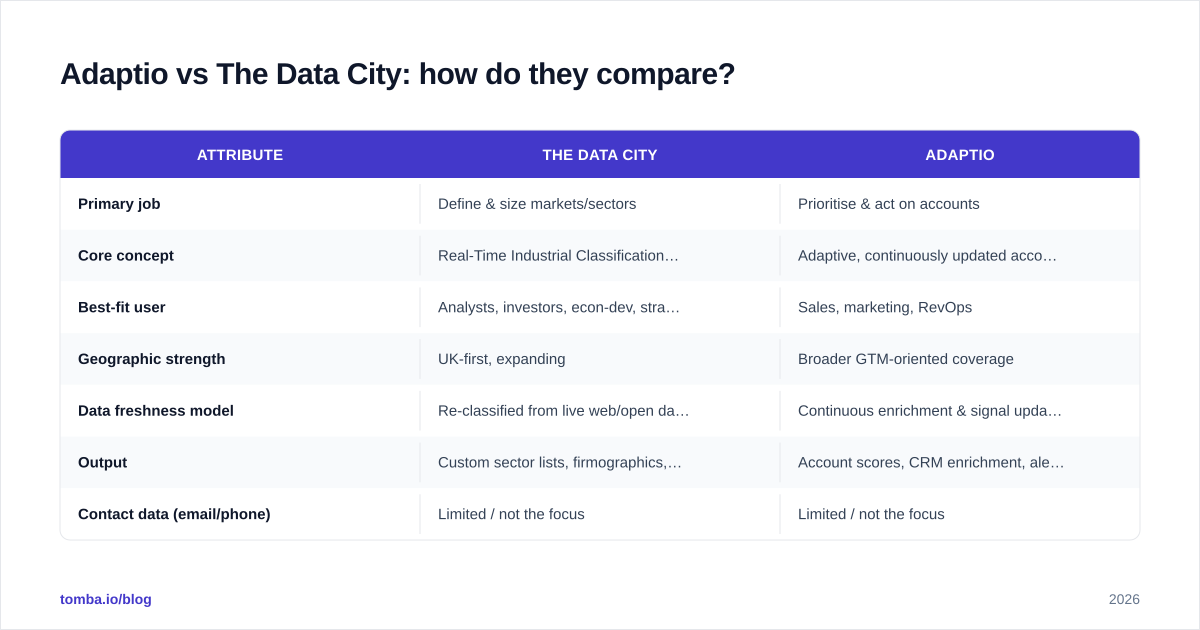
The fastest way to see the split is attribute by attribute. The values below describe the typical positioning and use case of each platform, not a guaranteed feature contract — always validate against current vendor docs.
| Attribute | The Data City | Adaptio |
|---|---|---|
| Primary job | Define & size markets/sectors | Prioritise & act on accounts |
| Core concept | Real-Time Industrial Classifications (RTICs) | Adaptive, continuously updated account data + signals |
| Best-fit user | Analysts, investors, econ-dev, strategy | Sales, marketing, RevOps |
| Geographic strength | UK-first, expanding | Broader GTM-oriented coverage |
| Data freshness model | Re-classified from live web/open data | Continuous enrichment & signal updates |
| Output | Custom sector lists, firmographics, growth signals | Account scores, CRM enrichment, alerts |
| Contact data (email/phone) | Limited / not the focus | Limited / not the focus |
| Typical buyer motion | Research subscription | GTM/RevOps platform deal |
Two honest takeaways from that table:
- They are not really substitutes. A market-research team and a sales-ops team could each buy the "right" tool and never overlap. The "vs" framing only matters if you have a single budget and have to pick one job to fund first.
- Neither closes the contact loop. Both give you accounts; neither is built to hand a rep a verified, deliverable email for the specific decision-maker at each account. That last mile is a separate data problem — and the one most teams underestimate.
Which one is better for your use case?#
"Better" depends entirely on the question you are trying to answer. Map your situation to the closest row below.
You need to size a market or find every company in a niche#
Go with The Data City. RTIC-style classification is purpose-built for "show me the full universe of companies doing X," and the real-time approach beats stale SIC codes for emerging sectors. This is the classic marketing qualified lead sourcing and TAM-sizing problem at the account level. Investors and economic-development teams especially benefit.
You need reps to act on the right accounts today#
Lean toward Adaptio. If your CRM is decaying and prioritisation is guesswork, an adaptive signal-and-scoring layer feeding the workflow is the higher-leverage buy. This is a revenue operations problem more than a research one.
You need both research and activation#
Many teams run a research platform for planning and a GTM data layer for execution. They are complementary, not redundant — just budget for two line items and a clear owner for each.
You need reachable contacts at those accounts#
Neither platform fully solves this. Once you have your target list from either tool, you need to convert company rows into verified, deliverable contacts. A dedicated email finder plus an email verifier handles that last mile, and a domain search lets you pull every known address pattern at a target company in one query.
How accurate and fresh is the data?#
Data quality in this category breaks into three questions: coverage, freshness, and accuracy of the join between a company and its real-world activity.
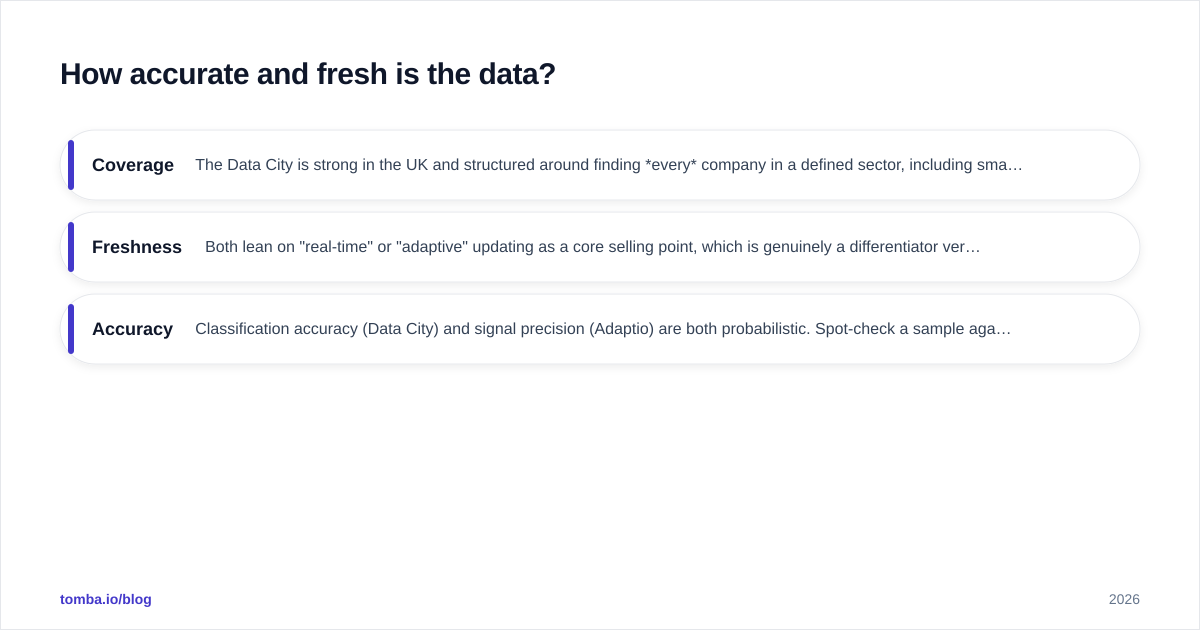
- Coverage — The Data City is strong in the UK and structured around finding every company in a defined sector, including small and new firms that legacy databases miss. Adaptio's value is in keeping a broad GTM-relevant set continuously enriched.
- Freshness — Both lean on "real-time" or "adaptive" updating as a core selling point, which is genuinely a differentiator versus quarterly-refreshed legacy databases. Verify the actual refresh cadence for the fields you care about; "real-time" can mean different things per field.
- Accuracy — Classification accuracy (Data City) and signal precision (Adaptio) are both probabilistic. Spot-check a sample against ground truth before you commit budget.
One nuance that catches teams out: a company record being fresh does not mean the contact attached to it is. People change jobs constantly. Even a perfectly classified, perfectly scored account is useless if the email bounces. That is why a verification step — checking deliverability and handling catch-all domains — matters regardless of which platform you choose. For third-party validation of either vendor's reliability claims, cross-reference reviews on G2 rather than taking marketing copy at face value.
What does each platform cost?#
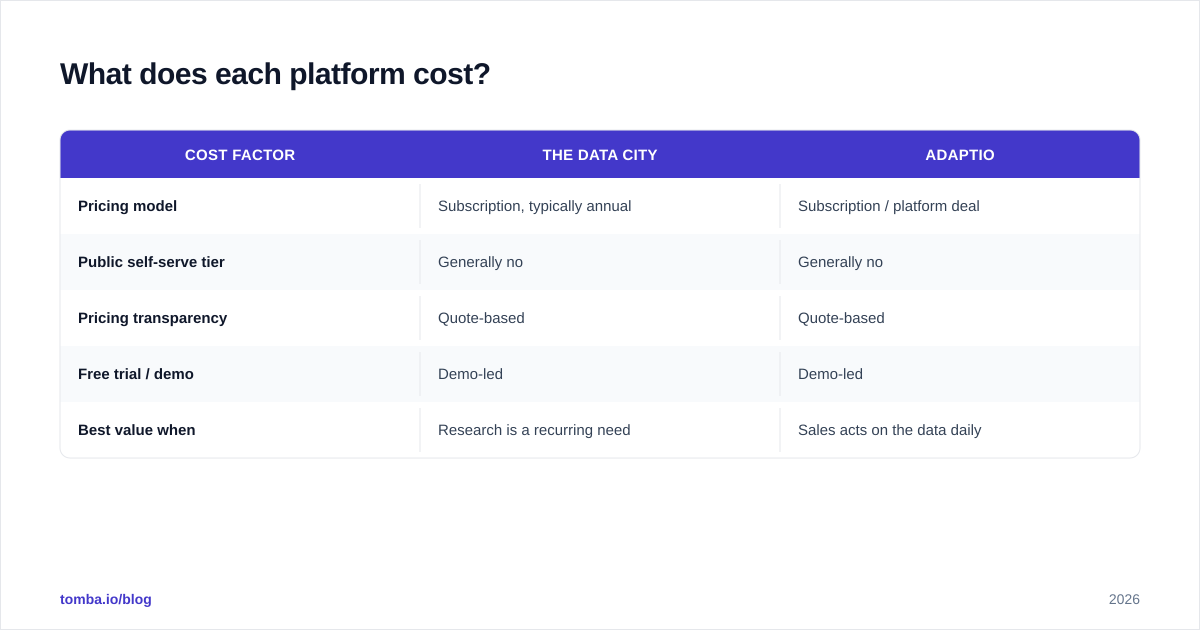
Both Adaptio and The Data City use quote-based or tier-based pricing rather than a public self-serve price list, which is normal for platforms in this category. That makes direct price comparison hard without a sales conversation — and means published numbers go stale fast, so confirm before you cite anything internally.
| Cost factor | The Data City | Adaptio |
|---|---|---|
| Pricing model | Subscription, typically annual | Subscription / platform deal |
| Public self-serve tier | Generally no | Generally no |
| Pricing transparency | Quote-based | Quote-based |
| Free trial / demo | Demo-led | Demo-led |
| Best value when | Research is a recurring need | Sales acts on the data daily |
If transparent, predictable pricing matters to you, that is worth weighing. For comparison, a contact-data layer like Tomba publishes its plans openly: a free tier with 25 searches a month, then Starter at $49/mo, Growth at $99/mo, and Pro at $249/mo, with Enterprise custom. You can see the full breakdown on the Tomba pricing page. The point is not that these are competing line items — they often are not — but that you should know exactly what each layer of your data stack costs.
What are the pros and cons?#
A blunt summary, because every platform has trade-offs.
The Data City — pros
- Best-in-class for emerging-sector definition and UK market mapping.
- Real-time classification beats legacy SIC codes for accuracy of what a company does.
- Reproducible, defensible sector lists for research and strategy work.
The Data City — cons
- Not built for daily sales activation or rep workflows.
- UK-centric strength may not match a global outbound motion.
- Quote-based pricing reduces upfront transparency.
Adaptio — pros
- Oriented around action: scoring, prioritisation, and CRM enrichment.
- Continuous updates fight CRM decay.
- Fits naturally into a RevOps and sales-execution stack.
Adaptio — cons
- Less suited to deep market-sizing research.
- Capability and coverage claims move fast — verify in a demo.
- Like The Data City, it is not a contact-finder.
The shared con is the important one: both stop at the company. You will still need to enrich accounts into people and verify those people are reachable. You can automate that step with bulk lead generation or wire it directly into your stack through the Tomba API, so the handoff from "target account" to "contactable person" does not become a manual copy-paste job.
How do these fit into a complete GTM data stack?#
Think of B2B data as three layers, like a postal system. The Data City and Adaptio give you the map and the addresses worth visiting — which neighbourhoods (markets) exist and which houses (accounts) are worth knocking on. But you still need the name on the door and a way to actually reach the person inside. That is the contact layer.
A clean stack usually looks like:
- Market layer — define and size the opportunity (The Data City excels here).
- Account layer — prioritise and keep accounts fresh (Adaptio's lane).
- Contact layer — turn accounts into verified people you can email or call.
For layer three, you want an email finder that maps a name and domain to a real address, a verifier to confirm deliverability, and ideally a phone finder for multichannel outreach. Skipping this layer is the most common reason a beautifully sourced account list produces a disappointing response rate — the data was right, but nobody could actually be reached.
If you are evaluating the broader category, it is also worth checking how these platforms compare to dedicated providers; analyst resources like Gartner cover the B2B data and revenue-intelligence space in depth and can frame where each vendor sits.
How should you decide?#
Run this quick decision filter:
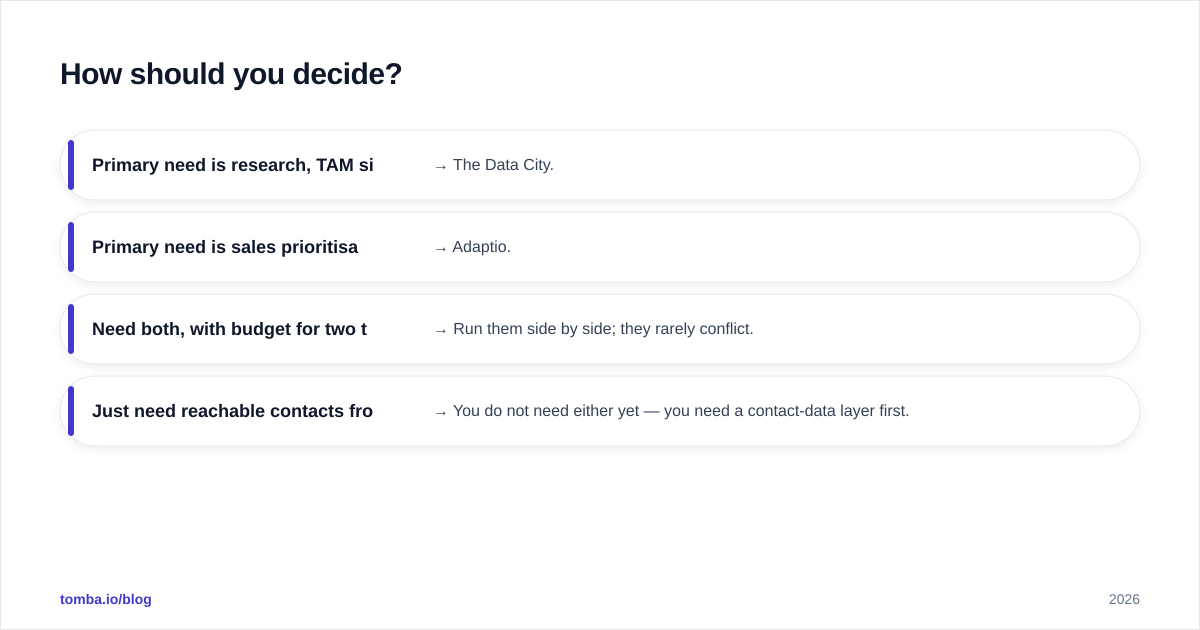
- Primary need is research, TAM sizing, or sector mapping (UK-heavy)? → The Data City.
- Primary need is sales prioritisation and CRM freshness? → Adaptio.
- Need both, with budget for two tools? → Run them side by side; they rarely conflict.
- Just need reachable contacts from a list you already have? → You do not need either yet — you need a contact-data layer first.
The mistake to avoid is buying a market-mapping tool to solve a sales-activation problem, or vice versa. They look similar on a feature grid and behave completely differently in daily use. Demo both against your actual target list, not a vendor-curated sample, and judge by whether the output drops cleanly into your existing workflow.
The bottom line#
Adaptio and The Data City are both credible B2B data platforms that happen to answer different questions: Adaptio is built to help revenue teams act on accounts, while The Data City is built to help analysts define and size markets. The "vs" only matters when one budget has to fund one job first — otherwise they are complementary.
What neither solves is the contact layer. Once you have your target accounts from either platform, you still have to find and verify the people behind them — and that is exactly the job the Tomba Email Finder is built for. Start free with 25 searches a month, find verified professional emails by name or domain, confirm deliverability before you send, and connect it to your CRM through Tomba's integrations so your sourced accounts become reachable contacts instead of dead rows. Map the market with one tool, prioritise with another, then let Tomba close the last mile.
// get started
Find, verify and enrich your first contacts today
Start on the free plan with 25 searches a month, then scale when your team is ready.
Free plan · No credit card required · GDPR & CCPA
// about the author