Adaptio vs The Org: B2B Org Intelligence Compared (2026)
Adaptio vs The Org: a neutral, side-by-side breakdown of org-chart mapping, account intelligence, pricing, and which one actually helps you book meetings in 2026.
You found the company. You found the buying committee. Now you need to know who reports to whom, who actually signs, and how to reach them before a competitor does. That is the job org-intelligence tools claim to solve, and Adaptio vs The Org is one of the more common shortlists buyers land on in 2026.
This guide breaks both down without the marketing gloss: what each one is built for, where the data comes from, how pricing scales, and the gap neither fully closes on its own.
TL;DR — Adaptio vs The Org at a glance#
- The Org is a public, crowdsourced org-chart platform — strong for visualizing reporting lines and verified leadership profiles, weaker as a high-volume prospecting engine.
- Adaptio positions itself around adaptive account intelligence and dynamic org mapping for revenue teams — more sales-workflow oriented, with less public transparency than The Org.
- Neither tool is primarily an email finder. Both map structure; getting contactable, verified emails and phone numbers is a separate step.
- If you mainly need to see an org chart, The Org's free public profiles are hard to beat. If you need org data wired into outbound motions, Adaptio leans closer.
- The pragmatic 2026 stack: use one of these for structure, then layer a dedicated data enrichment and email finder layer to turn names into reachable contacts.

What is The Org?#
The Org (theorg.com) is a public org-chart platform. Companies and individuals publish their reporting structures, and the result is a browsable, largely free directory of who-reports-to-whom across thousands of organizations. Think of it like a LinkedIn for organizational shape rather than individual networking — you land on a company and instantly see the hierarchy laid out as a tree.
Its strengths are transparency and accessibility. Profiles are public, leadership bios are verified by the companies themselves in many cases, and the visual chart is genuinely useful when you are trying to understand a buying committee before a call. For account research, mapping a CRO down through their VPs and directors takes seconds.
The trade-offs: coverage is uneven. Well-known tech companies are richly mapped; mid-market and regional firms often are not. Because much of the data is self-published or crowdsourced, freshness varies — a chart can lag a reorg by months. And The Org is a reference tool, not an outbound platform. It does not hand you verified emails, sequences, or CRM sync as a core function.
What is Adaptio?#
Adaptio sits in the account-intelligence and org-mapping category aimed more squarely at revenue teams. The pitch is adaptive org data — keeping a live picture of accounts as people move, get promoted, or leave, and surfacing that inside sales workflows rather than as a standalone public directory.
Compared with The Org, Adaptio is less about a public, browsable encyclopedia and more about being a working layer for sellers: identifying decision-makers, tracking changes in an account, and prioritizing who to engage. That orientation makes it feel closer to a B2B data and intelligence product than a reference site.
The honest caveat: because Adaptio is not a public directory, you cannot eyeball its coverage the way you can with The Org. Evaluate it the way you would any data vendor — request coverage stats for your target segments, test freshness on accounts you already know, and confirm how the data exports into your existing tools. Don't take category positioning as proof of depth in your niche.
Adaptio vs The Org: feature-by-feature comparison#
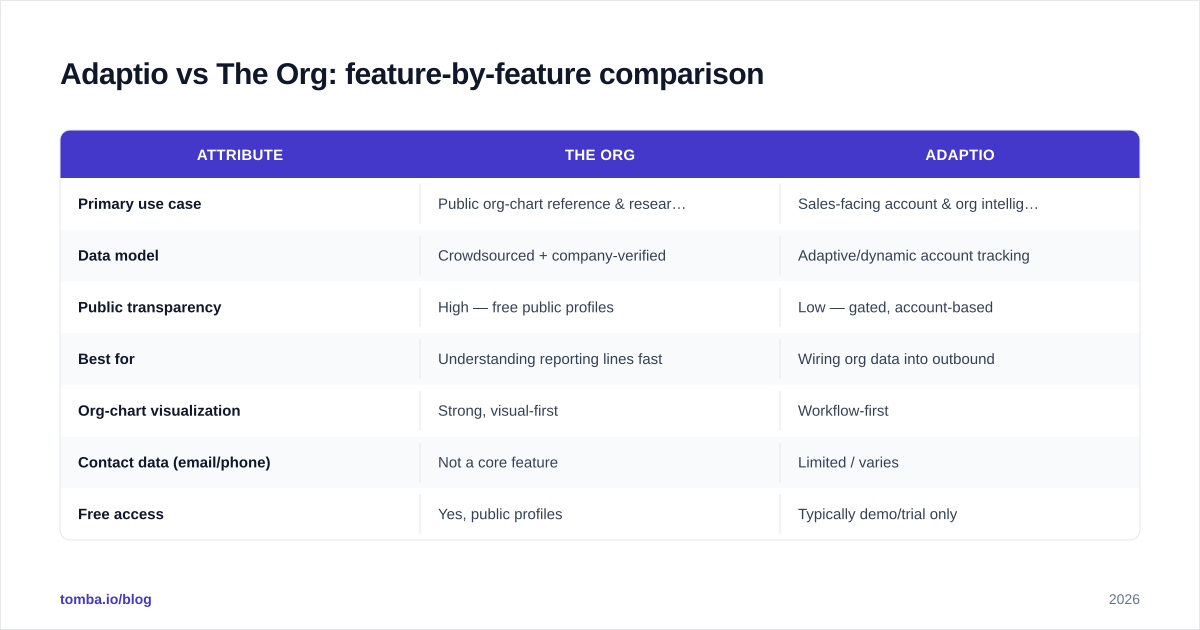
The table below maps the practical differences. Treat vendor-specific numbers you can't independently verify as directional, and always run your own test on your target accounts.
| Attribute | The Org | Adaptio |
|---|---|---|
| Primary use case | Public org-chart reference & research | Sales-facing account & org intelligence |
| Data model | Crowdsourced + company-verified | Adaptive/dynamic account tracking |
| Public transparency | High — free public profiles | Low — gated, account-based |
| Best for | Understanding reporting lines fast | Wiring org data into outbound |
| Org-chart visualization | Strong, visual-first | Workflow-first |
| Contact data (email/phone) | Not a core feature | Limited / varies |
| Free access | Yes, public profiles | Typically demo/trial only |
| CRM integration | Limited | More sales-tool oriented |
| Coverage transparency | Easy to spot-check | Must request for your ICP |
Is Adaptio better than The Org?#
Neither is universally "better" — the right pick depends on the job. Lead with the conclusion: choose by workflow, not brand.
Pick The Org when your main need is research clarity. If your reps spend pre-call time figuring out a committee, or you want a free, public way to validate a title and reporting line, its visual charts and open access are the fastest path. It is also the safer choice when you want to verify data quality yourself before paying anything.
Pick Adaptio when org data needs to act — feed prioritization, trigger plays when a champion changes roles, or sit inside a seller's daily flow rather than a separate browser tab. Teams running structured account-based motions get more from a tool designed to push intelligence into the workflow than from a reference directory they have to check manually.
The decision framework below is the one most RevOps teams end up drawing on a whiteboard anyway.
The branches are simple: Is the data free to inspect? Does it need to live inside your CRM or sequencer? How current must it be? Score both tools against those three axes for your segment and the winner usually becomes obvious.
How do the data sources compare?#
This is where most evaluations should start, because data accuracy determines everything downstream. A beautiful org chart built on stale data sends reps to people who left six months ago.
The Org's data is largely self-published and crowdsourced, with company verification on many leadership profiles. That makes the shape trustworthy for engaged companies, but coverage is a function of who bothered to publish. You can audit it for free — go look at ten of your target accounts right now.
Adaptio's value proposition is freshness through adaptive tracking — the claim is that it catches movement faster. The catch is you cannot verify that claim without a trial, so insist on testing it against accounts where you already know the current reality.
Either way, structure is not the same as reachability. Knowing that "Dana Lee, VP Marketing" reports to the CMO does not give you Dana's verified work email or direct dial. That is a separate data layer — and the one that actually determines whether your outreach lands.

Where both tools leave a gap (and how to close it)#
Here is the honest limitation of the whole category: org-intelligence tools tell you who and where in the hierarchy — they rarely give you a reliable, verified way to contact that person at scale. The Org doesn't try to. Adaptio's contact coverage varies. Both leave you with a name and a title, then a missing step.
That missing step is finding and verifying the contact. This is exactly the workflow a dedicated email-finding layer handles:
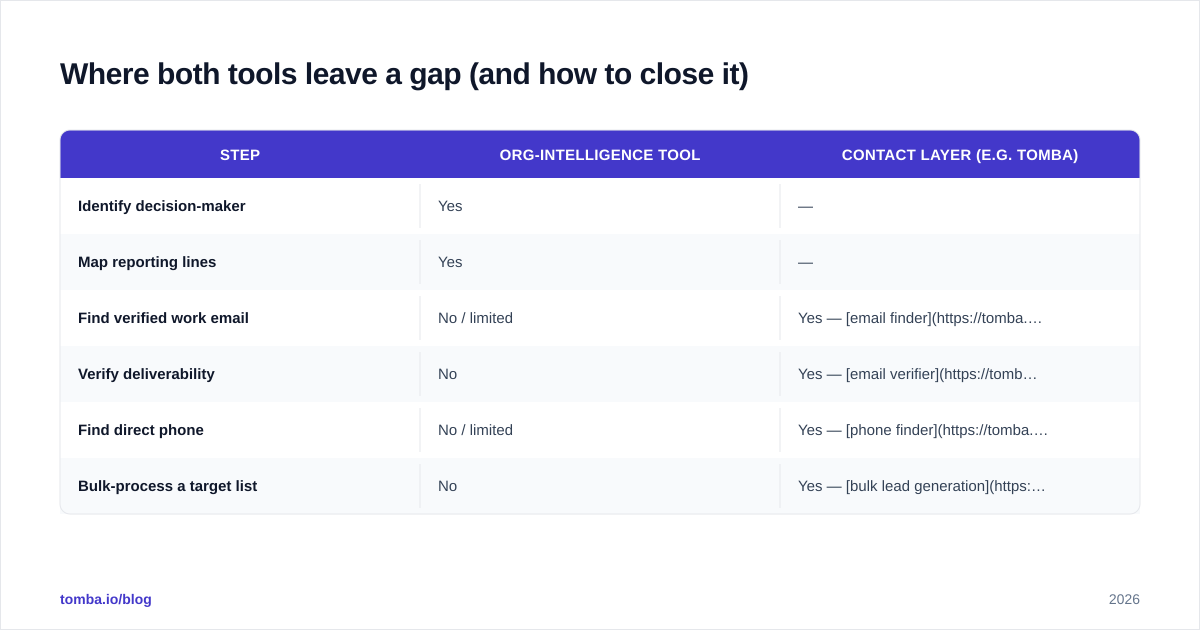
| Step | Org-intelligence tool | Contact layer (e.g. Tomba) |
|---|---|---|
| Identify decision-maker | Yes | — |
| Map reporting lines | Yes | — |
| Find verified work email | No / limited | Yes — email finder |
| Verify deliverability | No | Yes — email verifier |
| Find direct phone | No / limited | Yes — phone finder |
| Bulk-process a target list | No | Yes — bulk lead generation |
The practical 2026 stack looks like this: use The Org or Adaptio to understand the buying committee and reporting structure, export the names and companies, then run them through a finder-and-verifier layer to get contactable, deliverable details. You map structure once, then you operationalize it.
Tomba's domain search is useful here too — once you've identified the account and the roles you care about, you can pull the verified email pattern and the people behind those titles directly from the company domain, closing the loop the org chart opened.
How much do Adaptio and The Org cost?#
Pricing transparency differs sharply, and that itself is a signal.
The Org offers free public profiles, which makes it genuinely zero-cost for basic research; paid tiers exist for richer features and team use. Adaptio, like most account-intelligence vendors, is typically quote-based — you'll go through a demo and a sales conversation rather than a public price page. Budget for that process when you evaluate.
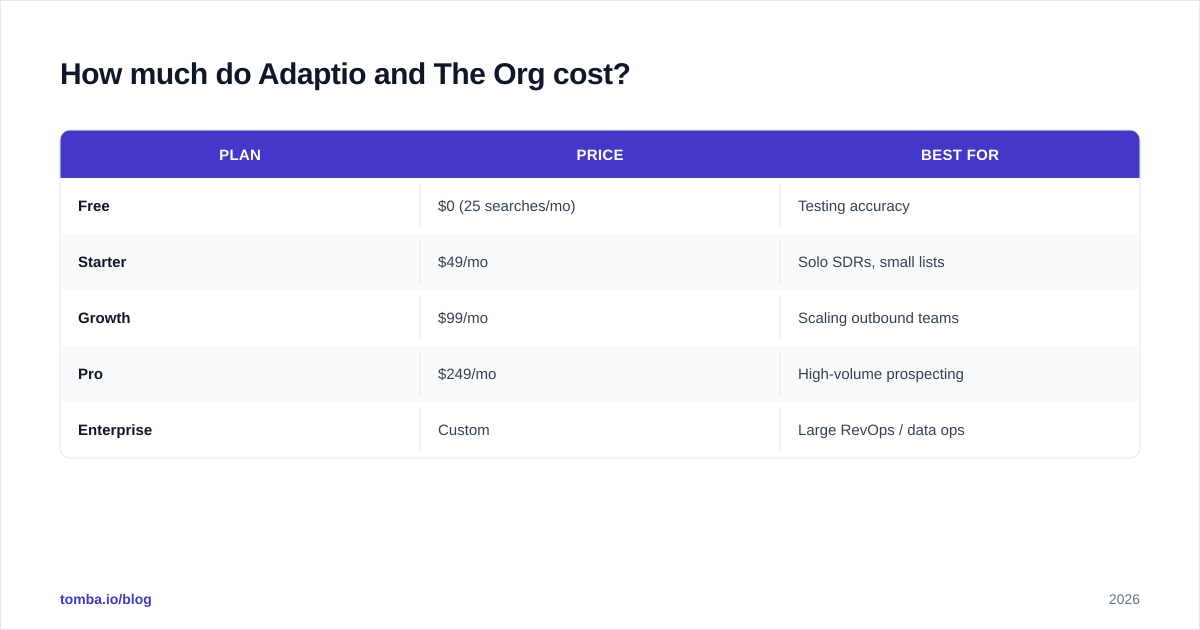
For the contact layer that sits alongside either tool, here is how a representative finder/verifier prices, for reference when you build the full stack. Tomba pricing is public and tiered:
| Plan | Price | Best for |
|---|---|---|
| Free | $0 (25 searches/mo) | Testing accuracy |
| Starter | $49/mo | Solo SDRs, small lists |
| Growth | $99/mo | Scaling outbound teams |
| Pro | $249/mo | High-volume prospecting |
| Enterprise | Custom | Large RevOps / data ops |
The point of showing this is not to compare apples to oranges — org tools and finders price differently because they do different jobs. It's to budget for the whole workflow. A free org chart plus a missing-contact problem still leaves you unable to send the email.
Which should you choose in 2026?#
Conclusion first: most teams should treat this as "and," not "or."
- If you only have budget and time for one tool and your need is research clarity with zero spend, start with The Org. It's free to inspect, visually fast, and good enough to brief a rep before a call.
- If you run a structured, account-based motion and want org intelligence inside the seller's workflow, evaluate Adaptio — but trial it hard against your own ICP for coverage and freshness before committing to a quote.
- Whichever you pick, pair it with a verified contact layer. Org structure without reachable emails is a map with no roads. Look at the broader category too — many teams comparing these also weigh an Apollo alternative or a focused B2B database to cover the contact gap.
A useful sanity check before you sign anything: validate the vendor on G2 reviews for your company size, and confirm the data exports cleanly into your CRM. The prettiest org chart is worthless if it can't leave the tool.
The bottom line#
Adaptio and The Org solve the same surface problem — understanding how an account is organized — from opposite directions. The Org is the open, browsable reference you can audit for free. Adaptio is the gated, workflow-embedded intelligence layer you have to trial. Pick based on whether you need visibility or operationalization, and remember that both stop at the name-and-title line.
To turn those names into booked meetings, you still need verified emails and direct dials. That's the step the org charts hand off and the Tomba Email Finder picks up — find professional email addresses by domain, name, or company, verify them before you send, and feed a clean list straight into your sequences. Map the org with one tool, make it reachable with Tomba. Start free with 25 searches and test the accuracy on your own target accounts before you scale.
// get started
Find, verify and enrich your first contacts today
Start on the free plan with 25 searches a month, then scale when your team is ready.
Free plan · No credit card required · GDPR & CCPA
// about the author