Adaptio vs Verifyemailio: Email Verification Compared (2026)
A neutral, hands-on breakdown of Adaptio vs Verifyemailio for email verification in 2026 — accuracy, catch-all handling, bulk, API, and pricing — plus where Tomba fits.
Choosing between Adaptio and Verifyemailio usually comes down to one question: which one keeps more bad addresses out of your send list without slowing you down? Both promise cleaner data and lower bounce rates, but they get there differently. This guide compares them on the things that actually move your bounce rate, then shows where a finder-plus-verifier platform like Tomba fits if you need both discovery and validation in one place.
TL;DR#
- Adaptio leans toward a streamlined, modern verification workflow — good for teams that want a simple "upload, clean, export" loop with API access.
- Verifyemailio focuses on credit-based, pay-as-you-go verification with SMTP-level checks and developer-friendly endpoints.
- The real differentiators are catch-all handling, deduplication, and how each tool scores "risky" addresses — not the marketing headline accuracy number.
- Neither is a prospecting tool: they verify lists you already have. If you also need to find emails, you'll bolt on a separate finder.
- If you want finding, verification, catch-all checks, and enrichment under one API and one bill, Tomba is the consolidation play — starting free, then $49/mo.
What are Adaptio and Verifyemailio?#
Both Adaptio and Verifyemailio are email verification tools. Their job is narrow and important: take a list of email addresses and tell you which ones are safe to send to, which will bounce, and which are uncertain.
Think of email verification like a bouncer checking IDs at the door. The address might look valid — correct format, real domain — but the verifier actually walks up to the mail server and asks, "Does this mailbox exist?" before letting the message through. That check is the difference between a 1% bounce rate and a 12% one that gets your domain throttled.
- Adaptio positions itself as a clean, fast verification layer with bulk uploads and an API, aimed at marketers and ops teams who want a low-friction "drop list in, get clean list out" experience.
- Verifyemailio (Verifyemail.io) is a verification service built around credits and per-check pricing, with real-time API verification and SMTP-level validation that developers can wire into signup forms and pipelines.
Neither finds new contacts. They validate what you already collected from forms, exports, or a separate email finder.
How does email verification actually work?#
Before comparing Adaptio vs Verifyemailio feature-by-feature, it helps to know what's happening under the hood — because that's where they quietly differ.
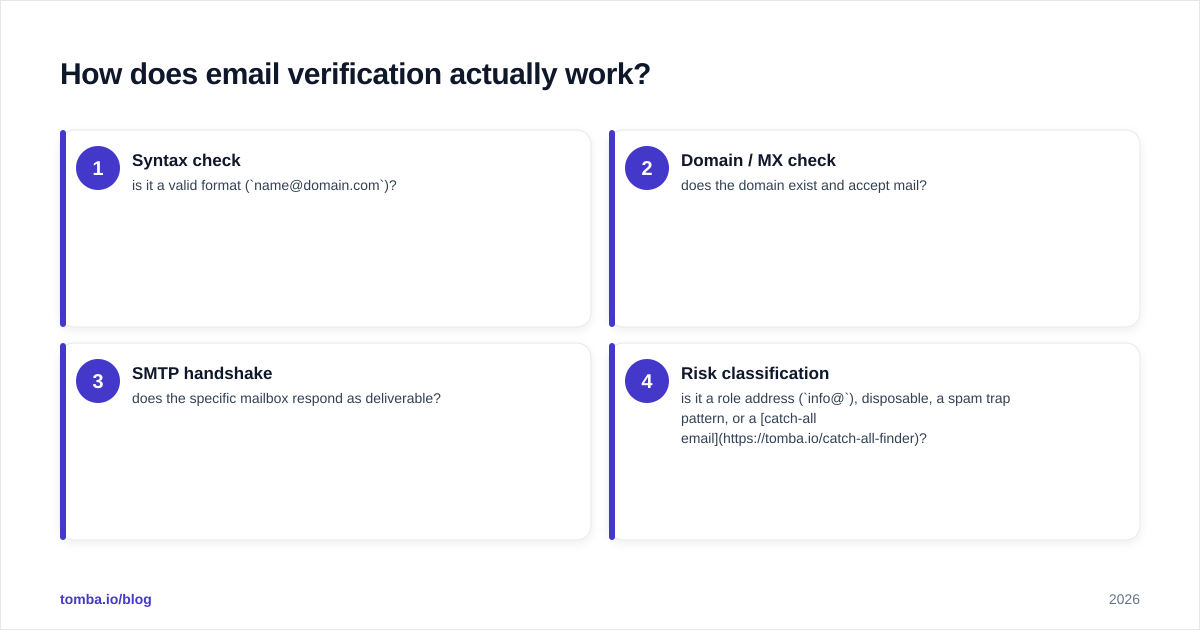
A solid verifier runs an address through several layers:
- Syntax check — is it a valid format (
name@domain.com)? - Domain / MX check — does the domain exist and accept mail?
- SMTP handshake — does the specific mailbox respond as deliverable?
- Risk classification — is it a role address (
info@), disposable, a spam trap pattern, or a catch-all email?
The first two steps are easy and every tool nails them. The last two are where Adaptio and Verifyemailio earn or lose their accuracy claims. Catch-all domains — servers that accept mail to any address — are the hardest case. A weak verifier marks them "valid" and you get burned; a strong one flags them as "accept-all / risky" so you can decide.

If a vendor advertises "99% accuracy" without telling you how it treats catch-all and role addresses, treat that number with suspicion. Accuracy is only meaningful relative to how aggressively a tool guesses on the uncertain cases.
The renderer swaps the meme token below in automatically.

Adaptio vs Verifyemailio: feature comparison#
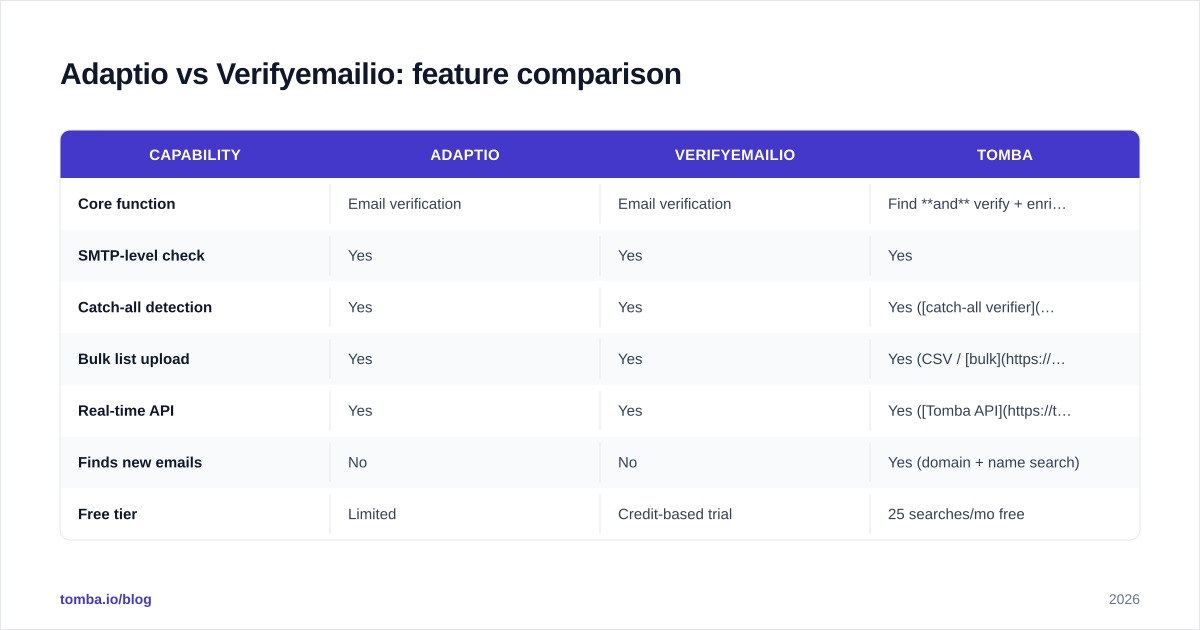
Here's the head-to-head on the capabilities that matter for a verification workflow. A third column shows Tomba for context, since many teams end up wanting find + verify together.
| Capability | Adaptio | Verifyemailio | Tomba |
|---|---|---|---|
| Core function | Email verification | Email verification | Find and verify + enrich |
| SMTP-level check | Yes | Yes | Yes |
| Catch-all detection | Yes | Yes | Yes (catch-all verifier) |
| Bulk list upload | Yes | Yes | Yes (CSV / bulk) |
| Real-time API | Yes | Yes | Yes (Tomba API) |
| Finds new emails | No | No | Yes (domain + name search) |
| Free tier | Limited | Credit-based trial | 25 searches/mo free |
| Deduplication | Yes | Partial | Yes |
| Data enrichment | No | No | Yes (enrichment) |
Vendor features and limits change often — confirm the current details on each provider's site before you buy.

The pattern is clear: Adaptio and Verifyemailio are close on raw verification. Both do SMTP checks, both handle catch-alls, both expose an API. Your decision between the two will hinge on pricing model, UI preference, and how each one labels the gray-area addresses. The bigger structural difference is scope — neither finds contacts, so if your funnel starts with "I have a company but no email," you'll need a separate finder anyway.
Which is more accurate, Adaptio or Verifyemailio?#
The honest answer: on clean, mainstream domains (Gmail, Outlook, corporate Google Workspace), the two are effectively tied. Both will correctly pass deliverable mailboxes and reject hard bounces.
The gap shows up on the hard 10–15% of any list:
- Catch-all domains. Watch how each tool labels these. A tool that calls them "valid" inflates its accuracy stat but hands you risk. One that returns "accept-all / unknown" is being honest. Test both on a domain you know is catch-all and compare the verdicts.
- Role and disposable addresses. Good verifiers flag
support@,sales@, and throwaway domains separately so you can exclude them from cold sends. - Greylisting tolerance. Some servers temporarily defer the SMTP check. A mature verifier retries; a rushed one returns "unknown" and you lose a usable contact.
Rather than trust a marketing percentage, run the same 500-address sample through both and check three things: how many "unknowns" each returns, how they label your known catch-all domains, and how fast the batch completes. The tool that gives you fewer ambiguous results and explains them wins for your data. For background on the mechanics, the Wikipedia entry on the Simple Mail Transfer Protocol explains why mailbox-level checks can never be 100% deterministic — which is exactly why "unknown" handling matters.
How do Adaptio and Verifyemailio price verification?#
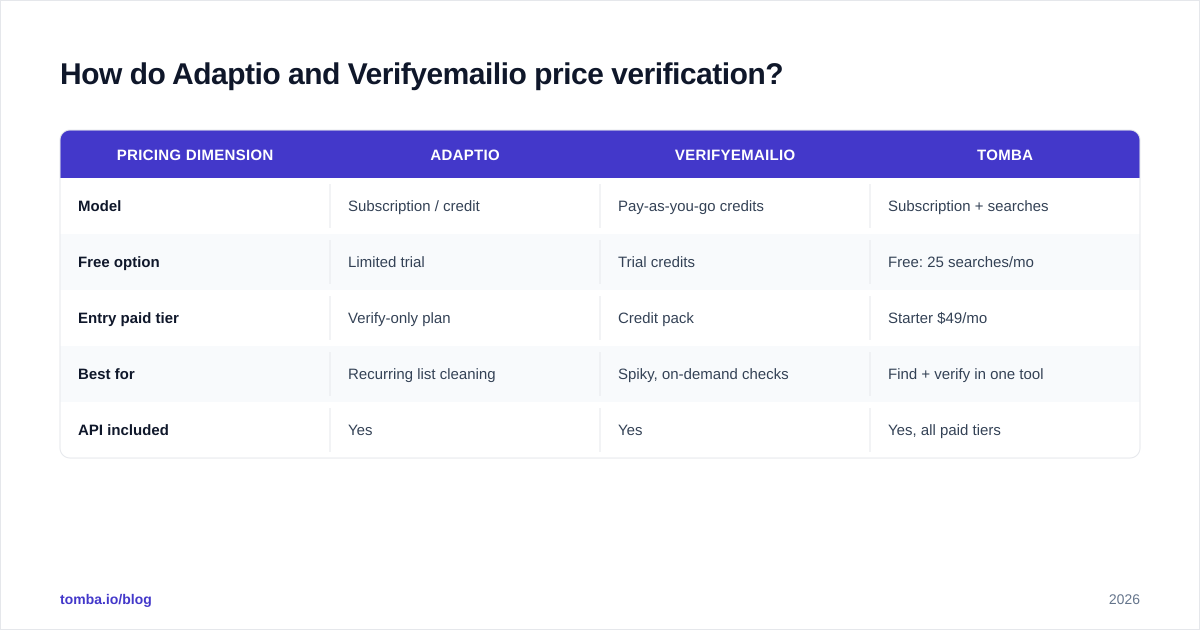
Both tools use consumption-based pricing — you pay per verification rather than per seat — but the packaging differs, and that changes the math at scale.
| Pricing dimension | Adaptio | Verifyemailio | Tomba |
|---|---|---|---|
| Model | Subscription / credit | Pay-as-you-go credits | Subscription + searches |
| Free option | Limited trial | Trial credits | Free: 25 searches/mo |
| Entry paid tier | Verify-only plan | Credit pack | Starter $49/mo |
| Best for | Recurring list cleaning | Spiky, on-demand checks | Find + verify in one tool |
| API included | Yes | Yes | Yes, all paid tiers |
Pay-as-you-go (Verifyemailio's style) is great when your volume is unpredictable — you top up credits and they don't expire on a monthly cycle the way subscription quotas can. Subscription/credit hybrids (closer to Adaptio's approach) reward steady, recurring cleaning. For Tomba's full breakdown across Free, Starter $49/mo, Growth $99/mo, Pro $249/mo, and Enterprise, see the Tomba pricing page. You can sanity-check any vendor's real-world reviews on G2's email verification category and Capterra before committing budget.
One cost trap to watch: if you're paying a verification tool and a separate finder and an enrichment tool, three line items often cost more than one platform that does all three.

Where does Tomba fit in the Adaptio vs Verifyemailio decision?#
If you only ever need to clean lists you already own, Adaptio or Verifyemailio will do the job. Pick the pricing model that matches your volume pattern and move on.
But most go-to-market teams have a messier reality: they start with a company name or a domain and no email at all. That's where a verify-only tool leaves a gap. Tomba closes the loop:
- Find — pull verified professional emails from a domain search or by name, including LinkedIn-sourced addresses.
- Verify — run the same SMTP and catch-all checks Adaptio and Verifyemailio offer, via the email verifier.
- Enrich — append job titles, company data, and phone numbers in the same call.
Because finding and verification share one API and one credit pool, you skip the export/import shuffle between tools. Transparency on sourcing matters here too — Tomba documents where its data comes from, which is worth checking for any vendor you trust with deliverability.
The trade-off is honest: if you genuinely only need verification and nothing else, a dedicated verifier may feel lighter. Tomba's edge appears the moment "verify my list" turns into "build and verify a list."
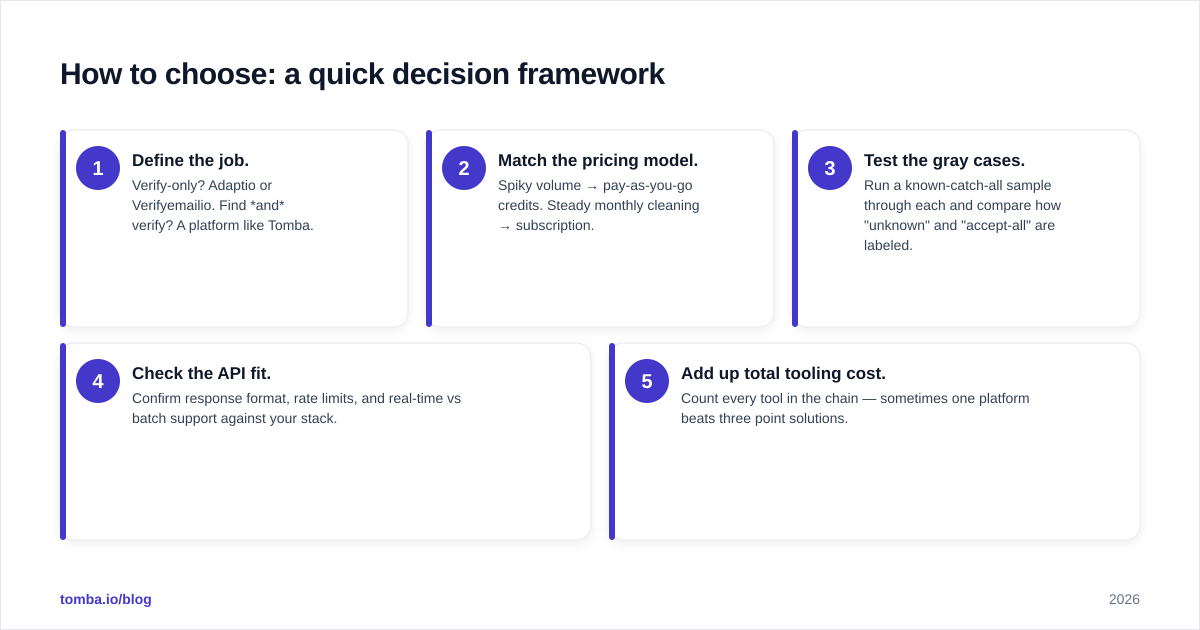
How to choose: a quick decision framework#
Use this order of operations rather than chasing the highest accuracy claim:
- Define the job. Verify-only? Adaptio or Verifyemailio. Find and verify? A platform like Tomba.
- Match the pricing model. Spiky volume → pay-as-you-go credits. Steady monthly cleaning → subscription.
- Test the gray cases. Run a known-catch-all sample through each and compare how "unknown" and "accept-all" are labeled.
- Check the API fit. Confirm response format, rate limits, and real-time vs batch support against your stack.
- Add up total tooling cost. Count every tool in the chain — sometimes one platform beats three point solutions.
Frequently asked questions#
Is Adaptio better than Verifyemailio? On core verification of mainstream domains, they're close. Adaptio tends to suit teams wanting a simple recurring cleaning workflow; Verifyemailio suits on-demand, credit-based checks. Test both on your own list and compare how they handle catch-all and unknown addresses.
Can Adaptio or Verifyemailio find new email addresses? No. Both are verification-only. To discover emails from a domain or name, you need a finder such as the Tomba Email Finder, then verify the results.
What bounce rate should I target? Keep hard bounces under roughly 2% to protect sender reputation. Verifying before you send is the single most reliable way to get there.
Do I need a verifier if my finder already verifies? Often not. If your finder returns verification status and catch-all flags natively, a separate verifier is redundant — which is the main argument for consolidating tools.
The bottom line#
Adaptio vs Verifyemailio is a close call decided by pricing model and how each labels the uncertain 10% of your list — not by headline accuracy stats. Both are competent verifiers; pick the one whose credit structure and API match your workflow, and pressure-test them on catch-all domains before you commit.
If your real problem is broader — you need to find contacts, verify them, and enrich them without stitching three tools together — start with the Tomba Email Finder. The free tier gives you 25 searches a month to test accuracy on your own domains, and paid plans start at $49/mo with finding, verification, catch-all checks, and the Tomba API all included. Verify before you send, find before you verify, and keep it in one place.
// get started
Find, verify and enrich your first contacts today
Start on the free plan with 25 searches a month, then scale when your team is ready.
Free plan · No credit card required · GDPR & CCPA
// about the author