Adaptio vs Warpleads (2026): Which Lead Gen Tool Wins?
Adaptio and Warpleads both promise more pipeline, but they solve different parts of the outbound problem. Here's a neutral 2026 breakdown of data, accuracy, pricing, and fit.
TL;DR
- Warpleads is built for volume: bulk B2B lead export, large contact pulls, and feeding cold-email sequences fast.
- Adaptio leans toward signal and targeting: enriching and prioritizing accounts so reps work fewer, better-fit leads.
- They are not really the same product. Warpleads competes on quantity and cost-per-lead; Adaptio competes on relevance and routing.
- Neither is a full replacement for a dedicated email finder + verifier layer — accuracy on exported contacts still depends on how you validate before sending.
- If your bottleneck is "not enough contacts," look at Warpleads. If it's "too many low-fit contacts," look at Adaptio. If it's "deliverability," fix verification first.
What are Adaptio and Warpleads?#
Short version: Adaptio is a targeting-and-enrichment tool, Warpleads is a volume-export tool. They sit at opposite ends of the same outbound pipeline.
Think of building a list like fishing. Warpleads hands you a bigger net — you pull a lot of fish quickly and sort them on the deck. Adaptio is more like a fish-finder sonar — it points you at where the right fish are so you cast less and catch better. Both can fill the cooler; they just disagree on where the work should happen.
Warpleads positions itself around unlimited or high-volume B2B lead exports for cold outreach. The pitch is straightforward: define a segment, pull a large batch of company and contact records, and push them into your sending tool. Teams that run high-throughput cold email — where reply rate is low but volume is high — gravitate toward this model.
Adaptio focuses on the quality side: scoring, enriching, and prioritizing leads so that reps and sequences spend time on accounts that actually resemble your best customers. Instead of "here are 50,000 contacts," the promise is closer to "here are the 2,000 worth contacting first."
Because their philosophies differ, a head-to-head "winner" depends entirely on which problem is currently costing you the most revenue.

How does each tool actually work?#
Both tools share the same raw ingredients — company firmographics, contact records, email addresses, and some intent or activity signals — but they package them differently.
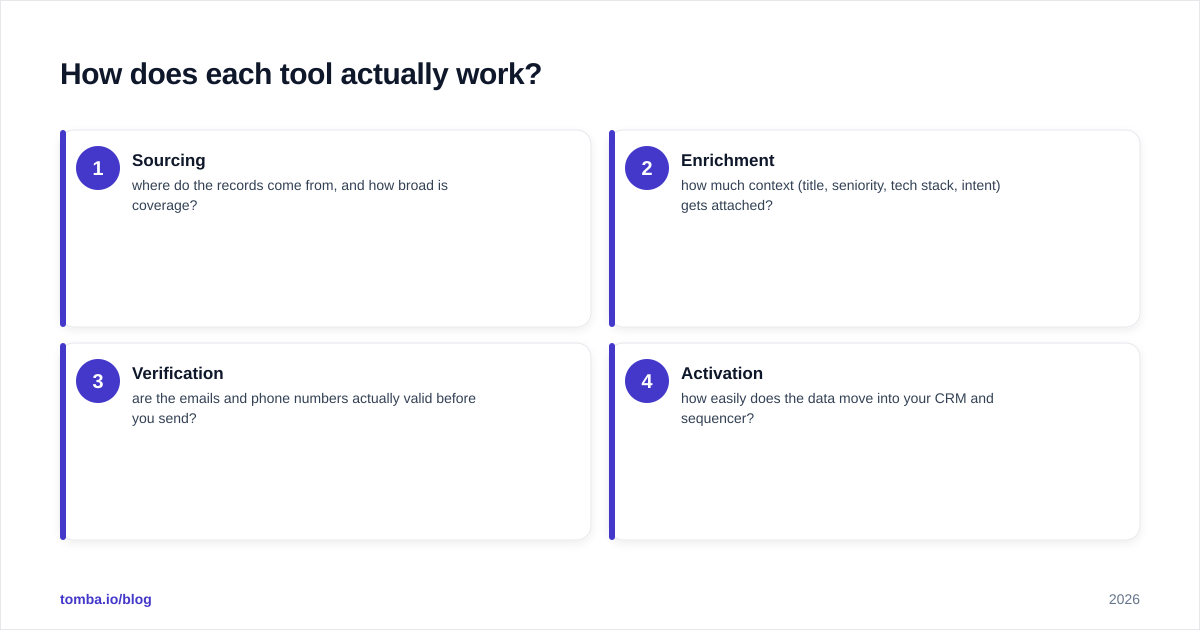
A useful way to evaluate any lead tool is to break it into four stages and ask how well each one performs at each stage. This is the framework we'll use for the rest of the comparison.

- Sourcing — where do the records come from, and how broad is coverage?
- Enrichment — how much context (title, seniority, tech stack, intent) gets attached?
- Verification — are the emails and phone numbers actually valid before you send?
- Activation — how easily does the data move into your CRM and sequencer?
Warpleads tends to be strongest at stage 1 (sourcing volume) and stage 4 (fast export). Adaptio tends to invest more in stage 2 (enrichment/scoring). Stage 3 — verification — is where both leave room for a dedicated layer, which is the part that most directly affects your sender reputation and reply rate.
Adaptio vs Warpleads: side-by-side comparison#
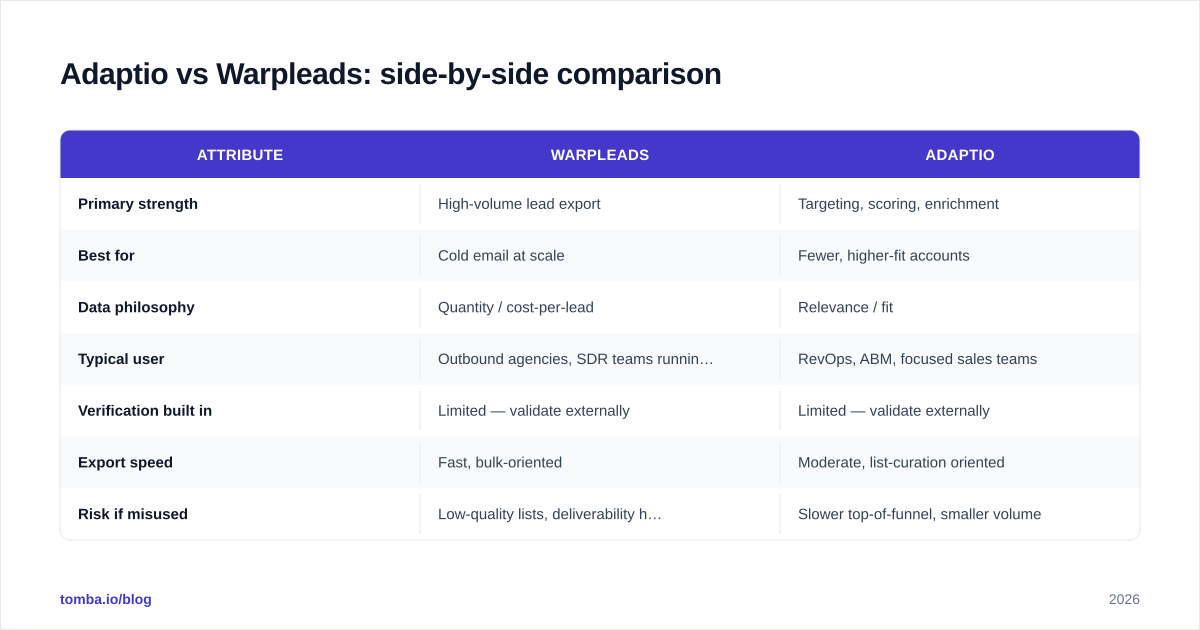
The table below summarizes the practical differences. Treat pricing as directional — both vendors change plans frequently, so confirm current numbers on their official sites and on review platforms like G2 before you buy.
| Attribute | Warpleads | Adaptio |
|---|---|---|
| Primary strength | High-volume lead export | Targeting, scoring, enrichment |
| Best for | Cold email at scale | Fewer, higher-fit accounts |
| Data philosophy | Quantity / cost-per-lead | Relevance / fit |
| Typical user | Outbound agencies, SDR teams running volume | RevOps, ABM, focused sales teams |
| Verification built in | Limited — validate externally | Limited — validate externally |
| Export speed | Fast, bulk-oriented | Moderate, list-curation oriented |
| Risk if misused | Low-quality lists, deliverability hits | Slower top-of-funnel, smaller volume |
| Learning curve | Low | Moderate |
The honest takeaway: these are complementary more often than they are competitive. A volume tool plus a targeting layer plus a verification step is a complete pipeline. Picking only one means accepting a gap somewhere.
Which one is better for cold email at scale?#
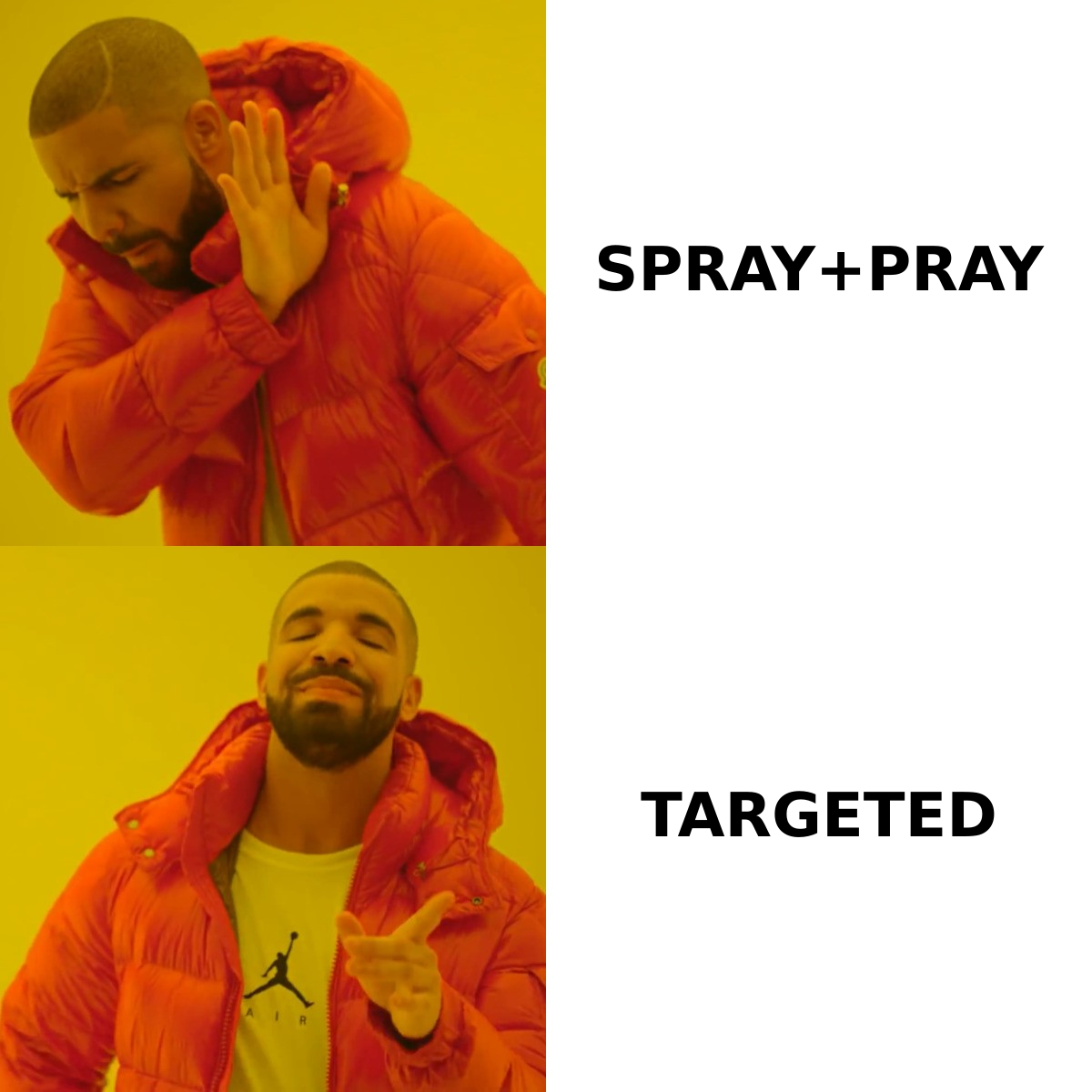
Warpleads wins on raw throughput, but only if you add verification. Volume without validation is the fastest way to torch a sending domain.
If your model is classic high-volume outbound — thousands of sends a week, low single-digit reply rates — Warpleads' export-first design fits the motion. You want lists fast and cheap, and you accept that a percentage will be junk.
The catch is deliverability. Large exported lists from any vendor contain stale, role-based, and catch-all addresses. Sending to them raises bounce rates, and bounce rate is one of the first signals mailbox providers use to throttle you. That's why the volume play only works when you run every export through an email verifier before the first send, and screen risky domains with a catch-all verifier.
For the actual sending and warmup mechanics, vendor-neutral guides like HubSpot's sales resources are a reasonable baseline. The tool you export from matters far less than whether you protect email deliverability on the way out.
Which one is better for targeted, account-based outreach?#
Adaptio is the stronger fit for low-volume, high-value selling. When each deal is worth five figures, prioritization beats volume.
If you sell into a defined set of accounts — ABM, enterprise, or anything with a long sales cycle — pulling 50,000 contacts is noise, not signal. Adaptio's scoring and enrichment orientation helps reps spend their limited hours on accounts that match your ideal customer profile.
The trade-off is volume. A targeting-first tool will surface fewer leads by design, and if your funnel needs sheer quantity to hit number, you may find it constraining. It also asks more of the operator: someone has to define fit criteria, maintain scoring logic, and keep the model honest as your market shifts.
This is where pairing matters. Adaptio can tell you who to contact; you still need accurate contact details for those accounts. A focused domain search to pull verified addresses for a named target list often closes that gap better than a broad export ever could.
What about data accuracy and email quality?#
This is the dimension buyers underweight — and it decides whether either tool pays off. A lead you can't reach is not a lead.
Neither Warpleads nor Adaptio is primarily an email-verification engine. Both source contact data, and both will include some percentage of addresses that bounce, belong to people who've left, or sit on catch-all domains that silently accept everything. That's not a knock on either vendor specifically — it's true of nearly every list source.
What separates teams that get results from teams that get spam-foldered is the verification step between sourcing and sending:
- Bounce control — remove invalid mailboxes before they hit your sender reputation.
- Catch-all handling — treat catch-all domains as "risky," not "valid," and verify them separately.
- Role-account filtering — deprioritize info@, sales@, and similar addresses that rarely convert.
- Enrichment gaps — fill missing names, titles, and companies so personalization isn't generic.
A dedicated email finder plus verification layer turns a mediocre export into a sendable list. If you're processing large batches, a bulk email finder and bulk verification step keeps cost-per-valid-lead honest, and data enrichment fills the fields your sequences need to feel personal.
The practical rule: judge a lead tool not by how many rows it returns, but by how many valid, reachable, well-fit rows survive verification. That number is usually far lower than the export count — and it's the only number that maps to pipeline.
How much do Adaptio and Warpleads cost?#
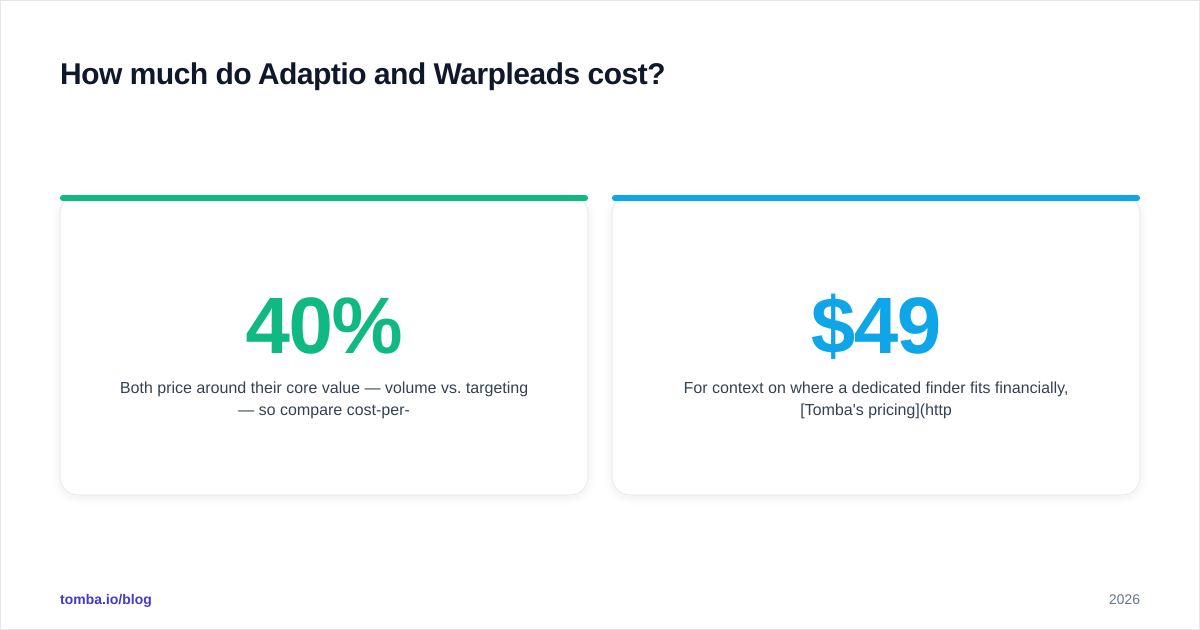
Both price around their core value — volume vs. targeting — so compare cost-per-valid-lead, not sticker price. A cheap export that's 40% invalid is more expensive than it looks.
Pricing on both platforms changes often, and tiers vary by seat count, export volume, and feature gating. Rather than quote numbers that will be stale by the time you read this, check each vendor's current pricing page and cross-reference user-reported pricing on Capterra. When you model the cost, normalize it:
- Take the plan price.
- Divide by the number of leads you can actually export per month.
- Multiply your expected valid-and-reachable rate (after verification) — not the vendor's claimed accuracy.
- The result is your true cost per usable lead.
Run that math for both tools against your real motion and the "expensive" option often turns out cheaper per booked meeting.
For context on where a dedicated finder fits financially, Tomba's pricing starts with a free tier of 25 searches per month, then a Starter plan at $49/mo, Growth at $99/mo, and Pro at $249/mo — designed to bolt onto whichever list source you choose rather than replace your whole stack.
Adaptio vs Warpleads: which should you choose?#
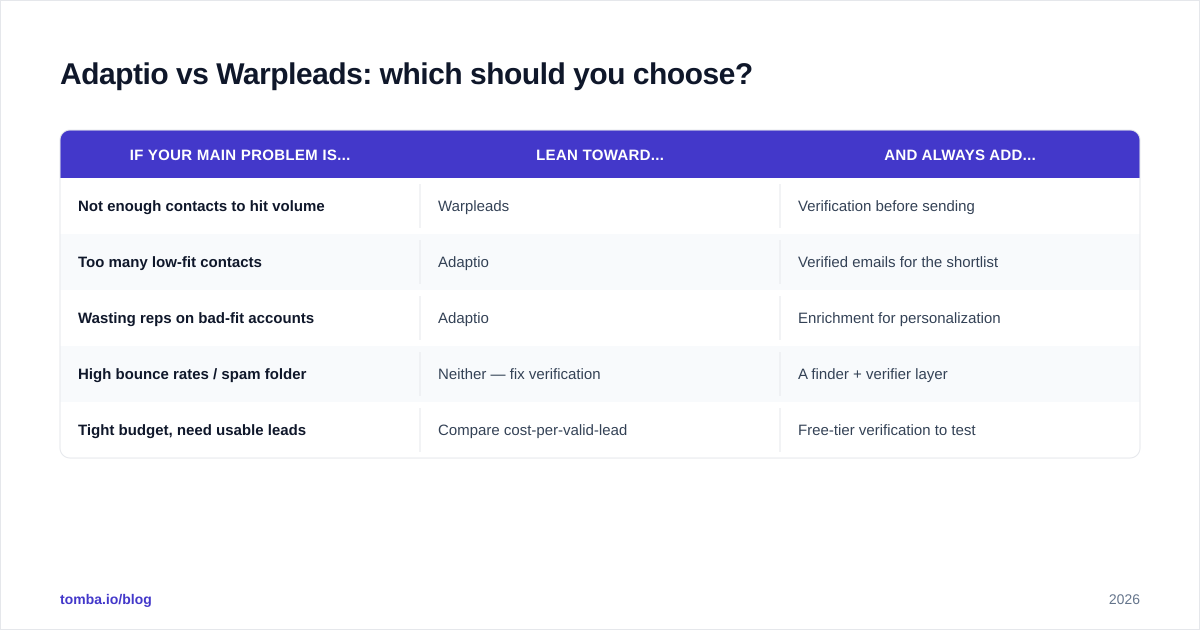
Here's the decision in one screen:
| If your main problem is... | Lean toward... | And always add... |
|---|---|---|
| Not enough contacts to hit volume | Warpleads | Verification before sending |
| Too many low-fit contacts | Adaptio | Verified emails for the shortlist |
| Wasting reps on bad-fit accounts | Adaptio | Enrichment for personalization |
| High bounce rates / spam folder | Neither — fix verification | A finder + verifier layer |
| Tight budget, need usable leads | Compare cost-per-valid-lead | Free-tier verification to test |
Choose Warpleads if you run a true volume motion and have the deliverability discipline to verify everything you export. Choose Adaptio if you sell into a defined account list and prioritization is your constraint. Choose both if your funnel needs volume at the top and precision at the bottom — they don't conflict.
What neither replaces is the accuracy layer. The single highest-ROI move for most outbound teams in 2026 isn't switching list vendors — it's adding verification so your response rate reflects real conversations instead of bounces.
The bottom line#
Adaptio and Warpleads aren't really rivals; they're different answers to "what's slowing my pipeline?" Warpleads scales the top of the funnel. Adaptio sharpens the middle. Both depend on contact data that's actually correct — and that's the part you control.
Before you commit to either, plug the gap that quietly kills outbound: unverified, under-enriched contact data. Start with the Tomba Email Finder to pull and verify professional emails for your target accounts, run your exports through verification, and only then decide whether your real bottleneck is volume (Warpleads) or targeting (Adaptio). Test it free with 25 searches a month — no card required — and measure the one metric that matters: valid, reachable leads per dollar.
Get the Tomba newsletter
Practical outbound tactics and product updates — once every two weeks.
About the author