Adaptio vs Webbula 2026: Which B2B Data Platform Wins?
A neutral, hands-on breakdown of Adaptio vs Webbula in 2026 — data hygiene, enrichment, audience activation, pricing models, and which one fits your GTM stack.
Choosing between two B2B data platforms is rarely about which one has the longer feature list. It is about which one keeps your pipeline clean, your sends landing in the inbox, and your reps talking to real humans. Adaptio vs Webbula is exactly that kind of decision: two vendors that touch the same problem — bad, stale, risky contact data — from different angles.
This guide is a neutral comparison. Where one tool is genuinely stronger, we say so. Where the public information is thin (and for Adaptio, it is), we flag the uncertainty instead of inventing numbers.
TL;DR — Adaptio vs Webbula in one screen#
- Webbula is best known for email hygiene and multi-dimensional data quality — it scores deliverability risk, flags traps and complainers, and appends demographic/firmographic fields for audience targeting.
- Adaptio positions closer to data activation and audience adaptation — shaping and routing contact data into campaigns and ad platforms, rather than acting purely as a verification engine.
- Both sell on a custom-quote, enterprise model rather than transparent self-serve pricing, so total cost depends heavily on volume and contract.
- If your core pain is list rot and inbox placement, hygiene-first Webbula maps more directly; if it is audience orchestration across channels, Adaptio's framing fits better.
- For most outbound teams, neither replaces a fast email verifier plus an email finder at the top of funnel — they sit downstream of where contacts are sourced.

What problem are Adaptio and Webbula actually solving?#
Think of your contact database like a fridge. Buying more groceries (more leads) feels productive, but if half the fridge is expired, you are cooking with bad ingredients. Adaptio and Webbula both promise to keep the fridge fresh — they just stand at different doors.
Webbula has built its reputation on email hygiene and data quality. Its pitch is that a simple valid/invalid check is not enough. An address can technically accept mail and still be a spam trap, a known complainer, a frequently-bouncing mailbox, or a bot-generated honeypot. Sending to those tanks your sender reputation even when the address "verifies." Webbula layers risk categories on top of validity and appends enrichment fields so marketers can segment.
Adaptio is framed more around adapting and activating audience data — taking contact and account records and shaping them for downstream use in campaigns, ad audiences, and personalization. The emphasis leans toward orchestration and targeting rather than a standalone deliverability-scoring engine.
The practical takeaway: these are adjacent categories that overlap, not identical products. Your decision should start with which job you are hiring the tool to do.
How do Adaptio and Webbula compare feature by feature?#
Here is the honest, category-level comparison. Where a cell says "Custom" or "Not publicly listed," that reflects the lack of transparent published detail — not a hidden weakness.
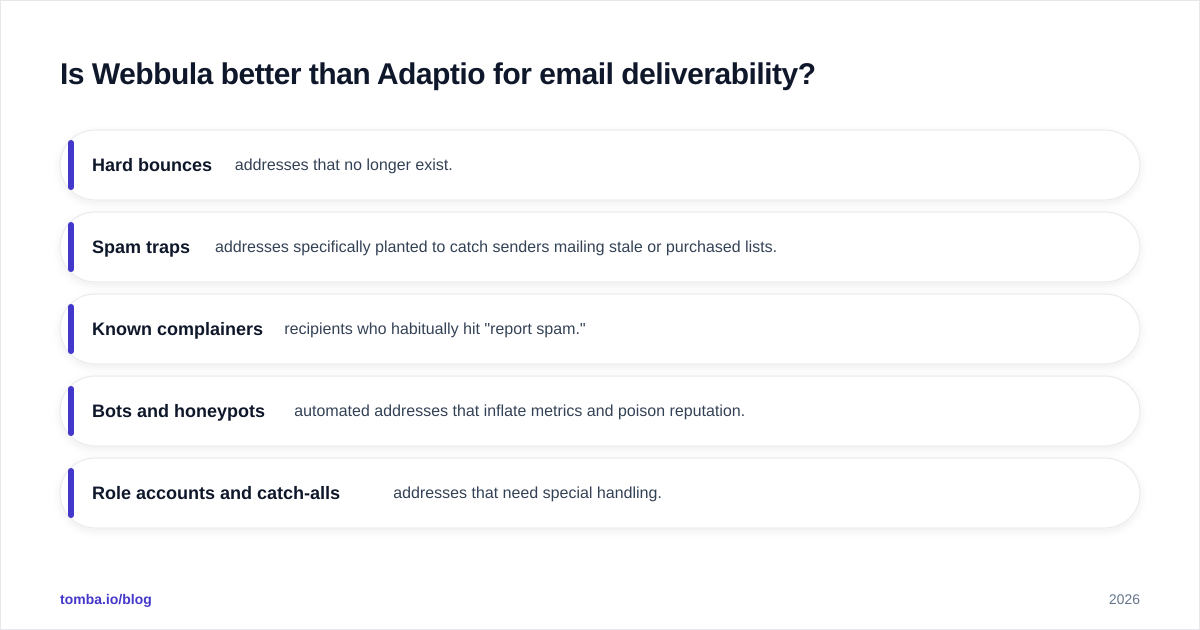
| Attribute | Webbula | Adaptio |
|---|---|---|
| Primary category | Email hygiene + data quality + enrichment | Audience data activation / adaptation |
| Core strength | Multi-category deliverability risk scoring | Shaping & routing data into channels |
| Verification depth | Beyond valid/invalid: traps, complainers, bots | Not positioned as a standalone verifier |
| Data enrichment | Demographic & firmographic appends | Audience-oriented enrichment |
| Pricing model | Custom quote (volume-based) | Custom quote |
| Free self-serve tier | Not publicly listed | Not publicly listed |
| Best fit | Marketers protecting inbox placement | Teams orchestrating cross-channel audiences |
| Typical buyer | Email/CRM/data-ops leads | Growth / paid-media / GTM teams |
A note on rigor: both vendors lean enterprise, so the published surface area is smaller than self-serve SaaS tools. If exact pricing or a specific certification matters to your procurement, get it in writing from each vendor — do not trust a blog (including this one) as the source of truth for a contract.
Is Webbula better than Adaptio for email deliverability?#
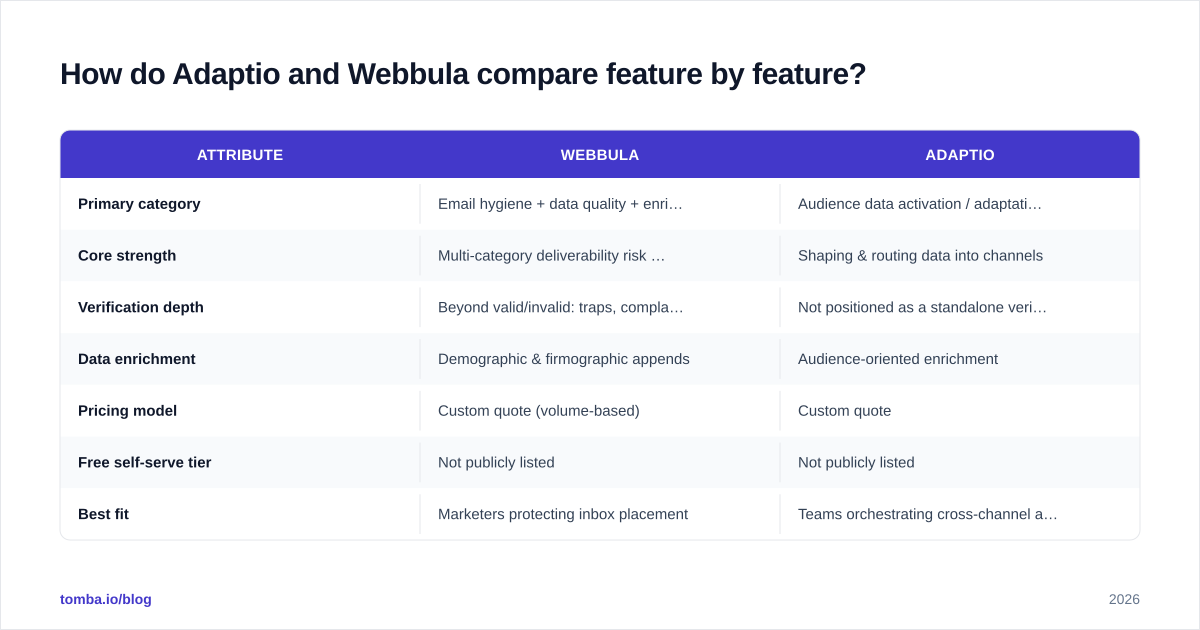
For pure email deliverability, Webbula's category is the more direct match. Deliverability is not a single yes/no signal; it is a stack of risk factors:
- Hard bounces — addresses that no longer exist.
- Spam traps — addresses specifically planted to catch senders mailing stale or purchased lists.
- Known complainers — recipients who habitually hit "report spam."
- Bots and honeypots — automated addresses that inflate metrics and poison reputation.
- Role accounts and catch-alls — addresses that need special handling.
Webbula's multi-dimensional model is designed to surface those buckets so you can suppress the risky ones before they touch your ESP. Adaptio, by its activation-first positioning, is not the tool you reach for when the question is "will this send land in the inbox?"
That said, deliverability is a system, not a single vendor. Even perfect hygiene fails if your authentication is broken. Before you blame a list, confirm your SPF record and DMARC alignment are correct, and watch your reputation in tools like Google Postmaster.
Which one is better for data enrichment and targeting?#
This is where the comparison gets closer, and where Adaptio's framing earns its keep.
If your goal is audience activation — building segments, pushing them to ad platforms, personalizing journeys — a tool oriented around adapting data for downstream channels is conceptually aligned. Webbula also enriches, but its enrichment is in service of cleaner targeting and safer sends rather than being the headline act.
A simple way to decide:
- "I have a list and I'm scared to mail it." → Hygiene-first. Webbula's lane.
- "I have audiences and I want them shaped and routed everywhere." → Activation-first. Adaptio's lane.
- "I don't have enough contacts yet." → Neither. You have a sourcing problem, and you need an email finder and data enrichment layer first.
That last point matters more than most comparison posts admit. Hygiene and activation both assume you already have records. If your funnel is starving for net-new contacts, polishing a small list is rearranging deck chairs.
What about pricing — Adaptio vs Webbula cost in 2026?#
Both vendors run on custom, quote-based pricing rather than a public self-serve table, so anyone quoting you exact monthly figures online is guessing. What you can reasonably expect:
- Pricing scales with record volume and frequency (one-time clean vs ongoing/API).
- Enterprise contracts usually mean annual commitments and minimums.
- Onboarding, support tier, and API access can be separate line items.
The honest move is to request quotes from both and normalize them to a cost-per-1,000-records-processed number so you can compare apples to apples. Ask specifically about:
- One-time vs recurring pricing.
- Overage rates beyond your committed volume.
- Whether enrichment fields are bundled or metered separately.
- API rate limits and SLA.
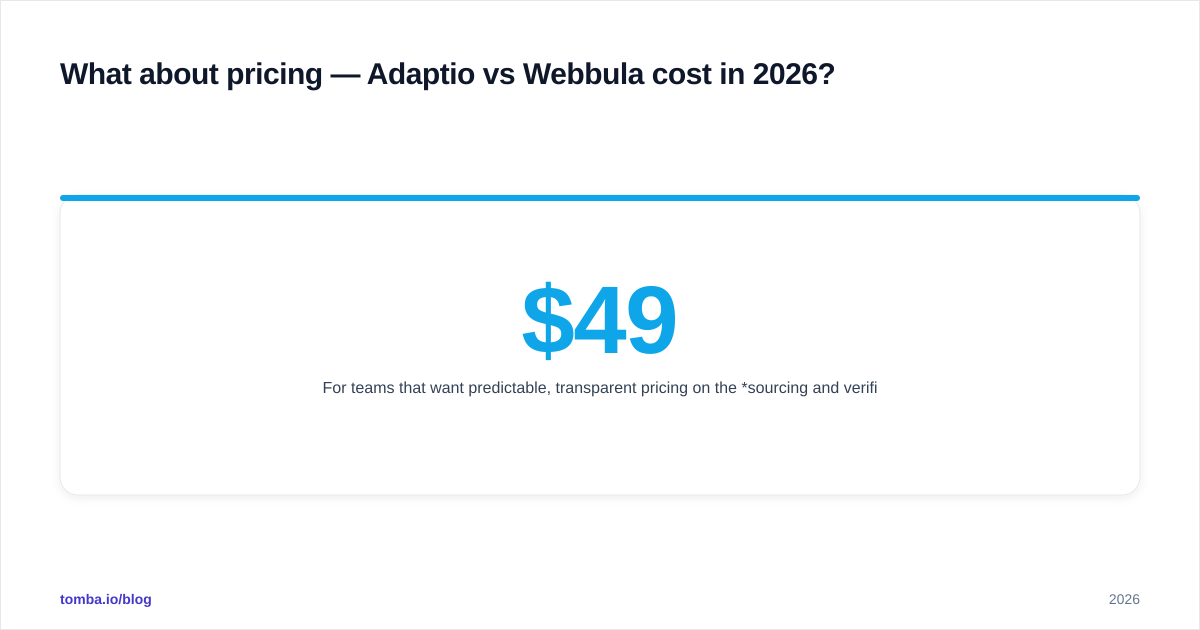
For teams that want predictable, transparent pricing on the sourcing and verification side of the stack, it is worth contrasting this opacity with published self-serve tiers. For example, Tomba pricing lists a free tier (25 searches/mo), Starter at $49/mo, Growth at $99/mo, and Pro at $249/mo — useful as a baseline anchor when an enterprise quote lands on your desk.
When should you use neither — and source clean data upstream instead?#
Here is the contrarian take: a lot of teams shopping Adaptio vs Webbula are solving the wrong layer.
Hygiene and activation are downstream of acquisition. If you are buying a remediation tool because your purchased list is full of traps, the durable fix is to stop starting from dirty lists. Build your contacts from first-party prospecting:
- Find verified work emails by name and company with an email finder.
- Pull every address on a target domain with domain search.
- Confirm risky addresses with a real-time catch-all verifier before they hit your sequencer.
- Process large lists at once with a bulk email finder and verifier.
When your inputs are clean, your hygiene bill shrinks and your activation results improve — because you are activating real, reachable people. Garbage in, garbage out is not a cliché in data ops; it is the entire P&L.
How do you actually choose between Adaptio and Webbula?#
Run this short decision framework before you book a single demo:
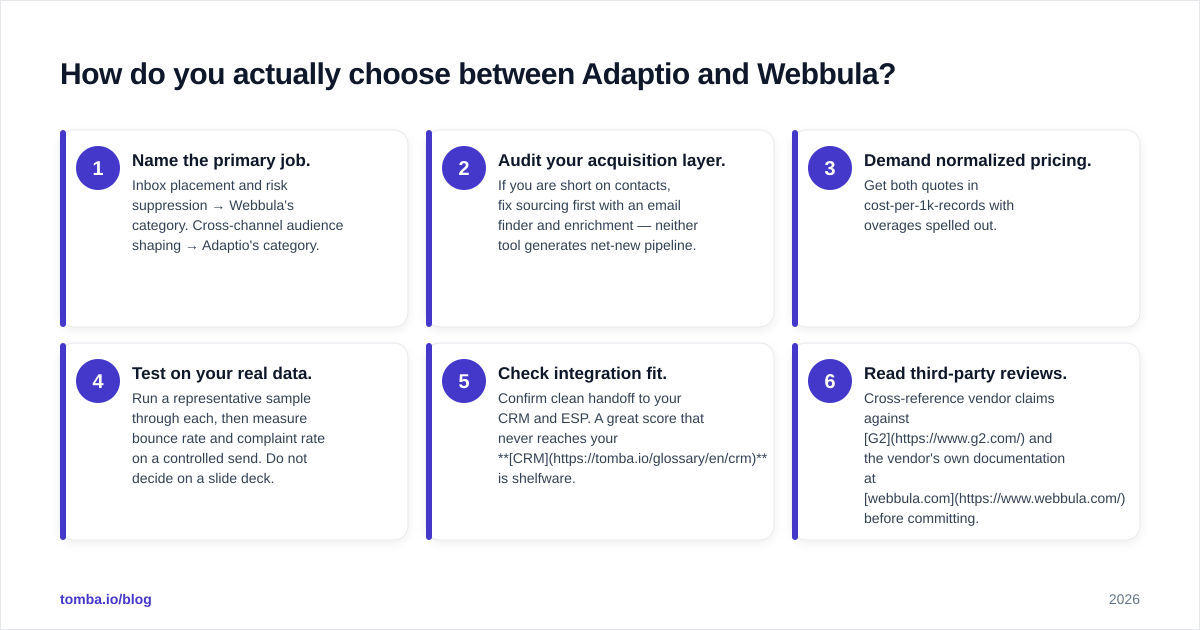
- Name the primary job. Inbox placement and risk suppression → Webbula's category. Cross-channel audience shaping → Adaptio's category.
- Audit your acquisition layer. If you are short on contacts, fix sourcing first with an email finder and enrichment — neither tool generates net-new pipeline.
- Demand normalized pricing. Get both quotes in cost-per-1k-records with overages spelled out.
- Test on your real data. Run a representative sample through each, then measure bounce rate and complaint rate on a controlled send. Do not decide on a slide deck.
- Check integration fit. Confirm clean handoff to your CRM and ESP. A great score that never reaches your CRM is shelfware.
- Read third-party reviews. Cross-reference vendor claims against G2 and the vendor's own documentation at webbula.com before committing.
For the deliverability fundamentals behind step 4, the broader concept of data quality is worth a refresher — risk scoring is just data quality applied to email.
Adaptio vs Webbula: the verdict#
There is no universal winner, and any post that declares one is selling something. The clean read:
- Pick Webbula if your dominant pain is list rot, bounces, traps, and protecting inbox placement. Its hygiene-first, multi-category risk model is the more direct answer to "is this list safe to mail?"
- Pick Adaptio if your dominant pain is shaping and activating audiences across channels, and you treat verification as a separate downstream step.
- Pick neither (yet) if you do not have enough verified contacts in the first place — that is a sourcing problem, and remediation tools cannot fix an empty pipeline.
Be skeptical of the pricing opacity on both sides. Get quotes, normalize them, and pilot on your own data. The right tool is the one that lowers your bounce and complaint rates on a real send — not the one with the prettier deck.
Start with clean data, not damage control#
The cheapest data to clean is the data you never let go dirty. Before you sign an enterprise hygiene or activation contract, make sure the contacts entering your funnel are verified at the source. Tomba Email Finder finds professional email addresses by name, company, or domain — and pairs with a built-in email verifier so the records that reach your CRM, ESP, Adaptio, or Webbula are already real. Start free with 25 searches a month, then scale on transparent, published Tomba pricing when you are ready. Fix the input, and the rest of the stack gets cheaper.
// get started
Find, verify and enrich your first contacts today
Start on the free plan with 25 searches a month, then scale when your team is ready.
Free plan · No credit card required · GDPR & CCPA
// about the author