Adaptio vs Zintlr 2026: B2B Sales Intelligence Compared
Adaptio vs Zintlr in 2026: a neutral, data-first breakdown of coverage, accuracy, personality intelligence, pricing, and which platform actually fits your outbound motion.
TL;DR
- Adaptio leans into AI-driven account prioritization and intent signals — it wants to tell you who to contact next, not just hand you a list.
- Zintlr combines a B2B contact database with "personality intelligence" (DISC-style profiles) so reps can tailor messaging before the first touch.
- Neither tool is a dedicated email-finder; both bundle contact data into a broader prospecting workflow, so raw email accuracy varies and usually needs a verification layer.
- For pure find-and-verify work at predictable cost, a focused tool like Tomba Email Finder often beats paying platform pricing for data you only partially use.
- Pick Adaptio for intent-led ABM, Zintlr for personality-led 1:1 outreach, and pair either with a verifier to protect deliverability.
What are Adaptio and Zintlr?#
Adaptio and Zintlr solve the same surface problem — help reps find and reach the right people — but they bet on different mechanisms.
Adaptio positions itself as an AI sales-intelligence layer. Its pitch is prioritization: ingest your ICP, watch buying signals, and surface the accounts most likely to convert this quarter. Contact data is part of the package, but the headline feature is the model that ranks and routes accounts so reps spend time on warm targets instead of cold lists.
Zintlr is a B2B database plus a differentiator it markets heavily: personality intelligence. Alongside name, title, company, and contact details, Zintlr attaches a behavioral profile — communication style, likely motivators, DISC-style traits — scraped and inferred from public footprints. The promise is that a rep opens a lead and already knows whether to be blunt, warm, data-heavy, or relationship-first.
Think of it like two different scouts. Adaptio is the analyst who tells you which doors are worth knocking on. Zintlr is the coach who tells you how the person behind each door likes to be spoken to. Both are useful; neither replaces a clean, deliverable email address — which is where a lot of teams get tripped up.
How do Adaptio and Zintlr compare at a glance?#
Here is the head-to-head on the attributes that actually change a buying decision. Treat platform-published accuracy claims with healthy skepticism — vendors measure "accuracy" differently, and self-reported numbers rarely survive contact with your real list.
| Attribute | Adaptio | Zintlr |
|---|---|---|
| Core strength | AI account prioritization + intent | Contact database + personality intelligence |
| Primary data type | Accounts, signals, contacts | Contacts, firmographics, behavioral profiles |
| Standout feature | Buying-signal scoring | DISC-style personality profiles |
| Email verification | Light / built-in basic | Light / built-in basic |
| Best for | Intent-led ABM teams | 1:1 personalized outreach |
| Typical learning curve | Moderate–high (model tuning) | Low–moderate |
| Free tier | Limited trial | Limited trial / freemium |
| Pricing transparency | Mostly quote-based | Tiered + quote-based |
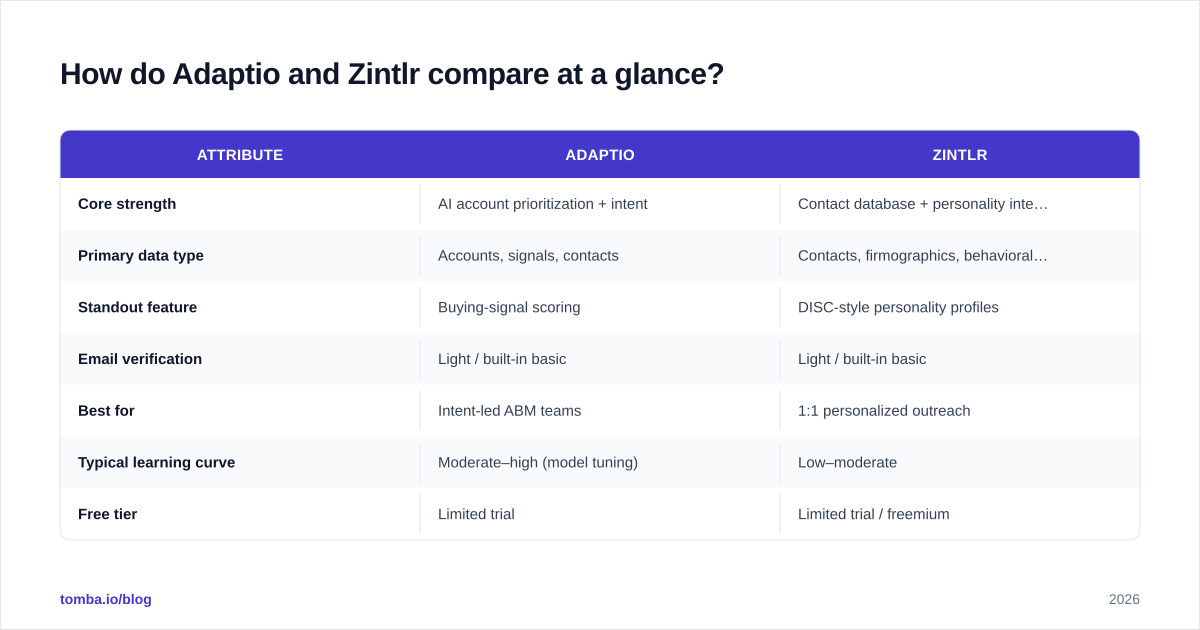
The pattern across both: rich workflow features, thinner guarantees on the one thing cold outreach lives or dies on — whether the email lands. That is not a knock; it is a design choice. Platforms optimize for breadth, and breadth and per-record verification accuracy pull in opposite directions.
Which has better data coverage and accuracy?#
Conclusion first: Zintlr tends to win on the depth of a single contact record; Adaptio tends to win on knowing which records matter. Neither reliably wins on raw email accuracy without a verification step.
Coverage and accuracy are different axes, and conflating them is the most common buyer mistake:
- Coverage is how many of your target contacts exist in the database at all. This depends heavily on geography and seniority. Both platforms are strongest in US/Europe tech and mid-market roles, thinner on SMB, non-English markets, and frontline titles.
- Accuracy is whether the email, phone, and title are currently correct. B2B data decays roughly 2–3% per month as people change jobs — so a record that was perfect in January can be dead by summer. No static database escapes this.
Adaptio's intent model is only as good as its underlying contact data, and its strength is ranking rather than per-record correctness. Zintlr's personality profiles are inferred, so they are directional, not gospel — a useful nudge, not a guarantee that your prospect is a hard-charging "D" type.
The practical takeaway: whichever you choose, run exported contacts through a dedicated email verifier before you load a sequence. A verifier that catches invalid and risky addresses protects your sender reputation far more than any vendor's headline accuracy stat. If you want to understand the mechanics, the field is governed by email deliverability fundamentals — bounce rate, spam traps, and domain reputation — not by how pretty the dashboard looks.
For a sanity check on any vendor's claims, third-party review aggregators like G2 and Capterra collect unfiltered user reports on data quality, which usually tell a more honest story than a marketing page.
Is Adaptio better than Zintlr for outbound?#
It depends on your motion. Map your team to the table below before you commit to a contract.
| Your situation | Lean Adaptio | LeanZintlr |
|---|---|---|
| You run account-based plays | ✅ Intent scoring routes reps | ➖ Less account-level signal |
| You personalize every email by hand | ➖ Overkill for 1:1 | ✅ Personality cues per contact |
| You need predictable prospecting cost | ➖ Quote-based, scales up | ➖ Tiered but adds up |
| You want plug-and-play contact export | ➖ Workflow-first | ✅ Database-first |
| You sell into complex buying committees | ✅ Multi-signal prioritization | ➖ Single-contact focus |
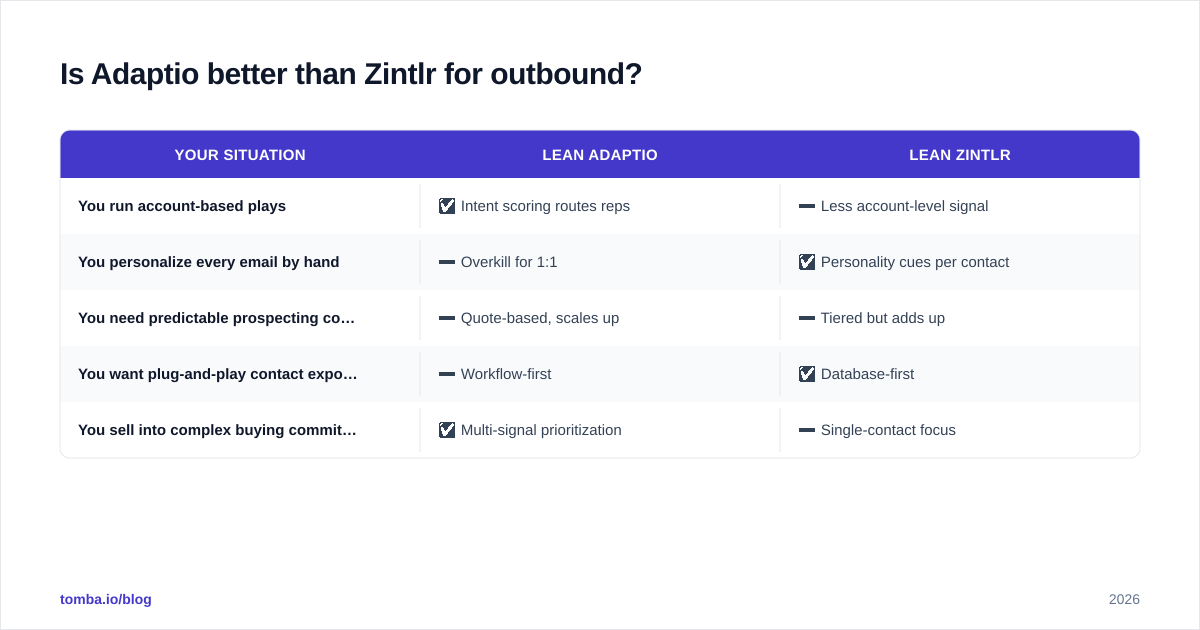
If your bottleneck is "too many accounts, not enough time," Adaptio's prioritization earns its keep. If your bottleneck is "I get the meeting only when the first message feels personal," Zintlr's profiles give reps a head start. Many teams discover their real bottleneck is upstream of both — they simply do not have enough verified, deliverable contacts to feed the machine. That is a data problem, not a workflow problem, and it is cheaper to fix.
What do Adaptio and Zintlr cost in 2026?#
Both platforms steer mid-market and enterprise buyers toward quote-based pricing, which makes apples-to-apples comparison hard and is itself a signal: you are buying a platform, not a metered utility. Expect seat-based licensing, annual commitments, and credit caps on data pulls.
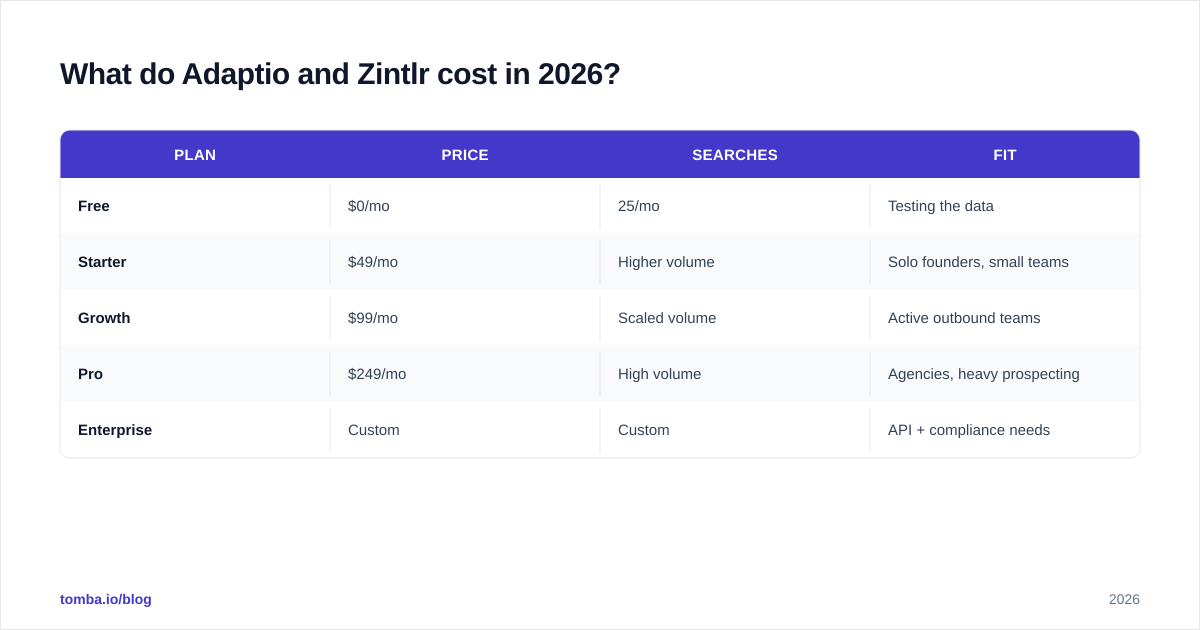
That structure is fine if you use the whole platform. It is wasteful if all you actually need is reliable contact discovery and verification. This is where a usage-priced specialist changes the math. For reference, transparent Tomba pricing runs:
| Plan | Price | Searches | Fit |
|---|---|---|---|
| Free | $0/mo | 25/mo | Testing the data |
| Starter | $49/mo | Higher volume | Solo founders, small teams |
| Growth | $99/mo | Scaled volume | Active outbound teams |
| Pro | $249/mo | High volume | Agencies, heavy prospecting |
| Enterprise | Custom | Custom | API + compliance needs |
The strategic point is not "Tomba is cheaper than Adaptio or
Zintlr" — they are partly different categories. It is that you can separate the data layer from the intelligence layer. Buy prioritization or personality insight from a platform if you need it, and source the actual verified emails from a focused tool. You stop paying enterprise rates for commodity contact records, and you stop trusting a single vendor's verification as your only line of defense.
Can you use a focused email finder alongside either tool?#
Yes — and for most teams it is the smarter architecture. Platforms like Adaptio and
Zintlr are excellent at deciding and personalizing; they are not built to be your last-mile verification engine.
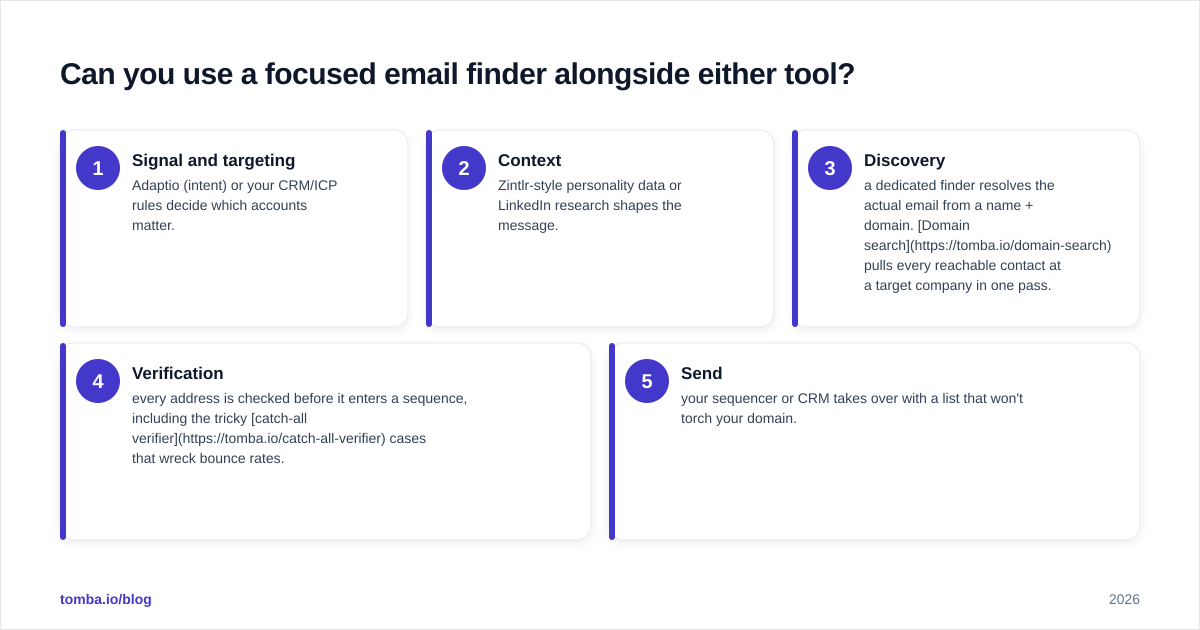
A clean stack usually looks like this:
- Signal and targeting — Adaptio (intent) or your CRM/ICP rules decide which accounts matter.
- Context — Zintlr-style personality data or LinkedIn research shapes the message.
- Discovery — a dedicated finder resolves the actual email from a name + domain. Domain search pulls every reachable contact at a target company in one pass.
- Verification — every address is checked before it enters a sequence, including the tricky catch-all verifier cases that wreck bounce rates.
- Send — your sequencer or CRM takes over with a list that won't torch your domain.
This separation also future-proofs you. If you swap Adaptio for another intent tool next year, or drop Zintlr, your verified-data pipeline doesn't break — it lives in a layer you control. Vendor lock-in is most painful exactly when your data and your workflow are welded together inside one platform.
Industry analysts have made this point for years: the modern GTM stack is modular, not monolithic. Established CRM vendors like HubSpot build entire ecosystems around the assumption that you'll plug in best-of-breed tools for discovery, enrichment, and verification rather than buying one box that does everything adequately and nothing exceptionally.
What are the limitations of each platform?#
Be honest with yourself about the failure modes before you sign.
Adaptio limitations
- Intent models need feeding. A model that ranks accounts is only useful once it has enough of your signal — early weeks can feel underwhelming.
- Prioritization is probabilistic. "High intent" is a bet, not a certainty, and reps who treat scores as gospel will misfire.
- Quote-based pricing makes budgeting and scaling unpredictable.
Zintlr limitations
- Personality profiles are inferred from public data. They are a useful prior, not a verified psychological assessment — over-indexing on them reads as creepy or wrong.
- Database-first tools still suffer data decay; a profile can be rich and out of date.
- Personalization at scale has diminishing returns once you're sending hundreds of touches a week.
Shared limitation
- Neither is a substitute for rigorous verification. If your bounce rate climbs, no amount of intent scoring or personality insight will save your sender reputation. Deliverability is upstream of everything else, and both platforms treat it as a feature rather than the foundation.
So which should you choose: Adaptio or Zintlr?#
Here is the decision in one line: choose Adaptio if your problem is prioritization, choose Zintlr if your problem is personalization, and fix your data layer separately regardless of which you pick.
- A RevOps-led, account-based team chasing a defined enterprise list will get more from Adaptio's signal scoring.
- A founder or AE doing high-craft, low-volume outreach will get more from Zintlr's personality cues.
- A team whose real gap is volume of deliverable contacts should not buy either as a data fix — they should add a finder-plus-verifier layer first, then decide whether they even need the intelligence platform.
The most common buyer regret with both tools is paying platform prices for contact data that still bounces. Don't make that mistake. Validate a sample of each vendor's data against ground truth — pull 100 contacts, verify them independently, and measure the real hit rate before you commit annual budget.
The bottom line#
Adaptio and Zintlr are both legitimate, capable platforms aimed at slightly different jobs — intent-led prioritization versus personality-led personalization. Neither is a dedicated email-finding and verification engine, and treating them as one is how teams quietly burn their domain reputation.
If your priority is finding accurate, verified professional emails at transparent, usage-based pricing — without committing to an enterprise platform contract — start with Tomba Email Finder. Find emails by name, company, or domain, verify them in the same workflow, and feed clean data into whichever intelligence layer you choose. Spin up the free tier with 25 searches, test the accuracy against your own list, and keep your data pipeline in a layer you control. Your bounce rate — and your reps — will thank you.
// get started
Find, verify and enrich your first contacts today
Start on the free plan with 25 searches a month, then scale when your team is ready.
Free plan · No credit card required · GDPR & CCPA
// about the author