AdvizorPro vs LeadGibbon: B2B Data Tools Compared (2026)
AdvizorPro targets financial-advisor data; LeadGibbon chases broad B2B leads. Here's how the two stack up on accuracy, coverage, pricing, and the teams each one actually fits.
TL;DR
- AdvizorPro is a niche database built for financial services — RIAs, broker-dealers, insurance, and wealth-management contacts with regulatory and AUM data attached.
- LeadGibbon is a general-purpose B2B lead tool: a LinkedIn-driven email and contact builder aimed at broad outbound prospecting.
- They rarely compete head-to-head. If you sell to financial advisors, AdvizorPro wins on depth. If you sell to anyone else, LeadGibbon's horizontal coverage matters more.
- Neither is a true email-verification engine, so both leave gaps you'll want to close with a dedicated email verifier before you send.
- For most teams that need accurate, broadly-sourced contact data plus verification in one place, a horizontal finder like Tomba is the cheaper, more flexible backbone.
What are AdvizorPro and LeadGibbon?#
The short answer: they solve two different problems that happen to overlap on the word "leads."
AdvizorPro is a vertical data platform. It maintains a curated database of financial-services professionals — registered investment advisors (RIAs), broker-dealers, insurance agents, retirement-plan specialists — enriched with the data that actually matters in that world: assets under management (AUM), Form ADV filings, custodian relationships, and licensing. If your ICP is "advisors managing $50M+ who custody at Schwab," AdvizorPro is purpose-built for that query. You can read more about its scope on the AdvizorPro site.
LeadGibbon is a horizontal B2B prospecting tool. It pulls contact data — primarily business emails and company info — and is best known for its LinkedIn workflow: build a list from a search, export verified-ish emails, push to a spreadsheet or CRM. It competes with the broad field of email finders and list builders rather than with vertical databases.
So the real framing of AdvizorPro vs LeadGibbon isn't "which tool is better." It's "which problem are you solving — depth in one industry, or reach across many?"
How do AdvizorPro and LeadGibbon compare on features?#
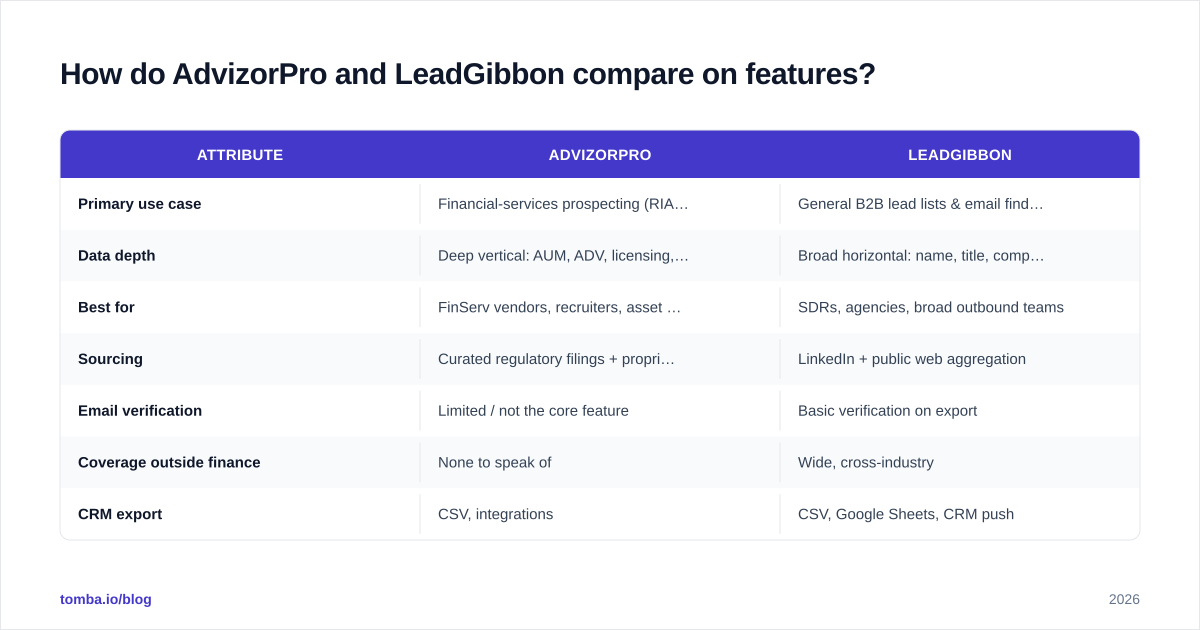
Here's the practical breakdown across the attributes that change how a sales or marketing team actually works.
| Attribute | AdvizorPro | LeadGibbon |
|---|---|---|
| Primary use case | Financial-services prospecting (RIA, BD, insurance) | General B2B lead lists & email finding |
| Data depth | Deep vertical: AUM, ADV, licensing, custodians | Broad horizontal: name, title, company, email |
| Best for | FinServ vendors, recruiters, asset managers | SDRs, agencies, broad outbound teams |
| Sourcing | Curated regulatory filings + proprietary research | LinkedIn + public web aggregation |
| Email verification | Limited / not the core feature | Basic verification on export |
| Coverage outside finance | None to speak of | Wide, cross-industry |
| CRM export | CSV, integrations | CSV, Google Sheets, CRM push |
| Pricing model | Premium, vertical-priced (quote-based) | Lower-cost, list/credit-based |
| Free option | Demo/trial on request | Limited free usage historically |
The pattern is clear. AdvizorPro charges a premium because the data is hard to assemble and narrowly valuable — there's no substitute if you sell software to RIAs. LeadGibbon is cheaper and wider because it's playing in the crowded horizontal-data market where many tools do roughly the same thing.
)
One thing both tools share: the data is a snapshot, and snapshots decay. People change jobs, emails bounce, companies get acquired. That's why the export step is where most teams quietly lose deliverability — and why verification is non-negotiable regardless of which platform you pick.
Is AdvizorPro better than LeadGibbon for accuracy?#
It depends entirely on your target market — accuracy isn't a single number, it's accuracy for your ICP.
Inside financial services, AdvizorPro is the more accurate source. Because it's built on regulatory filings (which firms are legally required to keep current) plus dedicated research, the advisor records are richer and more reliable than anything a horizontal scraper produces. You get not just a contact but the context: how much they manage, what licenses they hold, who their custodian is.
Outside financial services, AdvizorPro simply has no data, so LeadGibbon "wins" by default — it at least has a record. But LeadGibbon's accuracy is the accuracy of LinkedIn-plus-web aggregation, which means stale titles, personal Gmail addresses mixed with business ones, and the usual catch-all problem where a server accepts every address whether the mailbox exists or not. If you're hitting catch-all domains, you'll want a dedicated catch-all verifier to separate real inboxes from black holes.
The honest takeaway: neither tool's raw export is "send-ready." Both benefit from a verification pass. Treat the list as a starting point, not a finished asset, and your bounce rate will thank you. (For why bounce rate matters so much, see this primer on email deliverability.)
How do AdvizorPro and LeadGibbon pricing compare?#
AdvizorPro sits in the premium, quote-based tier typical of vertical data vendors — you talk to sales, and pricing scales with seats and data access. That's normal for niche databases; the value is concentrated, so the price is too.
LeadGibbon historically used a lower, list- or credit-based model aimed at individual reps and small teams who need volume without enterprise commitments.
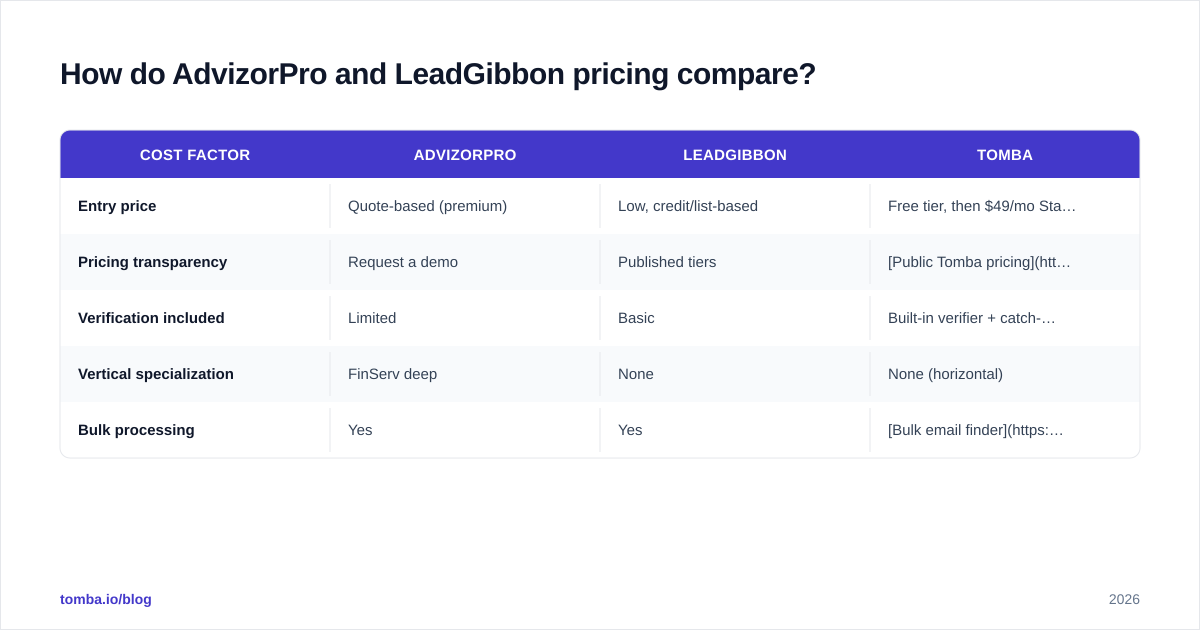
The trap with both is the same one that catches every data buyer: you pay for records, then pay again in deliverability when a chunk of them bounce. A list that's 15% stale isn't 15% cheaper — it costs you sender reputation, which is far more expensive to rebuild than to protect. Check the real cost-per-usable-contact, not cost-per-record.
| Cost factor | AdvizorPro | LeadGibbon | Tomba |
|---|---|---|---|
| Entry price | Quote-based (premium) | Low, credit/list-based | Free tier, then $49/mo Starter |
| Pricing transparency | Request a demo | Published tiers | Public Tomba pricing |
| Verification included | Limited | Basic | Built-in verifier + catch-all |
| Vertical specialization | FinServ deep | None | None (horizontal) |
| Bulk processing | Yes | Yes | Bulk email finder |
For reference, Tomba's published plans run Free (25 searches/mo), Starter at $49/mo, Growth at $99/mo, Pro at $249/mo, and custom Enterprise — transparent pricing you can evaluate without a sales call. You can sanity-check vendor reputations on independent review sites like G2 before committing.
Which one should you choose?#
Match the tool to the shape of your market. Here's the decision in plain terms.
Choose AdvizorPro if:
- Your entire ICP lives inside financial services.
- You need AUM, ADV, licensing, or custodian data to qualify and segment.
- You're a FinServ recruiter, asset manager, or vendor selling to advisors.
- Premium pricing is justified by the precision of a single, deep vertical.
Choose LeadGibbon if:
- You prospect across many industries, not one.
- You live in LinkedIn and want a quick search-to-list workflow.
- You're an SDR or agency optimizing for volume and low per-record cost.
- You can tolerate doing your own verification pass on exports.
Consider a horizontal finder + verifier (like Tomba) if:
- You want broad coverage and built-in verification in one workflow.
- You'd rather pay transparent, published prices than negotiate.
- You need an API, CRM integrations, or a Chrome extension feeding the same data source.
)
The mistake teams make is buying a niche tool like AdvizorPro for a broad need, or stretching a broad tool like LeadGibbon to do specialist FinServ work it was never built for. Both end in wasted spend. Be honest about whether your market is one vertical or many.
What about verification and deliverability?#
This is the gap neither tool fully closes, and it's where deals quietly die.
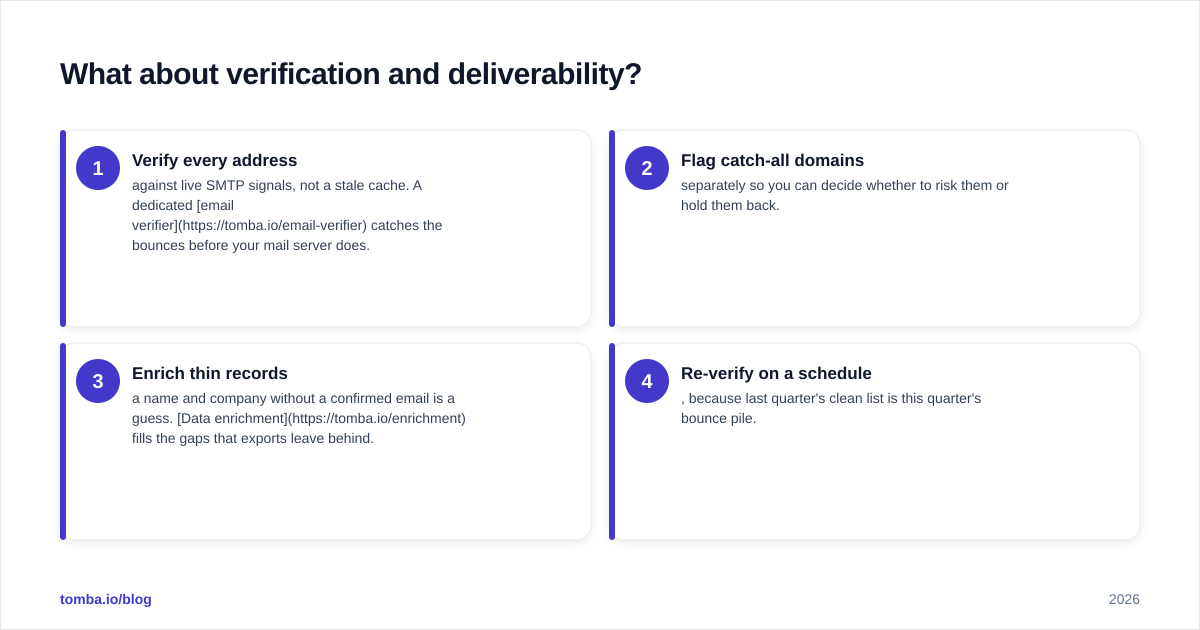
Any contact database — vertical or horizontal — degrades the moment it's published. The fix isn't a better list; it's a verification step layered on top. Before any campaign, you want to:
- Verify every address against live SMTP signals, not a stale cache. A dedicated email verifier catches the bounces before your mail server does.
- Flag catch-all domains separately so you can decide whether to risk them or hold them back.
- Enrich thin records — a name and company without a confirmed email is a guess. Data enrichment fills the gaps that exports leave behind.
- Re-verify on a schedule, because last quarter's clean list is this quarter's bounce pile.
Think of your contact data like fresh produce: the database is the grocery store, but verification is checking the expiration date before you serve it. Skip it and the whole meal — your sender reputation — goes bad. If you're connecting these steps to your stack, Tomba's integrations push verified data straight into HubSpot, Salesforce, Pipedrive, and Sheets so the clean list lands where reps actually work.
How do AdvizorPro and LeadGibbon fit a real workflow?#
Picture two teams.
Team A sells compliance software to RIAs. Their entire pipeline is financial advisors. AdvizorPro is the obvious backbone — they segment by AUM band and custodian, build target lists no horizontal tool could assemble, then run those emails through a verifier before the SDRs touch them. The premium price is trivial against a $40k ACV in a market they can't reach any other way.
Team B is a marketing agency prospecting SaaS, e-commerce, and professional-services clients. AdvizorPro is useless to them — wrong vertical. LeadGibbon gives them LinkedIn-sourced lists across all those industries. But because the data is aggregated, they verify aggressively and enrich the thin records before launching sequences. Their cost-per-record is low, but their cost-per-usable-record only stays low because they verify.
Notice that in both stories, the database is step one and verification is step two. The vendor you choose for step one depends on your market; the discipline of step two is universal. A horizontal platform that bundles both — finding and verifying in one place, with a published price — is why many teams outside FinServ skip the either/or entirely and standardize on a single source.
The bottom line#
AdvizorPro and LeadGibbon aren't really rivals — they're answers to different questions. AdvizorPro is the deepest data you'll find for selling to financial advisors, and worth its premium if that's your world. LeadGibbon is a serviceable, affordable horizontal lead builder for broad outbound, as long as you verify what it exports. Pick AdvizorPro for vertical depth, LeadGibbon for horizontal reach, and verify either way.
If your market spans more than one industry and you'd rather not stitch together a niche database, a separate verifier, and an enrichment tool, start with the Tomba Email Finder. You get broad, multi-source coverage, built-in verification and catch-all detection, an API and Chrome extension, and transparent pricing that starts free and scales to $49/mo — no demo gate, no guessing which records will bounce. Find the contact, confirm it's real, and send with confidence from one place.
// get started
Find, verify and enrich your first contacts today
Start on the free plan with 25 searches a month, then scale when your team is ready.
Free plan · No credit card required · GDPR & CCPA
// about the author