AdvizorPro vs ZoomInfo 2026: Which B2B Data Tool Wins?
AdvizorPro targets financial advisors with niche contact data; ZoomInfo covers the entire B2B market. Here's how the two stack up on accuracy, coverage, and price in 2026.
Choosing a B2B data provider usually comes down to one question: do you need data on everyone, or data on a specific audience that you can trust to be right? That's the real split between AdvizorPro and ZoomInfo.
TL;DR#
- AdvizorPro is a vertical data platform built for one audience: financial advisors, RIAs, broker-dealers, and insurance agents. It wins on depth — AUM, licenses, custodian, and broker-dealer affiliation — for that niche.
- ZoomInfo is a horizontal B2B data giant covering ~100M+ professionals across every industry, with intent data, org charts, and a deep integration ecosystem.
- If you sell to financial advisors, AdvizorPro's specialized fields and accuracy are hard to beat. If you sell to anyone else, ZoomInfo's breadth is the point.
- ZoomInfo is significantly more expensive (often $15K+/year, multi-seat minimums); AdvizorPro is cheaper but narrow.
- Many teams pair a database with a dedicated email finder and email verifier to fill gaps and keep bounce rates low — neither tool is a complete deliverability solution on its own.
What is AdvizorPro?#
AdvizorPro is a contact and intelligence database focused exclusively on the wealth-management and insurance ecosystem. Think of it as a specialist surgeon rather than a general practitioner: it doesn't try to cover every industry, but within financial services it goes deep.
A typical AdvizorPro record on an advisor includes verified email and direct phone, but also the fields that matter when you sell to this audience: assets under management (AUM), FINRA/SEC registration status, licenses held (Series 7, 65, etc.), broker-dealer affiliation, RIA firm details, and custodian relationships. You can read more about their coverage on the AdvizorPro site.
Who buys it? Fintech vendors selling software to RIAs, asset managers distributing funds, insurance wholesalers, and recruiters poaching advisor teams. For all of them, "is this person actually a registered advisor with $50M+ AUM?" is a more useful filter than raw contact volume.
What is ZoomInfo?#
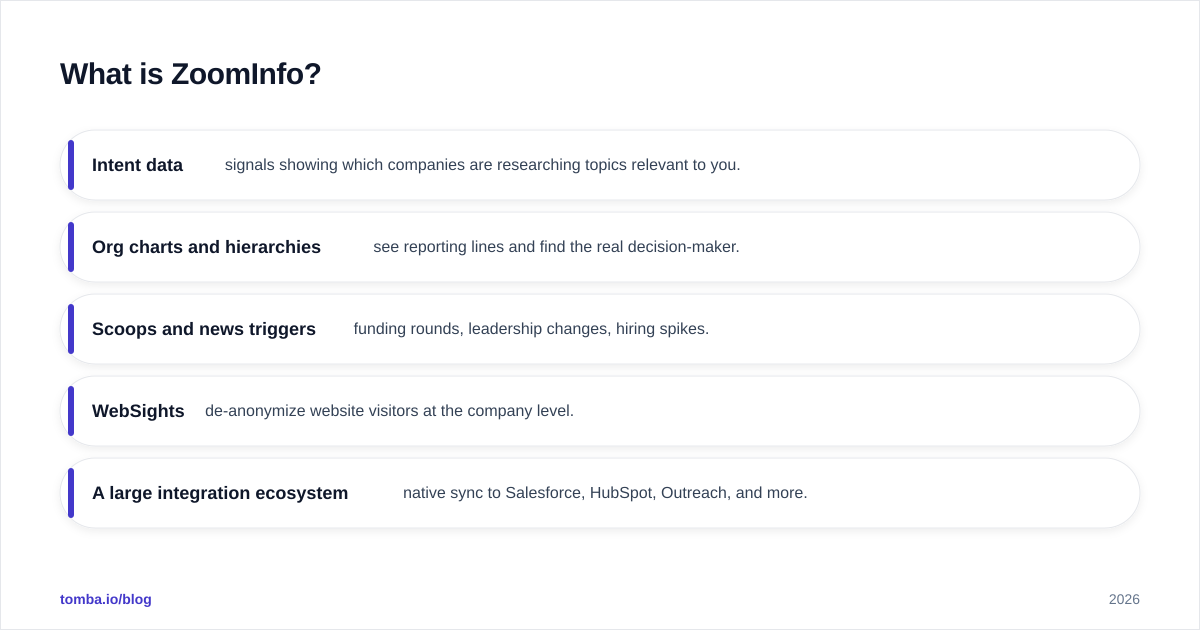
ZoomInfo is the 800-pound gorilla of B2B data. It's a horizontal platform: tens of millions of company profiles and over 100 million professional contacts spanning essentially every industry, role, and region. The official product line lives at zoominfo.com.
Beyond raw contacts, ZoomInfo bundles in capabilities most niche tools can't match:
- Intent data — signals showing which companies are researching topics relevant to you.
- Org charts and hierarchies — see reporting lines and find the real decision-maker.
- Scoops and news triggers — funding rounds, leadership changes, hiring spikes.
- WebSights — de-anonymize website visitors at the company level.
- A large integration ecosystem — native sync to Salesforce, HubSpot, Outreach, and more.
ZoomInfo's strength is also its tradeoff: it's built for scale and breadth, which means it's priced for enterprise budgets and structured around annual contracts and seat minimums.
AdvizorPro vs ZoomInfo: how do they compare?#
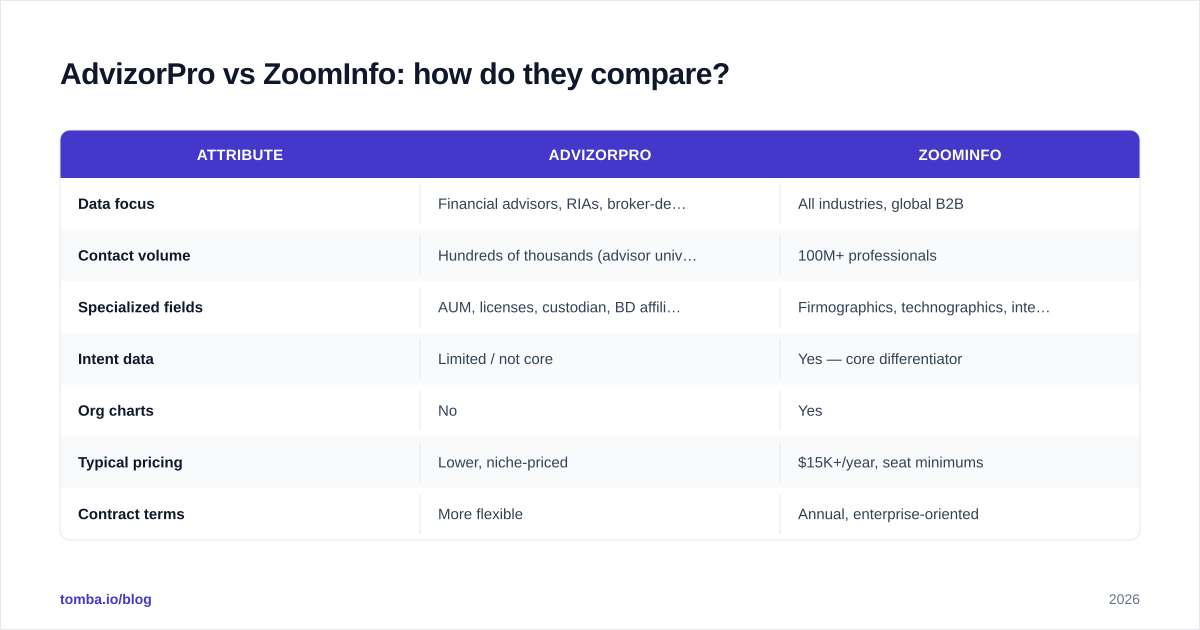
The honest answer is that these tools barely compete in the same lane — one is a scalpel, one is a Swiss Army knife. Here's the side-by-side.
| Attribute | AdvizorPro | ZoomInfo |
|---|---|---|
| Data focus | Financial advisors, RIAs, broker-dealers, insurance | All industries, global B2B |
| Contact volume | Hundreds of thousands (advisor universe) | 100M+ professionals |
| Specialized fields | AUM, licenses, custodian, BD affiliation | Firmographics, technographics, intent |
| Intent data | Limited / not core | Yes — core differentiator |
| Org charts | No | Yes |
| Typical pricing | Lower, niche-priced | $15K+/year, seat minimums |
| Contract terms | More flexible | Annual, enterprise-oriented |
| Best for | Selling to advisors | Selling to broad B2B markets |
Wait — that's the wrong way to render it. Here's the meme:

Which has more accurate data?#
Accuracy depends entirely on which data you mean — and this is where the niche-vs-broad distinction stops being abstract.
For the advisor universe specifically, AdvizorPro tends to be more accurate and more current, because maintaining a smaller, well-defined dataset is easier than maintaining a global one. Their data is cross-referenced against regulatory sources (FINRA BrokerCheck, SEC IAPD), which gives the licensing and registration fields a level of trust ZoomInfo's generalist records can't match for that vertical.
ZoomInfo wins on breadth of accuracy. Across millions of generic B2B contacts, its email and phone accuracy is strong relative to other horizontal providers, and its refresh cadence is high. But generalist databases inevitably carry stale records — people change jobs, and no provider catches every move instantly. That's true of every large database, ZoomInfo included.
The practical takeaway: no single database is a substitute for verification at send time. Whatever provider you use, run your list through an email verification step before a campaign. Job changes, typos, and catch-all domains will quietly inflate your bounce rate and damage sender reputation if you skip it. Independent reviews on G2 consistently flag "data decay" as the top complaint against every B2B data vendor — it's a category problem, not a vendor problem.
How do AdvizorPro and ZoomInfo price?#
This is the clearest difference of all.
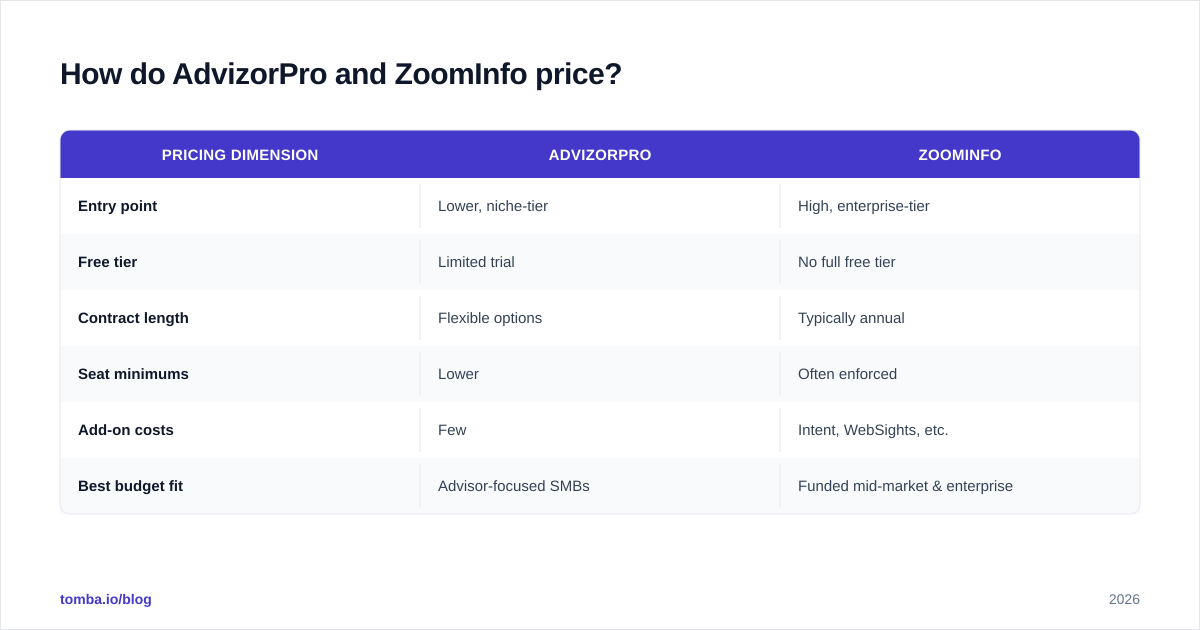
ZoomInfo is enterprise software. Public reporting and customer reviews put typical contracts in the $15,000+/year range, often with seat minimums and add-on fees for intent, WebSights, and advanced features. There's no meaningful self-serve free tier for the full platform. You're committing to an annual deal, usually after a demo and a negotiation.
AdvizorPro is priced for a narrower buyer. It's cheaper in absolute terms and the contracts are more flexible, because the scope is smaller. You're paying for depth in one vertical, not breadth across all of them.
| Pricing dimension | AdvizorPro | ZoomInfo |
|---|---|---|
| Entry point | Lower, niche-tier | High, enterprise-tier |
| Free tier | Limited trial | No full free tier |
| Contract length | Flexible options | Typically annual |
| Seat minimums | Lower | Often enforced |
| Add-on costs | Few | Intent, WebSights, etc. |
| Best budget fit | Advisor-focused SMBs | Funded mid-market & enterprise |
If your motion is advisor-specific and your budget is modest, AdvizorPro is the rational pick on cost alone. If you need cross-industry coverage and intent signals — and can justify the spend — ZoomInfo's price reflects what it's replacing (multiple point tools).
When should you pick AdvizorPro?#
Pick AdvizorPro when your entire total addressable market is financial advisors or insurance professionals. Specifically:
- You sell SaaS, portfolio tools, or compliance software to RIAs and broker-dealers.
- You're an asset manager or wholesaler who needs to segment by AUM, custodian, or product affinity.
- You recruit advisor teams and need accurate license and registration data.
- You want to avoid paying enterprise database prices for data you'll never use (every non-financial contact in ZoomInfo is dead weight to you).
In these cases, AdvizorPro's specialized fields aren't a nice-to-have — they're the segmentation logic your whole campaign depends on. A generic "Financial Services" industry tag in a horizontal database doesn't tell you whether someone manages $5M or $500M.
When should you pick ZoomInfo?#
Pick ZoomInfo when your buyers span industries or you need go-to-market features beyond a contact list:
- You sell to multiple verticals and need one source of truth.
- Intent data and buying signals are central to your outbound strategy.
- You need org charts to navigate complex enterprise deals.
- You're already running Salesforce/HubSpot/Outreach and want native enrichment baked into the workflow.
- You have the budget and headcount to extract value from a platform, not just a database.
The mistake teams make is buying ZoomInfo for a niche use case it doesn't specialize in. If 90% of your spend goes toward data you'll never touch, you've overpaid for breadth you don't need.
Do you need a third option?#
Often, yes — and this is the part most comparison posts skip. The "database vs database" framing assumes you must pick one expensive subscription and live inside it. In practice, many lean teams build a stack instead of buying a monolith.
A common pattern:
- Source targeted contacts from the database that fits your niche (AdvizorPro for advisors, or a broad provider for general B2B).
- Find missing emails with a dedicated finder when records are incomplete or when you're prospecting from a name + company you found elsewhere.
- Verify every address before it enters a sequence.
- Enrich thin records with firmographic and contact data.
This is where a focused tool earns its place alongside — or instead of — a heavyweight platform. Tomba's data enrichment and B2B database let you fill the gaps a niche provider leaves without committing to a five-figure
ZoomInfo contract. For teams whose pain is simply "I have names and companies but no reliable emails," a finder-plus-verifier stack solves the actual problem at a fraction of the cost.
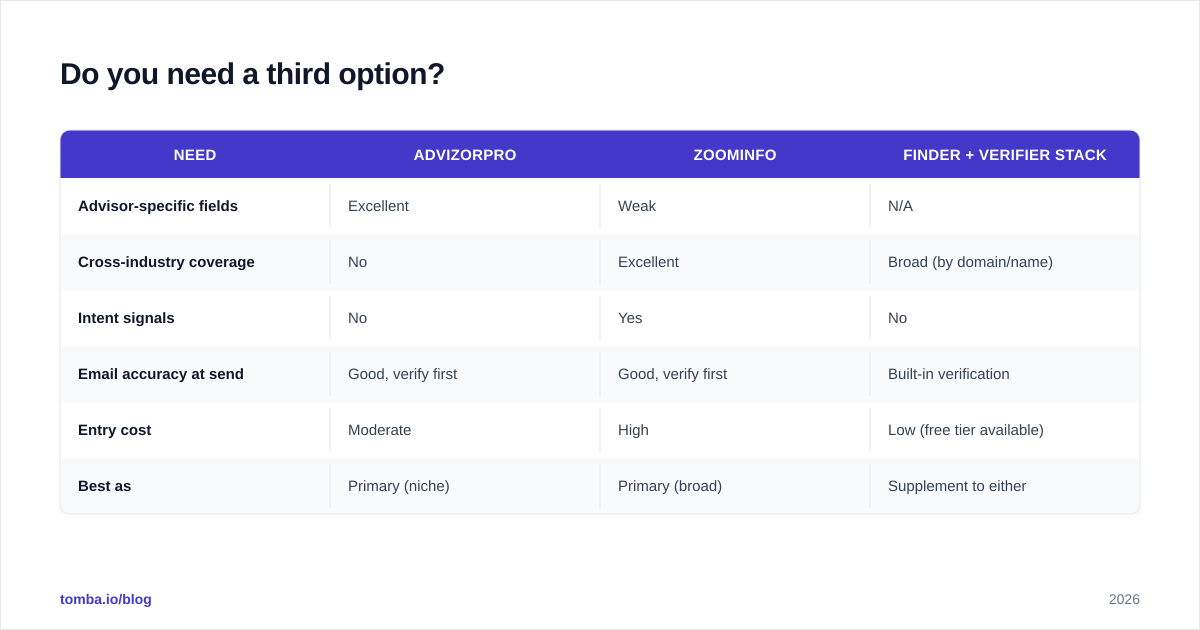
Here's how the three approaches compare on the dimensions that usually decide a purchase:
| Need | AdvizorPro | ZoomInfo | Finder + Verifier stack |
|---|---|---|---|
| Advisor-specific fields | Excellent | Weak | N/A |
| Cross-industry coverage | No | Excellent | Broad (by domain/name) |
| Intent signals | No | Yes | No |
| Email accuracy at send | Good, verify first | Good, verify first | Built-in verification |
| Entry cost | Moderate | High | Low (free tier available) |
| Best as | Primary (niche) | Primary (broad) | Supplement to either |
What about deliverability and data hygiene?#
A database only matters if the emails actually land. This is the silent killer of B2B campaigns: teams buy expensive data, skip verification, blast a sequence, and watch their domain reputation crater after a wave of bounces.
Regardless of whether you choose AdvizorPro, ZoomInfo, or a hybrid stack, build these guardrails:
- Verify before every send. Job changes mean even fresh data decays weekly. Catch-all domains need special handling — use a catch-all verifier rather than guessing.
- Warm up new sending domains and keep volume gradual.
- Monitor bounce rate and pause sequences that exceed ~2–3%.
- Authenticate your domain (SPF, DKIM, DMARC) so mailbox providers trust you.
ZoomInfo and AdvizorPro both sell data, not deliverability. The accuracy of the address at the moment you hit send is your responsibility — and it's the variable with the biggest impact on reply rates.
The bottom line: which one wins?#
There's no universal winner — there's a winner for your motion.
- Sell to financial advisors? AdvizorPro wins. Its specialized fields and regulatory-grounded accuracy are worth more than ZoomInfo's breadth, and you'll pay less.
- Sell across industries and want intent + org charts? ZoomInfo wins, provided you can fund it and staff it to extract value.
- Mostly need reliable contact data without the enterprise price tag? A dedicated finder-and-verifier stack beats both as a standalone or supplement.
Match the tool to the shape of your market, not the size of the vendor.
Find and verify the emails your database misses#
Whichever platform you land on, you'll still hit records with missing or stale emails — that's a guarantee with any B2B dataset. The Tomba Email Finder finds professional email addresses by name, company, or domain, and pairs natively with built-in email verification so addresses are validated before they ever enter a sequence. Start on the free tier (25 searches/month), then scale to the Starter plan at $49/mo as your pipeline grows — see full Tomba pricing for details. It's the low-cost layer that makes every other data investment actually convert.
// get started
Find, verify and enrich your first contacts today
Start on the free plan with 25 searches a month, then scale when your team is ready.
Free plan · No credit card required · GDPR & CCPA
// about the author