Aerosend Pricing, Reviews, Pros and Cons: A 2026 Buyer's Guide
A neutral, hands-on look at Aerosend pricing, reviews, pros and cons in 2026 — real plan tiers, accuracy expectations, alternatives, and who it actually fits.
TL;DR
- Aerosend is an email verification tool built to scrub bounce-prone addresses out of your list before you hit send — it competes with ZeroBounce, Bouncer, and the verifier side of platforms like Tomba.
- Pricing is credit-based and pay-as-you-go friendly, which suits teams that verify in bursts rather than continuously; heavier senders should model cost per 10k closely.
- The strongest reviews praise speed, a clean API, and catch-all handling; the most common complaints are around credit expiry, support response times, and edge-case accuracy on small or obscure domains.
- It is a verifier first, not a finder. If you need to discover emails (not just validate them), you'll pair it with a finder like Tomba or buy a broader platform.
- Best fit: lean growth, RevOps, and agency teams that already have lists and want a fast, scriptable way to clean them.
If you're weighing Aerosend pricing, reviews, pros and cons before committing budget for 2026, this guide gives you the neutral version — what it does well, where it frustrates people, and the realistic alternatives.
What is Aerosend and what problem does it solve?#
Aerosend is an email verification service. You feed it a list of addresses (or call it per-address through an API), and it tells you which ones are safe to mail, which are risky, and which will bounce. Think of it as a bouncer at the door of your sending domain: it checks IDs so the people who can't get in never reach your mailbox provider and damage your reputation.
That matters because bounces are not a cosmetic problem. Gmail, Outlook, and Yahoo watch your bounce and complaint rates closely, and a list full of dead addresses quietly drags down inbox placement for everyone you mail — including the good contacts. Cleaning a list before a campaign is one of the highest-leverage things you can do for email deliverability, and a dedicated verifier is the tool for that job.
Where Aerosend fits in the stack:
- Upstream: a finder or data source produces raw addresses (from forms, scraping, a CRM export, or an email finder).
- Aerosend's job: validate those addresses — syntax, domain/MX records, SMTP response, catch-all detection, role and disposable flags.
- Downstream: your ESP or sequencing tool sends only to the clean segment.

The key thing to internalize early: Aerosend verifies, it does not find. If your problem is "I have a name and a company but no email," that's a different tool. If your problem is "I have 40,000 addresses and no idea which are alive," Aerosend is in the right category.
How does Aerosend pricing work in 2026?#
Aerosend uses a credit model: one credit roughly equals one verification, and you buy credits in packs or through a subscription. This is the standard shape for the verification market, and it makes per-use cost easy to reason about — but the details decide whether it's cheap or expensive for you.
A few pricing mechanics to confirm directly on the vendor's site before buying, because they move the real cost more than the headline number:
- Do credits expire? Pay-as-you-go credits that expire in 12 months behave very differently from subscription credits that reset monthly.
- Are unknowns/catch-alls charged? Some verifiers charge a credit even when they can't return a confident result. That changes your effective price.
- Volume breakpoints. Per-credit cost almost always drops at higher tiers; the list price at 5k is not the price at 500k.
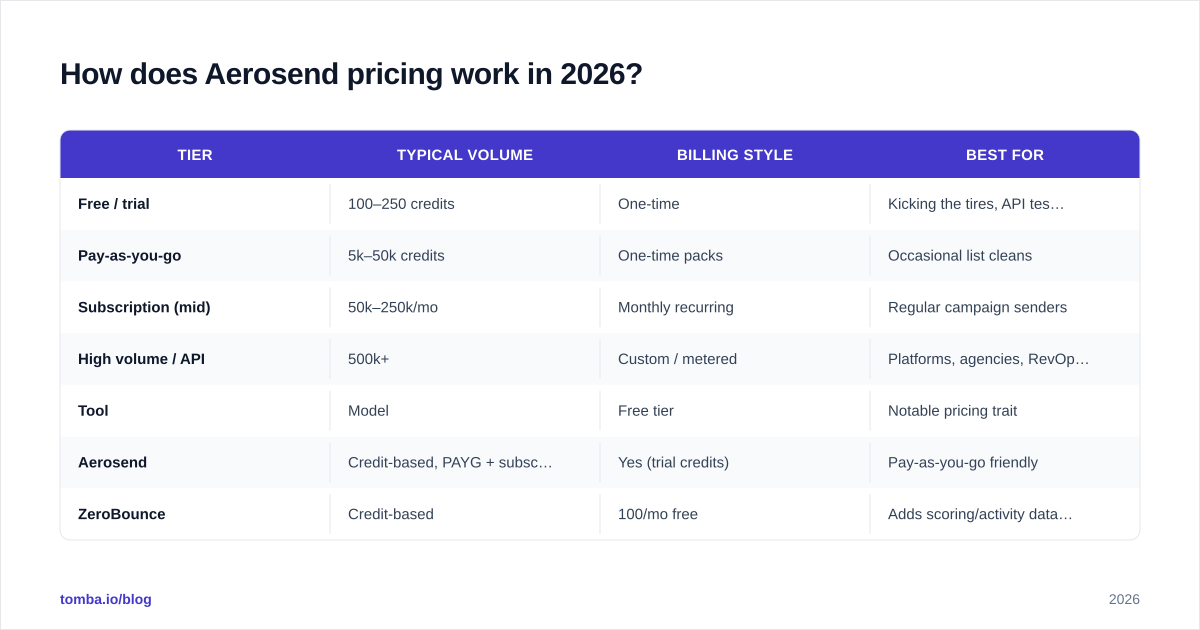
Here's a representative shape of how verification tools — including Aerosend — tend to tier. Treat the numbers as a model, not a quote, and verify current figures on the official site:
| Tier | Typical volume | Billing style | Best for |
|---|---|---|---|
| Free / trial | 100–250 credits | One-time | Kicking the tires, API testing |
| Pay-as-you-go | 5k–50k credits | One-time packs | Occasional list cleans |
| Subscription (mid) | 50k–250k/mo | Monthly recurring | Regular campaign senders |
| High volume / API | 500k+ | Custom / metered | Platforms, agencies, RevOps at scale |
How that compares to the broader market on style of pricing:
| Tool | Model | Free tier | Notable pricing trait |
|---|---|---|---|
| Aerosend | Credit-based, PAYG + subscription | Yes (trial credits) | Pay-as-you-go friendly |
ZeroBounce | Credit-based | 100/mo free | Adds scoring/activity data at higher cost | | Bouncer | Credit-based | Trial credits | Strong EU/GDPR positioning | | Tomba | Searches + verifications, tiered plans | 25 searches/mo free | Bundles finding + verifying in one plan |
The honest takeaway on cost: if you only verify, a focused verifier priced per credit is efficient. If you also need to find addresses, paying for a standalone verifier plus a separate finder often costs more than one tool that does both. Tomba's plans (Starter $49/mo, Growth $99/mo, Pro $249/mo) fold the email verifier in alongside the finder, which is the lever to model if you're buying two things today.

What do Aerosend reviews actually say?#
Reviews of any verifier cluster into a predictable set of themes once you read enough of them on sites like G2 and Capterra. Aerosend's feedback follows that pattern. Here's the balanced read.
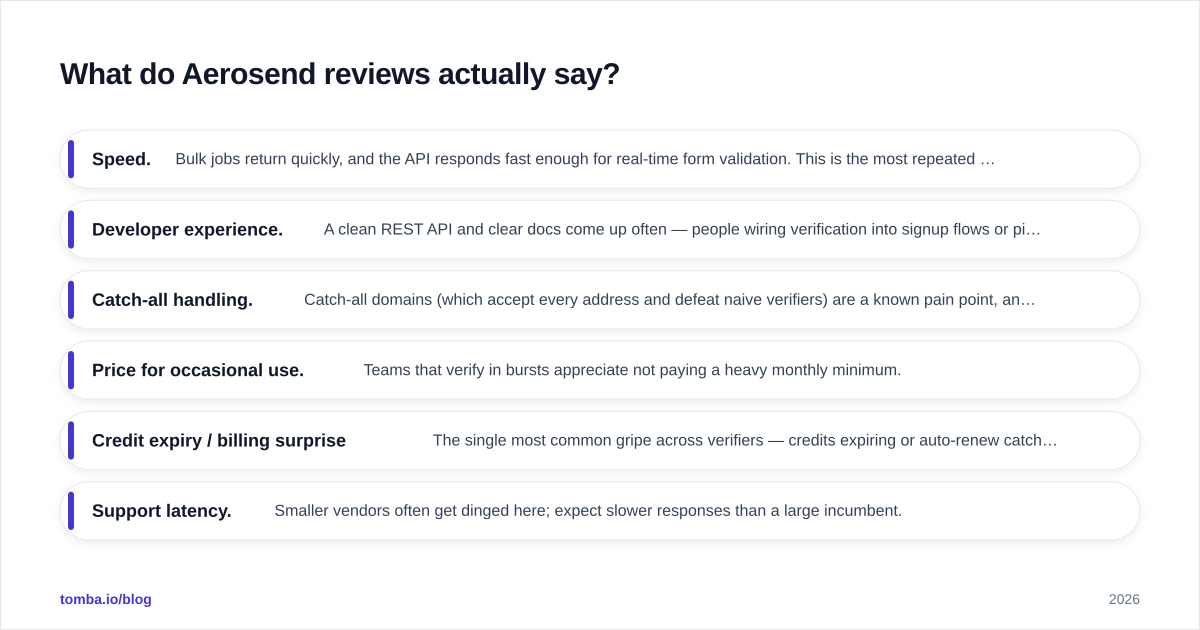
What reviewers consistently like:
- Speed. Bulk jobs return quickly, and the API responds fast enough for real-time form validation. This is the most repeated positive.
- Developer experience. A clean REST API and clear docs come up often — people wiring verification into signup flows or pipelines rate it well.
- Catch-all handling. Catch-all domains (which accept every address and defeat naive verifiers) are a known pain point, and Aerosend's handling is generally rated as competent.
- Price for occasional use. Teams that verify in bursts appreciate not paying a heavy monthly minimum.
What reviewers consistently complain about:
- Credit expiry / billing surprises. The single most common gripe across verifiers — credits expiring or auto-renew catching people off guard. Read the terms.
- Support latency. Smaller vendors often get dinged here; expect slower responses than a large incumbent.
- Edge-case accuracy. On small, obscure, or aggressively firewalled domains, every SMTP-based verifier returns more "unknowns." Reviewers who mail unusual TLDs notice this most.
A practical note on reading reviews: weight them by how similar the reviewer's use case is to yours. A solo founder verifying 2k newsletter signups and an agency verifying 2M cold-outreach addresses will rate the same tool differently. Accuracy claims, in particular, depend heavily on list quality going in — garbage lists make every verifier look worse.
What are the pros and cons of Aerosend?#
Here's the condensed scorecard.
| Dimension | Pros | Cons |
|---|---|---|
| Core function | Fast, focused verification | Verifier only — no finding |
| Pricing | PAYG-friendly, no big minimums | Credit expiry can bite |
| Developer fit | Clean API, good docs | Fewer native CRM integrations than incumbents |
| Accuracy | Solid catch-all handling | More unknowns on obscure domains |
| Support | Responsive for simple issues | Slower on complex tickets |
| Scale | Handles bulk well | Enterprise features thinner than |
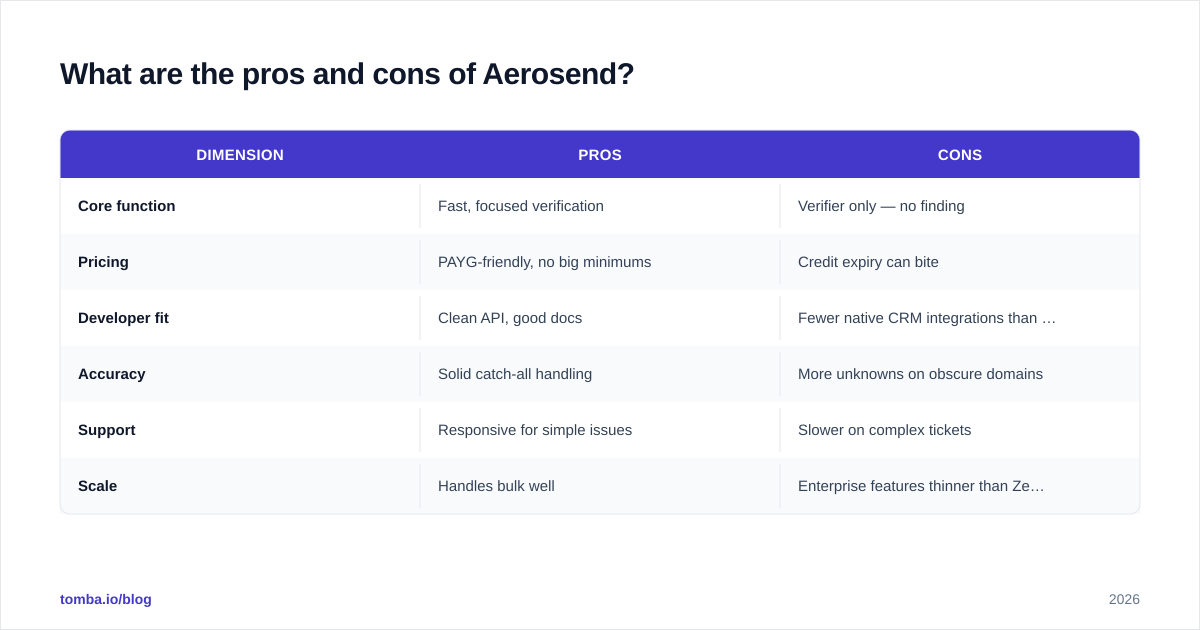
ZeroBounce |
Pros, expanded:
- It does one thing and does it fast. Focus is a feature. If verification is your only need, a specialist beats a bloated suite.
- Easy to start. Trial credits plus pay-as-you-go means you can prove value before committing budget.
- Scriptable. The API makes it realistic to verify at the point of capture — stopping bad addresses before they enter your CRM, not after.
Cons, expanded:
- You'll likely need a second tool. Without a finder, your top-of-funnel still depends on something else. That's not a flaw so much as a scope boundary — but it affects total cost.
- Read the billing fine print. This is where avoidable frustration lives.
- Unknowns are real. No SMTP verifier returns 100% certainty; budget for a small unknown bucket and decide your risk tolerance for mailing it.
How does Aerosend compare to Tomba and other alternatives?#
The right comparison depends on whether you need verification only or find + verify.
If you need verification only, Aerosend competes head-to-head with [
ZeroBounce](https://tomba.io/alternative/zerobounce), Bouncer, and similar specialists. The decision usually comes down to price-per-credit at your volume, GDPR posture, and whether you want extra data (activity scoring, append) bolted on.
If you need find + verify, the calculus changes. Buying a verifier and a finder separately means two contracts, two dashboards, and two bills. A platform that bundles both — like Tomba — often wins on total cost and workflow simplicity, because the domain search feeds straight into verification without an export/import dance. Tomba also covers catch-all verification, bulk jobs, and a documented email verification API, so the same use cases reviewers praise Aerosend for are covered, plus the finding step.

Decision framework:

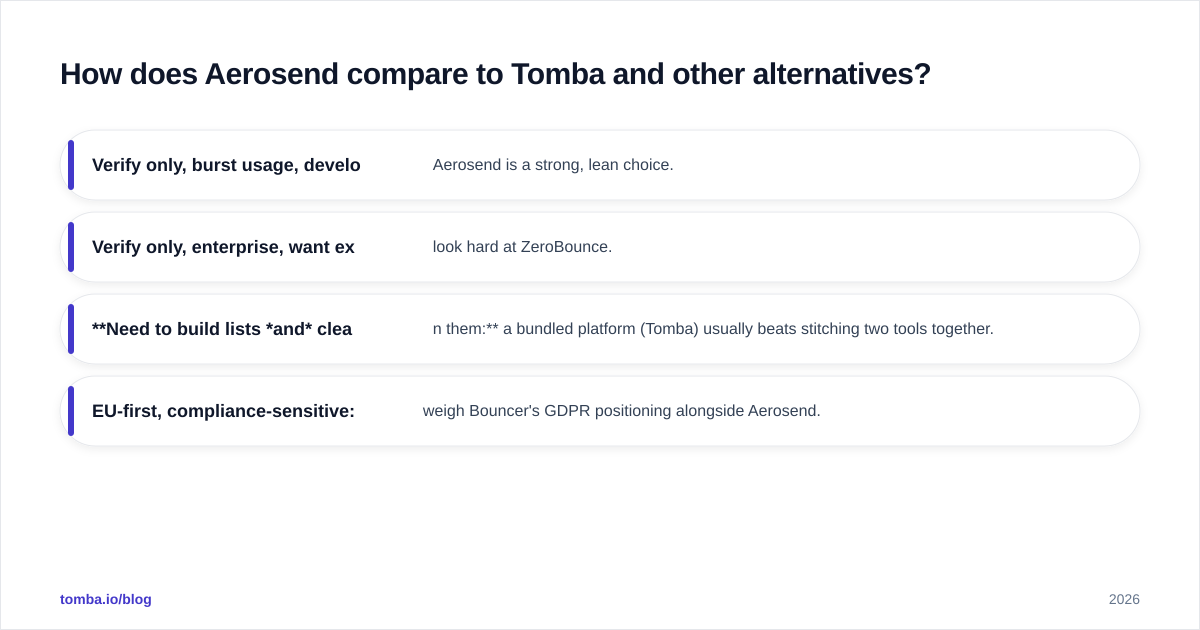
- Verify only, burst usage, developer-led: Aerosend is a strong, lean choice.
- Verify only, enterprise, want extra data layers: look hard at ZeroBounce.
- Need to build lists and clean them: a bundled platform (Tomba) usually beats stitching two tools together.
- EU-first, compliance-sensitive: weigh Bouncer's GDPR positioning alongside Aerosend.
Is Aerosend accurate enough for cold outreach?#
Short answer: for verification, yes — within the limits every SMTP-based tool shares. Aerosend will catch obvious dead addresses, syntax errors, disposables, and most role accounts reliably. Where accuracy gets fuzzy is the same place it gets fuzzy for all verifiers: catch-all domains and hosts that throttle or block verification probes.
For cold outreach specifically, the accuracy that matters is keeping your bounce rate under the ~2–3% danger zone that mailbox providers punish. A competent verifier — Aerosend included — gets you there if your input list isn't junk. The bigger accuracy risk in cold outreach is usually upstream: addresses guessed or scraped poorly in the first place. That's why pairing strong finding with strong verifying beats over-optimizing the verifier alone. If your finder returns clean, confidence-scored emails, your verifier has far less to reject.
One workflow tip: don't auto-discard every "unknown." For catch-all domains, treat unknowns as a separate, lower-priority segment rather than deleting them — many are valid, they just can't be confirmed via SMTP. Tools like a dedicated catch-all finder exist precisely to squeeze more certainty out of that bucket.
Who should buy Aerosend — and who shouldn't?#
Buy Aerosend if:
- You already generate lists and need a fast, affordable way to clean them.
- You're developer-led and want a clean API for real-time validation at signup.
- Your usage is bursty and you'd rather not pay a fat monthly minimum.
Look elsewhere if:
- You need to find emails, not just verify them — you'll want a finder or a bundled platform.
- You're enterprise and need deep CRM-native integrations, SSO, and rich contact data layers — incumbents are more built out.
- You want a single tool for finding, verifying, enriching, and exporting to your CRM — that's a platform decision, not a verifier decision.
The bottom line#
Aerosend is a legitimate, focused email verifier that earns its reviews on speed, a clean API, and fair pay-as-you-go pricing — with the usual asterisks around credit expiry, support depth, and the unknowns every SMTP verifier produces. If verification is genuinely all you need, it's a sensible 2026 pick. Just go in having modeled your cost-per-10k and read the billing terms.
But most teams don't have a verification problem in isolation — they have a pipeline problem: find the right contacts, confirm they're real, and get them into outreach without bouncing. If that's you, consolidating into one tool usually beats buying a finder and a verifier separately.
That's the gap Tomba fills. Start with the Tomba Email Finder to discover verified, confidence-scored professional emails by name, company, or domain — verification is built in, so the addresses you export are already clean. Spin up the free tier (25 searches a month, no card), run a real list through it, and compare the find-and-verify workflow against buying two tools to do the same job. For most lean growth and RevOps teams, that's the faster path to a list you can actually mail.
Get the Tomba newsletter
Practical outbound tactics and product updates — once every two weeks.
About the author