Affistash Pricing and Reviews: Pros and Cons (2026 Guide)
A neutral breakdown of Affistash pricing, real-world reviews, and the pros and cons of using it for affiliate and partner research in 2026.
TL;DR
- This guide to Affistash pricing and reviews covers what the tool does, what each plan gates, and where real users say it falls short. Affistash helps brands discover affiliates, spy on competitor programs, and build outreach lists — but it is not an affiliate network itself.
- Pricing is subscription-based with monthly and annual tiers. The value depends almost entirely on how many qualified affiliates you can actually recruit each month.
- Reviewers praise the competitor-discovery angle and the time it saves. They also flag thin contact data, occasional stale results, and a learning curve on filters.
- The biggest hidden cost is verification. Affiliate emails you export still need to be confirmed before you send, or your deliverability suffers.
- If your real bottleneck is reaching the partners you find, pair affiliate discovery with a dedicated email finder and verifier rather than relying on one tool to do everything.
What is Affistash and who is it for?#
Affistash is a research platform for affiliate program managers, agencies, and growth teams who need to find and recruit affiliates at scale. Think of it as a metal detector for the affiliate world. Instead of scrolling through blogs, coupon sites, and review pages by hand, you run one search. The tool then surfaces sites that already promote products like yours.
The core promise is competitor intelligence. You feed it a competitor's domain or a niche. It returns a list of affiliates, publishers, and content sites tied to that space. Each result often comes with traffic estimates, category tags, and contact hints. From there you build an outreach list and pitch those affiliates to join your own program.
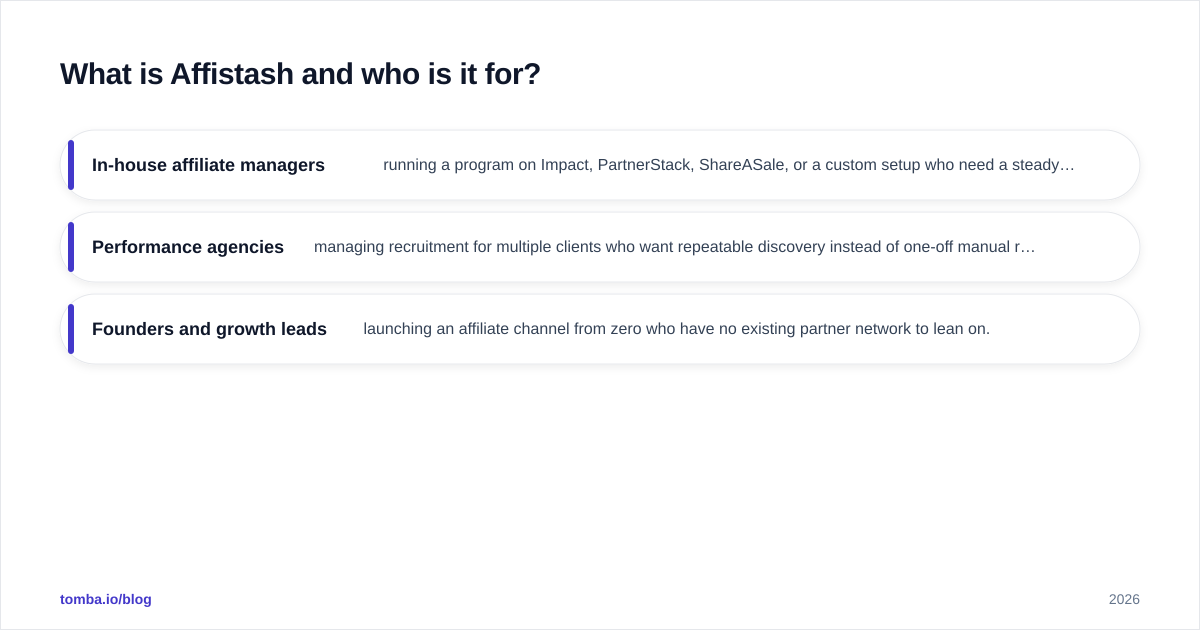
That makes Affistash most useful for three groups:
- In-house affiliate managers running a program on Impact, PartnerStack, ShareASale, or a custom setup who need a steady pipeline of new partners.
- Performance agencies managing recruitment for multiple clients who want repeatable discovery instead of one-off manual research.
- Founders and growth leads launching an affiliate channel from zero who have no existing partner network to lean on.
If you only need two or three affiliates total, you do not need a tool like this — manual research is fine. Affistash earns its keep when recruitment is a recurring, volume game.
Affistash pricing and reviews: how do the plans work in 2026?#
Affistash uses a tiered subscription model, like most B2B research tools. The exact dollar figures shift over time and with promotions. So treat the numbers below as a structural guide. Confirm the live figure on the vendor's own pricing page before you buy. What matters more than the headline price is the shape of the plans and what gets gated.
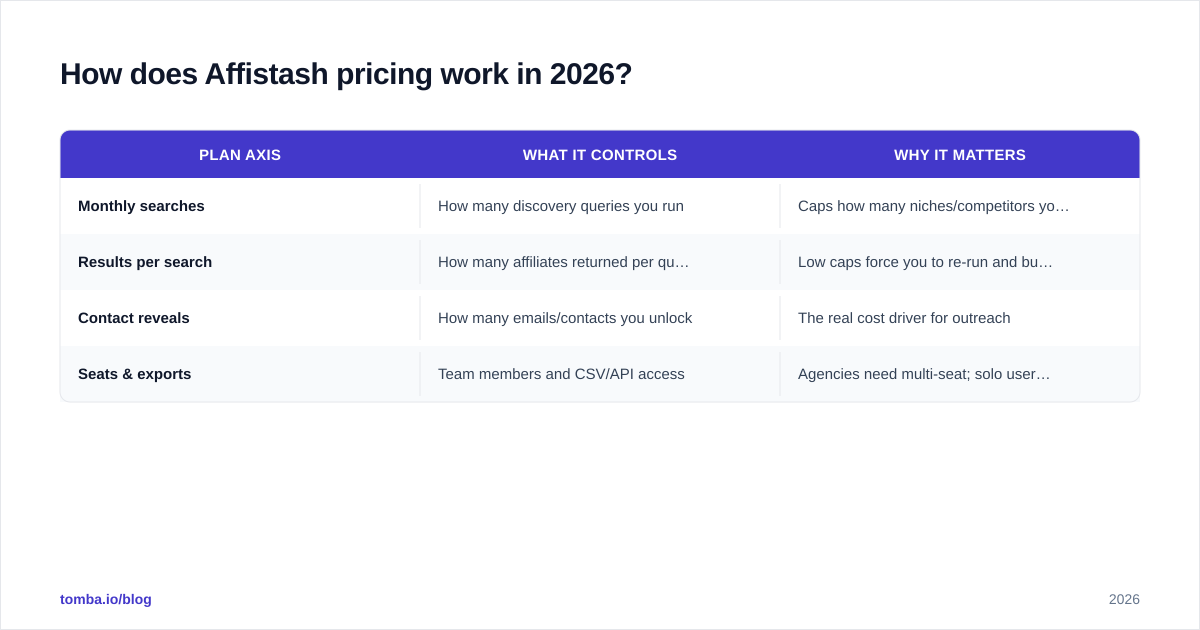
Pricing tiers in this category almost always vary along four axes:
| Plan axis | What it controls | Why it matters |
|---|---|---|
| Monthly searches | How many discovery queries you run | Caps how many niches/competitors you can mine |
| Results per search | How many affiliates returned per query | Low caps force you to re-run and burn quota |
| Contact reveals | How many emails/contacts you unlock | The real cost driver for outreach |
| Seats & exports | Team members and CSV/API access | Agencies need multi-seat; solo users do not |
The practical takeaway is simple. A plan that looks cheap on monthly searches can become expensive if contact reveals are tightly metered. Most teams underestimate how many reveals they burn. Not every discovered affiliate is worth contacting, so you pay to look, then discard half.
Now compare Affistash against its own annual option. The annual discount is usually meaningful — commonly two to three months free versus paying monthly. But only commit annually after you have checked that the data quality fits your niche. Run a single paid month first, export real lists, and measure how many contacts are usable.
A quick budgeting analogy: buying an affiliate-research subscription is like renting a fishing boat. The rental fee is fixed. Your catch depends on whether there are actually fish in the water you are allowed to sail. Test the water before you sign a season-long lease.
What do Affistash reviews say — the pros?#
Pulling together public reviews on sites like G2 and Capterra, plus community threads, a few consistent strengths show up.
1. Competitor-driven discovery saves real hours. The single most-praised feature is reverse-engineering a competitor's affiliate footprint. Reviewers describe going from "I have no idea who promotes products like mine" to a working shortlist in an afternoon. For a channel that lives or dies on partner volume, that saved research time is the headline benefit.
2. Niche coverage beyond the obvious. Several reviewers note that the tool surfaces smaller niche publishers — not just the big coupon and deal aggregators everyone already knows. Long-tail affiliates often convert better because their audiences are more targeted, so finding them is genuinely valuable.
3. Decent starting point for outreach lists. Even when the contact data is incomplete, reviewers say the discovered domains give them a strong base to enrich and verify elsewhere. As a list-building seed, it does the job.
4. Lower friction than enterprise platforms. Compared with heavyweight partnership suites, Affistash is positioned as approachable. Smaller teams appreciate not needing onboarding calls or annual enterprise contracts just to start.
These strengths cluster around one theme: discovery. As a way to answer "who could promote us?", the reviews skew positive.
What are the cons and complaints?#
No tool is all upside, and honest reviews flag recurring frustrations. If you are evaluating Affistash, weigh these seriously.
1. Contact data is often thin or missing. This is the most common complaint. Discovery finds the site. It does not always find a reliable, current email for the right person. Many reviewers end up exporting domains and then using a separate email finder and email verifier to reach a human. Budget for that extra step rather than assuming the contact column is ready to send.
2. Some results are stale. Affiliate sites churn. A publisher that promoted your competitor 18 months ago may be dormant now. A subset of reviewers report dead domains or partners who have moved on, which means manual qualification is still required.
3. Filter learning curve. Clean, relevant results depend on knowing how to phrase searches and stack filters. New users report noisy first results before they learn the tool's logic. The output quality is real, but it is not zero-effort.
4. Quota anxiety. Because reveals and searches are metered, some users ration their usage. They hesitate to run an exploratory search because it eats quota. That friction can undercut the "research freely" promise.
5. It is one layer, not a full stack. Affistash discovers. It does not warm up your outreach, verify deliverability, or manage the relationship afterward. Teams expecting an end-to-end recruitment-to-payout solution will be disappointed — that is not what it is.

How does Affistash compare to alternatives?#
Affistash sits in a crowded space. Depending on your real bottleneck — discovery, contact data, or outreach — a different tool may fit better. Here is a structural comparison of the categories you will weigh.
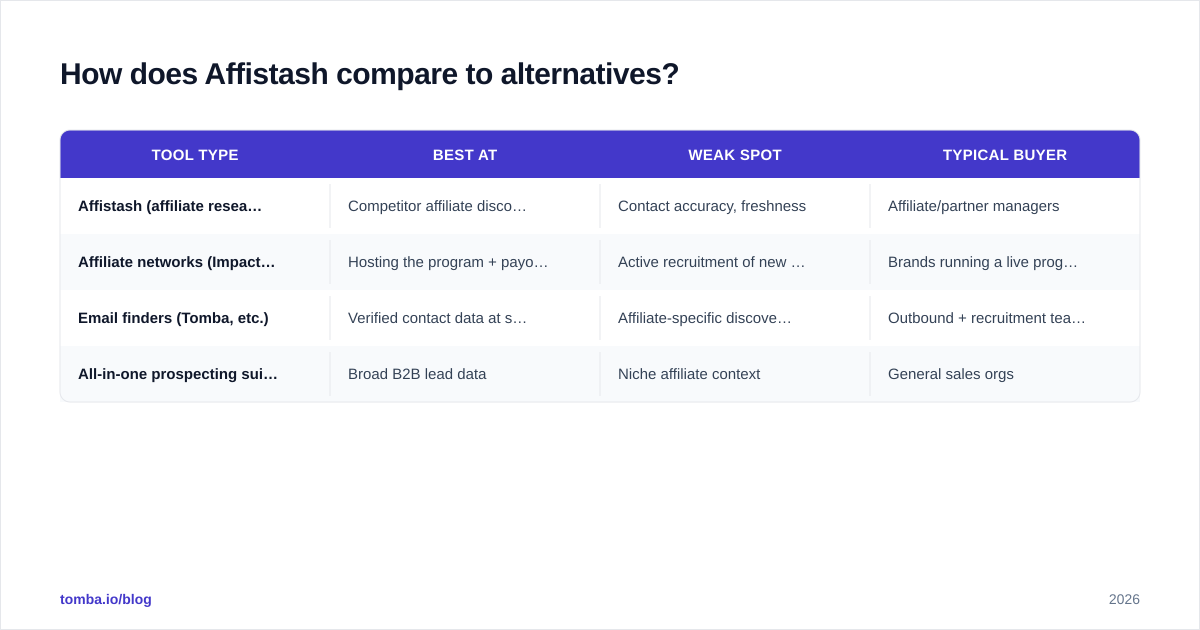
| Tool type | Best at | Weak spot | Typical buyer |
|---|---|---|---|
| Affistash (affiliate research) | Competitor affiliate discovery | Contact accuracy, freshness | Affiliate/partner managers |
| Affiliate networks (Impact, ShareASale) | Hosting the program + payouts | Active recruitment of new partners | Brands running a live program |
| Email finders (Tomba, etc.) | Verified contact data at scale | Affiliate-specific discovery | Outbound + recruitment teams |
| All-in-one prospecting suites | Broad B2B lead data | Niche affiliate context | General sales orgs |
The key insight: these tools are complements more often than substitutes. Affistash tells you which sites to recruit. A network handles tracking and payment. An email-finding layer handles how you actually reach the decision-maker. Buying one and expecting it to cover all three jobs is where teams waste money.
If your discovery is already solid but your outreach bounces, the fix is not another research tool — it is better contact data. If you are also weighing broader prospecting platforms, our roundups of an Apollo alternative and a RocketReach alternative walk through where general B2B data tools overlap with affiliate recruitment.
Is Affistash worth the price?#
Most honest takes on Affistash pricing and reviews land on one number: your cost per recruited affiliate. The subscription is only "worth it" if the partners you sign generate more revenue than the tool plus your time to find them.
Run this simple math before subscribing:
- Estimate how many qualified affiliates you can realistically contact per month with the plan's reveal limit.
- Apply a conservative response rate. Affiliate outreach often lands in the 5–15% reply range for cold pitches, and lower if your emails are unverified.
- Apply a conservative recruit-to-active rate. Many recruited affiliates never drive a single sale.
- Multiply active affiliates by your average affiliate-driven revenue.
If that revenue comfortably exceeds the subscription, Affistash pays for itself. If the numbers are tight, the gap is usually your outreach quality, not the discovery. That is exactly why verification matters so much. Sending to unverified affiliate emails tanks your response rate and your sender reputation at the same time, which double-penalizes every campaign.
A fair verdict from the reviews: Affistash is a strong discovery tool with an honest weakness in contact data and freshness. Treat it as the first layer in a stack — discover here, enrich and verify elsewhere, then run disciplined outreach — and it delivers. Expect a magic "press button, get affiliates" machine and it will underwhelm, as would any single tool in this space.
How do you get the most out of Affistash?#
If you do buy, a few practices separate teams who renew from teams who churn:
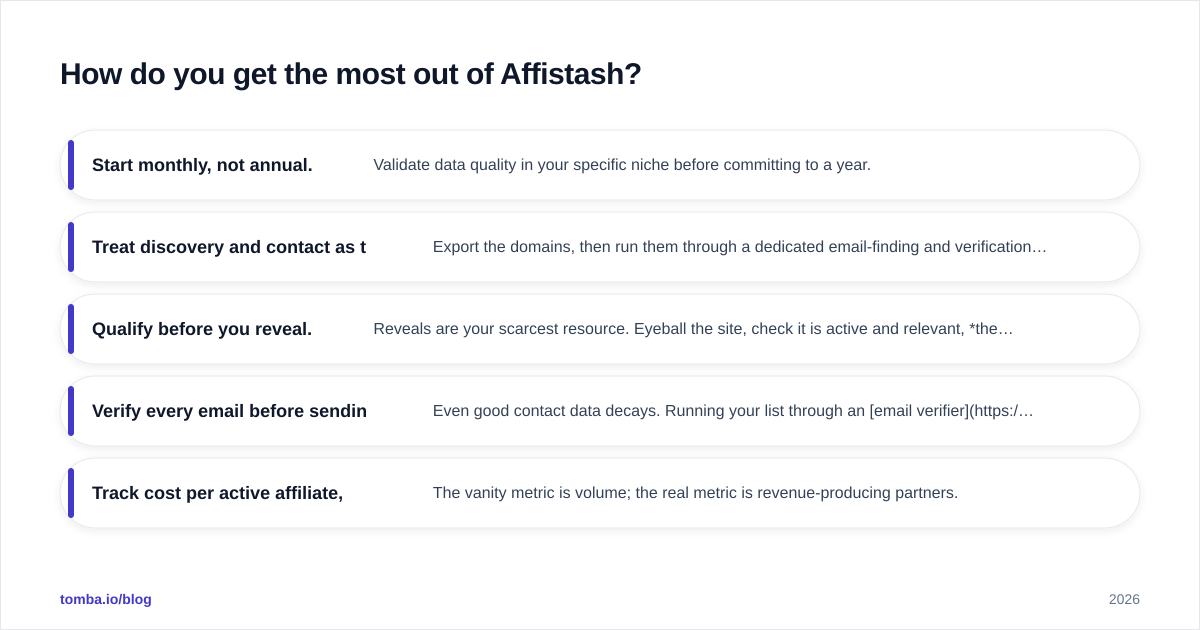
- Start monthly, not annual. Validate data quality in your specific niche before committing to a year.
- Treat discovery and contact as two jobs. Export the domains, then run them through a dedicated email-finding and verification step so you are not pitching to dead inboxes. A bulk email finder turns a raw domain list into reachable contacts quickly.
- Qualify before you reveal. Reveals are your scarcest resource. Eyeball the site, check it is active and relevant, then spend the reveal.
- Verify every email before sending. Even good contact data decays. Running your list through an email verifier protects deliverability and keeps your bounce rate low.
- Track cost per active affiliate, not cost per email sent. The vanity metric is volume. The real metric is revenue-producing partners.
Done this way, Affistash becomes the front end of a clean pipeline rather than a standalone gamble.
Frequently asked questions#
Is Affistash an affiliate network? No. It is a research and discovery tool. You still run your program on a network or in-house platform; Affistash helps you find partners to invite.
Does Affistash give you verified emails? Not reliably. Reviews consistently note that contact data is the weak spot, so plan to enrich and verify discovered contacts with a dedicated tool before outreach.
Is there a free plan? Offerings change frequently. Check the live pricing page. If a trial or limited free tier exists, use it to test data quality in your niche before paying.
Who competes with Affistash? Other affiliate-research tools, broad B2B prospecting suites, and — for the contact-data half of the job — email finders. They often work best together rather than as either/or choices.
The bottom line#
Weighing the Affistash pricing and reviews together, the picture is clear. It is a capable affiliate-discovery tool with one real strength (competitor-driven research) and clear limits (contact accuracy and freshness). Its pricing is reasonable if you treat discovery as one layer and build verification and outreach around it. Judge it by cost per active affiliate, test before you commit annually, and never send to an unverified address.
Once Affistash hands you a list of promising affiliate domains, the next bottleneck is reaching a real person at each one. That is exactly what the Tomba Email Finder is built for: turn a domain or a name into a verified, deliverable email so your recruitment pitches actually land. Pair it with the built-in email verifier to keep bounce rates low and your sender reputation intact. Start on the free tier (25 searches/month), and review the full Tomba pricing — Starter is $49/mo — when you are ready to scale recruitment outreach.
Ready to find emails that actually work?
Join 150,000+ professionals who stopped guessing and started sending. Free credits on signup — no credit card required.
Get the Tomba newsletter
Practical outbound tactics and product updates — once every two weeks.
About the author