Affistash vs Cufinder 2026: B2B Data Tools Compared
Affistash and Cufinder both promise B2B contact data, but they solve different problems. Here's an honest 2026 breakdown of accuracy, pricing, and fit.
TL;DR
- Affistash leans toward affiliate and partner discovery plus broad company lists; Cufinder is a general-purpose B2B data and enrichment engine with a large API surface. They overlap, but they are not the same buy.
- For email finding accuracy and verification, Cufinder is the stronger of the two; Affistash is better when your job is sourcing partners and affiliates, not cold prospecting.
- Pricing differs in structure: Affistash sells niche lead/affiliate packages, Cufinder sells credit-based enrichment tiers. Neither publishes a single clean number that fits every team.
- If your real need is high-accuracy email finding and verification at a predictable price, a focused tool like Tomba Email Finder often beats either generalist.
- Read the comparison table below before you commit — the right pick depends entirely on whether you are doing partner recruitment or outbound prospecting.
What are Affistash and Cufinder?#
Short answer: they sit in the same neighborhood — B2B data — but on different streets.
Affistash positions itself around affiliate and partnership discovery. Think of it as a scout that helps you find companies, affiliates, and potential partners in a niche, then hands you contact angles to reach them. If you run an affiliate program or a partnerships motion, that framing matters: you are not just buying emails, you are buying who to talk to in a specific ecosystem.
Cufinder is closer to a Swiss-army knife for B2B data. It does company search, contact enrichment, email and phone lookup, and pushes most of that through an API and bulk tools. Teams use it to enrich CRM records, append missing fields, and find decision-maker contact details at scale.
Here is the everyday analogy: Affistash is like a matchmaker who specializes in introducing you to the right business partners. Cufinder is like a bulk directory service that fills in the blanks on contacts you already half-know. Both give you data; the intent behind the data is different.
That distinction drives everything else in this comparison — pricing, accuracy expectations, and which one belongs in your stack.
How do Affistash and Cufinder compare at a glance?#
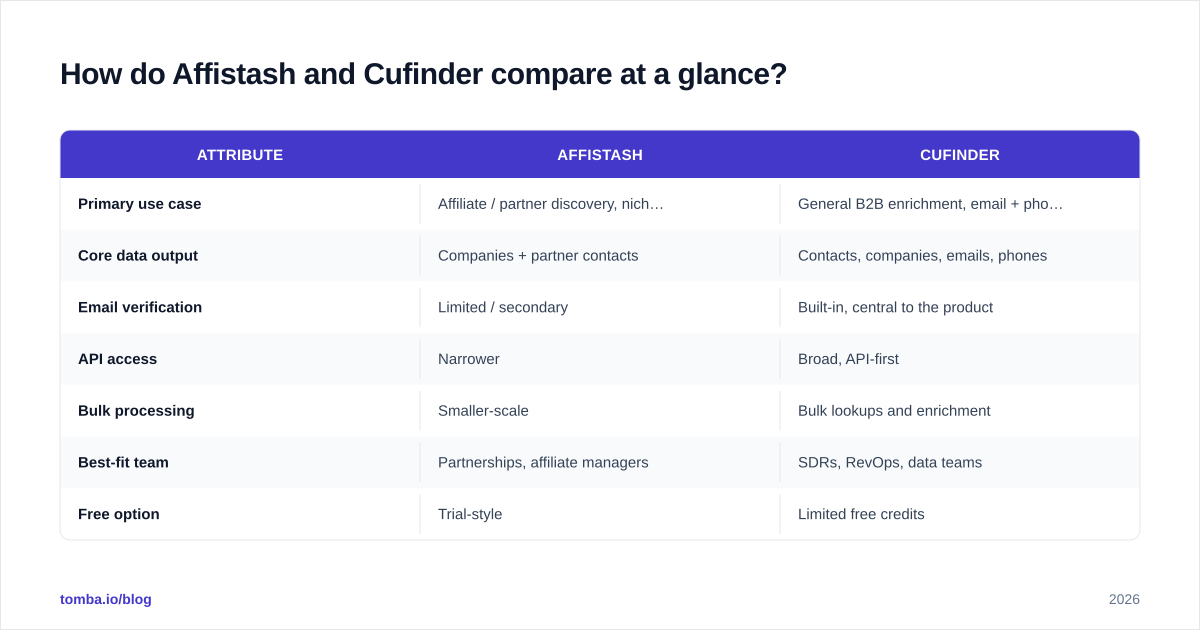
Before the deep dive, here is the side-by-side. Treat published vendor numbers as starting points — both platforms negotiate and repackage, and credit definitions vary.
| Attribute | Affistash | Cufinder |
|---|---|---|
| Primary use case | Affiliate / partner discovery, niche company lists | General B2B enrichment, email + phone lookup |
| Core data output | Companies + partner contacts | Contacts, companies, emails, phones |
| Email verification | Limited / secondary | Built-in, central to the product |
| API access | Narrower | Broad, API-first |
| Bulk processing | Smaller-scale | Bulk lookups and enrichment |
| Best-fit team | Partnerships, affiliate managers | SDRs, RevOps, data teams |
| Free option | Trial-style | Limited free credits |
| Pricing model | Package / niche-based | Credit-based tiers |
The pattern is clear: if your workflow is "find partners in a niche," Affistash speaks your language. If it is "enrich and contact a list of target accounts," Cufinder is built for that shape of work.
Which tool has better email accuracy?#
Conclusion first: Cufinder wins on email accuracy and verification, because verification is a first-class feature rather than an afterthought.
Affistash can surface contact angles for partners, but it is not engineered as a high-throughput, verify-every-address email engine. When your outreach volume is low and relationship-driven — say, ten carefully chosen affiliate partners — that is fine. You are sending personalized notes, not blasting a 5,000-line list.
Cufinder treats email lookup and validation as core. That means it tries harder to catch the things that wreck sender reputation: role addresses, dead mailboxes, and the dreaded catch-all domain that accepts everything and confirms nothing.
But "better than Affistash" is not the same as "best available." Email-finder accuracy is its own discipline, and dedicated finders typically benchmark higher than generalist enrichment platforms because that is the only thing they optimize. If accuracy is your top priority, compare both against a specialist using independent numbers rather than vendor self-reports.

A practical rule: whatever tool sources your emails, run them through a dedicated email verifier before you send. Sourcing and verification are two jobs. Tools that bundle both are convenient; tools that specialize in each are usually more accurate. And if you deal with catch-all domains often, a purpose-built catch-all verifier will save you from guessing.
How does pricing compare for Affistash vs Cufinder?#
Conclusion first: neither is expensive in absolute terms, but they price differently, so a flat "X is cheaper" claim is misleading.
Affistash tends to package around niche lead and affiliate discovery — you are paying for curated access to a specific kind of list and partner intelligence. Cufinder uses credit-based tiers, where each lookup or enrichment consumes credits, and heavier API use pushes you up the ladder.
The trap with credit-based pricing is effective cost per usable record. If a tool is cheap per credit but 30% of results are unverified or wrong, your real cost per usable contact is much higher than the sticker. Always divide price by verified, usable records, not raw lookups.
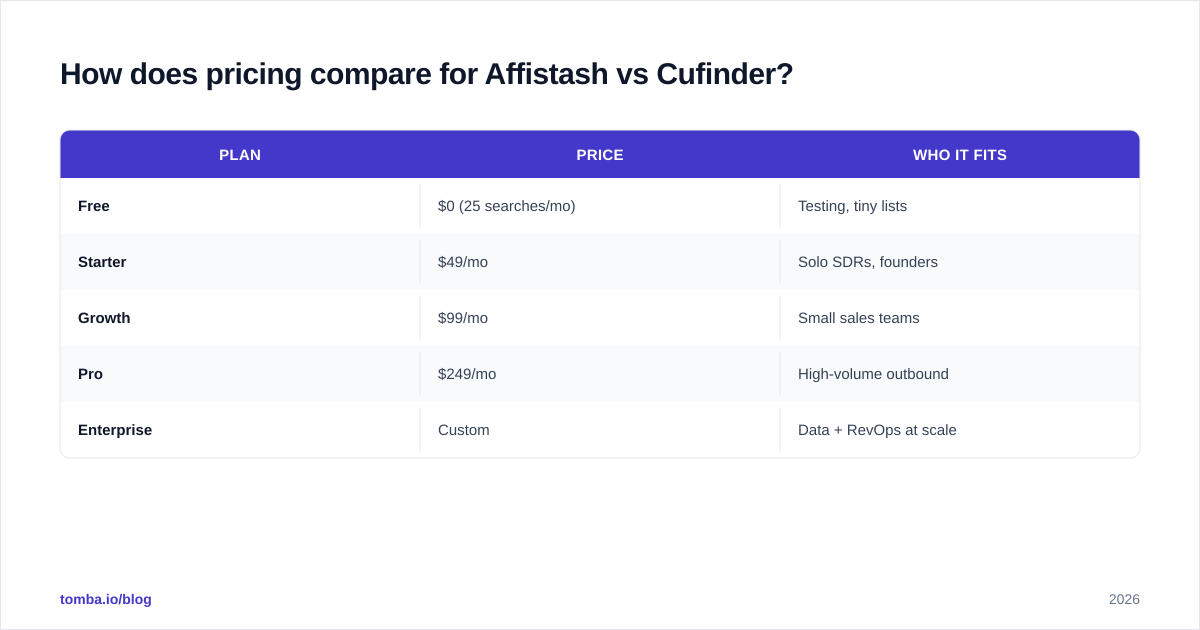
For reference, here is how a focused email-finder tier structure looks, using transparent published Tomba pricing:
| Plan | Price | Who it fits |
|---|---|---|
| Free | $0 (25 searches/mo) | Testing, tiny lists |
| Starter | $49/mo | Solo SDRs, founders |
| Growth | $99/mo | Small sales teams |
| Pro | $249/mo | High-volume outbound |
| Enterprise | Custom | Data + RevOps at scale |
The point is not that one number beats another — it is that you should compare like for like. Map Affistash's package to the actual number of partner contacts you'll use, and map Cufinder's credits to verified records you'll actually email. Then compare both against a specialist's per-record cost.
When should you pick Affistash?#
Pick Affistash when your motion is partnerships and affiliates, not cold outbound.
Concretely, choose it if:
- You run or are launching an affiliate program and need to discover relevant publishers, creators, or partner companies in a niche.
- Your outreach is low-volume and relationship-led — dozens of carefully chosen targets, not thousands.
- You value partner discovery and ecosystem mapping more than raw email verification throughput.
- You are in a business-development seat where the hard part is finding the right company to partner with, and contact details are secondary.
In that world, Affistash's niche focus is a feature. A general enrichment tool would hand you a firehose of contacts without the partner-fit intelligence you actually need. If you've ever tried to build an affiliate pipeline out of a generic contact database, you know the discovery step is the bottleneck — and that's exactly where Affistash earns its keep.
What Affistash is not great for: high-volume SDR prospecting where you need thousands of verified emails per month with predictable accuracy. That is Cufinder's lane — or, more pointedly, a dedicated email finder's lane.
When should you pick Cufinder?#
Pick Cufinder when your motion is enrichment and outbound at scale.
Choose it if:
- You need to enrich CRM records — appending firmographics, emails, and phones to accounts you already track.
- Your team is SDR- or RevOps-heavy and runs structured outbound against target-account lists.
- You want an API-first workflow to wire data into your own systems, sequences, or sales automation stack.
- You process contacts in bulk and need verification baked in rather than bolted on.
Cufinder's breadth is the selling point here. It tries to be the single endpoint for "given a company or a name, give me the contact data." For teams that live in a CRM and need fields filled reliably, that consolidation is valuable. Pair it with solid data enrichment hygiene and you have a workable pipeline.
The honest caveat: breadth has a cost. Generalist tools spread engineering effort across many data types, so any single dimension — email accuracy, phone validity, firmographic freshness — may trail a specialist that does only that one thing. That trade-off is fine if you value consolidation over peak accuracy. It is not fine if a 10% bad-email rate quietly torches your domain reputation.

What's the catch-all and deliverability angle?#
This is the part most comparisons skip, and it is where money leaks.
Both Affistash and Cufinder will, at some point, hand you addresses on catch-all domains — domains configured to accept any address whether or not the mailbox exists. A naive tool marks these "valid" because the server didn't reject them. Then you send, the mailbox doesn't exist, you bounce, and your sender reputation takes the hit.
The defense is a dedicated catch-all handling step. A specialized catch-all finder and verifier uses deeper signals than a simple SMTP ping, so you send to addresses that are actually deliverable. Neither generalist platform makes this its headline feature, so if you do volume outbound, plan to add a verification layer regardless of which one you choose. Deliverability is a discipline of its own — treat it that way.
A simple deliverability-safe workflow, tool-agnostic:
- Source contacts (Affistash, Cufinder, or a specialist finder).
- Verify every address, with explicit catch-all handling.
- Drop role addresses (info@, sales@) unless they're intentional targets.
- Warm up and segment before sending volume.
Skip step two and it does not matter how good your sourcing tool is — your reply rate will reflect your bounce rate.
Affistash vs Cufinder vs a dedicated email finder#
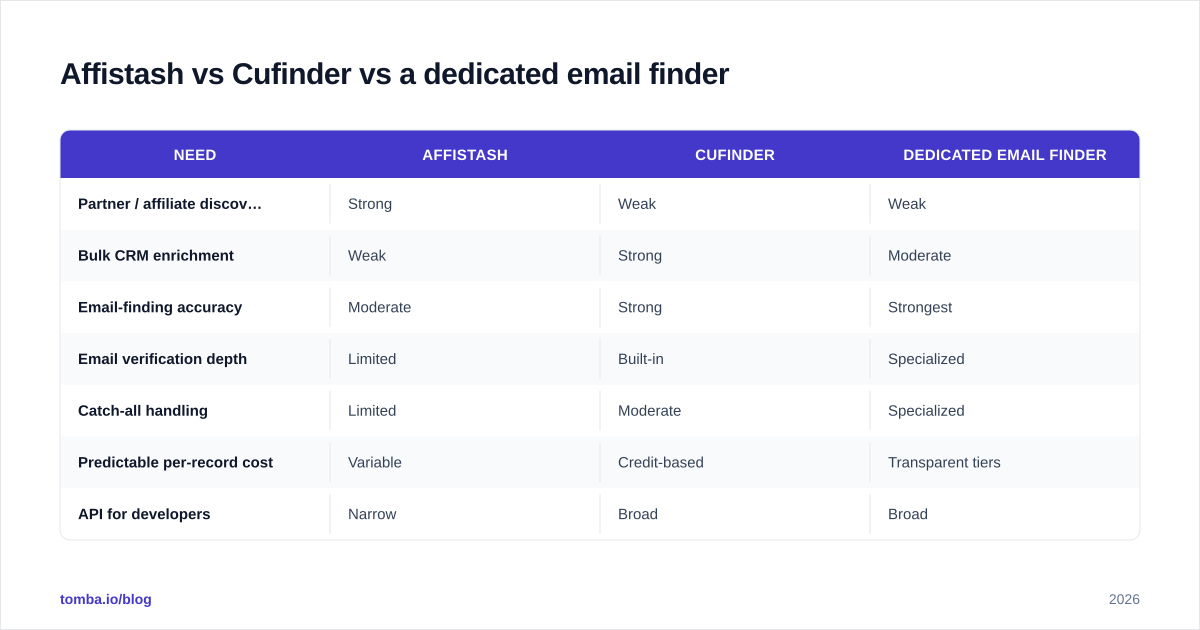
Here is the three-way honesty check, because most teams comparing these two are actually asking a bigger question: "What's the best way to get reliable B2B contact data?"
| Need | Affistash | Cufinder | Dedicated email finder |
|---|---|---|---|
| Partner / affiliate discovery | Strong | Weak | Weak |
| Bulk CRM enrichment | Weak | Strong | Moderate |
| Email-finding accuracy | Moderate | Strong | Strongest |
| Email verification depth | Limited | Built-in | Specialized |
| Catch-all handling | Limited | Moderate | Specialized |
| Predictable per-record cost | Variable | Credit-based | Transparent tiers |
| API for developers | Narrow | Broad | Broad |
If you only remember one thing: match the tool to the job, not the brand to the hype. Affiliate motion → Affistash. Broad enrichment → Cufinder. Maximum email accuracy and clean deliverability → a focused finder and verifier.
For the accuracy-and-verification job specifically, you can compare independent benchmarks rather than taking any vendor's word for it.

You don't have to pick just one, either. Plenty of teams run a discovery tool for partners and a separate finder-plus-verifier for outbound. The stacks are cheap enough that buying the right tool for each job beats forcing one platform to do both badly.
How do you decide in practice?#
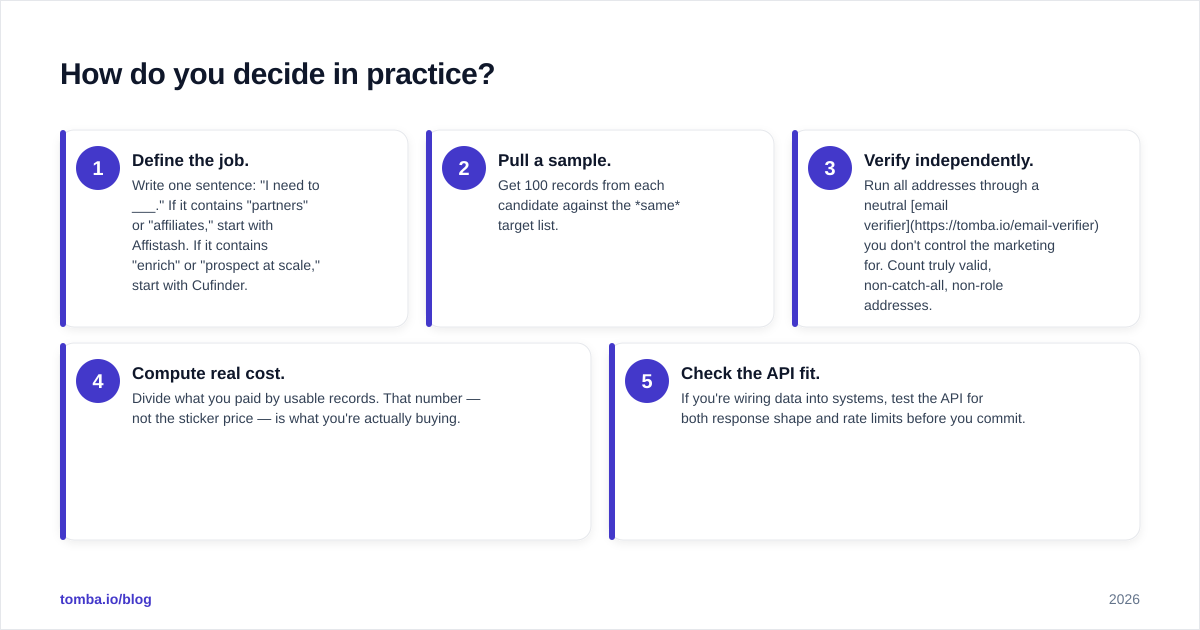
Run a one-week bake-off instead of trusting any marketing page — including this one.
- Define the job. Write one sentence: "I need to ___." If it contains "partners" or "affiliates," start with Affistash. If it contains "enrich" or "prospect at scale," start with Cufinder.
- Pull a sample. Get 100 records from each candidate against the same target list.
- Verify independently. Run all addresses through a neutral email verifier you don't control the marketing for. Count truly valid, non-catch-all, non-role addresses.
- Compute real cost. Divide what you paid by usable records. That number — not the sticker price — is what you're actually buying.
- Check the API fit. If you're wiring data into systems, test the API for both response shape and rate limits before you commit.
Teams that do this almost always discover the same thing: the cheapest per-lookup option is rarely the cheapest per-usable-contact, and accuracy gaps cost more than license fees once you factor in wasted sends and reputation damage.
For broader context on where each category fits, G2's data and enrichment category and vendor docs like HubSpot's data management resources are useful neutral references while you scope your stack.
The bottom line#
Affistash and Cufinder are not rivals so much as tools for different jobs. Affistash is your pick for affiliate and partner discovery in a niche. Cufinder is your pick for broad, API-driven B2B enrichment. Where they overlap — finding and verifying emails for outbound — both are serviceable, but neither makes accuracy its single obsession.
If accuracy and deliverability are what actually keep you up at night, put a specialist in your stack. Tomba's email finder is built for exactly that: find professional email addresses by domain, name, or company, with verification and catch-all handling designed to protect your sender reputation. Start free with 25 searches a month, then scale to a transparent $49/mo Starter plan when you're ready — and spend your budget on contacts that actually convert, not on guesses that bounce.
// get started
Find, verify and enrich your first contacts today
Start on the free plan with 25 searches a month, then scale when your team is ready.
Free plan · No credit card required · GDPR & CCPA
// about the author