Affistash vs Kipplo: Which B2B Lead Tool Wins in 2026?
Affistash vs Kipplo compared head-to-head: data accuracy, pricing, integrations, and which platform actually fits your outbound stack in 2026 — plus where a dedicated email-data layer beats both.
Choosing between Affistash and Kipplo usually comes down to one question that the marketing pages on either side won't answer directly: which one actually moves pipeline for your motion, and which one just looks good in a demo? This guide compares the two on the criteria that matter when money is on the line — data accuracy, workflow fit, pricing, and how cleanly each one plugs into the rest of your stack.
TL;DR — Affistash vs Kipplo in 30 seconds#
- Affistash leans toward breadth: large contact universe, lots of filters, and a UI built for high-volume list building. Good if your team lives in "build a 5,000-row list, then sequence it."
- Kipplo leans toward workflow: tighter native integrations, simpler onboarding, and features aimed at smaller GTM teams that want fewer moving parts.
- Neither is a deliverability tool. Both hand you contacts; what lands in the inbox still depends on verification and sender hygiene downstream.
- Pricing is close enough that data quality decides it. A cheaper plan that returns 30% bounces is the more expensive plan.
- If your real bottleneck is email accuracy rather than UI polish, a dedicated email finder plus a email verifier layer often beats paying either platform for data you'll re-verify anyway.
What are Affistash and Kipplo?#
Think of both tools as the front door to your outbound: you tell them who you want to reach, and they return contact records — names, roles, companies, and contact details — that you push into a sequencer or CRM.
Affistash positions itself as a volume-first prospecting and list-building platform. The pitch is reach: large datasets, granular filtering (industry, headcount, tech stack, geography), and bulk export so a single SDR can assemble big target lists quickly.
Kipplo takes the opposite posture. It's the "less is more" option — fewer screens, faster setup, and native connectors that aim to remove the CSV shuffle between finding a contact and contacting them. It tends to attract founders and small revenue teams who'd rather not administer a heavyweight platform.
Here's the part both will gloss over: the category they compete in — B2B contact data — is one where accuracy decays constantly. People change jobs, domains migrate, mailboxes get deactivated. Whichever you pick, you're buying a snapshot that starts aging the moment you export it. That single fact reshapes the whole comparison, which is why the framework below puts data freshness at the center rather than feature count.
How do Affistash and Kipplo compare feature by feature?#
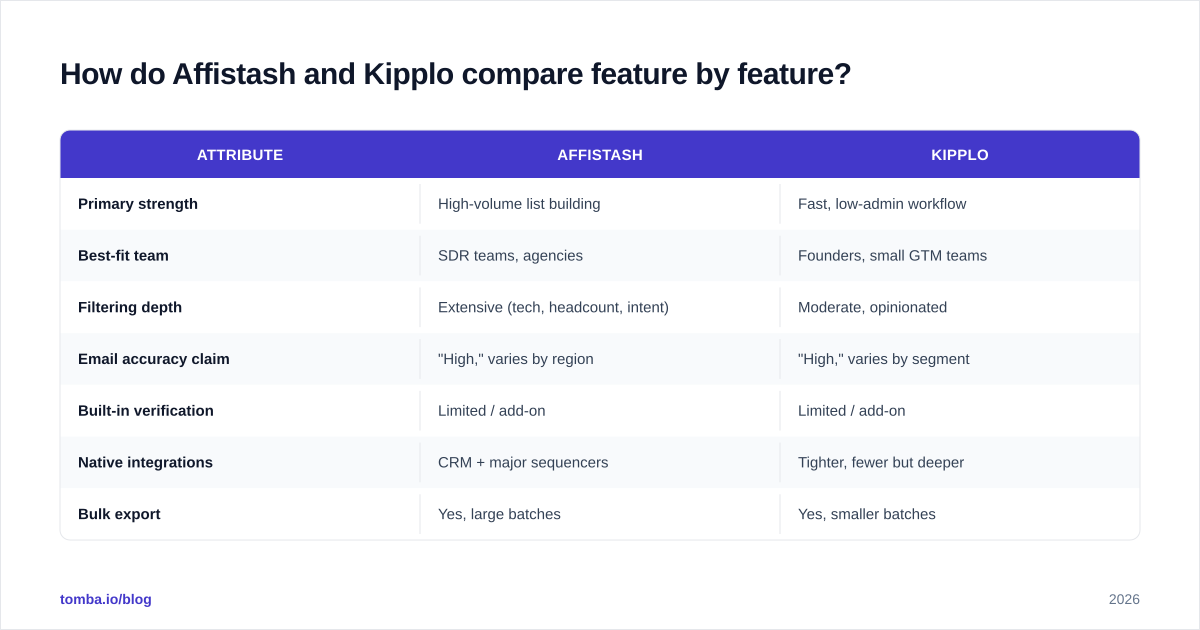
The table below maps the two across the attributes that actually change your day-to-day. Treat pricing as representative tiers to sanity-check against each vendor's current page — both adjust plans frequently, so confirm before you buy.
| Attribute | Affistash | Kipplo |
|---|---|---|
| Primary strength | High-volume list building | Fast, low-admin workflow |
| Best-fit team | SDR teams, agencies | Founders, small GTM teams |
| Filtering depth | Extensive (tech, headcount, intent) | Moderate, opinionated |
| Email accuracy claim | "High," varies by region | "High," varies by segment |
| Built-in verification | Limited / add-on | Limited / add-on |
| Native integrations | CRM + major sequencers | Tighter, fewer but deeper |
| Bulk export | Yes, large batches | Yes, smaller batches |
| Onboarding effort | Higher (more to configure) | Lower (faster to value) |
| Starter price (representative) | ~$59–$79/mo | ~$49–$69/mo |
| API access | On higher tiers | On higher tiers |
Two takeaways. First, the feature lists rhyme — both do filtering, both export, both integrate. The differentiator is posture: Affistash optimizes for scale, Kipplo for simplicity. Second, notice the shared weak spot: verification is "limited / add-on" on both. That's the gap that quietly inflates your real cost, and it's the reason the next section matters more than any feature checkbox.

Which one has more accurate data?#
Short answer: don't trust either vendor's headline accuracy number, and don't trust mine. Accuracy is segment-specific — a tool that's 95% accurate for US SaaS mid-market can be 60% accurate for EU SMBs or APAC enterprises. The only number that matters is the bounce rate you see on your ICP.
Here's the practical test, and it costs almost nothing:
- Take a known list of 100 contacts you can independently confirm (recent customers, LinkedIn connections at target accounts).
- Run the same 100 through Affistash and through Kipplo.
- Verify both outputs through an independent email verification pass.
- Compare valid-vs-catch-all-vs-invalid splits side by side.
Whichever tool wins that test for your segment is the right answer — regardless of which scored better in a generic G2 review. Speaking of which, cross-reference current user sentiment on G2 and Capterra before committing; both surface segment-specific complaints (e.g., "great for US, weak for LATAM") that marketing pages bury.
The deeper issue is catch-all domains. A large share of B2B domains accept-all, meaning a basic verifier returns "valid" for addresses that will still bounce. If a meaningful slice of your ICP sits on catch-all infrastructure, you'll want a dedicated catch-all verifier regardless of whether Affistash or Kipplo found the address. Neither platform is built to solve that on its own.
Is Affistash better than Kipplo for outbound at scale?#
If "scale" means thousands of net-new contacts per month across many segments, Affistash's volume orientation is the more natural fit — bigger batch exports, deeper filtering, and a UI that assumes you're building large lists. But scale amplifies the accuracy problem: a 12% bounce rate on a 300-contact list is annoying; on a 6,000-contact list it's a sender reputation event that can put your whole domain in the spam folder.
So the honest framing is: Affistash may find at scale, but scaling safely requires a verification and hygiene layer it doesn't fully provide. Kipplo at scale hits the same wall from the other direction — its leaner export limits can become a throughput ceiling for high-volume teams.
The diagram below shows where the breakage usually happens — not at "find," but at the unguarded handoff between find and send.
Is Kipplo better than Affistash for small teams?#
For a founder-led or two-to-five-person GTM team, Kipplo's simplicity is a real advantage, and it's easy to undervalue. Every hour an SDR spends configuring filters, mapping fields, and reconciling exports is an hour not spent in conversations. Kipplo's faster time-to-value and tighter native integrations reduce that tax.
Affistash's depth becomes a liability for small teams: more configuration surface, more ways to build a subtly wrong list, more onboarding. Power you don't use is just complexity you pay for.
The Drake-rule applies cleanly here: a smaller, cleaner, verified list beats a giant raw one almost every time for a small team, because small teams can't absorb the deliverability damage of a bad send.
What do Affistash and Kipplo both miss?#
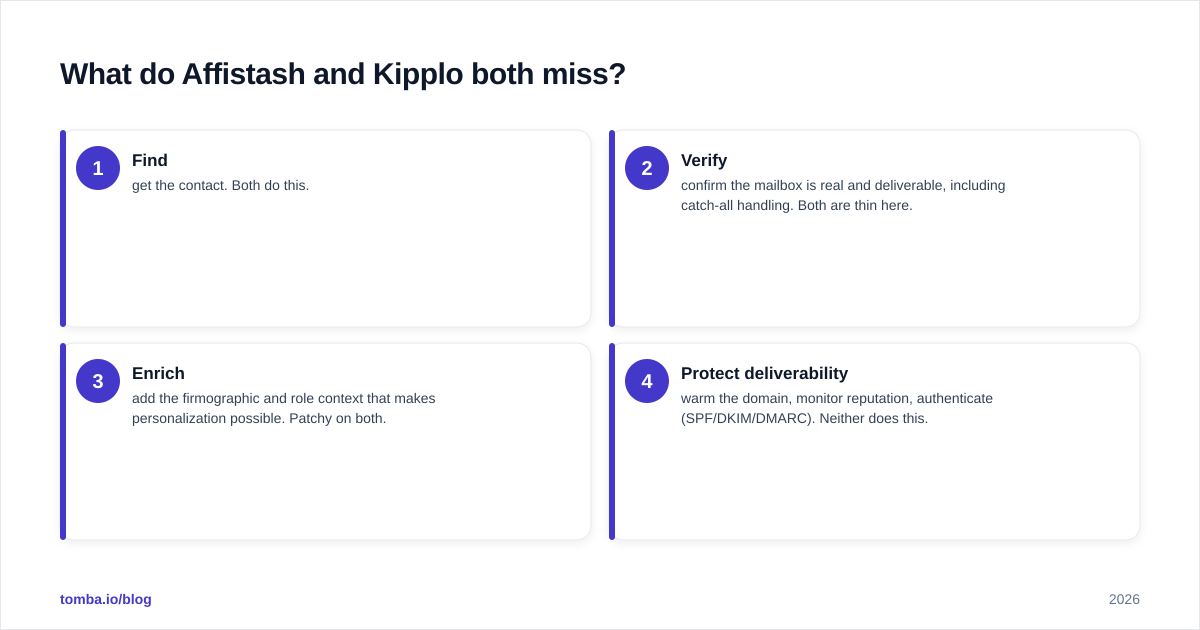
Both are contact-finding tools. A modern outbound stack needs four jobs done well, and finding is only the first:
- Find — get the contact. Both do this.
- Verify — confirm the mailbox is real and deliverable, including catch-all handling. Both are thin here.
- Enrich — add the firmographic and role context that makes personalization possible. Patchy on both.
- Protect deliverability — warm the domain, monitor reputation, authenticate (SPF/DKIM/DMARC). Neither does this.
This is where treating "the lead tool" as a single purchase gets teams into trouble. You can run a focused domain search to map every reachable contact at a target account, push the results through verification and data enrichment, and only then sequence — and you can wire the whole chain together through an email finder API instead of clicking through a UI. That pipeline is tool-agnostic on the "find" step; what it's not optional about is the verify step that both Affistash and Kipplo treat as an afterthought.
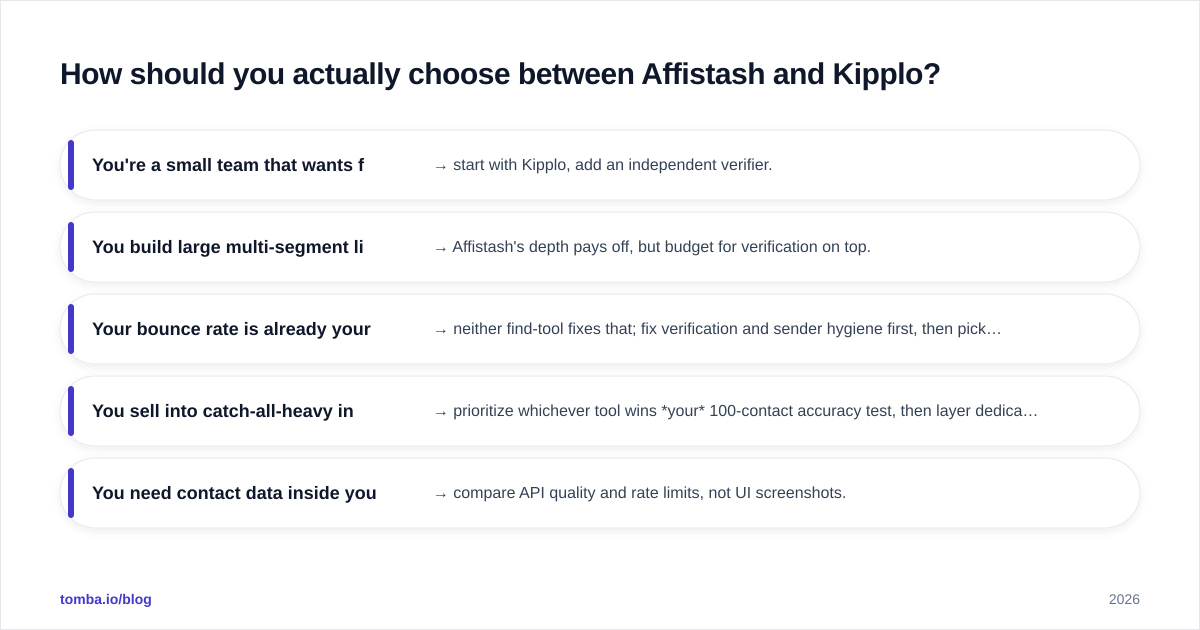
How should you actually choose between Affistash and Kipplo?#
Run this decision sequence in order — stop at the first line that describes you:
- You're a small team that wants fewer tools and faster setup → start with Kipplo, add an independent verifier.
- You build large multi-segment lists weekly → Affistash's depth pays off, but budget for verification on top.
- Your bounce rate is already your bottleneck → neither find-tool fixes that; fix verification and sender hygiene first, then pick the cheaper finder.
- You sell into catch-all-heavy industries (enterprise, finance, gov) → prioritize whichever tool wins your 100-contact accuracy test, then layer dedicated catch-all verification.
- You need contact data inside your own product or scripts → compare API quality and rate limits, not UI screenshots.
Notice that three of those five branches end at the same place: verification and deliverability, not the finder itself. That's the real lesson of an Affistash-vs-Kipplo bake-off. The find tool is a commodity; the data quality layer is the moat.
For benchmarking the broader category beyond these two, vendor-neutral directories like Gartner Peer Insights are useful for enterprise buyers who need procurement-grade references rather than self-reported stats.
Affistash vs Kipplo: the verdict#
There's no universal winner — there's a winner for your segment and team size. Kipplo wins on simplicity and speed-to-value for small teams. Affistash wins on filtering depth and volume for larger SDR orgs and agencies. Both lose on the thing that actually determines outbound ROI: verified, deliverable, enriched data.
So the smartest move isn't to agonize over the two demos. It's to decouple "finding" from "data quality." Pick whichever finder fits your workflow and budget, then put a serious accuracy layer underneath it.
That's exactly where Tomba fits. Use the Tomba Email Finder to source professional addresses by name, domain, or company, run every result through built-in verification and catch-all checks, and enrich before you ever hit send — at transparent Tomba pricing that starts free (25 searches/month) and scales from $49/mo Starter to $99/mo Growth and $249/mo Pro. Whether you land on Affistash or Kipplo for the front end, give your sequences clean data to work with. Start free, run the 100-contact accuracy test against your current tool, and let the bounce rate pick the winner.
// get started
Find, verify and enrich your first contacts today
Start on the free plan with 25 searches a month, then scale when your team is ready.
Free plan · No credit card required · GDPR & CCPA
// about the author