Affistash vs Reachstream: B2B Data Tools Compared 2026
Affistash vs Reachstream, broken down by data accuracy, pricing, coverage, and workflow fit. See which B2B data platform earns your budget in 2026 — and where a dedicated email finder beats both.
Choosing between Affistash and Reachstream usually comes down to one question: do you want a niche prospecting tool, or a broad contact database? They sound similar in a feature grid, but they solve different problems — and picking the wrong one means paying for records you will never email.
This is a neutral breakdown. No marketing gloss, just where each tool is strong, where it leaks budget, and when a dedicated email finder makes more sense than either.
TL;DR — Affistash vs Reachstream at a glance#
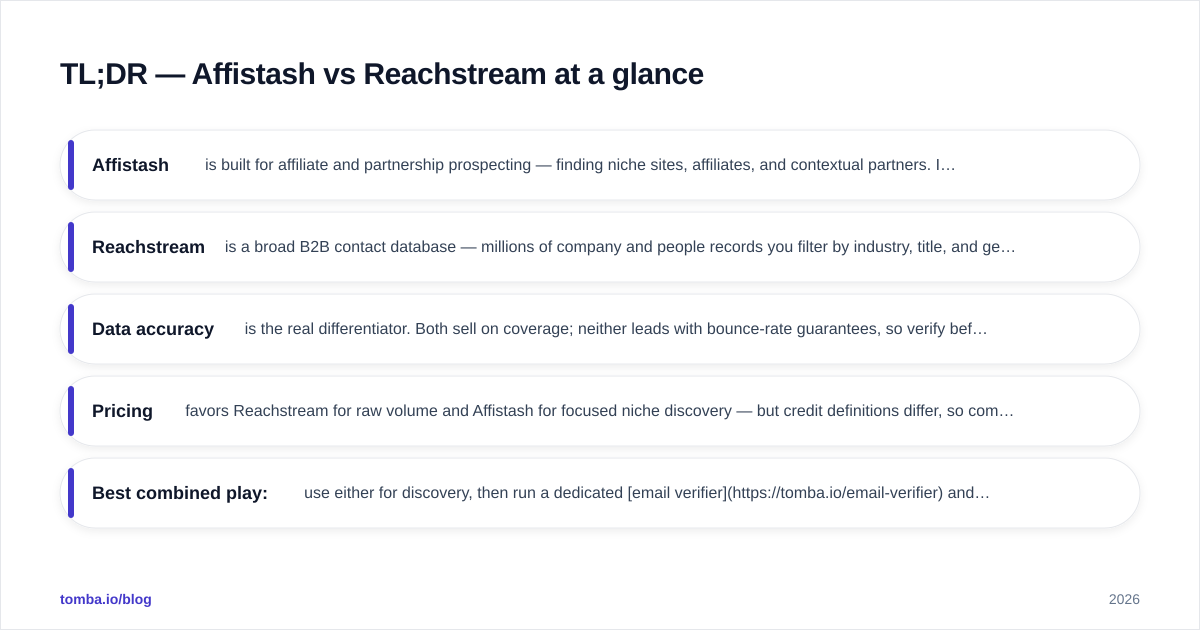
- Affistash is built for affiliate and partnership prospecting — finding niche sites, affiliates, and contextual partners. It shines if your motion is partner-led, not classic cold outbound.
- Reachstream is a broad B2B contact database — millions of company and people records you filter by industry, title, and geography. It fits volume-driven SDR teams.
- Data accuracy is the real differentiator. Both sell on coverage; neither leads with bounce-rate guarantees, so verify before you send.
- Pricing favors Reachstream for raw volume and Affistash for focused niche discovery — but credit definitions differ, so compare cost-per-usable-contact, not cost-per-record.
- Best combined play: use either for discovery, then run a dedicated email verifier and email finder to confirm deliverability before launch.

What is Affistash and who is it for?#
Affistash is a prospecting tool aimed at affiliate marketers, partnership teams, and anyone running a referral or contextual-link motion. Instead of dumping a generic list of "marketing managers," it helps you surface websites, publishers, and affiliates that are topically relevant to your niche, then pulls contact details so you can pitch a partnership.
The core promise is relevance over raw size. If you sell a SaaS product and want 200 review sites, comparison blogs, or coupon partners in your category, Affistash is structured around that workflow. You search by niche or competitor, and it returns sites plus the people behind them.
Where this breaks down: affiliate-style databases tend to be thinner on direct-dial phone numbers and verified corporate emails than a pure B2B data vendor. You often get a generic info@ or a guessed pattern that still needs validation. For partnership outreach that is usually fine — you are emailing a webmaster, not a VP of Procurement. For high-volume cold sales, it is limiting.
You can check current positioning and reviews on G2 and the vendor's own site at affistash.com before committing.
What is Reachstream and who is it for?#
Reachstream is a traditional B2B contact and company database. Think tens of millions of records you slice by firmographic and demographic filters — industry, company size, revenue, job title, seniority, location — then export to CSV or push into your CRM.
This is the classic "list-building" category. SDR teams that need 5,000 contacts in fintech with a director-or-above title this quarter are the target user. Reachstream competes with the broad data providers on price, often undercutting the enterprise incumbents while offering comparable filter depth.
The tradeoff is the same one every large database faces: scale and freshness pull against each other. A record that was accurate eight months ago may now point at someone who changed jobs. Reachstream, like its peers, refreshes data, but you should treat exported emails as candidates until verified — not as guaranteed-deliverable addresses. Cross-check their claims on Capterra and reachstream.com.
How do Affistash and Reachstream compare feature by feature?#
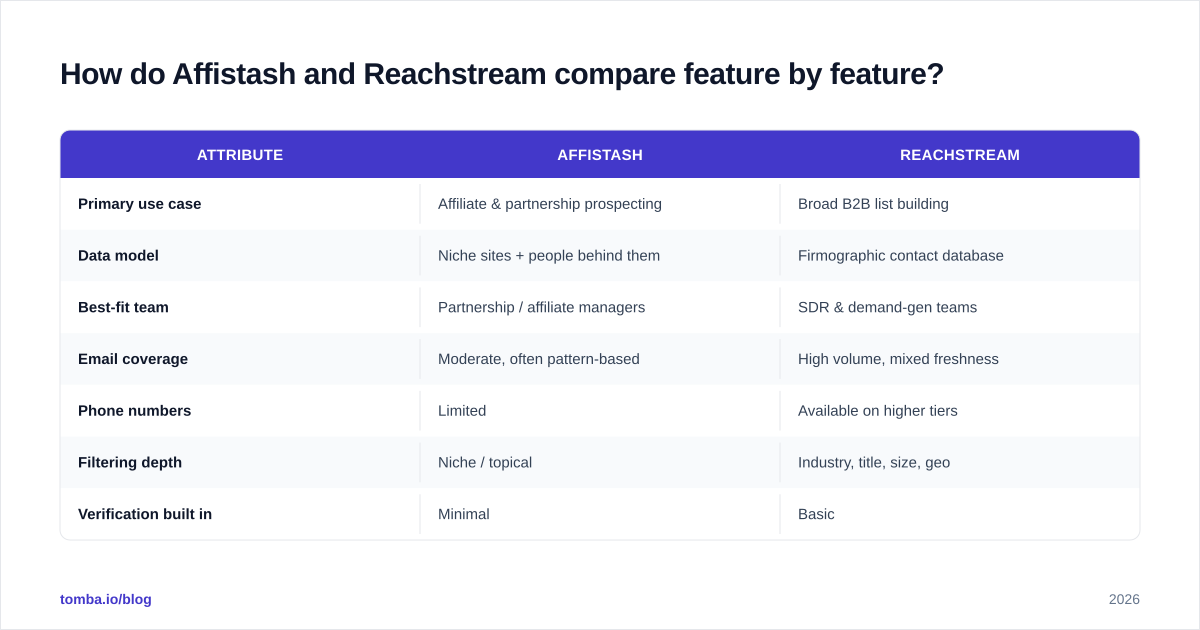
Here is the head-to-head. Treat "credits" cautiously — each vendor counts them differently, and a "contact" on one platform may unlock an email on another and a full enriched profile on a third.
| Attribute | Affistash | Reachstream |
|---|---|---|
| Primary use case | Affiliate & partnership prospecting | Broad B2B list building |
| Data model | Niche sites + people behind them | Firmographic contact database |
| Best-fit team | Partnership / affiliate managers | SDR & demand-gen teams |
| Email coverage | Moderate, often pattern-based | High volume, mixed freshness |
| Phone numbers | Limited | Available on higher tiers |
| Filtering depth | Niche / topical | Industry, title, size, geo |
| Verification built in | Minimal | Basic |
| Export / CRM push | CSV + integrations | CSV + CRM connectors |
| Ideal motion | Partner-led growth | Volume cold outbound |
The pattern is clear: Affistash optimizes for context, Reachstream optimizes for volume. Neither leads with a deliverability guarantee, which is the gap you have to close yourself.
Which has better data accuracy?#
Accuracy is where both tools ask for trust you should verify. Neither publishes an independently audited bounce rate, and "millions of contacts" is a coverage claim, not an accuracy claim. The two are frequently confused.
Coverage answers "do you have a record for this person?" Accuracy answers "is the email on that record still valid today?" A database can be enormous and still bounce 30% of a list if it has not been re-verified recently. This is the single most expensive mistake in outbound: sending to stale data torches your sender reputation, and once your domain reputation drops, even your good emails land in spam.
For partnership outreach through Affistash, a slightly higher bounce rate is survivable — volumes are low and you are often emailing role addresses. For Reachstream-scale sending, a 15–20% invalid rate across 5,000 contacts is a deliverability emergency.
The fix is the same regardless of source: never send to raw exported data. Pipe every list through verification first. A standalone email verifier catches invalid, role-based, and risky addresses, and a catch-all verifier handles the domains that accept everything and tell you nothing. If you want the mechanics, our glossary entry on email deliverability explains how bounces compound into reputation damage.
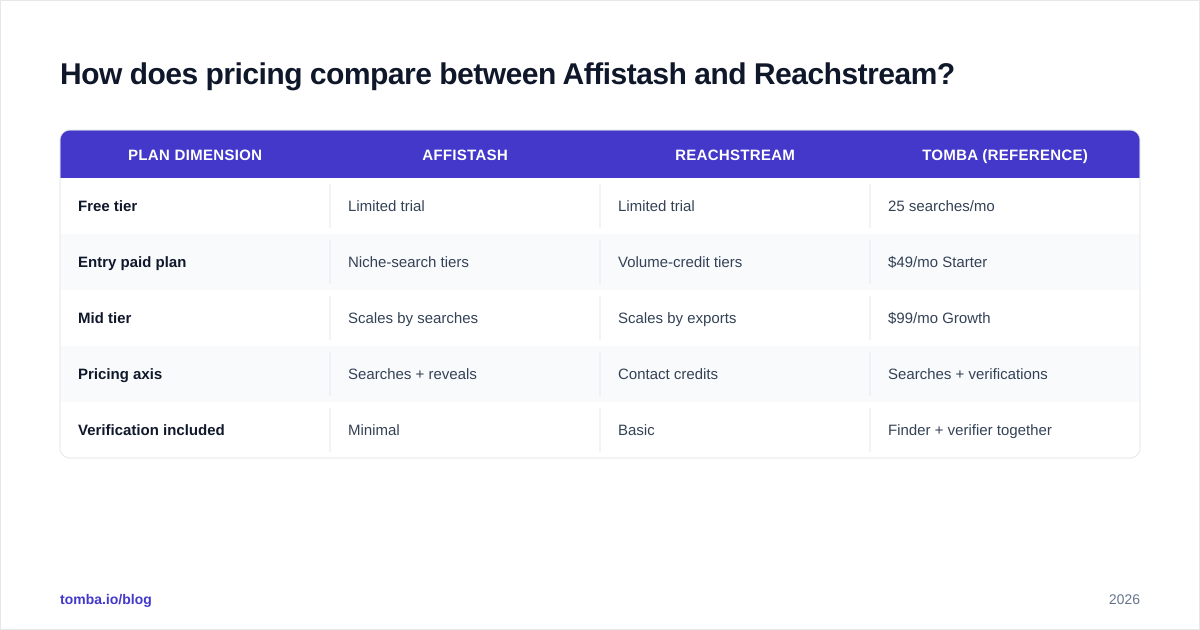
How does pricing compare between Affistash and Reachstream?#
Both sit below enterprise data incumbents, but they price on different axes. Affistash charges around niche searches and contact reveals; Reachstream charges around contact credits and export volume. That makes a flat "X is cheaper" verdict misleading.
The honest comparison is cost per usable contact — meaning a record that is both relevant to your ICP and verified deliverable. A cheaper credit that bounces is not cheaper; you paid for the credit and then paid again in reputation.
| Plan dimension | Affistash | Reachstream | Tomba (reference) |
|---|---|---|---|
| Free tier | Limited trial | Limited trial | 25 searches/mo |
| Entry paid plan | Niche-search tiers | Volume-credit tiers | $49/mo Starter |
| Mid tier | Scales by searches | Scales by exports | $99/mo Growth |
| Pricing axis | Searches + reveals | Contact credits | Searches + verifications |
| Verification included | Minimal | Basic | Finder + verifier together |
For transparency on how a finder-plus-verifier bundle is priced, see the public Tomba pricing page — the Starter plan is $49/mo, not the $39 you may see misquoted elsewhere. The point of including it here is not to crown a winner on price alone, but to show that "discovery tool + separate verification" often costs more in total than a platform that bundles both.
When should you pick Affistash over Reachstream?#
Pick Affistash when:
- Your growth motion is partner-led — affiliates, review sites, comparison blogs, co-marketing.
- Topical relevance matters more than raw count. Two hundred perfectly-matched niche sites beat 5,000 random contacts.
- You are doing link-building or contextual outreach and need the people behind specific domains.
- Direct-dial phone coverage is not a requirement.
Pick Reachstream when:
- You run volume cold outbound and need large, filterable lists fast.
- Firmographic targeting (industry, revenue, headcount, seniority) drives your ICP.
- You want CSV exports or CRM pushes at scale and will handle verification downstream.
- Phone numbers and broad title coverage are part of the plan.
If neither description fits cleanly — for example, you want specific, verified work emails for named people at named companies — you are actually describing an email finder, not a database or a niche prospector. That is a different tool category, and it is worth naming explicitly.
Is there a better alternative to both?#
For many outbound teams, the better setup is discovery from one of these tools plus a dedicated finder-and-verification layer. Affistash and Reachstream are good at finding who; they are weaker at confirming the email lands. Those are separable jobs, and the second one is where deliverability is won or lost.
A purpose-built finder fills that gap:
- Domain search pulls every discoverable email pattern at a target company, so you are not guessing whether it is
first.last@orflast@. - Bulk email finder turns a list of names and companies into verified addresses in one pass — exactly the step after a Reachstream export.
- A combined finder + verifier means you are not paying two vendors and stitching CSVs together.
This is not an argument that Affistash and Reachstream are bad — it is that "database" and "verified-email-delivery" are different competencies. Use the right tool for each, or use one platform that does both well. For a deeper look at how vendors source and refresh records, our breakdown of data sources covers what separates fresh data from stale.
Affistash vs Reachstream: the verdict#
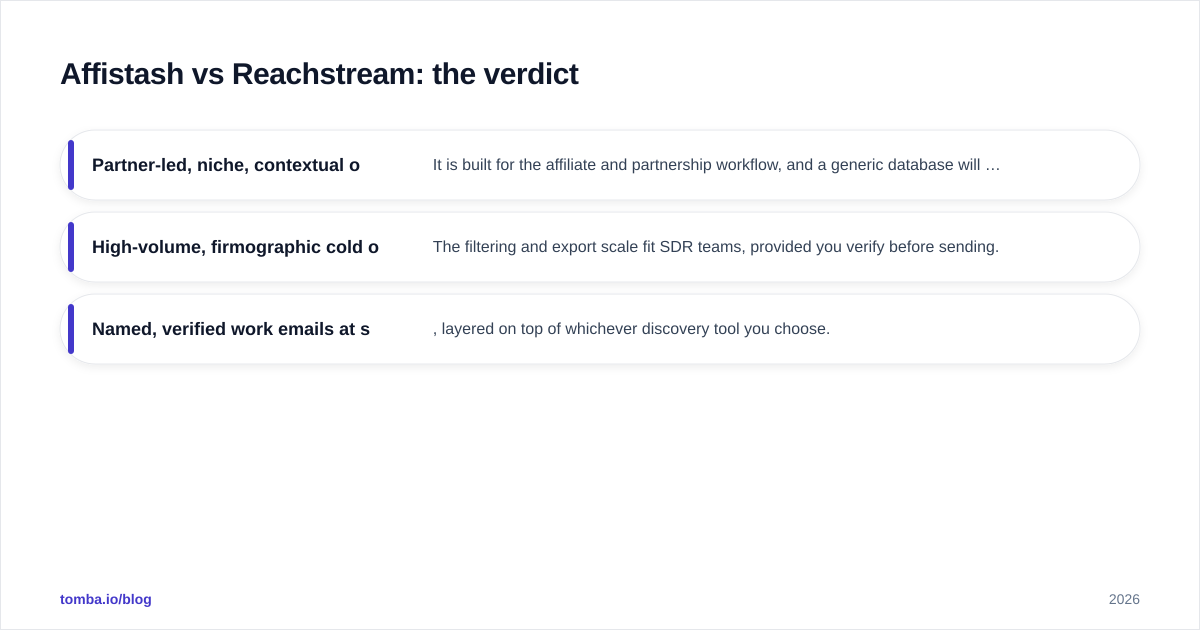
There is no universal winner — there is a winner for your motion:
- Partner-led, niche, contextual outreach → Affistash. It is built for the affiliate and partnership workflow, and a generic database will frustrate you.
- High-volume, firmographic cold outbound → Reachstream. The filtering and export scale fit SDR teams, provided you verify before sending.
- Named, verified work emails at scale → a dedicated email finder, layered on top of whichever discovery tool you choose.
Whatever you pick, the non-negotiable step is verification. Stale data is the silent killer of cold campaigns, and neither tool is selling itself primarily on bounce-rate guarantees. Close that gap yourself.
Find and verify emails that actually land#
If your real goal is verified, deliverable emails for the people you have already identified, start with the Tomba Email Finder. Find professional addresses by domain, name, or company, confirm them with the built-in verifier, and run lists in bulk — so the contacts you pull from Affistash or Reachstream turn into replies instead of bounces. The free tier includes 25 searches a month, enough to test accuracy against your own list before you spend a dollar.
// get started
Find, verify and enrich your first contacts today
Start on the free plan with 25 searches a month, then scale when your team is ready.
Free plan · No credit card required · GDPR & CCPA
// about the author