Affistash vs RocketReach 2026: Which B2B Data Tool Wins?
Affistash vs RocketReach compared on data accuracy, coverage, pricing, and workflow fit — plus where a verification-first finder like Tomba beats both in 2026.
Choosing between Affistash and RocketReach usually comes down to one question: do you need a broad, mature contact database, or a leaner partner-and-prospect discovery tool that won't blow your budget? Both promise emails and phone numbers at scale, but they solve slightly different problems — and neither one is automatically the right answer for your outbound motion.
This guide breaks down where each tool wins, where each one quietly costs you, and how a verification-first email finder fits into the picture.
TL;DR#
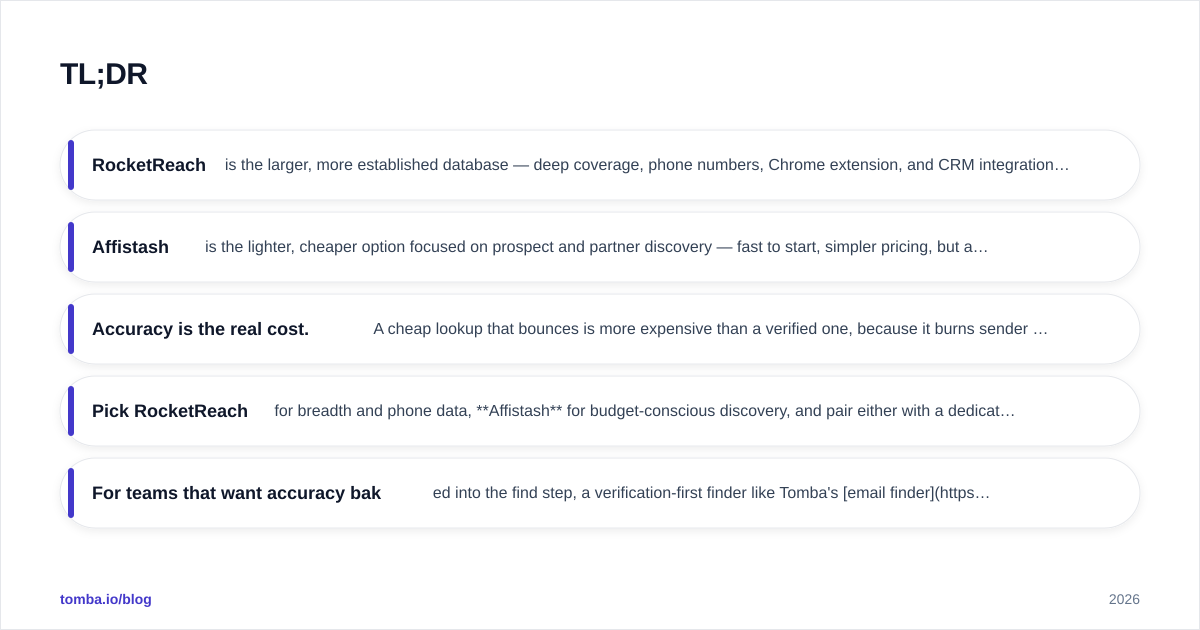
- RocketReach is the larger, more established database — deep coverage, phone numbers, Chrome extension, and CRM integrations, but priced per-lookup with credits that expire and accuracy that varies by region.
- Affistash is the lighter, cheaper option focused on prospect and partner discovery — fast to start, simpler pricing, but a smaller dataset and fewer enterprise integrations.
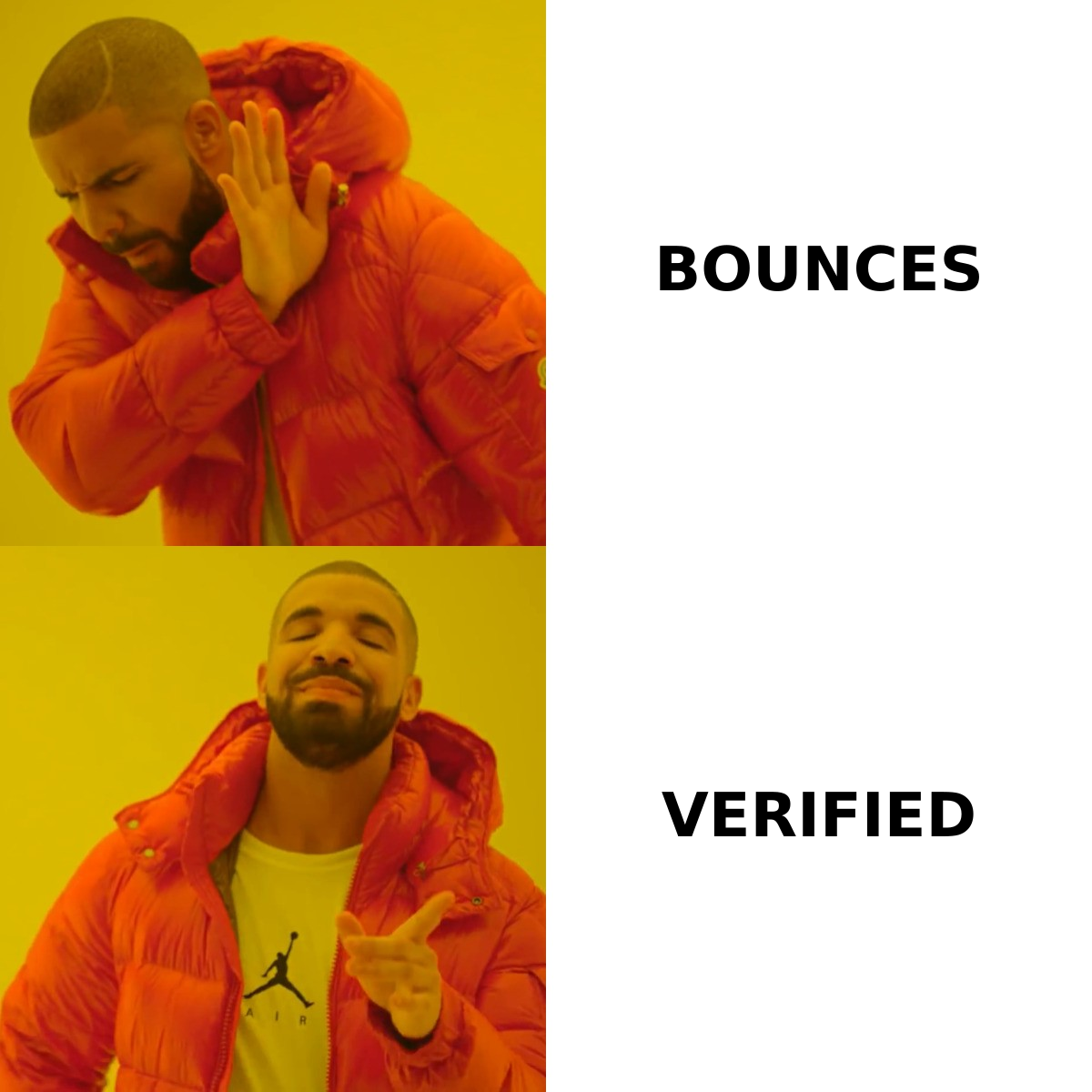
- Accuracy is the real cost. A cheap lookup that bounces is more expensive than a verified one, because it burns sender reputation, not just credits.
- Pick RocketReach for breadth and phone data, Affistash for budget-conscious discovery, and pair either with a dedicated email verifier before you send.
- For teams that want accuracy baked into the find step, a verification-first finder like Tomba's email finder often replaces the "find then clean" two-tool dance entirely.
What is Affistash?#
Affistash is a B2B prospecting and partner-discovery tool. Think of it as a search engine for companies and the people inside them: you filter by industry, role, or niche, and it returns contact records — typically a business email, sometimes a LinkedIn profile or company detail.
Its sweet spot is affiliate, partnership, and lead discovery for smaller teams. The pitch is speed and price: you don't need a procurement cycle or an annual contract to start pulling contacts. For solo founders, agencies, and lean growth teams, that low barrier to entry is the main draw.
The trade-off is depth. Affistash's database is smaller than the incumbents, regional coverage is uneven outside North America and Western Europe, and you'll find fewer native integrations into the rest of your stack. It's a discovery layer, not a full data-intelligence platform.
What is RocketReach?#
RocketReach is one of the older, larger contact-data platforms. It maintains a database the company describes in the hundreds of millions of professional profiles, and it surfaces emails and direct-dial phone numbers, plus a browser extension that pulls contact data while you're on LinkedIn or a company site.
You can read more about its positioning on the RocketReach homepage and user reviews on G2.
RocketReach's strengths are breadth and maturity: more records, phone coverage, bulk lookups, an API, and integrations with CRMs and outreach tools. Its weaknesses are the usual database-incumbent ones — credit-based pricing that expires monthly, accuracy that swings depending on the seniority and region of the contact, and a habit of returning "best guess" emails that haven't been validated against a live mail server.
How do Affistash and RocketReach compare on features?#
Here's the head-to-head on the attributes that actually change your day-to-day workflow.
| Attribute | Affistash | RocketReach |
|---|---|---|
| Primary use case | Prospect & partner discovery | Broad contact database |
| Database size | Smaller, niche-focused | Hundreds of millions of profiles |
| Phone numbers | Limited | Yes, including direct dials |
| Email verification | Basic / variable | Best-guess + tiered verification |
| Chrome extension | Limited | Yes |
| Bulk lookups | Limited | Yes |
| API access | Limited | Yes |
| CRM integrations | Few | HubSpot, Salesforce,Zapier, more |
| Pricing model | Lower entry, simpler | Credit tiers, monthly expiry |
| Best for | Budget teams, niche discovery | Sales teams needing scale + phone |
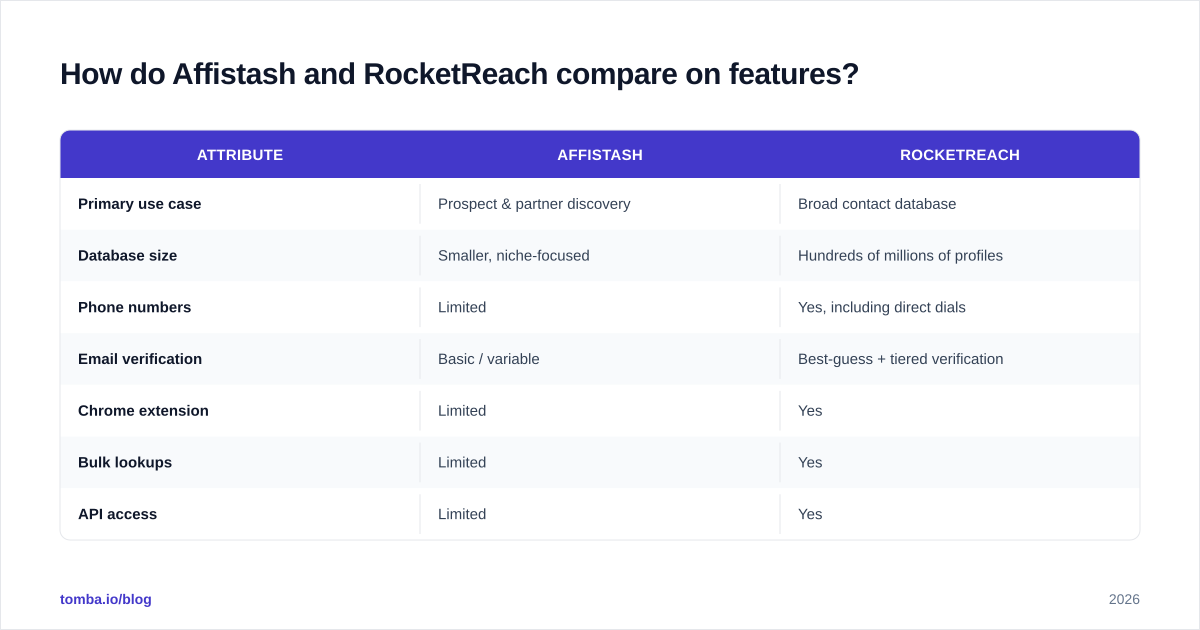
The pattern is clear: RocketReach buys you breadth and infrastructure; Affistash buys you a lower bill and faster onboarding. Neither guarantees the thing you actually care about — that the email lands.
Is Affistash or RocketReach more accurate?#
Accuracy is where this comparison gets honest, because it's the metric vendors are softest about. Both tools return a mix of verified addresses and pattern-based guesses (for example, first.last@company.com inferred from a known company format). A guessed address that nobody validated against the mail server is a coin flip — and every bounce chips away at your sender reputation.
Independent benchmarks consistently show that database-only tools trade accuracy for coverage. The bigger the dataset, the more stale records creep in, because people change jobs and companies rename inboxes faster than any crawler can keep up.

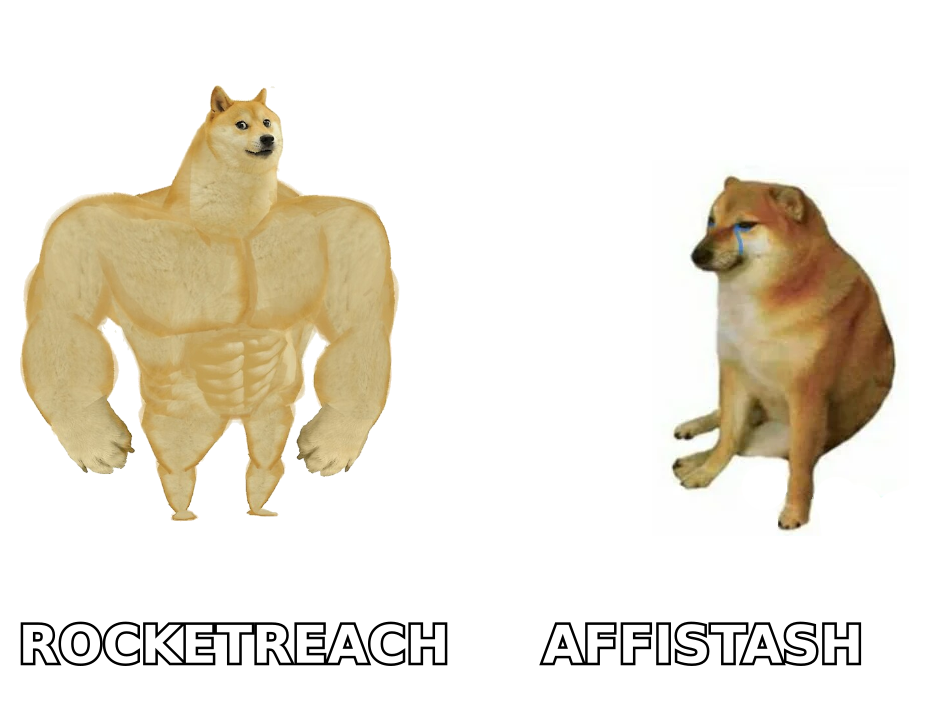
RocketReach generally edges Affistash on raw accuracy simply because it has more data points to triangulate from. But "more accurate than the smaller tool" is not the same as "safe to send to." The practical rule:
- Treat every email from either tool as unverified until proven otherwise.
- Run a real-time SMTP check before it enters a sequence.
- Watch out for catch-all domains, which both tools will happily return as "valid" when they actually accept everything and confirm nothing. A dedicated catch-all verifier is the only way to separate a real inbox from a black hole.
That last point matters more than people expect. On catch-all domains, a tool reporting "deliverable" is reporting nothing useful — the server accepts all addresses by design.
How does pricing compare?#
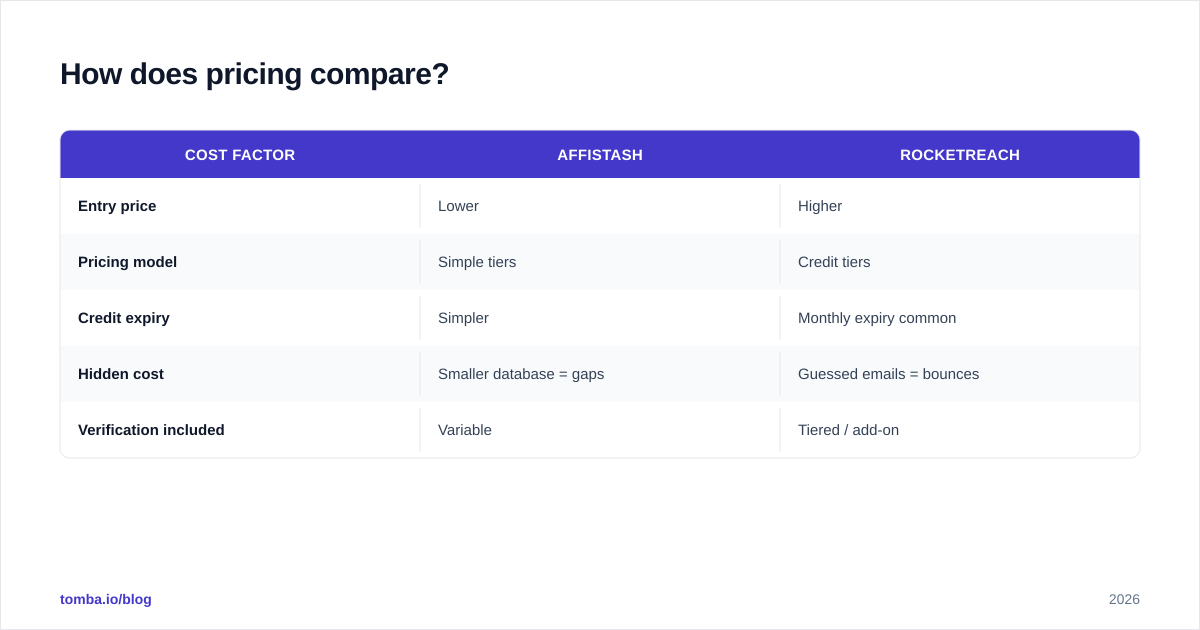
Pricing is the most common reason teams switch, so look past the headline number to the cost per usable contact.
Affistash positions itself as the affordable option with simpler tiers and a lower entry price — attractive when you're early and watching every dollar. RocketReach uses credit tiers that scale up quickly, and a detail that catches people out: unused credits typically expire each month, so you're paying for capacity whether you use it or not.
Now factor in accuracy. If Tool A is cheaper per lookup but bounces twice as often, Tool A is more expensive per delivered email — and the bounce damage to your domain isn't on the invoice at all.
| Cost factor | Affistash | RocketReach |
|---|---|---|
| Entry price | Lower | Higher |
| Pricing model | Simple tiers | Credit tiers |
| Credit expiry | Simpler | Monthly expiry common |
| Hidden cost | Smaller database = gaps | Guessed emails = bounces |
| Verification included | Variable | Tiered / add-on |
For reference, a verification-first finder like Tomba runs a free tier (25 searches/month) and a Starter plan at $49/month, with Growth at $99/month — full Tomba pricing is public, no sales call required. The point isn't that one number beats another; it's that you should compare on verified contacts, not raw lookups.
When should you choose RocketReach?#
Choose RocketReach if:
- You need phone numbers and direct dials alongside email — its phone coverage is a genuine advantage over Affistash.
- You're running high-volume outbound and need bulk lookups plus an API.
- You live inside HubSpot or Salesforce and want native CRM integrations.
- Your targets skew toward large, well-indexed companies where database coverage is deepest.
The compromise you accept: higher cost, expiring credits, and a verification step you'll still need to bolt on before sending.
When should you choose Affistash?#
Choose Affistash if:
- You're budget-constrained and want to start without a big commitment.
- Your use case is partner, affiliate, or niche prospect discovery rather than mass cold outreach.
- You operate in markets where its dataset happens to be strong, and you can tolerate gaps elsewhere.
- You value a simpler tool over a sprawling platform you'll only half-use.
The compromise: a smaller database, fewer integrations, and verification quality you'll want to double-check independently.
Where does a verification-first finder fit?#
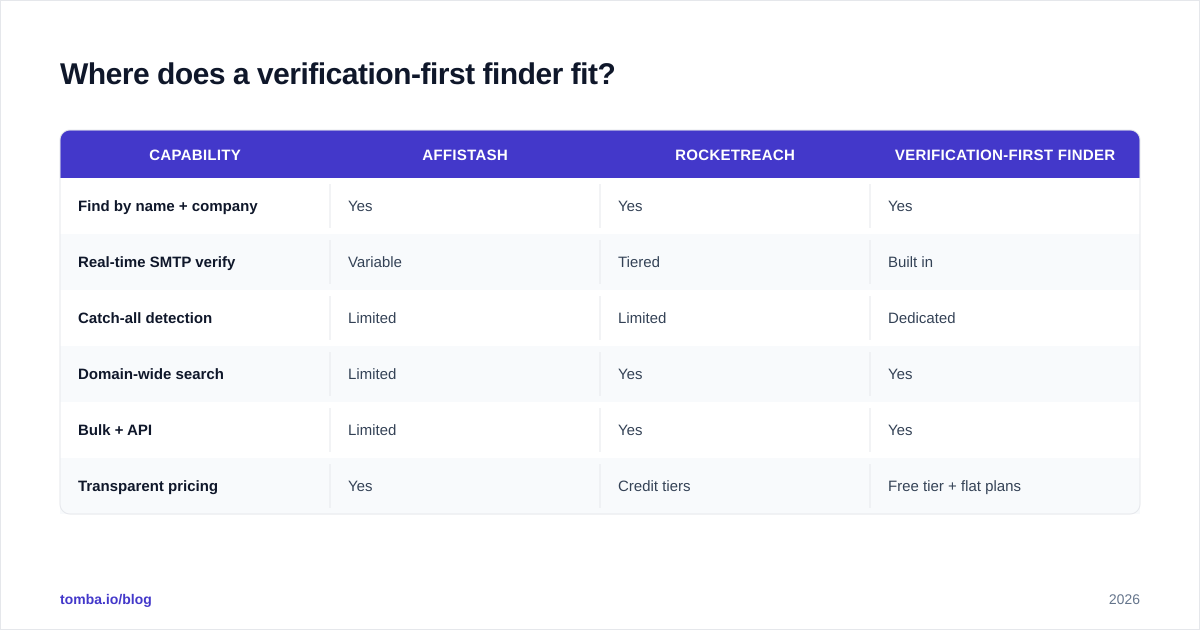
Here's the structural problem with the Affistash-vs-RocketReach framing: both are database-first tools. They optimize for "do we have a record?" and treat verification as a secondary, often paid, add-on. That's why teams end up buying two products — one to find, one to clean.
A verification-first finder flips the order. It searches, then validates the result against the live mail server before handing it to you, so the address you get is the address you can send to. This is the gap Tomba targets: the email finder and built-in email verifier run as one motion, and domain search maps every public address at a company in a single query.
| Capability | Affistash | RocketReach | Verification-first finder |
|---|---|---|---|
| Find by name + company | Yes | Yes | Yes |
| Real-time SMTP verify | Variable | Tiered | Built in |
| Catch-all detection | Limited | Limited | Dedicated |
| Domain-wide search | Limited | Yes | Yes |
| Bulk + API | Limited | Yes | Yes |
| Transparent pricing | Yes | Credit tiers | Free tier + flat plans |
You can see how the broader field stacks up here:

None of this means Affistash or RocketReach are bad tools — they're not. It means the find-then-verify split is a workflow tax, and you should decide consciously whether to pay it or collapse it.
What's the verdict on Affistash vs RocketReach?#
RocketReach wins on breadth, phone data, and integrations; Affistash wins on price and simplicity. If you need scale and direct dials, RocketReach is the safer pick. If you're a lean team doing niche discovery, Affistash gets you moving for less.
But the metric that decides whether your outbound actually works — deliverability — sits outside both their core promises. Whichever you choose, verify before you send, watch your catch-all rates, and measure cost per delivered contact rather than per lookup. For the deliverability fundamentals behind all of this, the basics of email deliverability are worth a five-minute read.
Ready to find emails that actually land?#
If the find-then-clean two-tool routine is wearing thin, try collapsing it into one step. Tomba's email finder finds professional addresses by name, company, or domain and validates them in the same pass — with a free tier of 25 searches a month so you can benchmark its accuracy against your current stack before paying a cent. Start there, compare the bounce rates, and let the delivered-email numbers settle the Affistash-vs-RocketReach debate for your specific list.
// get started
Find, verify and enrich your first contacts today
Start on the free plan with 25 searches a month, then scale when your team is ready.
Free plan · No credit card required · GDPR & CCPA
// about the author