Agenda for Sales Meeting: Templates & Structure (2026)
A sales meeting without an agenda is a status update in disguise. Here are battle-tested agenda templates for weekly, pipeline, and 1:1 meetings that actually move revenue.
TL;DR
- A good agenda for sales meeting time has three jobs: review what happened, decide what's next, and unblock deals — in that order, on the clock.
- Status-update meetings ("go around the room") waste the most expensive hour your team has. Replace recital with decisions.
- Use a different template for each meeting type: weekly team sync, pipeline review, 1:1, and deal strategy. One template can't do all four.
- Cap the meeting, assign a timekeeper, and end every block with an owner and a due date — or it didn't happen.
- Send the agenda 24 hours ahead with numbers pre-filled so the meeting is for decisions, not data entry.
Why do most sales meetings fail?#
Most sales meetings fail because they're status updates wearing a meeting's clothes. Each rep reads their numbers aloud, the manager nods, and nobody decides anything. That information could have been a Slack message or a dashboard.
A meeting earns its hour only when it does something a document can't: surface a blocker, force a decision, align people who disagree, or coach a skill in real time. Everything else is broadcast — and broadcast belongs in your CRM, not on a calendar invite that pulls ten reps off the phones.
The fix is structural, not motivational. You don't need your team to "engage more." You need an agenda that makes passive attendance impossible because every block ends with a decision and an owner.
What should a sales meeting agenda always include?#
Every effective agenda — regardless of meeting type — contains five components. Think of it like a flight checklist: the pilot runs the same sequence every time, which is exactly why nothing gets skipped when it's busy.
- Objective — one sentence stating what must be true when the meeting ends. "Decide which three deals get exec sponsorship this quarter," not "discuss pipeline."
- Timebox per block — minutes allocated, visible to everyone, enforced by a timekeeper.
- Pre-read data — numbers sent ahead so the room reacts instead of reciting.
- Decisions & owners — every discussion ends with who does what by when.
- Parking lot — a place to dump tangents so they don't derail the clock.
If a block has no decision attached to it, ask whether it belongs in the meeting at all. Often it belongs in an async update.
How do you structure a weekly sales team meeting?#
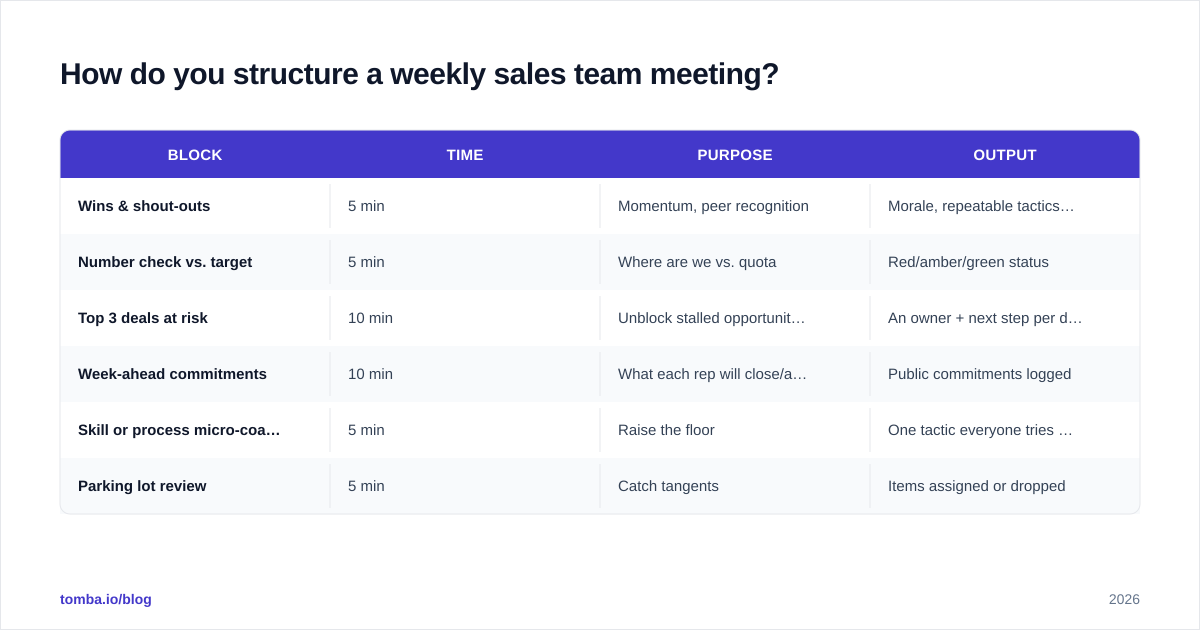
Keep the weekly team meeting to 30–45 minutes and bias it toward forward motion. The classic mistake is spending 80% of the time on what already happened. Flip the ratio: spend most of the hour on the week ahead.
Here's a proven weekly structure:
| Block | Time | Purpose | Output |
|---|---|---|---|
| Wins & shout-outs | 5 min | Momentum, peer recognition | Morale, repeatable tactics named |
| Number check vs. target | 5 min | Where are we vs. quota | Red/amber/green status |
| Top 3 deals at risk | 10 min | Unblock stalled opportunities | An owner + next step per deal |
| Week-ahead commitments | 10 min | What each rep will close/advance | Public commitments logged |
| Skill or process micro-coaching | 5 min | Raise the floor | One tactic everyone tries this week |
| Parking lot review | 5 min | Catch tangents | Items assigned or dropped |
Notice the number check is only five minutes. The dashboard already shows the numbers; the meeting exists to act on them. Track your team's win rate over time so the "number check" block surfaces trends, not just this week's noise.
HubSpot's research on sales meeting cadence makes the same point: the highest-performing teams run shorter, more frequent syncs focused on a handful of deals rather than marathon all-hands reviews.
What does a pipeline review agenda look like?#
A pipeline review is not a weekly team meeting, and treating them the same is why both feel useless. The pipeline review zooms into deal mechanics: stage accuracy, slippage, and forecast confidence. It's usually a manager-with-rep or small-pod session, not the whole team.
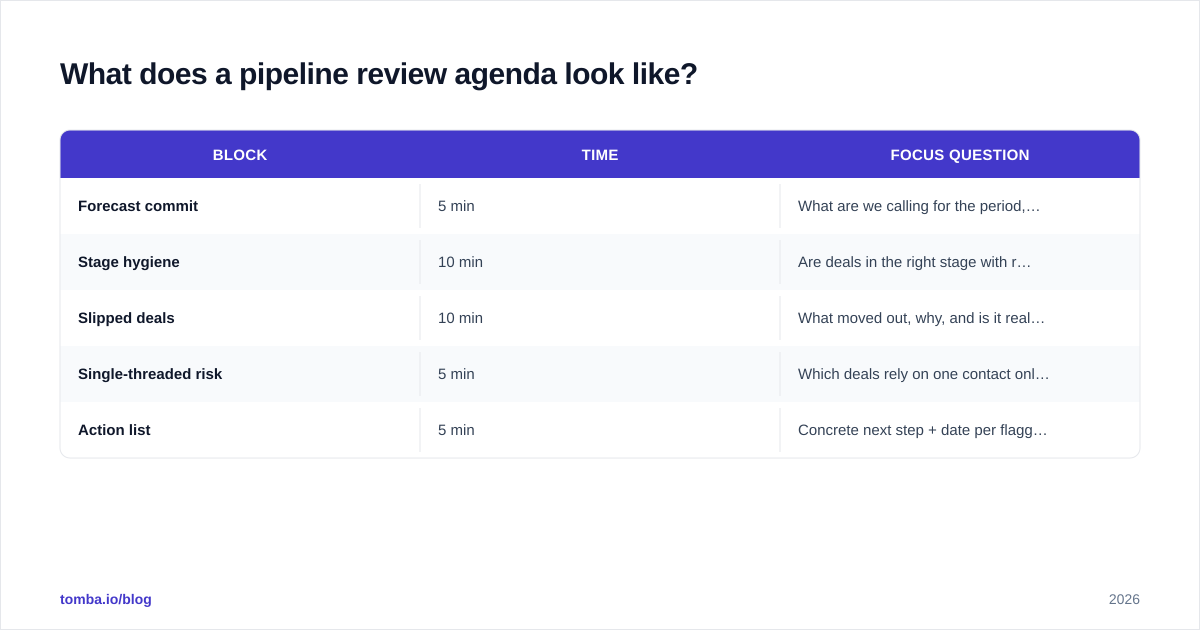
A focused pipeline review agenda:
| Block | Time | Focus question |
|---|---|---|
| Forecast commit | 5 min | What are we calling for the period, and how sure are we? |
| Stage hygiene | 10 min | Are deals in the right stage with real next steps? |
| Slipped deals | 10 min | What moved out, why, and is it real or hope? |
| Single-threaded risk | 5 min | Which deals rely on one contact only? |
| Action list | 5 min | Concrete next step + date per flagged deal |
The "single-threaded risk" block matters more than people expect. A deal with one champion and no other contacts is one job change away from dying. This is where prospecting tooling earns its keep — when a champion goes quiet, you need to reach other stakeholders fast. Teams use a domain search to map every contact at the account and multi-thread before the deal stalls.
Gartner's research on B2B buying groups shows the typical enterprise purchase now involves six to ten decision-makers. If your pipeline review only tracks one contact per deal, your forecast is built on sand.
How long should a sales meeting be?#
Cap weekly team meetings at 45 minutes, pipeline reviews at 30, and 1:1s at 30. The discipline of a hard stop forces ruthless prioritization — work expands to fill whatever time you give it.
A few timing rules that hold up in practice:
- Start on time regardless of stragglers. Waiting "two more minutes" trains everyone to arrive late.
- Assign a rotating timekeeper. When the responsibility moves around the team, everyone internalizes the cost of overruns.
- Default to no meeting. If the agenda is thin this week, cancel it. A canceled meeting with a posted async update beats a hollow ritual.
- Protect prime selling hours. Don't schedule team meetings at 10 a.m. when reps should be calling. Bookend the day instead.

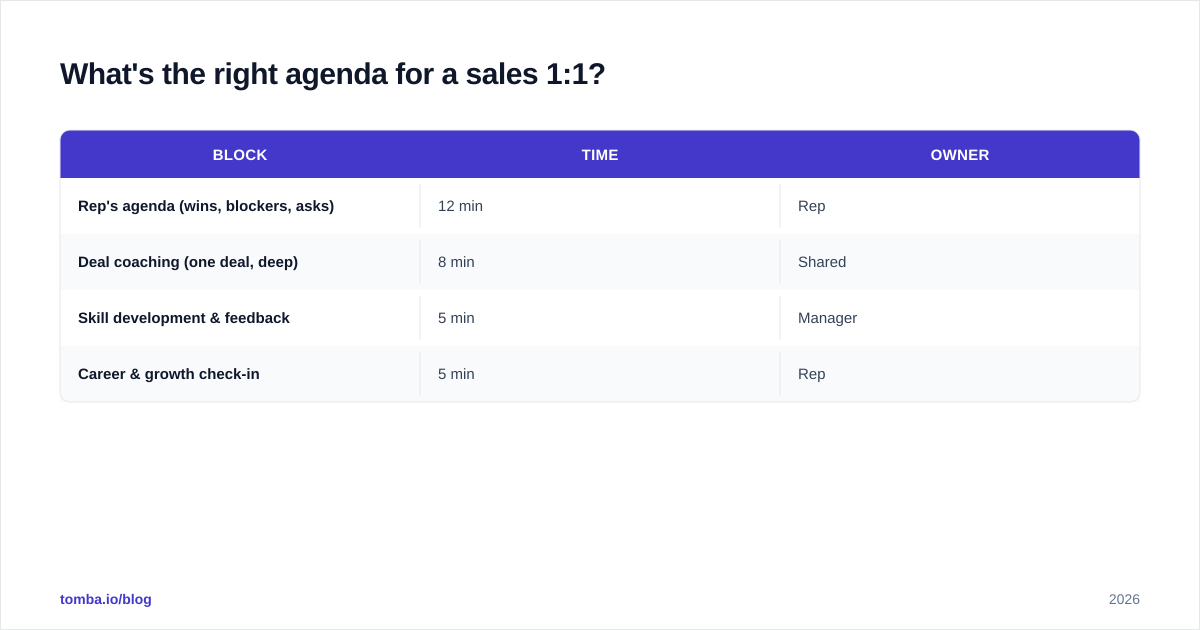
What's the right agenda for a sales 1:1?#
A 1:1 belongs to the rep, not the manager. Its agenda should be roughly 70% the rep's topics and 30% yours. The fastest way to ruin a 1:1 is to turn it into a second pipeline review — the rep already did that with you this week.
A balanced 1:1 agenda:
| Block | Time | Owner |
|---|---|---|
| Rep's agenda (wins, blockers, asks) | 12 min | Rep |
| Deal coaching (one deal, deep) | 8 min | Shared |
| Skill development & feedback | 5 min | Manager |
| Career & growth check-in | 5 min | Rep |
The "one deal, deep" block is the highest-leverage part. Instead of skimming the whole pipeline, pick a single representative deal and work it together — discovery gaps, missing stakeholders, next-step quality. Coaching one deal thoroughly teaches a pattern the rep applies to twenty others. Pair this with reliable sales automation so the rep spends 1:1 time on judgment calls, not data entry.
What's a good deal strategy meeting agenda?#
For big or stuck deals, run a dedicated strategy session — separate from any recurring meeting. These are called when a deal is worth the focus, not on a fixed schedule.
A deal strategy agenda:
- Deal snapshot (3 min) — size, stage, close date, current status. Pre-read, not presented.
- The buying group map (7 min) — who's the economic buyer, champion, blocker, influencer? Where are the gaps?
- Why us / why now / why not (10 min) — the three questions that predict the outcome.
- Competitive landscape (5 min) — who else is in, and how do we differentiate?
- Battle plan (5 min) — three concrete moves with owners and dates.
The buying-group map is where deals are won or lost. If your team can name only two of the six people involved, the first action item writes itself: find the rest. Reps often start with a name and company and need to reach a specific stakeholder — that's exactly what an email finder is for, turning a LinkedIn name into a verified, reachable contact.
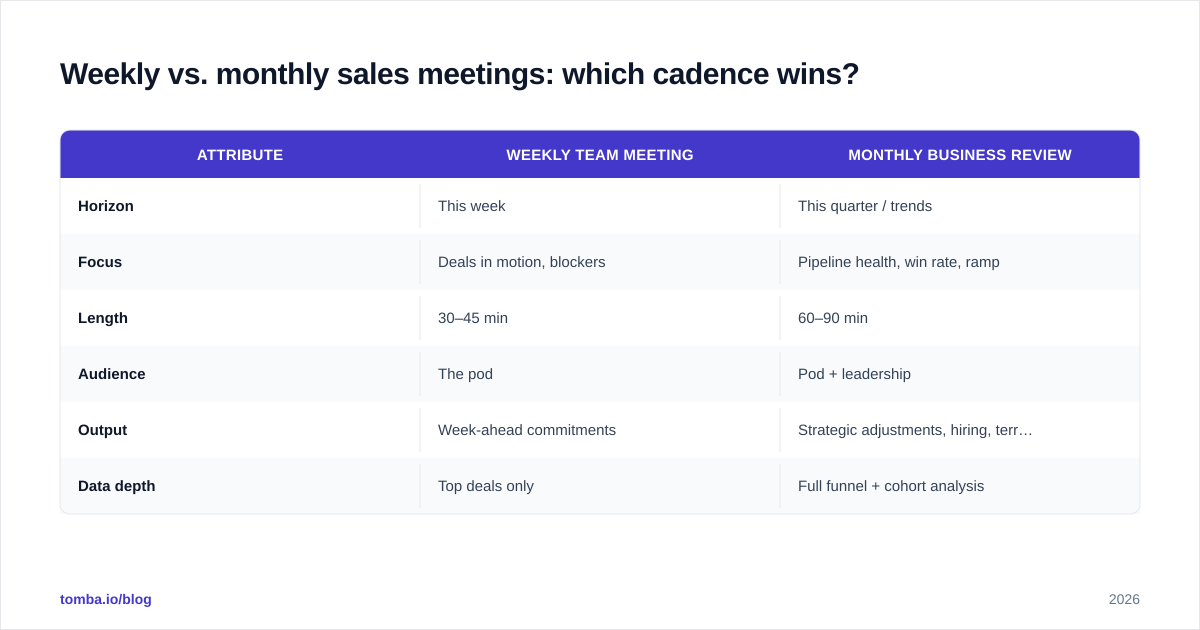
Weekly vs. monthly sales meetings: which cadence wins?#
Run tactical meetings weekly and strategic meetings monthly — they answer different questions and shouldn't be merged.
| Attribute | Weekly team meeting | Monthly business review |
|---|---|---|
| Horizon | This week | This quarter / trends |
| Focus | Deals in motion, blockers | Pipeline health, win rate, ramp |
| Length | 30–45 min | 60–90 min |
| Audience | The pod | Pod + leadership |
| Output | Week-ahead commitments | Strategic adjustments, hiring, territory |
| Data depth | Top deals only | Full funnel + cohort analysis |
The monthly review is where you step back and ask whether the system is working: Is the lead source converting? Are new reps ramping on schedule? Is win rate trending up or down? Salesforce's sales management resources reinforce splitting the rhythm this way — weekly meetings keep deals moving, monthly reviews keep the strategy honest.
How do you make sales meetings actually drive action?#
The single highest-impact habit: end every agenda block with a documented owner and due date, then start the next meeting by reviewing those commitments. Accountability that loops back is what separates meetings that compound from meetings that evaporate.
A practical operating rhythm:
- Send the agenda 24 hours ahead, with all numbers pre-filled. Reps arrive ready to decide, not to look things up.
- Capture decisions live in a shared doc or your CRM — not in someone's notebook where they die.
- Open the next meeting with last meeting's action items. Public follow-through changes behavior faster than any pep talk.
- Kill recurring meetings that stop producing decisions. If three weeks of agendas show no decisions, the meeting is theater. Cancel it.
Before strategy sessions, make sure the contact data feeding your buying-group map is current. Stale or single-threaded contacts produce bad battle plans. Running accounts through a quick data enrichment pass — and a bulk email finder for the accounts you're reviewing — means the meeting reasons about reality instead of a six-month-old snapshot.
Putting it together#
A great agenda for a sales meeting isn't about templates for their own sake — it's about respecting the most expensive hour your team spends together. Match the template to the meeting type, timebox every block, end each one with an owner, and default to canceling when the agenda is thin. Do that consistently and your meetings stop being a tax on selling time and start being the place deals get unstuck.
The thread running through every one of these agendas — pipeline review, deal strategy, the at-risk-deal block — is reachable, accurate contact data. You can't multi-thread a single-threaded deal, map a buying group, or rescue a stalled opportunity if you can't reach the people involved. Tomba's Email Finder turns a name and company into a verified email in seconds, so the action items your meetings produce are actually executable. Start free with 25 searches a month, or check Tomba pricing — Starter is $49/mo — when your team is ready to scale outreach across every account on the board.
// get started
Find, verify and enrich your first contacts today
Start on the free plan with 25 searches a month, then scale when your team is ready.
Free plan · No credit card required · GDPR & CCPA
// about the author