Agentic AI for Sales in 2026: The Complete Playbook
Agentic AI for sales is moving from hype to pipeline. Here's how autonomous agents prospect, qualify, and book meetings — and where they still need a human.
TL;DR
- Agentic AI for sales means software that acts — it plans multi-step tasks, calls tools, and adapts — instead of just generating text on request.
- The highest-ROI starting point is the boring middle of the funnel: research, enrichment, list-building, qualification, and follow-up sequencing.
- Agents are only as good as their data. Bad emails and stale firmographics turn an autonomous SDR into an autonomous spammer.
- Keep humans on strategy, pricing, objection nuance, and anything that touches a signed contract. Automate the repetitive lookups and admin.
- You can pilot agentic workflows this quarter with tools you already own plus a clean data layer like Tomba's email finder.
What is agentic AI for sales?#
Agentic AI for sales is software that pursues a goal across multiple steps on its own — researching an account, deciding the next action, calling external tools, and correcting course when something fails — rather than waiting for a prompt every time.
Think of the difference between a calculator and an intern. A calculator answers the exact question you type. An intern hears "build me a list of 50 fintech VPs of Engineering and find their emails," then figures out the sub-tasks, runs the searches, handles the dead ends, and hands you a finished sheet. Classic generative AI is the calculator. Agentic AI is the intern who plans, uses tools, and reports back.
Technically, an agent is a loop: it observes state, plans, takes an action (often an API or tool call), observes the result, and repeats until the goal is met or a guardrail stops it. For sales, those "actions" are things like querying a CRM, enriching a contact, drafting a sequence, or scheduling a task — chained together without a human clicking between each step.
How is agentic AI different from a chatbot or Copilot?#
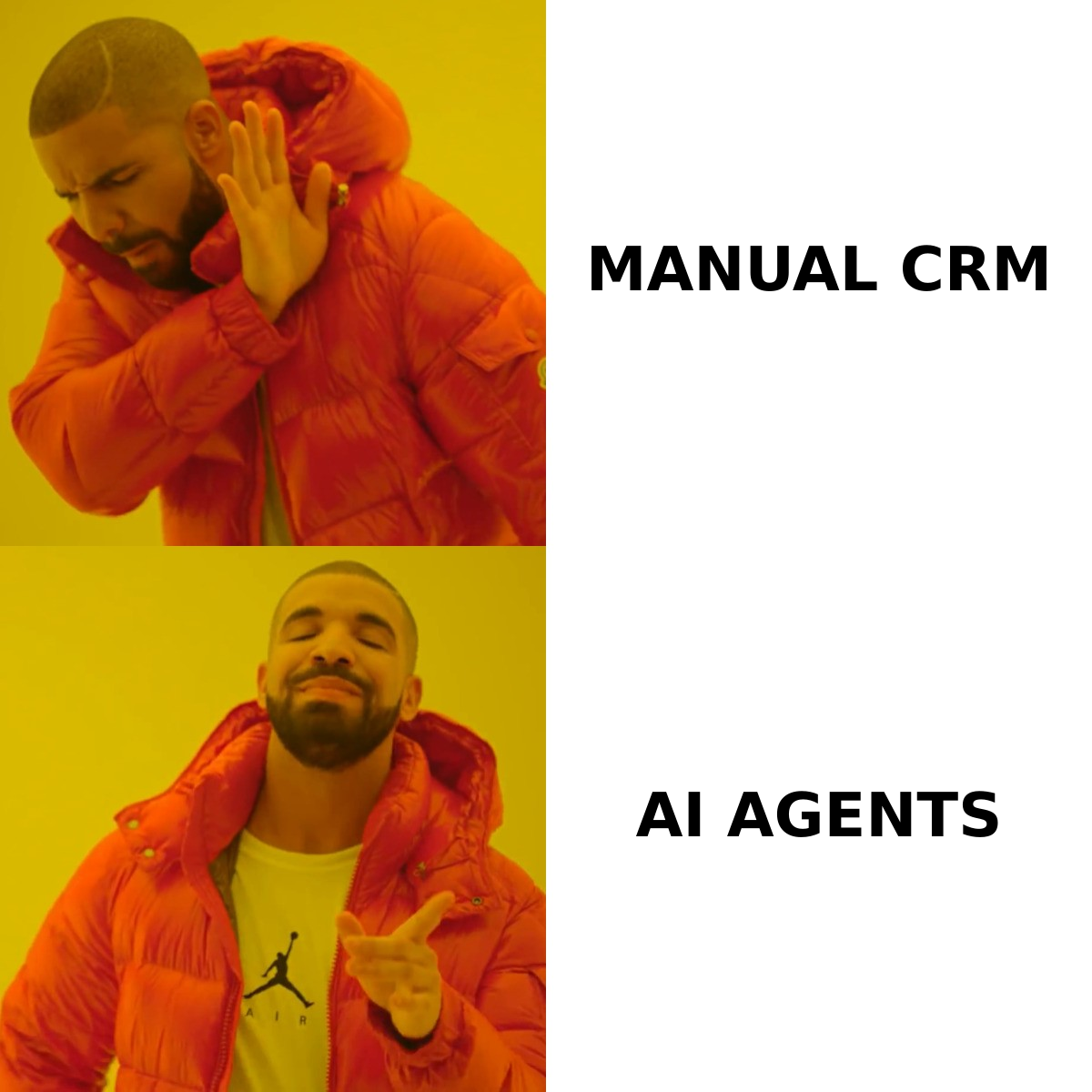
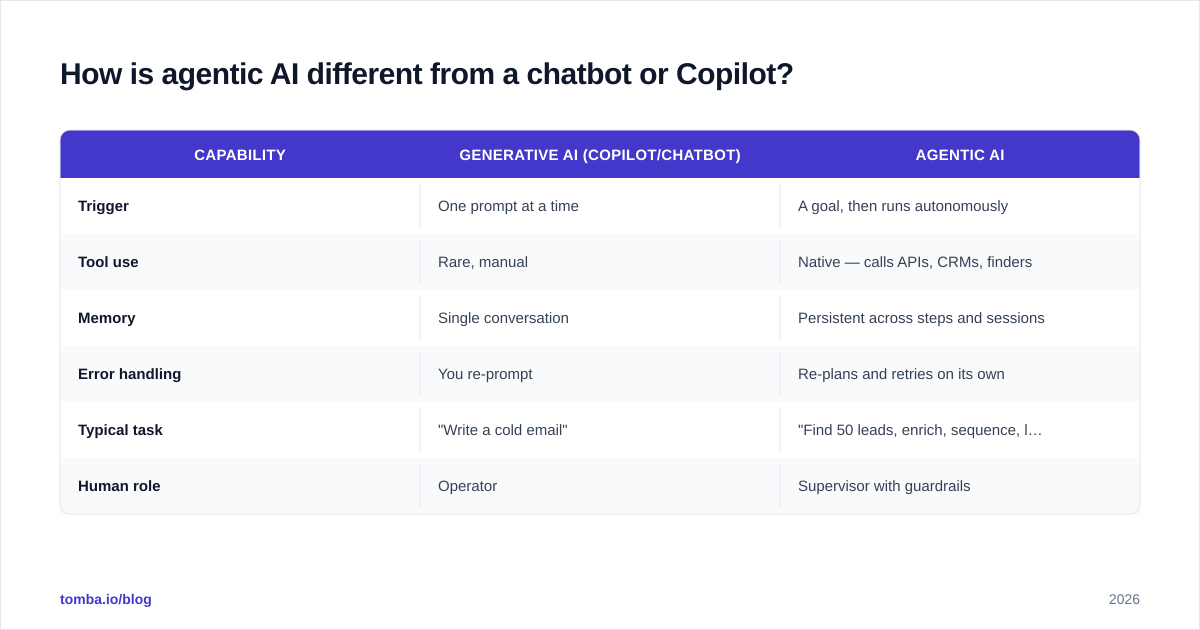
The short version: a Copilot suggests, an agent executes. A chatbot answers a question and stops; an agent owns an outcome and keeps going.
| Capability | Generative AI (Copilot/chatbot) | Agentic AI |
|---|---|---|
| Trigger | One prompt at a time | A goal, then runs autonomously |
| Tool use | Rare, manual | Native — calls APIs, CRMs, finders |
| Memory | Single conversation | Persistent across steps and sessions |
| Error handling | You re-prompt | Re-plans and retries on its own |
| Typical task | "Write a cold email" | "Find 50 leads, enrich, sequence, log to CRM" |
| Human role | Operator | Supervisor with guardrails |
This distinction matters because most "AI sales tools" sold in 2026 are still assistive. They draft an email or summarize a call. That is useful, but it does not remove the work of stitching steps together. Agentic systems aim at the stitching itself — which is where reps actually lose hours. For grounding on the underlying concept, the Wikipedia overview of intelligent agents is a clean primer, and Gartner's research on agentic AI trends tracks how fast this is moving into go-to-market teams.
Where does agentic AI actually create value in the sales cycle?#
Start where the work is repetitive, rule-based, and data-heavy — not where it is creative or relational. The sweet spot is the research-to-qualification stretch that eats an SDR's morning.
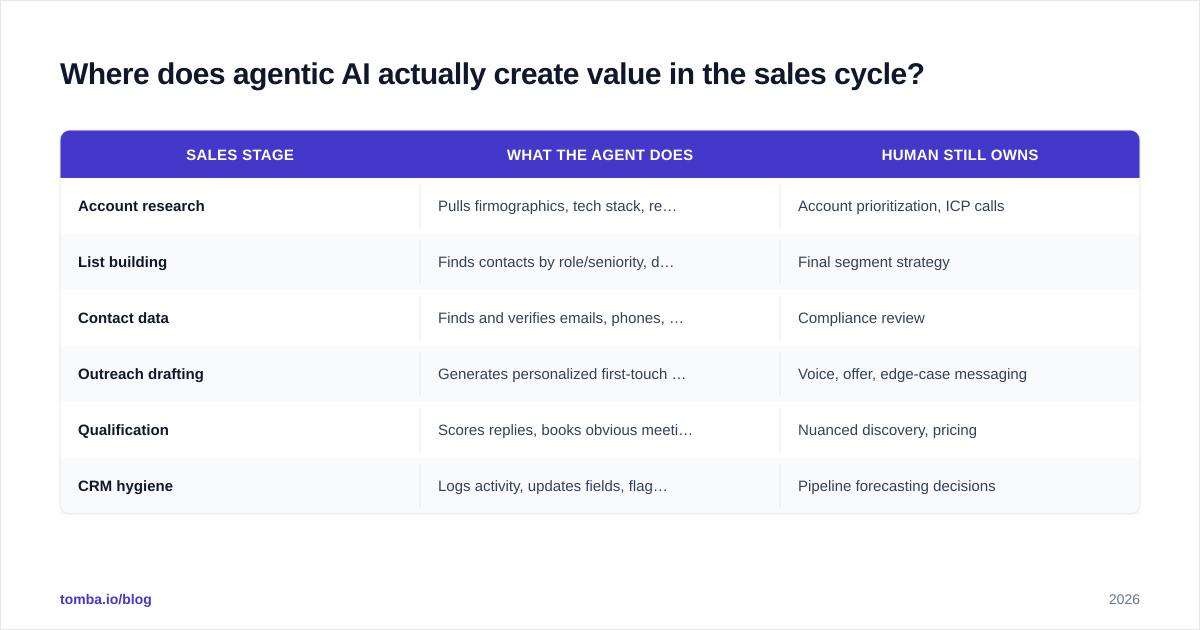
Here is a practical map of the funnel and how agentic automation lands in each stage.
| Sales stage | What the agent does | Human still owns |
|---|---|---|
| Account research | Pulls firmographics, tech stack, recent news | Account prioritization, ICP calls |
| List building | Finds contacts by role/seniority, dedupes | Final segment strategy |
| Contact data | Finds and verifies emails, phones, LinkedIn | Compliance review |
| Outreach drafting | Generates personalized first-touch + follow-ups | Voice, offer, edge-case messaging |
| Qualification | Scores replies, books obvious meetings | Nuanced discovery, pricing |
| CRM hygiene | Logs activity, updates fields, flags stale records | Pipeline forecasting decisions |
Notice that every row depends on accurate contact data. An agent that drafts a flawless sequence to a bounced inbox produces nothing but a damaged sender reputation. That is why a verification layer — running every address through an email verifier before send — is not optional in an agentic stack. It is the difference between automation and amplified waste.
If you want a deeper grounding on why bad data sinks automation, the concept of a marketing qualified lead only works when the underlying record is real and reachable in the first place.
What does an agentic sales workflow look like end to end?#
Picture a single goal handed to an agent on Monday morning: "Book five qualified demos with Series B SaaS marketing leaders this week." A well-built agent breaks that into a chain like this.
- Define the target. Translate the goal into an ICP filter: Series B, SaaS, marketing titles, North America.
- Build the list. Run a domain search across target companies to surface people in the right roles.
- Find contacts. Resolve names to verified work emails and, where allowed, phone numbers.
- Enrich. Append role, seniority, company size, and recent triggers so messaging can be specific.
- Draft and sequence. Generate a three-touch sequence personalized to each lead's trigger event.
- Verify before send. Drop catch-all and risky addresses; only sequence confirmed-valid inboxes.
- Execute and log. Send through your sending tool, then write every action back to the CRM.
- Watch replies. Classify responses, auto-book the easy yeses, and escalate the rest to a human.
The orchestration can run on whatever you already use — a workflow tool like Zapier or Make.com, a custom script hitting the Tomba API, or an MCP-based agent through the Tomba MCP server. The point is not the platform. The point is that steps 2 through 7 used to be a human's entire day, and now they are a supervised loop.

What are the risks of handing sales to AI agents?#
The biggest risk is speed without judgment: an agent can do the wrong thing 1,000 times before lunch. Autonomy multiplies whatever you point it at, including mistakes.
Watch these failure modes specifically:
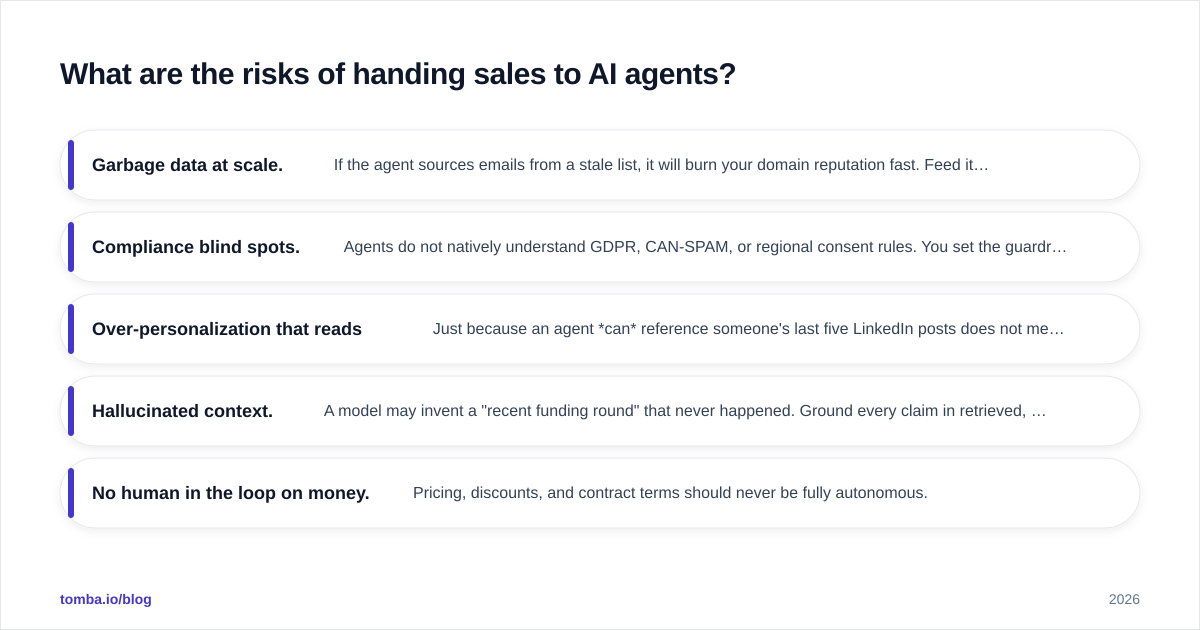
- Garbage data at scale. If the agent sources emails from a stale list, it will burn your domain reputation fast. Feed it verified data and check email deliverability signals continuously.
- Compliance blind spots. Agents do not natively understand GDPR, CAN-SPAM, or regional consent rules. You set the guardrails; they do not invent them.
- Over-personalization that reads as creepy. Just because an agent can reference someone's last five LinkedIn posts does not mean it should.
- Hallucinated context. A model may invent a "recent funding round" that never happened. Ground every claim in retrieved, verifiable data, not generation.
- No human in the loop on money. Pricing, discounts, and contract terms should never be fully autonomous.
The fix is not to avoid agents — it is to scope them tightly. Give an agent a narrow goal, read-only access where possible, a verification gate before any outbound action, and a clear escalation path to a human. Treat it like a new SDR on day one: capable, fast, and in need of supervision until it earns trust.
Which tasks should stay human in 2026?#
Keep humans on the parts of selling that are relational, strategic, or irreversible. Agents are excellent at finding and preparing; people are still better at deciding and persuading.
| Keep human | Safe to delegate to an agent |
|---|---|
| Discovery call nuance and active listening | Pre-call research and account briefs |
| Pricing and negotiation | Building and enriching target lists |
| Reading buyer emotion and intent | Verifying contact data at scale |
| Complex multi-threaded deals | First-touch drafting and follow-up cadence |
| Final go/no-go on a contract | CRM logging and data hygiene |
| Brand voice and messaging strategy | Routine reply classification |
A useful rule: if a mistake is cheap and reversible, let the agent run. If a mistake is expensive or relationship-ending, keep a human's hand on it. Booking a meeting with a slightly-off subject line is cheap. Quoting the wrong annual price to an enterprise buyer is not.
How do you start a low-risk agentic AI pilot this quarter?#
Start with one narrow, measurable workflow that touches data but not dollars — list-building and enrichment is the classic first win. You prove value without risking a deal.
A pragmatic 30-day pilot:
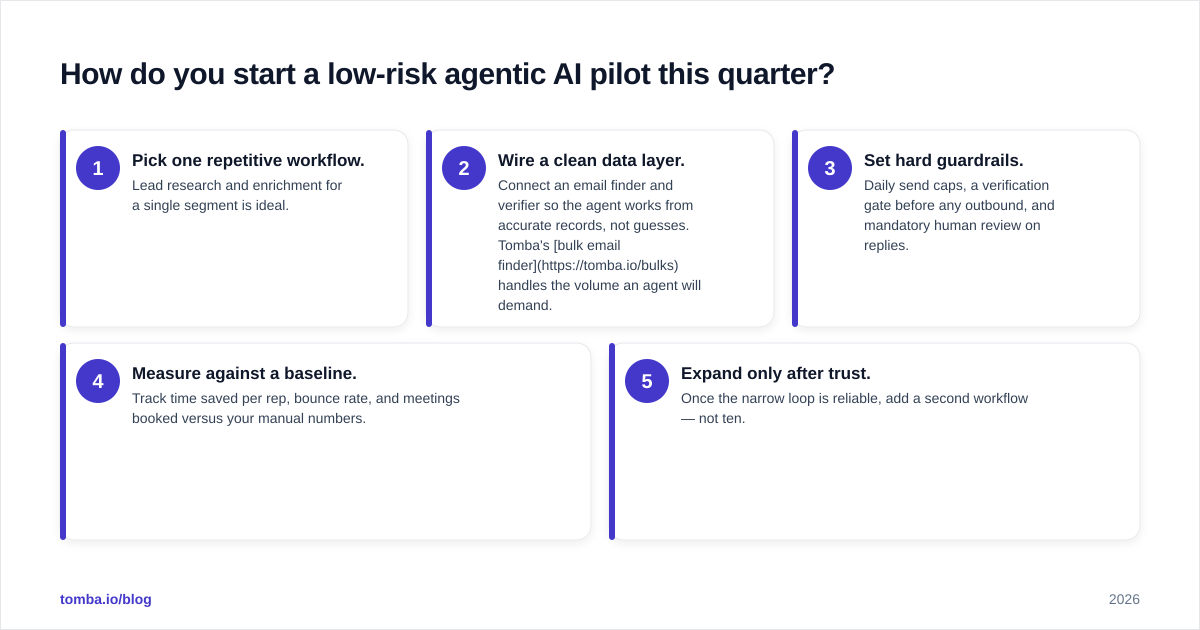
- Pick one repetitive workflow. Lead research and enrichment for a single segment is ideal.
- Wire a clean data layer. Connect an email finder and verifier so the agent works from accurate records, not guesses. Tomba's bulk email finder handles the volume an agent will demand.
- Set hard guardrails. Daily send caps, a verification gate before any outbound, and mandatory human review on replies.
- Measure against a baseline. Track time saved per rep, bounce rate, and meetings booked versus your manual numbers.
- Expand only after trust. Once the narrow loop is reliable, add a second workflow — not ten.
Keep the budget honest, too. You do not need an enterprise platform to start. Review the Tomba pricing tiers — the Free plan gives you 25 searches a month to test wiring, and the $49/mo Starter plan covers a real pilot. Compare that to the cost of a single SDR's wasted week, and the math favors a small, supervised experiment over a big-bang rollout.
For teams already living in HubSpot or Salesforce, the fastest path is to bolt the data layer onto your existing CRM with the HubSpot integration or Salesforce integration, so the agent reads and writes where your reps already work. G2's sales AI category is a reasonable place to scan adjacent tools once your foundation is solid.
What does the agentic sales stack look like underneath?#
An agentic sales system is really four layers stacked on top of each other, and most failed pilots skip the bottom one.
- Data layer. Accurate, verified contacts and firmographics. This is the foundation — get it wrong and everything above it amplifies the error.
- Tool layer. The APIs the agent can call: finders, verifiers, enrichment, CRM, sending platform.
- Orchestration layer. The agent loop itself — planning, sequencing tool calls, retrying, escalating.
- Supervision layer. Human guardrails, approval gates, and analytics that keep the loop honest.
Most vendors sell you the orchestration layer and assume you have the rest. In practice the data layer is where pilots live or die. An agent reasoning over verified emails, real phone numbers via a phone finder, and current company data behaves like a sharp SDR. The same agent reasoning over a scraped, unverified list behaves like a liability. Invest from the bottom up.
The bottom line#
Agentic AI for sales in 2026 is not about replacing reps — it is about deleting the repetitive research, enrichment, and admin that keeps them off the phone. The teams winning with it are not the ones with the flashiest agent; they are the ones feeding their agents clean, verified data and supervising tight, narrow workflows.
Start with the foundation. Before you orchestrate a single autonomous loop, make sure every contact your agent touches is real and reachable. Tomba's Email Finder gives your agents accurate, verified emails by domain, name, or company — the data layer that turns an autonomous SDR into a productive one instead of an expensive one. Spin up the free tier, wire it into your first pilot, and let your agents work from facts, not guesses.
// get started
Find, verify and enrich your first contacts today
Start on the free plan with 25 searches a month, then scale when your team is ready.
Free plan · No credit card required · GDPR & CCPA
// about the author