Agile Education Marketing: Pricing, Reviews, Pros & Cons (2026)
A neutral 2026 breakdown of Agile Education Marketing — what its education data costs, where reviewers say it shines, and where it falls short for K-12 and higher-ed teams.
If you sell into schools, districts, colleges, or ed-tech buyers, you have probably run into Agile Education Marketing. It is one of the older names in education-specific contact data. But "older and well-known" is not the same as "right for your budget," and the pricing is not on a public page where you can just check it.
This is a neutral teardown: what the company actually sells, what it costs in 2026, what reviewers consistently praise and complain about, and where the honest trade-offs are versus a general-purpose data stack.
TL;DR#
- What it is: A data and marketing-services vendor focused exclusively on the U.S. education market — K-12 schools, districts, higher ed, and the administrators inside them.
- Pricing: Quote-based, no public price list. Education lists typically start in the low thousands of dollars; managed email campaigns and append services cost more.
- Best for: Ed-tech vendors, publishers, and institutional sellers who need verticalized education contacts and don't want to build that data themselves.
- Weak spots: Cost, list freshness/decay, minimum commitments, and limited self-serve tooling compared with modern data platforms.
- The smart move: Treat any purchased education list as raw input — re-verify it before you send, or pair it with a self-serve finder you control.
What is Agile Education Marketing?#
Agile Education Marketing is a niche B2B data provider built around one vertical: the U.S. education sector. Think of it less like a general contact database and more like a specialist supplier — the way a restaurant buys seafood from a dedicated fish wholesaler instead of a wholesale-everything warehouse.
Its core offerings fall into three buckets:
- Education contact lists — segmented by institution type (K-12 public/private, charter, district office, community college, four-year university), role (superintendent, principal, curriculum director, IT decision-maker, professor), grade level, and geography.
- Data services — email and postal append, list hygiene, and enrichment against their education file.
- Managed marketing — done-for-you email deployment, multichannel campaigns, and lead programs aimed at education buyers.
The pitch is verticalization. A generic provider might tag someone as "Director, Education," but a specialist claims to know whether that person controls a curriculum budget, which grade bands they oversee, and the district's enrollment size. For a publisher selling a literacy program to elementary schools, that granularity is the whole point.
How much does Agile Education Marketing cost in 2026?#
Short answer: there is no published price, and you will get a custom quote. That is the single most common frustration in reviews, so set expectations early.
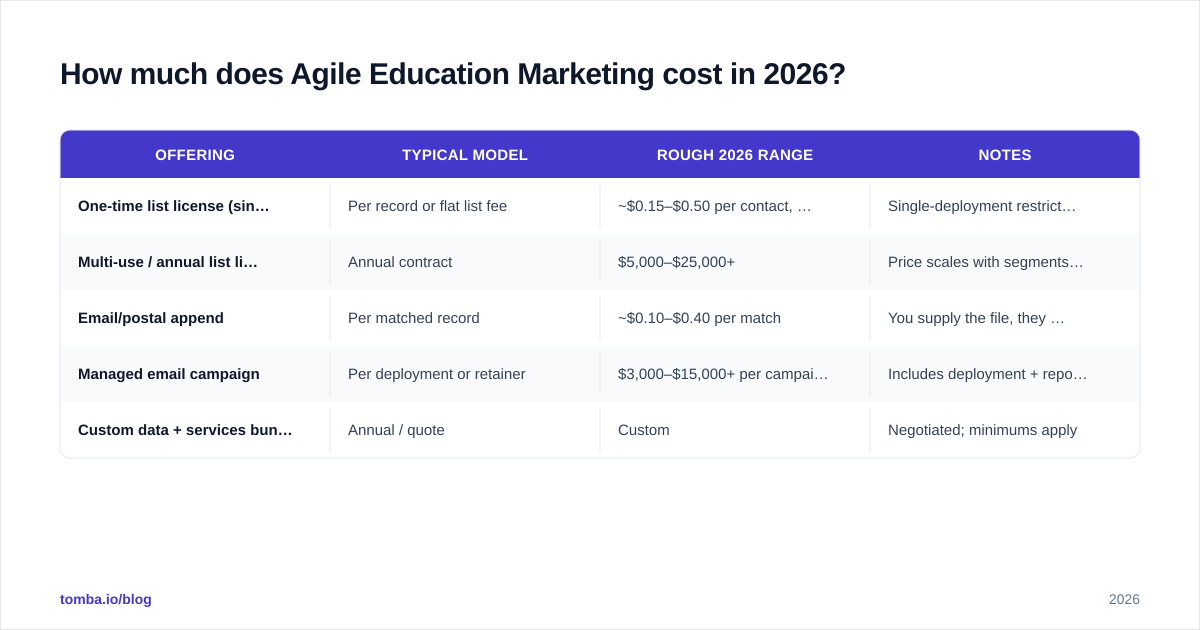
Based on how the vendor and comparable education-data sellers package deals, here is the realistic shape of the spend in 2026:
| Offering | Typical model | Rough 2026 range | Notes |
|---|---|---|---|
| One-time list license (single use) | Per record or flat list fee | ~$0.15–$0.50 per contact, often $2,000+ minimum | Single-deployment restrictions are common |
| Multi-use / annual list license | Annual contract | $5,000–$25,000+ | Price scales with segments and volume |
| Email/postal append | Per matched record | ~$0.10–$0.40 per match | You supply the file, they enrich it |
| Managed email campaign | Per deployment or retainer | $3,000–$15,000+ per campaign | Includes deployment + reporting |
| Custom data + services bundle | Annual / quote | Custom | Negotiated; minimums apply |
Two things matter more than the headline numbers. First, licensing terms: many education lists are sold for single-use deployment, meaning you cannot just load them into your CRM forever — re-use can require another license. Second, minimums: small teams often discover the entry commitment is higher than they expected.
If predictable, self-serve billing matters to you, compare this against transparent Tomba pricing, where a Free tier gives 25 searches a month and paid plans start at $49/mo (Starter), $99/mo (Growth), and $249/mo (Pro). Different product, but it frames what "no surprises" billing looks like.
What do reviews say about Agile Education Marketing?#
Public review volume on sites like G2 and Capterra is thinner than for mainstream sales tools, which itself tells you something — this is a specialist serving a specific buyer, not a mass-market SaaS. Reading across reviews, sales communities, and direct buyer feedback, a consistent pattern emerges.
What reviewers praise:
- Depth of education segmentation. Buyers repeatedly say the targeting beats generic databases for reaching the right administrator or department.
- Account support. Managed-service and list customers tend to like having a human who knows the education vertical.
- Coverage of hard-to-find roles. District-level and institutional contacts that are tedious to source manually.
What reviewers criticize:
- Opaque pricing and sales friction. Everything routes through a quote and a sales conversation.
- Data decay. Education has brutal annual turnover — staff change roles every summer — and some buyers report bounced or stale records.
- Limited self-serve tooling. You don't get a modern dashboard to search, filter, and pull contacts on demand the way you do with newer platforms.
- Minimums and licensing limits. Single-use restrictions surprise teams that assumed they were buying data outright.
The data-decay complaint is not unique to this vendor — it is structural to the education vertical. That is exactly why your verification step matters more than which list you buy.
What are the pros and cons of Agile Education Marketing?#
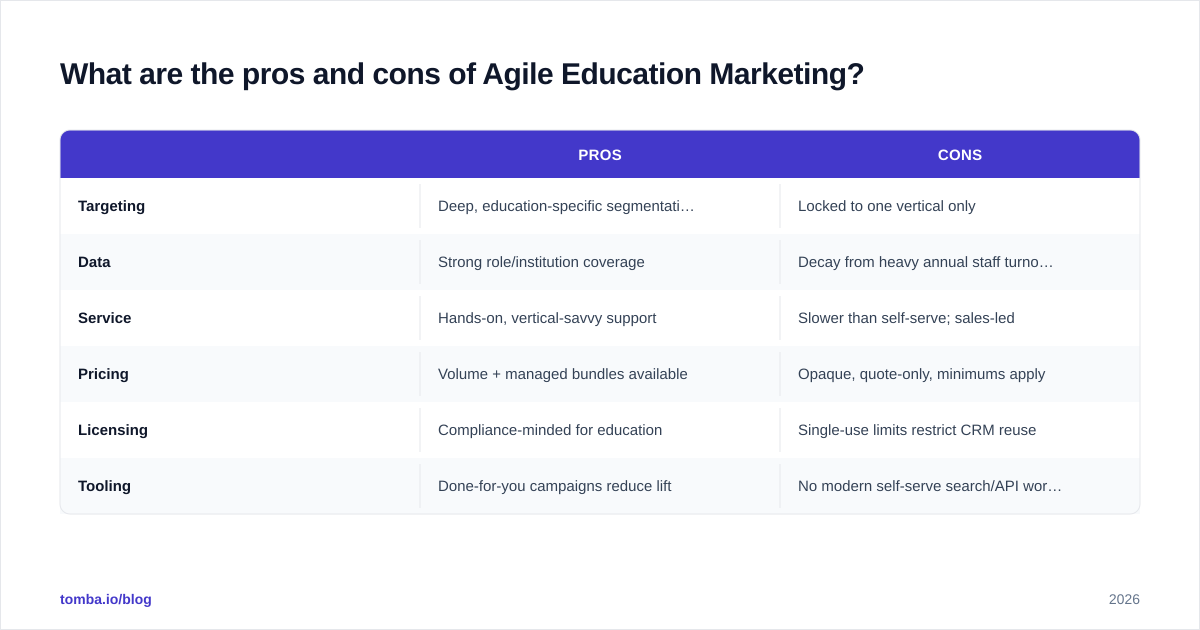
| Pros | Cons | |
|---|---|---|
| Targeting | Deep, education-specific segmentation | Locked to one vertical only |
| Data | Strong role/institution coverage | Decay from heavy annual staff turnover |
| Service | Hands-on, vertical-savvy support | Slower than self-serve; sales-led |
| Pricing | Volume + managed bundles available | Opaque, quote-only, minimums apply |
| Licensing | Compliance-minded for education | Single-use limits restrict CRM reuse |
| Tooling | Done-for-you campaigns reduce lift | No modern self-serve search/API workflow |
The honest summary: Agile Education Marketing is a credible specialist if education is your entire go-to-market and you want someone else to own the data and deployment. It is a poor fit if you want transparent pricing, on-demand self-serve access, or you only need education contacts as one slice of a broader prospecting motion.
How does Agile Education Marketing compare to the alternatives?#
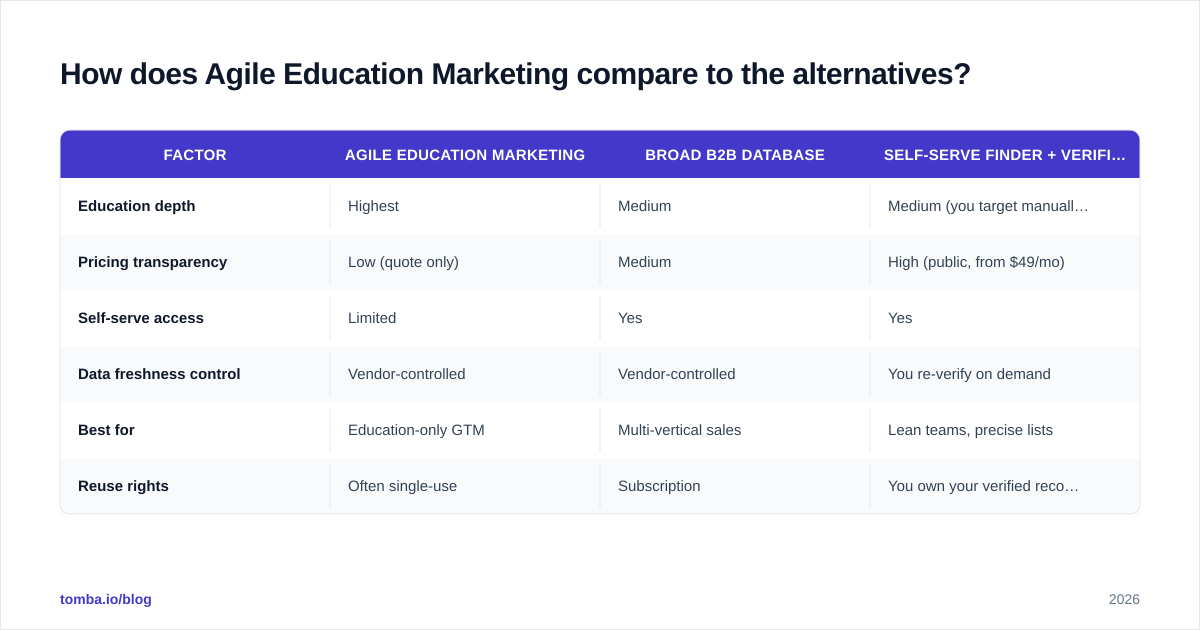
There are three realistic paths to education contacts: a vertical specialist (Agile Education Marketing), a broad B2B database, or a self-serve email finder you control and verify yourself. Most effective teams in 2026 blend the last two.
| Factor | Agile Education Marketing | Broad B2B database | Self-serve finder + verifier |
|---|---|---|---|
| Education depth | Highest | Medium | Medium (you target manually) |
| Pricing transparency | Low (quote only) | Medium | High (public, from $49/mo) |
| Self-serve access | Limited | Yes | Yes |
| Data freshness control | Vendor-controlled | Vendor-controlled | You re-verify on demand |
| Best for | Education-only GTM | Multi-vertical sales | Lean teams, precise lists |
| Reuse rights | Often single-use | Subscription | You own your verified records |
A common stack that works: use a self-serve tool to pull and verify contacts by institution domain, then layer a specialist list only for the hard segments you cannot reach yourself. For the self-serve half, a domain search pulls every public address on a district or university domain, and an email verifier catches the dead records before they wreck your sender reputation. For large pulls, a bulk email finder handles thousands of institutions at once.
How should you vet education data before you buy?#
Conclusion first: never send to a purchased education list raw. Treat every list — from any vendor — as an unverified input, then run it through a fixed gate.
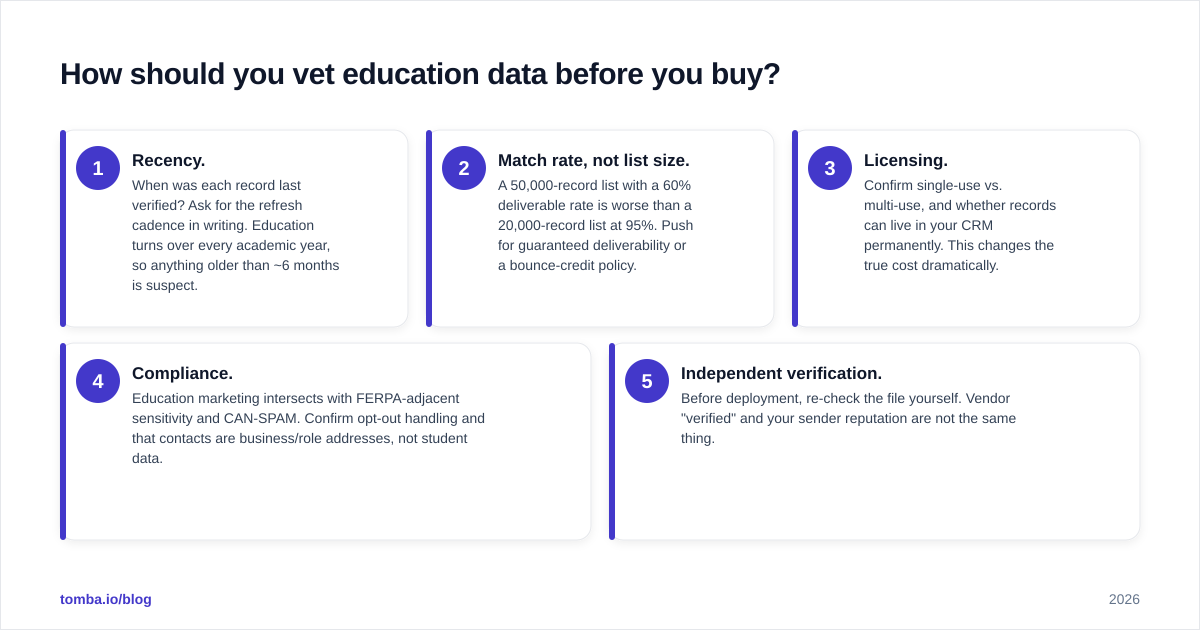
Use this five-point framework when you evaluate Agile Education Marketing or any competitor:
- Recency. When was each record last verified? Ask for the refresh cadence in writing. Education turns over every academic year, so anything older than ~6 months is suspect.
- Match rate, not list size. A 50,000-record list with a 60% deliverable rate is worse than a 20,000-record list at 95%. Push for guaranteed deliverability or a bounce-credit policy.
- Licensing. Confirm single-use vs. multi-use, and whether records can live in your CRM permanently. This changes the true cost dramatically.
- Compliance. Education marketing intersects with FERPA-adjacent sensitivity and CAN-SPAM. Confirm opt-out handling and that contacts are business/role addresses, not student data.
- Independent verification. Before deployment, re-check the file yourself. Vendor "verified" and your sender reputation are not the same thing.
That last step is where most teams cut corners and pay for it in bounces. Run any purchased file through a verification pass — a catch-all verifier is essential here because education domains frequently accept-all, which hides dead inboxes behind a "valid" SMTP response.
For context on why this matters, weak list hygiene is the fastest way to damage email deliverability — once your domain reputation drops, even your good emails land in spam. The economics are simple: verification costs cents per record; a blacklisted sending domain costs you the channel.
Is Agile Education Marketing right for you?#
Choose Agile Education Marketing if all of these are true:
- Education is your primary or only market.
- You want a vendor to own data sourcing and, ideally, campaign deployment.
- You have budget for quote-based, four- to five-figure commitments.
- You value vertical depth over self-serve speed and pricing transparency.
Look elsewhere — or build a hybrid stack — if:
- You need education contacts as one part of a broader, multi-vertical motion.
- You want transparent, predictable, self-serve pricing.
- You prefer to find, verify, and own your records on demand rather than license a static list.
- You are a lean team that cannot absorb high minimums.
For tooling decisions, frameworks like analyst reviews on HubSpot's blog and category listings on Capterra are useful sanity checks before you commit to any annual data contract.
The bottom line#
Agile Education Marketing earns its niche: when you need deep, role-level education targeting and want a partner to handle the heavy lifting, it delivers something generic databases cannot. The trade-offs are equally real — opaque pricing, single-use licensing, data decay, and limited self-serve control.
Whatever you buy, own your verification step. The teams that win in education outbound aren't the ones with the biggest list; they're the ones whose list actually reaches a live inbox.
If you'd rather find and control your own education contacts — pulling verified, role-level addresses by school or district domain instead of licensing a static file — start with the Tomba Email Finder. Search by domain, name, or company, verify every result before you send, and only pay for the data you actually use. It pairs cleanly with a purchased specialist list when you need one, and replaces it entirely when you don't.
// get started
Find, verify and enrich your first contacts today
Start on the free plan with 25 searches a month, then scale when your team is ready.
Free plan · No credit card required · GDPR & CCPA
// about the author