Agile Education Marketing vs LeadsForge: 2026 Data Showdown
Picking an education data source in 2026? We compare Agile Education Marketing vs LeadsForge on accuracy, coverage, pricing, and compliance so you buy the right list.
Selling into schools, districts, colleges, and edtech buyers lives or dies on one thing: the quality of the contact data behind your outreach. Two names come up constantly when education marketers shop for that data — Agile Education Marketing, the long-running specialist database, and LeadsForge, a newer, automation-first lead source. They solve the same problem from opposite ends.
This guide breaks down where each one wins, where each one frustrates buyers, and how to decide which fits your motion in 2026.
TL;DR#
- Agile Education Marketing is the depth play: deep K-12 and higher-ed coverage, role-level segmentation (superintendents, principals, curriculum directors), and compliance built for the education vertical. Best for enterprise edtech and publishers running large, segmented campaigns.
- LeadsForge is the speed play: self-serve, automation-first, lower entry price, and faster list builds. Best for lean teams and startups that want leads today without a sales call.
- Neither tool is a true email verification layer — both ship records you should re-verify before sending, or you risk bounces and sender-reputation damage.
- Pricing models differ sharply: Agile leans toward licensed-data contracts and custom quotes; LeadsForge leans toward transparent monthly tiers and credits.
- The smart 2026 setup is hybrid: source from a specialist, then verify and enrich with a tool like Tomba before the data touches your sequencer.
What is Agile Education Marketing?#
Agile Education Marketing is a data and marketing-services company focused entirely on the education sector. Think of it as the specialist library versus a general bookstore — it doesn't try to cover every industry, it goes deep on one. Their database spans U.S. K-12 schools and districts, higher education, early childhood, and the administrators and educators inside them, with segmentation by role, subject, grade level, enrollment size, and geography.
Because education is a regulated, relationship-heavy market, Agile positions itself around data governance, opt-in sourcing, and channel services (email deployment, direct mail, digital audiences) layered on top of the raw records. You can buy a list, or you can hand them a campaign to run. That full-service angle is the core reason enterprise edtech vendors and curriculum publishers keep them on a contract.
You can review their positioning on the Agile Education Marketing homepage and cross-check user sentiment on G2.
What is LeadsForge?#
LeadsForge is an automation-first lead generation platform built for speed and self-service. Where Agile is the consultative specialist, LeadsForge is the vending machine: you describe an audience, it assembles a list, and you export or push it into your outreach stack — often within minutes, no account executive required.
It typically uses AI-assisted search and prompt-style inputs ("find curriculum directors at districts over 5,000 students") to generate contact lists across roles and industries, including but not limited to education. That generalist breadth is a double-edged sword: you get flexibility and a low barrier to entry, but you trade away the vertical-specific governance and role taxonomy that an education-only provider bakes in.
For lean teams that value momentum over a polished enterprise relationship, that tradeoff is often worth it. Check current reviews on Capterra before committing.
How do Agile Education Marketing and LeadsForge compare head-to-head?#
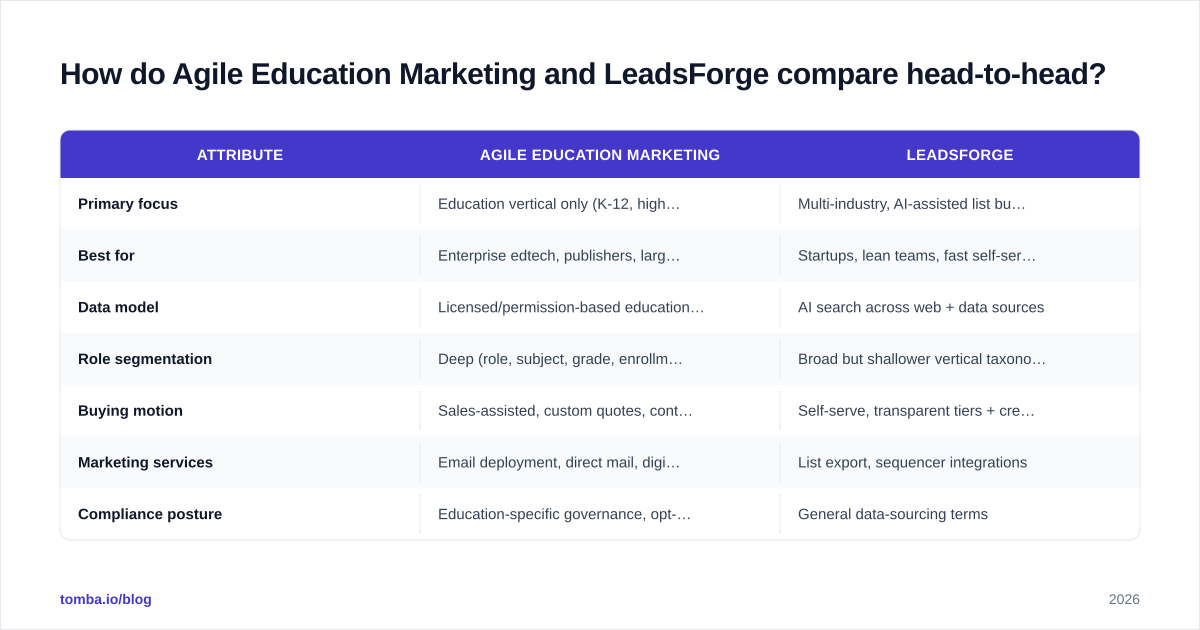
Here is the practical comparison most buyers actually need. Treat the data figures as directional — both vendors update coverage and pricing frequently, so confirm specifics during your trial.
| Attribute | Agile Education Marketing | LeadsForge |
|---|---|---|
| Primary focus | Education vertical only (K-12, higher ed, early childhood) | Multi-industry, AI-assisted list building |
| Best for | Enterprise edtech, publishers, large segmented campaigns | Startups, lean teams, fast self-serve list builds |
| Data model | Licensed/permission-based education database | AI search across web + data sources |
| Role segmentation | Deep (role, subject, grade, enrollment, geo) | Broad but shallower vertical taxonomy |
| Buying motion | Sales-assisted, custom quotes, contracts | Self-serve, transparent tiers + credits |
| Marketing services | Email deployment, direct mail, digital audiences | List export, sequencer integrations |
| Compliance posture | Education-specific governance, opt-in sourcing | General data-sourcing terms |
| Built-in email verification | Limited | Limited |
| Time to first list | Days (consultative) | Minutes (self-serve) |
| Entry price | Higher, quote-based | Lower, published tiers |
The pattern is clear: Agile trades speed and price for depth and governance; LeadsForge trades depth for speed and accessibility. Your motion decides which tradeoff is correct.
)
Is Agile Education Marketing better than LeadsForge?#
It depends on what you're optimizing for — there is no universal winner, only a winner for your motion.
Choose Agile Education Marketing if:
- Education is your only market and you need role-level precision (you're targeting Title I coordinators, not "decision makers").
- You run large, recurring campaigns and want a managed-services partner to deploy them.
- Compliance and data provenance are non-negotiable — you sell into districts with strict procurement and privacy rules.
- Your deal sizes justify a contract and a custom quote.
Choose LeadsForge if:
- You're a startup or small team that needs leads this week, not after a procurement cycle.
- Your audience spans education and other verticals, so a generalist tool reduces tool sprawl.
- You want transparent, self-serve pricing without a sales call.
- You'd rather iterate on small list builds quickly than commit to a large licensed dataset.
A useful analogy: Agile is hiring a specialist research firm; LeadsForge is buying a powerful self-serve tool. The firm gives you depth and accountability. The tool gives you autonomy and speed. Both are legitimate — the mistake is buying one when your motion clearly needs the other.
What about data accuracy and deliverability?#
Here is the part most comparison posts skip, and it's the one that decides whether your campaign actually lands.
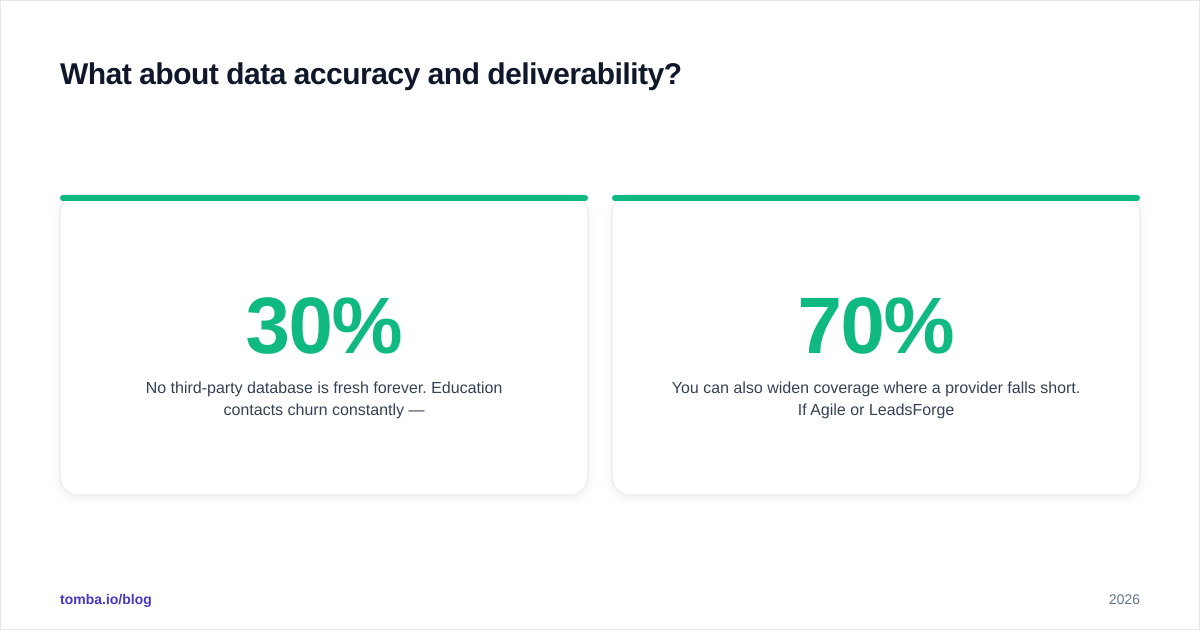
No third-party database is fresh forever. Education contacts churn constantly — teachers change schools every summer, administrators rotate, districts consolidate. Industry benchmarks routinely show B2B contact data decaying 20-30% per year, and education's seasonal hiring cycle makes it worse. So whether you buy from Agile or LeadsForge, a meaningful slice of those records will be stale on arrival.
That matters because mailbox providers punish bad sending. A list with a high invalid rate drives bounces, and bounces wreck your sender reputation and your broader email deliverability. One bad bulk send can quietly suppress months of good outreach.
The fix is a verification step between sourcing and sending. Before any purchased education list enters your sequencer, run it through an email verifier to drop invalids, flag risky catch-all domains, and confirm deliverability. School domains are frequently catch-all configured, so a dedicated catch-all verifier is especially valuable in this vertical.
)
You can also widen coverage where a provider falls short. If Agile or LeadsForge returns a record missing the contact's direct email, a domain search against the school or district domain often surfaces it, and data enrichment fills in title, seniority, and social profiles. This is how teams turn a "70% usable" list into a "95% usable" one without buying a second database.
How should you price out each option?#
Pricing philosophy is where these two diverge hardest, so model your real cost — not the sticker.
Agile Education Marketing generally operates on licensed-data agreements and custom quotes. You're often paying for a defined audience, a usage window, and optionally the deployment services on top. That can be cost-effective at scale but carries a higher floor and a procurement conversation.
LeadsForge leans toward published monthly tiers and a credit system, so you can start small and scale up. The transparency is a real advantage for budget-conscious teams, though per-record costs can climb as volume grows.
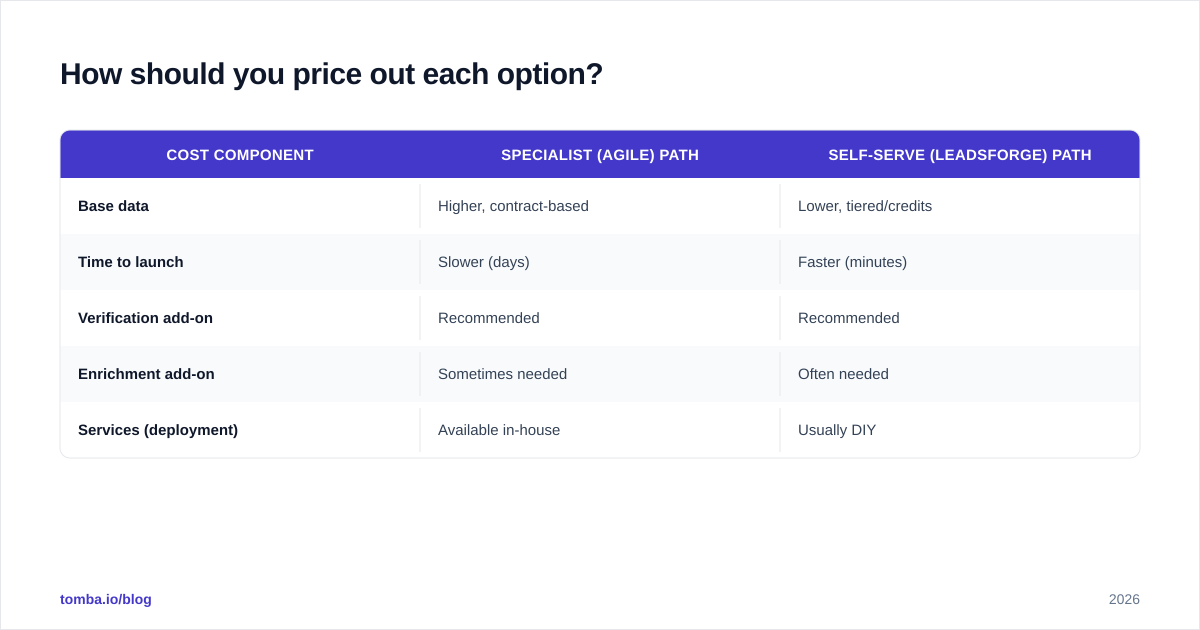
When you compare total cost, factor in the verification and enrichment layer either way. Here's how the math typically shakes out for a mid-size education campaign:
| Cost component | Specialist (Agile) path | Self-serve (LeadsForge) path |
|---|---|---|
| Base data | Higher, contract-based | Lower, tiered/credits |
| Time to launch | Slower (days) | Faster (minutes) |
| Verification add-on | Recommended | Recommended |
| Enrichment add-on | Sometimes needed | Often needed |
| Services (deployment) | Available in-house | Usually DIY |
Add a verification and enrichment tool, and your true cost-per-deliverable-contact often matters more than the headline data price. A cheaper list with a 25% invalid rate can cost more per usable contact than a pricier, cleaner one. For comparison on the verification side, Tomba pricing starts free (25 searches/month), then Starter at $49/mo and Growth at $99/mo — small relative to most education data contracts, and it directly protects the deliverability you're paying to reach.
Can you build an education list without either tool?#
For some teams, yes — at least partially. If your target list is small or you're testing a niche segment, you can assemble contacts directly from school and district domains rather than licensing a full database.
The workflow looks like this:
- Build your target account list (districts, schools, edtech companies, colleges).
- Run a domain search on each domain to pull associated professional emails and roles.
- Use the bulk email finder to process the whole account list at once instead of one domain at a time.
- Verify everything with an email verifier before import.
- Enrich the survivors so your CRM has clean titles, seniority, and firmographics.
This DIY route won't replace Agile's role taxonomy or LeadsForge's instant audiences for large campaigns, but it's a legitimate, lower-cost path for focused ABM-style education outreach — and it gives you full control over data freshness because you're pulling it live. Tomba's data sources page explains how the underlying records are gathered and scored, which is worth reading before you decide how much to trust any single provider, including this DIY approach.
Which one should you pick in 2026?#
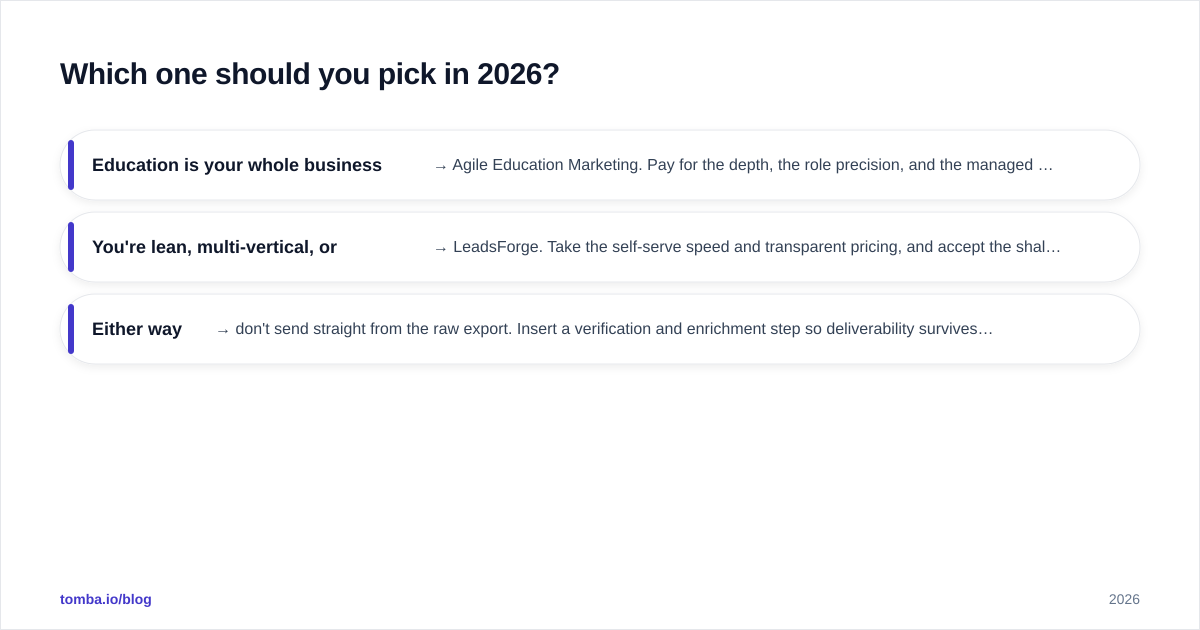
Decide with a single question: Is education your whole business, or one segment of it?
- Education is your whole business, deals are large, compliance is strict → Agile Education Marketing. Pay for the depth, the role precision, and the managed services. The contract is justified.
- You're lean, multi-vertical, or moving fast → LeadsForge. Take the self-serve speed and transparent pricing, and accept the shallower vertical taxonomy.
- Either way → don't send straight from the raw export. Insert a verification and enrichment step so deliverability survives contact with reality.
The teams that win in 2026 aren't the ones with the biggest list — they're the ones with the cleanest list reaching real inboxes. A specialist database gives you reach; a verification layer gives you results. You need both.
Ready to clean and extend any education list?#
Whichever provider you choose, the contacts you buy are only as good as the inboxes they actually reach. Run your Agile Education Marketing or LeadsForge export through the Tomba Email Finder and verifier to fill missing emails, drop invalids, confirm catch-all school domains, and enrich every record before it touches your sequencer. Start free with 25 searches a month, scale to Starter at $49/mo when you're ready, and stop paying — in bounces and burned reputation — for data nobody verified. Build the list with a specialist, but make it deliverable with Tomba.
// get started
Find, verify and enrich your first contacts today
Start on the free plan with 25 searches a month, then scale when your team is ready.
Free plan · No credit card required · GDPR & CCPA
// about the author