Agile Education Marketing vs SalesQL: 2026 Data Showdown
Static education lists or live LinkedIn enrichment? A neutral 2026 breakdown of Agile Education Marketing vs SalesQL — coverage, accuracy, pricing, and which fits your outbound motion.
TL;DR
- Agile Education Marketing is a niche data provider selling pre-built contact lists for the K-12, higher-ed, and education-technology markets. SalesQL is a horizontal LinkedIn email-and-phone extractor that pulls contacts in real time from profiles you browse.
- They solve different problems: Agile gives you a bought audience for education campaigns; SalesQL gives you self-serve enrichment for any vertical you prospect on LinkedIn.
- Agile wins on education-segment depth (roles, grade levels, district budgets). SalesQL wins on flexibility, price, and speed-to-first-contact.
- Neither verifies email deliverability the way a dedicated email verifier does, so plan a validation step either way.
- If your ICP spans more than the education sector, a domain-and-name email finder is usually the cheaper, more accurate backbone — more on that below.
What is Agile Education Marketing?#
Agile Education Marketing (now operating under the Market Data Retrieval / Agile family) is a list and audience vendor built specifically for companies that sell into education — curriculum publishers, ed-tech SaaS, school-supply brands, and higher-ed services. Instead of letting you search the open web, it licenses you a curated database of teachers, administrators, district decision-makers, and faculty, often segmented by subject, grade band, enrollment size, and funding.
Think of Agile like a specialty grocer. You don't wander the aisles assembling ingredients yourself; you order a pre-portioned meal kit tuned to one cuisine. That focus is the whole value proposition: the records are tagged with education-specific attributes you simply can't reconstruct from a LinkedIn scrape.
The trade-off is that you're buying a snapshot. Education staff turn over every summer, districts reorganize, and a list licensed in March can decay noticeably by September. You also buy in audience blocks rather than paying per useful contact.
What is SalesQL?#
SalesQL is a Chrome extension that finds personal and work emails plus phone numbers from LinkedIn and Sales Navigator profiles. You open a profile (or a search result set), click, and it returns enriched contact details you can export to CSV or push to a CRM. It's a horizontal tool — it doesn't care whether you're chasing school superintendents or SaaS CFOs.
If Agile is the meal kit, SalesQL is a smart shopping assistant that walks the aisles with you and reads the labels. You still choose the targets; it just surfaces the contact data on demand. You can review its real-user positioning on G2 and the feature set on the official SalesQL site.
The strength is immediacy and control: you enrich exactly the people you decide are worth contacting, and you pay roughly per credit. The weakness is that coverage is only as good as the LinkedIn footprint of your prospect — and many education staff (especially K-12 teachers) keep thin or no LinkedIn presence.
How do their data models actually differ?#
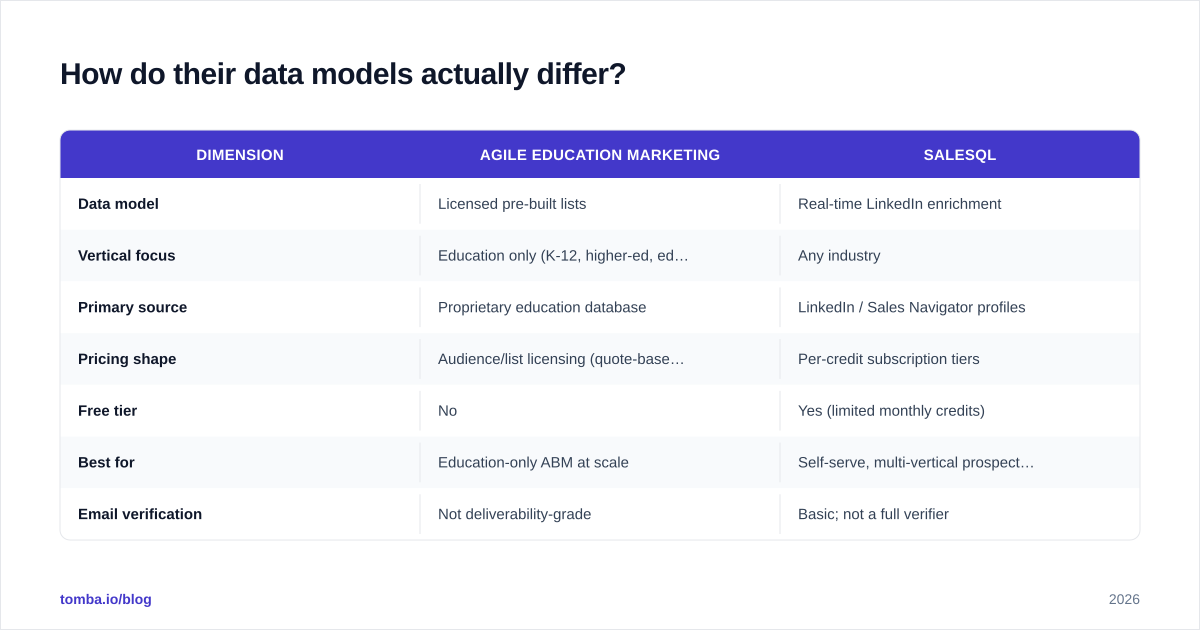
The core distinction is bought audience vs. on-demand enrichment, and it cascades into everything else — freshness, pricing, compliance, and the kind of campaign each one fits.
| Dimension | Agile Education Marketing | SalesQL |
|---|---|---|
| Data model | Licensed pre-built lists | Real-time LinkedIn enrichment |
| Vertical focus | Education only (K-12, higher-ed, ed-tech) | Any industry |
| Primary source | Proprietary education database | LinkedIn / Sales Navigator profiles |
| Pricing shape | Audience/list licensing (quote-based) | Per-credit subscription tiers |
| Free tier | No | Yes (limited monthly credits) |
| Best for | Education-only ABM at scale | Self-serve, multi-vertical prospecting |
| Email verification | Not deliverability-grade | Basic; not a full verifier |
| Data freshness risk | Decays after license date | Live at lookup, but LinkedIn-dependent |
| Phone numbers | Available in many records | Available on paid plans |
Notice that the freshness story flips depending on your motion. Agile's data is curated and attribute-rich the day you license it, then ages. SalesQL is fresh at the moment of lookup, but only for prospects who maintain real profiles. Neither model removes the need to validate before you send — a bounced send hurts your sender reputation regardless of where the address came from.
Which one is more accurate?#
Accuracy depends on whether your targets live where each tool looks. For education administrators and district leaders, Agile usually has deeper, better-tagged coverage — it knows the difference between a curriculum director and a procurement lead, and it carries institutional context (enrollment, Title I status, budget bands) that you'd never reconstruct from a profile.
For anyone with an active professional presence, SalesQL tends to be more current, because it reads the profile as it exists today rather than a record captured months ago. But its accuracy collapses for segments with weak LinkedIn adoption, and personal-email matches in particular vary in reliability.
The honest takeaway: both deliver raw contacts, not validated ones. Independent accuracy benchmarks across the email-finder category show wide spreads between vendors, and even strong sources need a verification pass.

Whatever you choose, run results through deliverability checks — a real email verifier plus a catch-all verifier for ambiguous domains — before committing them to a sequence. Education domains (.edu, district subdomains) are frequently catch-all, which is exactly where naive lists generate silent bounces.
How does pricing compare?#
Agile Education Marketing prices like a list broker: you request a quote for an audience that matches your filters, and cost scales with volume and segmentation depth. That makes budgeting predictable for a single large campaign but expensive if you only need a few hundred precise contacts.
SalesQL prices like SaaS: a free tier with a small monthly credit allowance, then paid plans that scale credits and add phone numbers and team seats. You can verify current tiers on its Capterra listing or the vendor site. For low-volume, high-precision prospecting, the per-credit model is far cheaper than licensing a block of records.
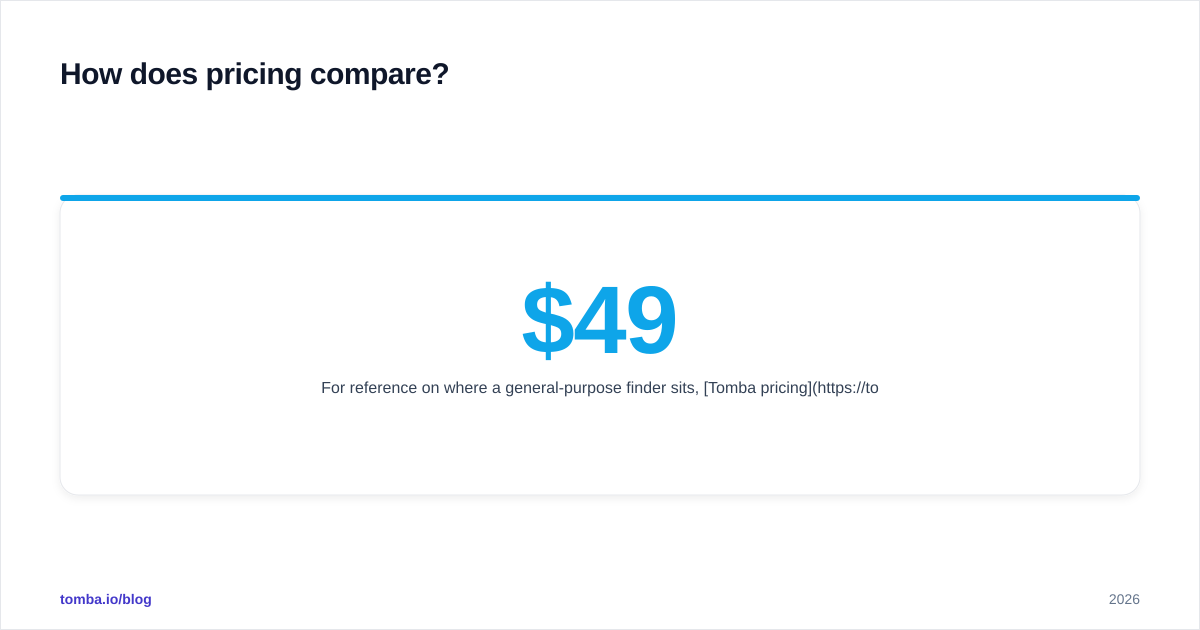
For reference on where a general-purpose finder sits, Tomba pricing runs a free tier at 25 searches/month, Starter at $49/mo, Growth at $99/mo, and Pro at $249/mo — credit-based like SalesQL but not locked to LinkedIn as the only source.
Which should you choose for your use case?#
Match the tool to the shape of your campaign, not to a feature checklist.
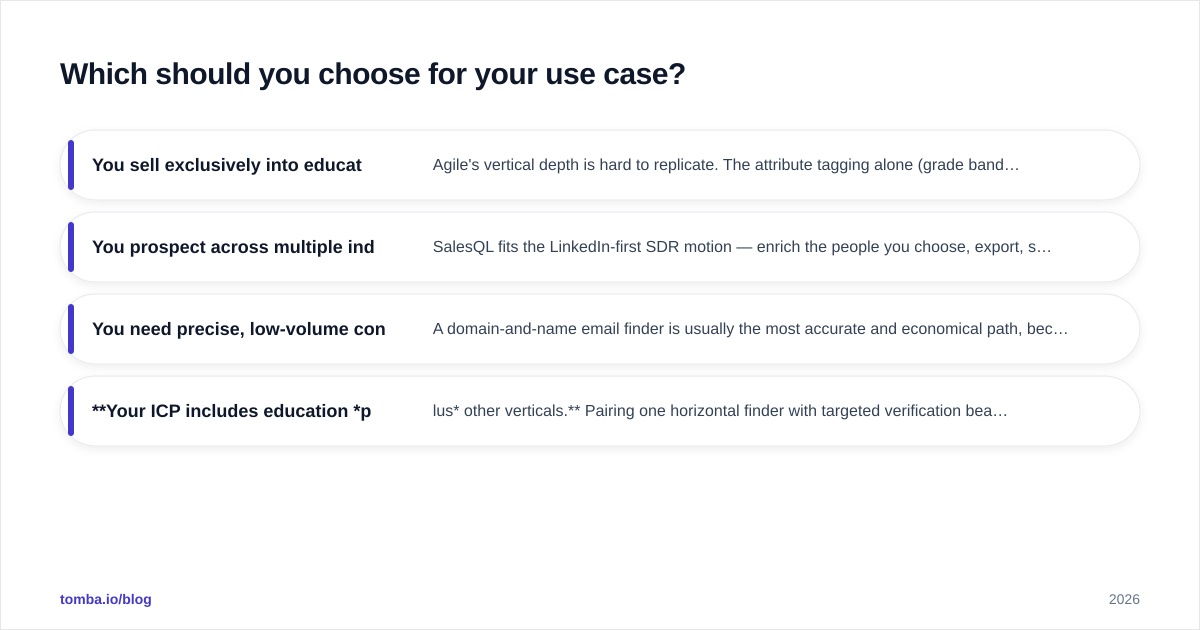
- You sell exclusively into education and run big, segmented campaigns. Agile's vertical depth is hard to replicate. The attribute tagging alone (grade band, district size, funding) can justify the licensing cost if education is your entire business.
- You prospect across multiple industries and want self-serve control. SalesQL fits the LinkedIn-first SDR motion — enrich the people you choose, export, sequence.
- You need precise, low-volume contacts without a LinkedIn dependency. A domain-and-name email finder is usually the most accurate and economical path, because it resolves addresses from company domains rather than profile availability.
- Your ICP includes education plus other verticals. Pairing one horizontal finder with targeted verification beats stitching a niche list vendor to a separate LinkedIn scraper.
For that last case, see the full email-finder field below — vertical list vendors and LinkedIn extractors are only two slices of it.

What about compliance and data freshness?#
Both models carry obligations. Licensed education lists must respect the terms of the license and applicable privacy rules (FERPA-adjacent contexts, CAN-SPAM, GDPR where EU staff are involved). On-demand LinkedIn extraction sits in a grayer zone around platform terms of service — useful, widely used, but you should understand the rules you operate under, especially for personal-email capture.
Freshness is the practical risk most teams underestimate. A bought list is a depreciating asset: budget a re-license or a re-verification pass each term. Live enrichment avoids the staleness problem but inherits LinkedIn's blind spots. The durable fix in both cases is an enrichment-and-verification layer that re-checks records on a schedule rather than trusting any single capture. Tools like data enrichment keep contact rows current as people change roles, which is the actual failure mode that kills education outreach after summer turnover.
Is there a simpler alternative to both?#
For most teams whose targeting isn't 100% education, yes. A general-purpose finder that resolves emails from a company domain and a name — then verifies them — gives you the multi-vertical reach of SalesQL without the LinkedIn dependency, and the precision of a list vendor without buying a depreciating block. You can also enrich an existing roster of schools or companies with a domain search instead of licensing a whole audience you'll only partly use.
The pattern that holds up in 2026: find from the domain, verify before you send, enrich on a cadence. That sequence is source-agnostic, so it survives whatever single tool you bolt on top.
The bottom line#
Agile Education Marketing and SalesQL aren't really rivals — they're different answers to different questions. Agile is the right call when education is your whole market and you want pre-segmented depth. SalesQL is the right call when you want flexible, self-serve, LinkedIn-driven enrichment across any vertical. Both still need a verification step you'll have to add yourself.
If your prospecting reaches beyond the education sector — or you simply want one accurate, affordable backbone instead of a niche list plus a scraper — start with the Tomba Email Finder. Resolve verified business emails from a company domain and name, enrich them as roles change, and keep your bounce rate low without licensing a list that's stale by next semester. Spin up the free tier, test it against your own target accounts, and only scale the spend once the accuracy proves out on your data.
// get started
Find, verify and enrich your first contacts today
Start on the free plan with 25 searches a month, then scale when your team is ready.
Free plan · No credit card required · GDPR & CCPA
// about the author