Agile Sales Organization in 2026: A Practical Playbook
An agile sales organization ships pipeline in short cycles, kills dead deals fast, and adapts to buyers in real time. Here is the 2026 operating model, roles, cadence, and metrics that make it work.
TL;DR
- An agile sales organization plans in short cycles (1–2 week sprints), reviews pipeline continuously instead of once a quarter, and reallocates effort the moment data says a play is dead.
- The model borrows three ideas from software teams — small cross-functional pods, time-boxed sprints, and retrospectives — and maps them onto pipeline, not code.
- The biggest unlock is feedback latency: rigid teams learn what works after the quarter ends; agile teams learn this week.
- It runs on clean data. Sprints fail when reps spend half their time hunting for contact details instead of selling.
- This guide gives you the operating model, a sample sprint cadence, the roles, and the metrics that prove it is working — plus where most rollouts break.
What is an agile sales organization?#
An agile sales organization is a revenue team that plans, executes, and adjusts in short, repeatable cycles instead of locking a plan for a full quarter and hoping it survives contact with the market.
Think of it like the difference between a cargo ship and a speedboat. A cargo ship sets a heading and commits — turning it takes miles. A speedboat reads the water and adjusts every few seconds. Traditional sales forecasting is the cargo ship: a number gets set in January, and everyone steers toward it even when February proves the assumptions wrong. Agile selling is the speedboat. You still have a destination, but you correct course constantly using real signals.
This is not "work faster and sweat more." It is a structural change in how decisions get made. The core mechanics come straight from Agile software development: short iterations, small cross-functional teams, visible work, and a hard discipline of reflecting and adjusting at the end of every cycle. The difference is the unit of work. For engineers it is a feature. For an agile sales org it is a pipeline play — a target segment, a message, a channel, and a motion you test for one or two weeks and then keep, kill, or double down on.
Why are rigid sales orgs losing in 2026?#
The short answer: buyers changed faster than annual plans can absorb.
Buying committees are larger, more research-driven, and far less tolerant of generic outreach than they were even three years ago. Gartner's research on the B2B buying journey shows buyers spend the majority of their time researching independently and only a sliver of it talking to any single vendor's reps. When the window to influence a deal is that thin, a sales motion that updates four times a year is structurally too slow.
Rigid orgs also bury their best information. A great talk track a rep discovers in week two of the quarter sits in that rep's head until the next QBR — if it surfaces at all. Multiply that across a 30-person team and you have an organization that is constantly relearning lessons it already paid for.
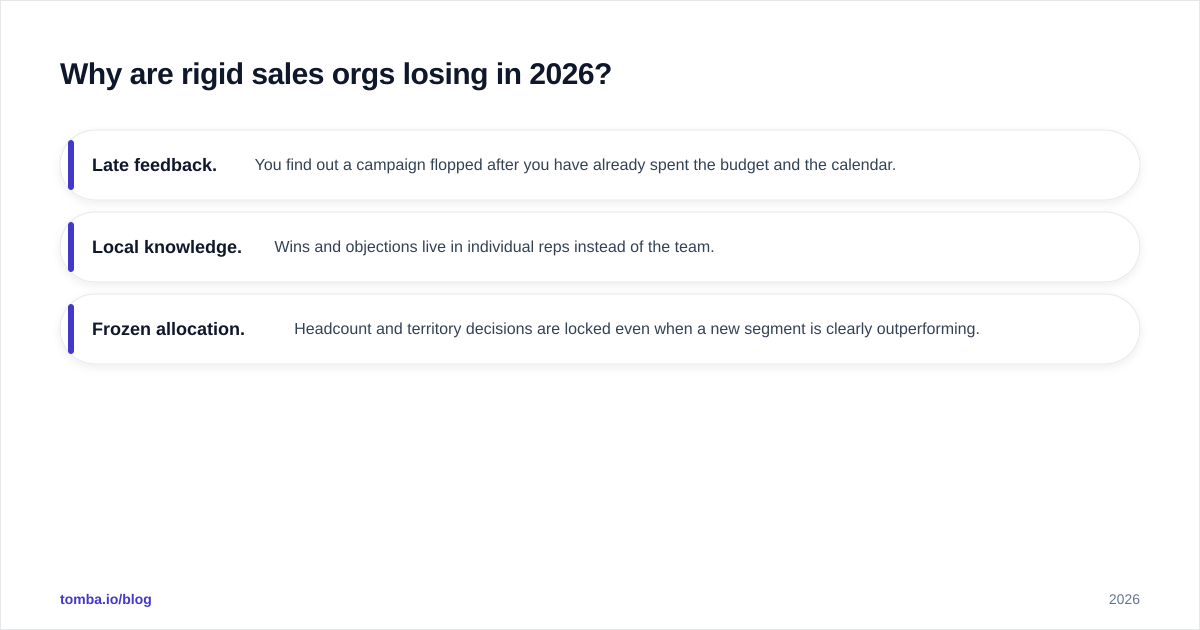
Three failure patterns show up again and again in waterfall-style sales teams:
- Late feedback. You find out a campaign flopped after you have already spent the budget and the calendar.
- Local knowledge. Wins and objections live in individual reps instead of the team.
- Frozen allocation. Headcount and territory decisions are locked even when a new segment is clearly outperforming.
How does agile sales work compared to traditional sales?#
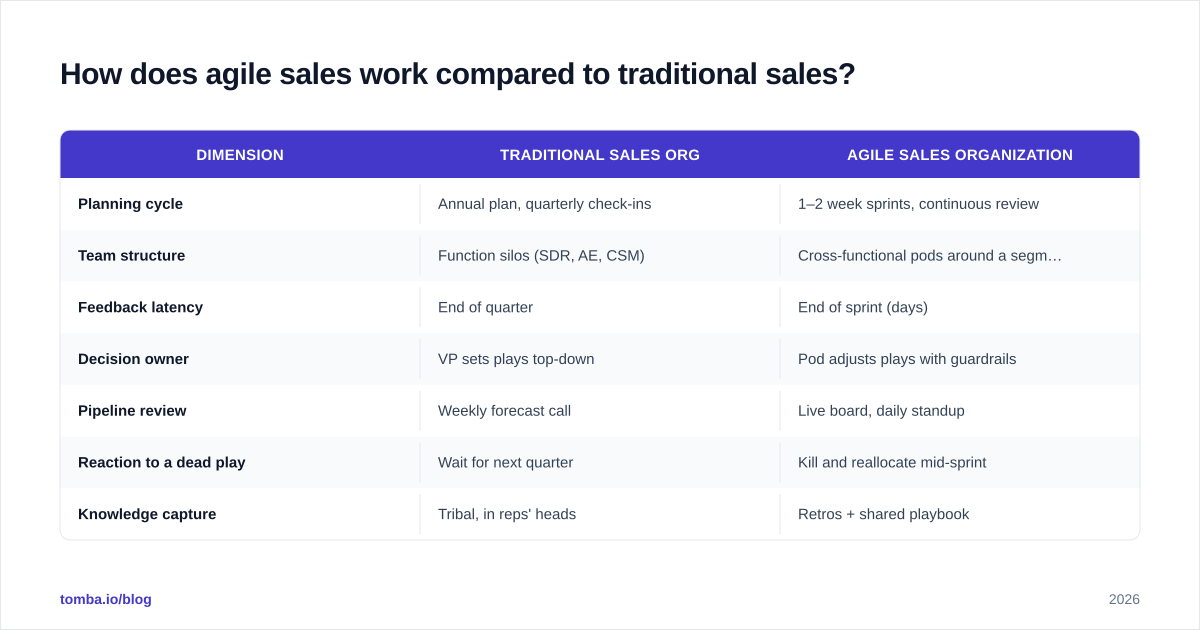
Here is the side-by-side. The agile column is not "better at everything" — it trades predictability of process for speed of learning. For most teams selling into fast-moving markets, that trade is worth it.
| Dimension | Traditional sales org | Agile sales organization |
|---|---|---|
| Planning cycle | Annual plan, quarterly check-ins | 1–2 week sprints, continuous review |
| Team structure | Function silos (SDR, AE, CSM) | Cross-functional pods around a segment |
| Feedback latency | End of quarter | End of sprint (days) |
| Decision owner | VP sets plays top-down | Pod adjusts plays with guardrails |
| Pipeline review | Weekly forecast call | Live board, daily standup |
| Reaction to a dead play | Wait for next quarter | Kill and reallocate mid-sprint |
| Knowledge capture | Tribal, in reps' heads | Retros + shared playbook |
| Core risk | Slow to adapt | Churn from over-pivoting |
The last row matters. The failure mode of agile is not rigidity — it is thrash. Teams that re-plan every two days never let a play run long enough to produce a signal. Sprints exist precisely to prevent that: inside the sprint, you commit; between sprints, you adjust.
What does an agile sales sprint cadence look like?#
A sprint is a fixed time box — usually one or two weeks — with a committed goal, a daily sync, and a closing review. Here is a clean two-week version you can copy.
Sprint planning (Monday, week 1). The pod picks 2–4 plays for the sprint. A play is concrete: "Reach 120 RevOps leaders at Series B SaaS companies with the migration-pain message via email + LinkedIn." Each play has an owner and a target metric.
Daily standup (15 min). Three questions, same as engineering: what moved yesterday, what is the plan today, what is blocking me. Blockers get cleared by the pod lead, not parked.
Mid-sprint signal check (Thursday, week 1). Look at leading indicators — reply rates, meeting bookings, not closed revenue. If a play is clearly cold, you decide whether to adjust the message or let it ride to the end of the sprint.
Sprint review (Friday, week 2). What did each play produce? Keep, kill, or scale. Winners get promoted into the shared playbook.
Retrospective (30 min). Not about deals — about the system. What slowed us down? What should we change about how we work next sprint? This is the meeting most teams skip and the one that compounds.
The whole point is to shorten the loop between trying something and knowing whether it worked. Faster loops mean more shots on goal and a win rate that climbs because you stop repeating losing motions.
What roles and structure does an agile sales org need?#
You reorganize around outcomes, not job titles. The unit is the pod — a small cross-functional team (typically 4–7 people) that owns a segment or motion end to end.
A typical pod:
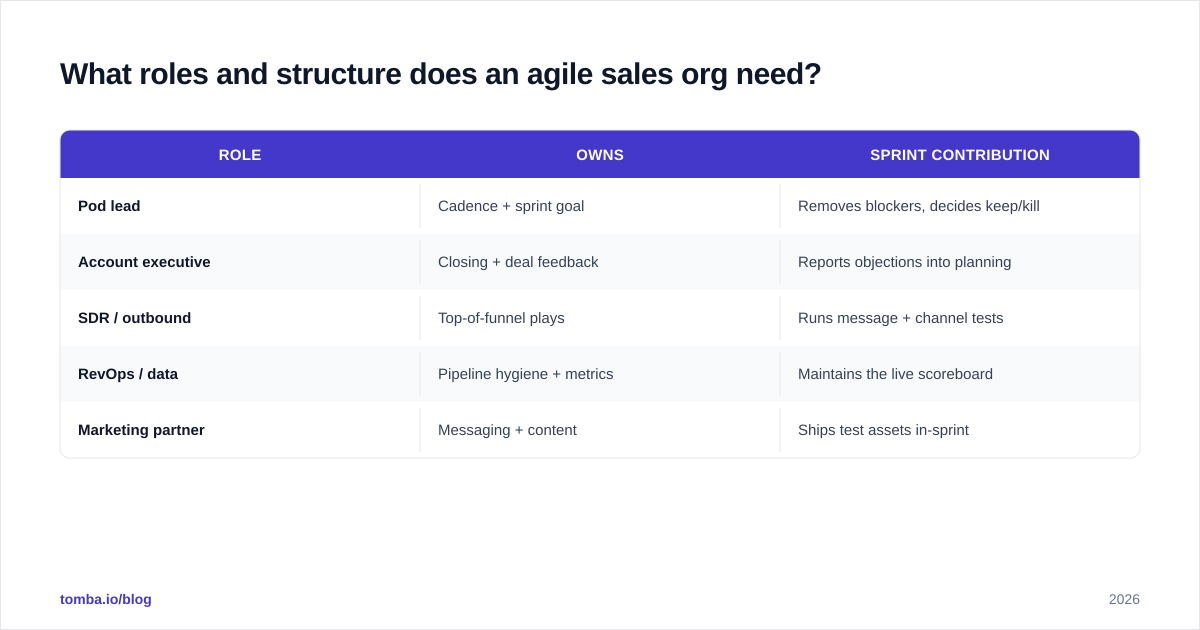
- Pod lead — runs the cadence, clears blockers, owns the sprint goal. Not a traditional manager; closer to a scrum master who also carries quota accountability.
- AEs — close, but also feed objections and wins back into planning.
- SDR / outbound — own top-of-funnel experiments inside each sprint.
- A RevOps / data partner — keeps the pipeline data clean and instruments the metrics. This role is non-negotiable; agile without trustworthy data is just chaos with standups.
- Embedded marketing or product input — part-time, so messaging tests do not require a cross-department ticket.
This is where revenue operations earns its seat. RevOps sets the guardrails — territory rules, data standards, the shared scoreboard — so pods can move fast without colliding. Done right, RevOps is the thing that lets you decentralize decisions without losing the plot.
| Role | Owns | Sprint contribution |
|---|---|---|
| Pod lead | Cadence + sprint goal | Removes blockers, decides keep/kill |
| Account executive | Closing + deal feedback | Reports objections into planning |
| SDR / outbound | Top-of-funnel plays | Runs message + channel tests |
| RevOps / data | Pipeline hygiene + metrics | Maintains the live scoreboard |
| Marketing partner | Messaging + content | Ships test assets in-sprint |
Which metrics prove an agile sales org is working?#
Stop reporting only on lagging numbers like closed revenue. Closed revenue tells you about decisions you made 90 days ago. Agile teams instrument the loop itself.
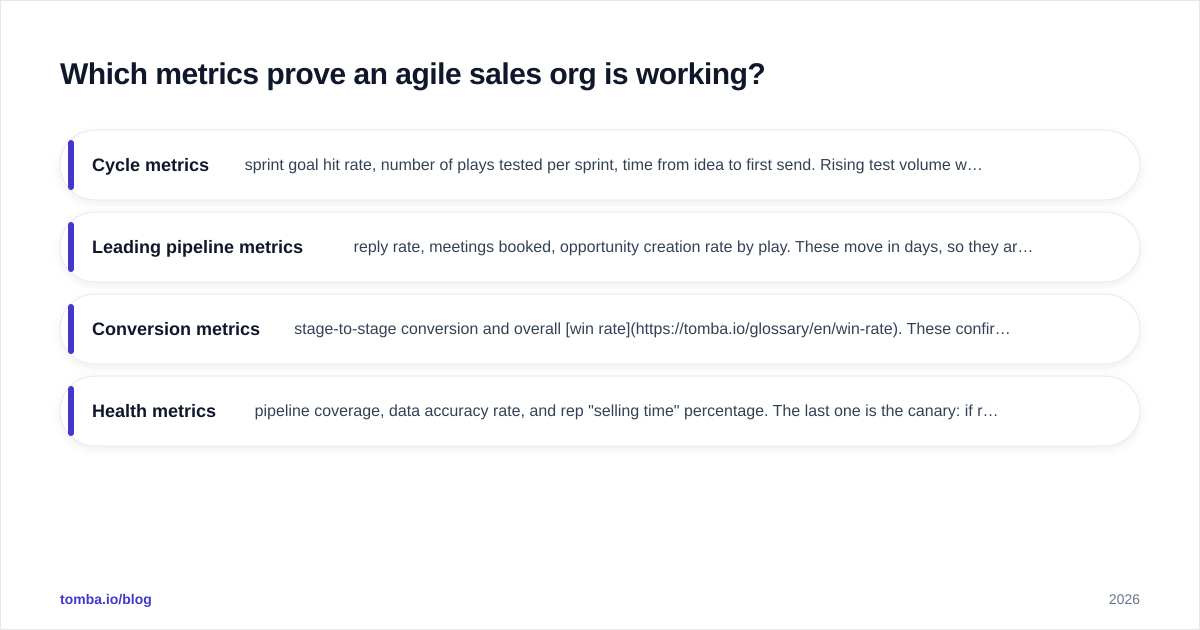
Watch these four families:
- Cycle metrics — sprint goal hit rate, number of plays tested per sprint, time from idea to first send. Rising test volume with stable quality is the signal that the machine is healthy.
- Leading pipeline metrics — reply rate, meetings booked, opportunity creation rate by play. These move in days, so they are how you steer mid-sprint.
- Conversion metrics — stage-to-stage conversion and overall win rate. These confirm whether faster learning is translating into more wins.
- Health metrics — pipeline coverage, data accuracy rate, and rep "selling time" percentage. The last one is the canary: if reps spend their day on admin and data hunting, your sprints will starve.
A practical rule: every play in a sprint declares its target leading metric before it starts. "We expect a 6% reply rate; below 3% we kill it Thursday." That removes the temptation to rationalize a dead play because someone is attached to it.
How do you transition to an agile sales organization without breaking pipeline?#
Do not flip the whole org overnight. Run a pilot.
1. Pick one pod and one segment. Choose a motion with enough volume to generate signal in two weeks. A tiny enterprise segment with three deals a quarter will not give you the feedback loop agile depends on.
2. Set guardrails before you decentralize. Define what pods can change freely (messaging, channel mix, sequencing) and what stays central (pricing, discounting, territory boundaries). Autonomy without guardrails is how you get channel conflict.
3. Fix the data layer first. This is the step teams skip and regret. Sprints assume reps can act on a target list immediately. If half the contacts bounce or lack direct details, the sprint stalls on plumbing instead of selling. Invest in data enrichment and a reliable email finder so a pod can go from "target 120 RevOps leaders" to a verified, contactable list the same morning. Pair that with sales automation so the repetitive sending and logging does not eat the sprint.
4. Run three sprints before you judge it. The first sprint is awkward, the second is messy, the third is where the cadence clicks. Most teams that abandon agile quit after sprint one.
5. Scale by cloning, not decree. When the pilot pod beats the control group, expand by standing up a second pod that copies the cadence — not by issuing a company-wide mandate. Proof travels better than policy.
For deeper background on the broader operating-model shift, McKinsey's writing on agile organizations and the customer-experience research at HubSpot are worth reading alongside this. The principles are the same whether the unit of work is a product feature or a pipeline play.
What are the common mistakes that kill agile sales rollouts?#
- Standups become status theater. If the daily sync is reps reciting numbers to a manager, you have a metrics meeting, not agile. It exists to surface and clear blockers.
- No retrospective. Skipping the retro means you never improve the system, only grind harder inside it. This is the single highest-leverage 30 minutes in the cadence.
- Pivoting too often. Re-planning mid-sprint on a whim destroys the signal. Commit inside the sprint; adjust between them.
- Dirty data. Covered above and worth repeating — agile amplifies whatever your data quality already is. Garbage in, faster garbage out.
- Pods without authority. If every message change needs VP sign-off, the loop is as slow as the old model with extra meetings.
Closing: make sprints run on data you can trust#
An agile sales organization lives or dies on one quiet thing: can a pod turn a target segment into a verified, contactable list before the sprint clock runs out? Everything else — the standups, the retros, the keep/kill decisions — assumes reps are spending their hours selling, not scrubbing bad records.
That is where Tomba Email Finder fits the agile motion. Point it at a domain, a name, or a company, and your pod gets verified professional emails in minutes instead of an afternoon of manual digging — so each sprint starts with a clean list and ends with real signal. Start on the free tier (25 searches a month), and when the cadence proves itself, the Starter plan at $49/mo and Growth at $99/mo scale with your pipeline. Check the full Tomba pricing to match a plan to your sprint volume. Fast loops need clean fuel — give your agile team both.
Ready to find emails that actually work?
Join 150,000+ professionals who stopped guessing and started sending. Free credits on signup — no credit card required.
Get the Tomba newsletter
Practical outbound tactics and product updates — once every two weeks.
About the author