AI Agent for Sales in 2026: The Practical Buyer's Guide
An AI agent for sales can research, prospect, and reply for you—but only if you wire it to clean data. Here's how to build one that actually books meetings in 2026.
TL;DR
- An AI agent for sales is software that plans and executes multi-step sales work on its own—researching accounts, drafting outreach, updating the CRM—instead of waiting for a human to click each button.
- The agent is only as good as the data underneath it. Garbage contacts in, confidently wrong emails out.
- Most teams should start with one narrow job (lead research, reply triage, or list enrichment), prove ROI, then expand.
- Buy for the workflow you actually run, not the demo. Watch for autonomy you can't audit, opaque data sources, and per-seat pricing that punishes scale.
- A finder-and-verifier layer like Tomba sits underneath the agent so it acts on real, deliverable contacts—not hallucinated ones.
What is an AI agent for sales?#
An AI agent for sales is a program that takes a goal—"book 10 demos with HR directors at 200-person SaaS firms"—and works through the steps to reach it without a human driving every click. It decides what to do next, calls tools (a CRM, an email finder, a calendar), reads the result, and adjusts.
Think of it like the difference between a power drill and a contractor. Old sales software was the drill: powerful, but it only moved when you squeezed the trigger. An AI agent is closer to a junior contractor who reads the blueprint, picks up the right tool, and reports back when a wall is framed. You still inspect the work. You're no longer holding every tool.
Technically, these agents run on large language models wrapped in a loop: perceive (read context), plan (decide next step), act (call a tool or API), and observe (check the result), repeating until the goal is met or a guardrail stops them. That loop is what separates a true agent from a one-shot AI feature like a subject-line generator.
What can an AI sales agent actually do today?#
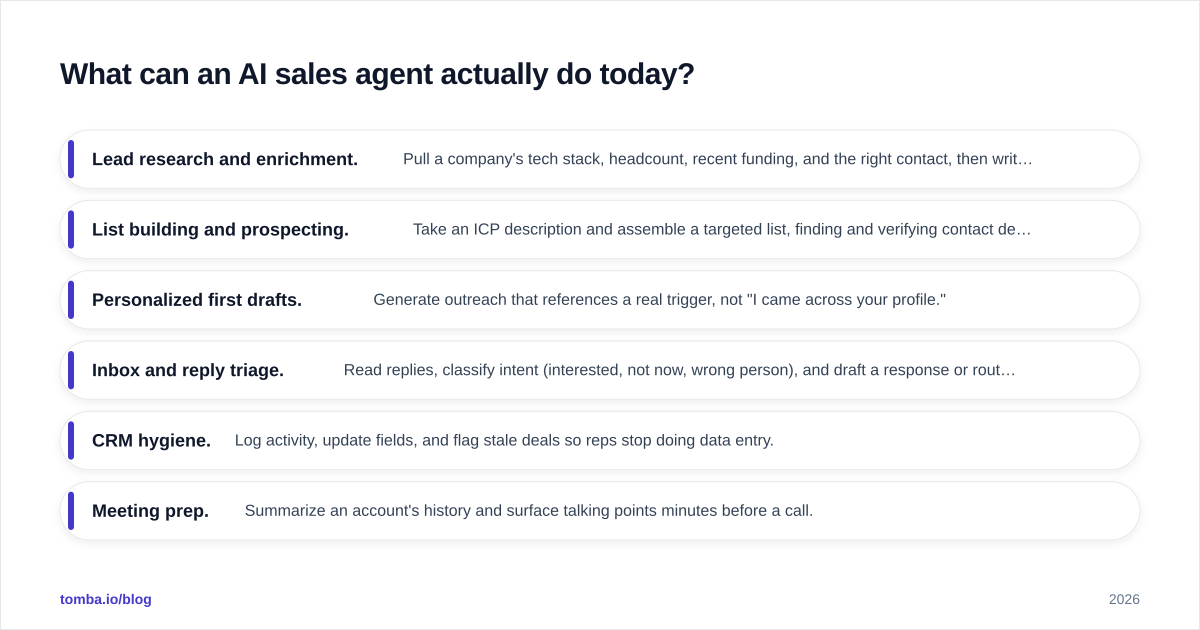
Plenty—but in narrow lanes, not as an all-knowing closer. The honest 2026 picture:
- Lead research and enrichment. Pull a company's tech stack, headcount, recent funding, and the right contact, then write a one-line "why now."
- List building and prospecting. Take an ICP description and assemble a targeted list, finding and verifying contact details automatically.
- Personalized first drafts. Generate outreach that references a real trigger, not "I came across your profile."
- Inbox and reply triage. Read replies, classify intent (interested, not now, wrong person), and draft a response or route the lead.
- CRM hygiene. Log activity, update fields, and flag stale deals so reps stop doing data entry.
- Meeting prep. Summarize an account's history and surface talking points minutes before a call.
What it still does badly: reading a room, handling a multi-threaded enterprise negotiation, and knowing when a "no" is really a "not yet." Treat the agent as leverage for the repeatable 70%, not a replacement for judgment on the hard 30%.
Is an AI agent for sales better than a human SDR?#
Wrong question. The right one is "what should each do?" The agent wins on volume, consistency, and never getting bored doing research at 11 p.m. A human wins on nuance, relationship, and creative problem-solving when a deal goes sideways.
The teams getting results in 2026 pair them: the agent handles tier-2 and tier-3 accounts at scale and does the grunt research for tier-1, while reps spend their time on live conversations and strategic accounts. This is also where data quality becomes the whole ballgame—an agent emailing 2,000 prospects a week will torch your domain reputation fast if a third of those addresses bounce. Pairing the agent with a real email verifier before send is not optional.
For a deeper primer on the category mechanics, sales automation explains where rules-based tooling ends and agentic behavior begins.
How do you choose an AI agent for sales?#
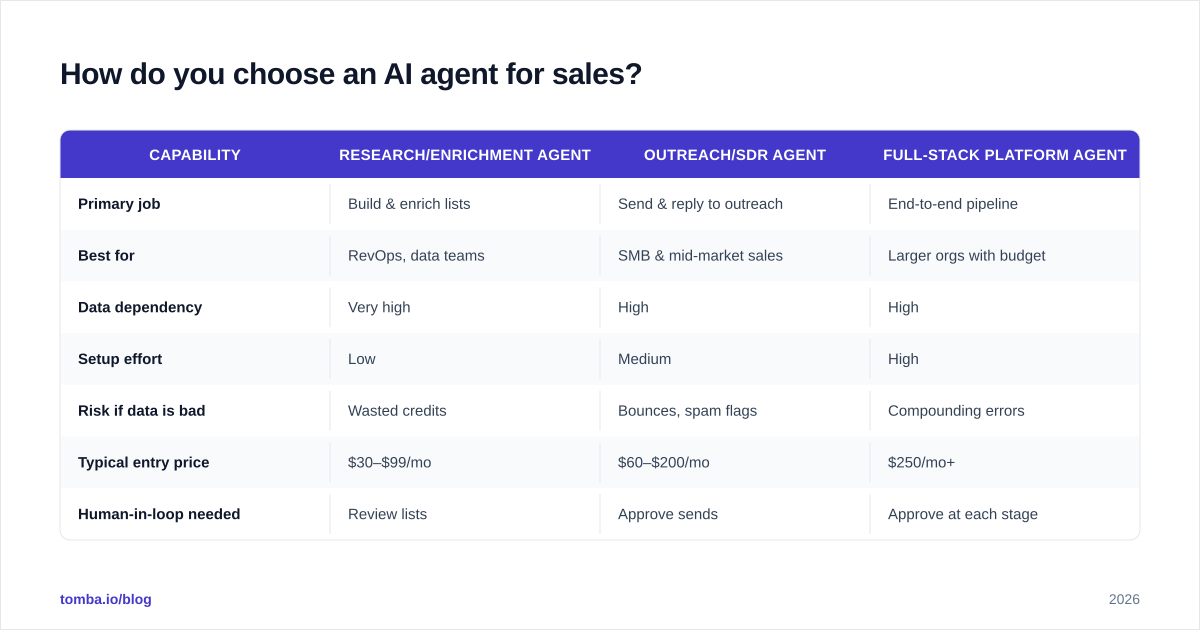
Match the tool to the job you run most. Here's how the common categories stack up.
| Capability | Research/Enrichment agent | Outreach/SDR agent | Full-stack platform agent |
|---|---|---|---|
| Primary job | Build & enrich lists | Send & reply to outreach | End-to-end pipeline |
| Best for | RevOps, data teams | SMB & mid-market sales | Larger orgs with budget |
| Data dependency | Very high | High | High |
| Setup effort | Low | Medium | High |
| Risk if data is bad | Wasted credits | Bounces, spam flags | Compounding errors |
| Typical entry price | $30–$99/mo | $60–$200/mo | $250/mo+ |
| Human-in-loop needed | Review lists | Approve sends | Approve at each stage |
Beyond the category, score every shortlisted tool on five things:
- Data transparency. Where do contacts come from, and how is accuracy measured? If the vendor dodges this, walk. Tomba publishes its data sources for exactly this reason.
- Auditability. Can you see every action the agent took and why? Black-box autonomy is a liability.
- Guardrails. Sending limits, approval gates, and domain warmup awareness.
- Integrations. Does it write to your actual CRM (HubSpot, Salesforce, Pipedrive) without a brittle
Zapier chain? 5. Pricing that survives scale. Per-action or credit pricing usually beats per-seat once volume climbs.
Why does data quality decide whether the agent works?#
Because an AI agent acts on whatever you feed it, fast, and at scale. That's the upside and the trap. A reasoning model will confidently construct an email address that looks right—first.last@company.com—and the agent will send to it without blinking. If the real pattern is flast@, you just bounced, and a few hundred bounces drag your sender reputation down for everyone on the domain.
This is why the durable architecture puts a verified-data layer beneath the agent:
- Find the contact from a name + domain with an email finder instead of guessing the pattern.
- Verify each address with an email verifier before the agent is allowed to send.
- Enrich the record so personalization has something true to reference via data enrichment.
Skip this layer and the agent's speed works against you—it just makes mistakes more efficiently.
How do you roll out an AI sales agent without breaking things?#
Start absurdly small. The failure mode is buying a "full autonomy" platform, pointing it at your whole funnel, and discovering three weeks later that it's been sending broken personalization to your best accounts.
A safer path:
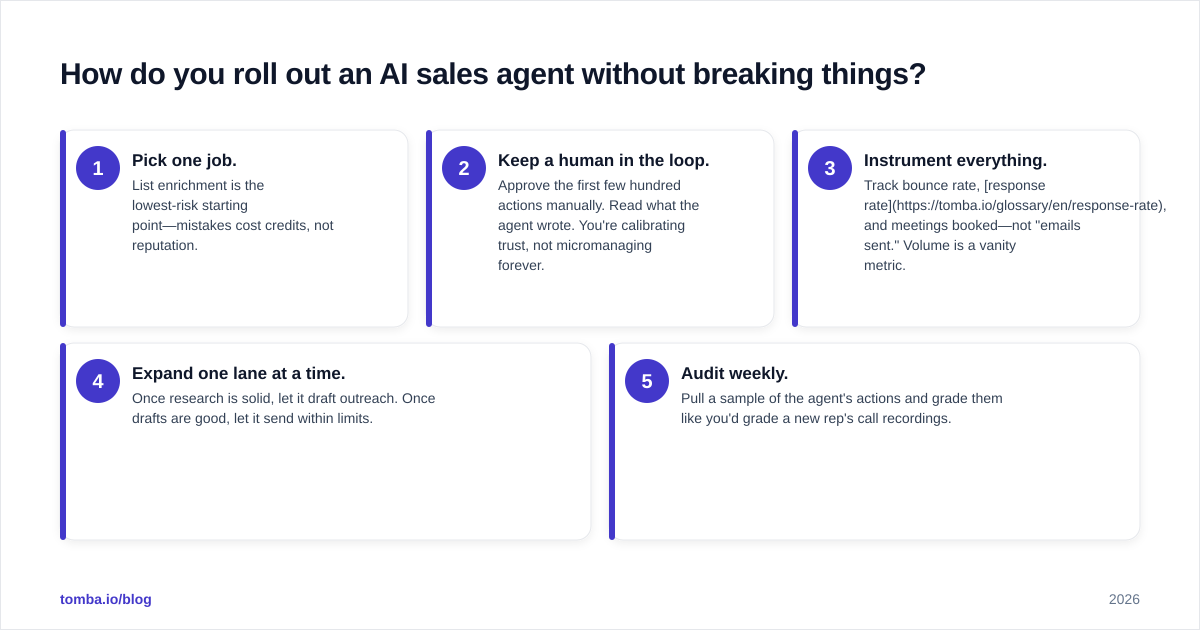
- Pick one job. List enrichment is the lowest-risk starting point—mistakes cost credits, not reputation.
- Keep a human in the loop. Approve the first few hundred actions manually. Read what the agent wrote. You're calibrating trust, not micromanaging forever.
- Instrument everything. Track bounce rate, response rate, and meetings booked—not "emails sent." Volume is a vanity metric.
- Expand one lane at a time. Once research is solid, let it draft outreach. Once drafts are good, let it send within limits.
- Audit weekly. Pull a sample of the agent's actions and grade them like you'd grade a new rep's call recordings.
Treat the agent like an employee in onboarding. You wouldn't hand a new SDR your top 50 accounts on day one; don't hand them to the agent either.
What does an AI sales agent cost in 2026?#
Pricing splits into three models, and the cheapest sticker price is often the most expensive in practice.
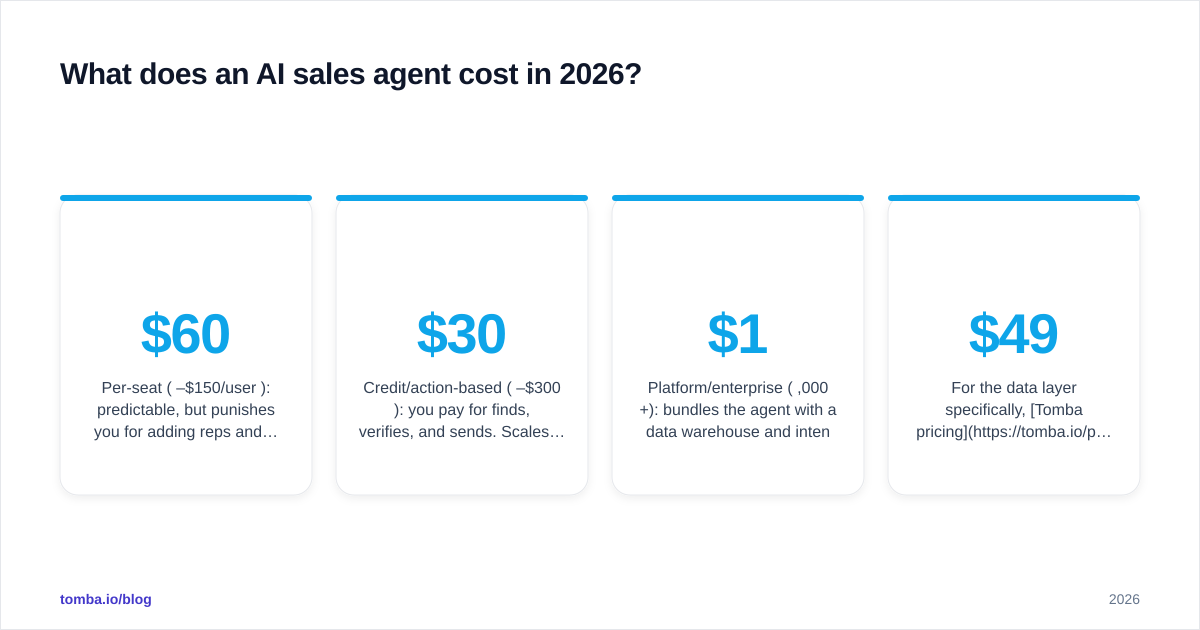
- Per-seat ($60–$150/user/mo): predictable, but punishes you for adding reps and discourages letting the agent run wide.
- Credit/action-based ($30–$300/mo): you pay for finds, verifies, and sends. Scales with usage, which is fair, but model your volume first.
- Platform/enterprise ($1,000/mo+): bundles the agent with a data warehouse and intent signals. Worth it only if you'll use the whole stack.
For the data layer specifically, Tomba pricing runs a Free tier at 25 searches a month, Starter at $49/mo, Growth at $99/mo, and Pro at $249/mo—so you can verify the agent's targets without a five-figure commitment. The math that matters: one prevented spam-trap hit or one salvaged sender reputation usually pays for the verification layer many times over.
For broader market context on agentic sales tooling and adoption trends, G2's sales AI category and vendor docs like HubSpot's AI tools are reasonable neutral starting points before you commit budget.
Common mistakes to avoid#
- Buying autonomy you can't audit. If you can't replay what the agent did, you can't trust it at scale.
- Skipping verification to "move fast." Fast bouncing is still bouncing.
- Measuring activity, not outcomes. 5,000 sent emails with a 0.2% reply rate is worse than 500 with 8%.
- Personalizing on bad data. "Congrats on the Series B" to a bootstrapped company is worse than no personalization.
- No human review window. Even mature agents drift; a weekly audit catches it before customers do.
How does Tomba fit into an AI sales agent stack?#
Tomba is the data layer your agent stands on. Whatever brain you choose to orchestrate the workflow, it needs to find and confirm real contacts before it acts—and that's exactly what the Tomba Email Finder does. Point your agent at it through the Tomba API (or the MCP server if you're wiring up a Claude- or LLM-based agent), and every "send" is aimed at a verified, deliverable address instead of a confident guess.
Start free with 25 searches a month, validate that your agent is acting on accurate data, and scale to Starter at $49/mo when the pipeline proves out. The agent makes the decisions—Tomba makes sure those decisions land in a real inbox.
// get started
Find, verify and enrich your first contacts today
Start on the free plan with 25 searches a month, then scale when your team is ready.
Free plan · No credit card required · GDPR & CCPA
// about the author