AI BDR Agent in 2026: What It Is and Whether It Works
An AI BDR agent promises to research, write, and book meetings without a human rep. Here's what these agents actually do in 2026, where they break, and how to deploy one without torching your domain.
TL;DR
- An AI BDR agent is software that runs the top of the sales-development workflow end to end: it picks accounts, finds contacts, researches them, writes personalized outreach, sends it, and follows up — with little or no human in the loop per message.
- The technology is real and useful for volume and consistency, but the "fires your whole SDR team" pitch is marketing. Reply quality, deliverability, and data accuracy are still where most deployments break.
- Your agent is only as good as the data underneath it. Bad emails kill domains faster than bad copy.
- Treat an AI BDR agent as a force multiplier for a human, not a replacement. The winning setup in 2026 is one rep supervising one or more agents.
- Below: a clear definition, a feature-by-feature comparison, a deployment framework, realistic pricing, and the failure modes nobody puts on the landing page.
What is an AI BDR agent?#
An AI BDR agent is an autonomous (or semi-autonomous) system that performs the work of a business development representative: building a target list, enriching contacts, researching each prospect, drafting tailored messages, sending them across email and sometimes LinkedIn, and handling follow-ups and reply triage.
Think of it like a self-driving car for the top of your funnel. A cruise-control tool (classic sales automation) holds a fixed speed and direction — you still steer. An AI BDR agent is supposed to read the road, change lanes, and brake on its own. The reality in 2026 sits closer to "supervised autopilot": it does most of the driving, but you keep your hands near the wheel.
The difference from older sales automation is the decision-making. A sequence tool sends step 2 three days after step 1 to everyone. An agent decides who to contact, what to say to each person based on signals (job change, funding, tech stack, recent post), and when to stop or escalate. That decision layer is what vendors mean when they slap "AI" and "agent" on the box.
What does an AI BDR agent actually do, step by step?#
Break the hype into the concrete jobs an agent chains together:
- Account selection. Pulls or scores accounts against your ICP — firmographics, intent signals, technographics.
- Contact discovery. Finds the right people at those accounts and their contact details. This is the make-or-break step; everything downstream depends on a valid email.
- Enrichment and research. Gathers context: role, seniority, recent company news, social activity, mutual connections.
- Message generation. Writes a first touch and follow-ups, ideally referencing the research rather than spraying a {{first_name}} mail-merge.
- Sending and deliverability management. Rotates inboxes, throttles volume, warms domains, and tries to stay out of spam.
- Reply handling. Classifies responses (interested, not now, wrong person, unsubscribe) and either drafts a reply or hands off to a human.
- Booking. Proposes times and pushes a meeting to the calendar and CRM.
Most "AI BDR agent" products are strong at steps 4 and 5 and weak at step 2. That imbalance matters, because a beautifully written email to a guessed, unverified address is just a bounce with extra steps.
Is an AI BDR agent better than a human SDR?#
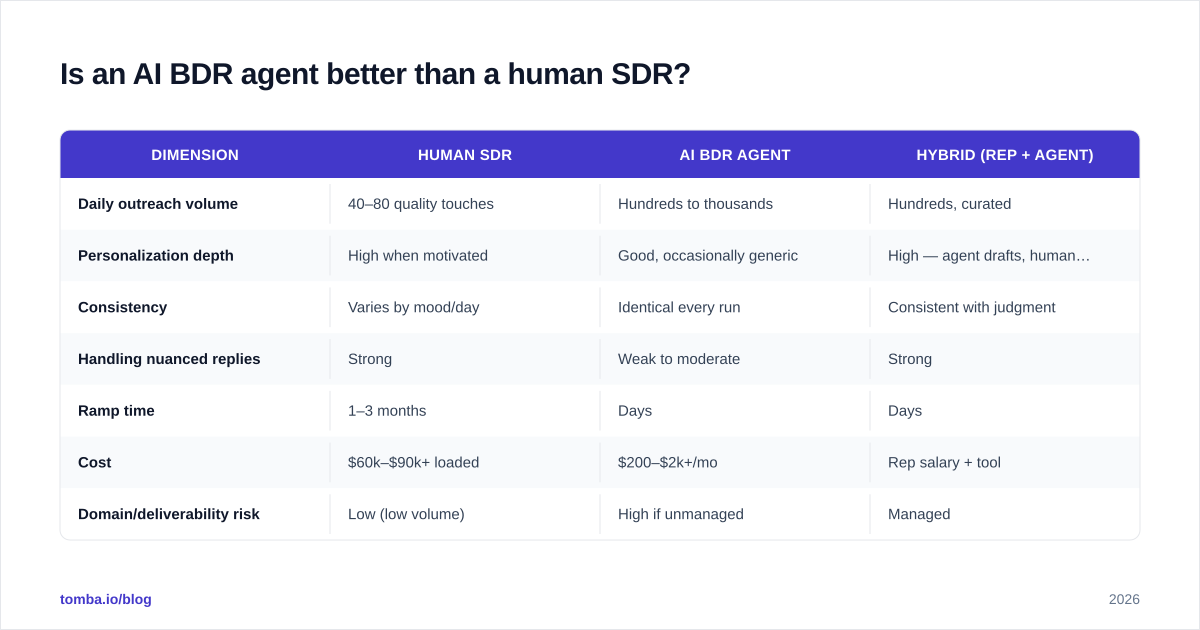
Short answer: not better — different, and best together. Here is an honest split.
| Dimension | Human SDR | AI BDR Agent | Hybrid (rep + agent) |
|---|---|---|---|
| Daily outreach volume | 40–80 quality touches | Hundreds to thousands | Hundreds, curated |
| Personalization depth | High when motivated | Good, occasionally generic | High — agent drafts, human edits |
| Consistency | Varies by mood/day | Identical every run | Consistent with judgment |
| Handling nuanced replies | Strong | Weak to moderate | Strong |
| Ramp time | 1–3 months | Days | Days |
| Cost | $60k–$90k+ loaded | $200–$2k+/mo | Rep salary + tool |
| Domain/deliverability risk | Low (low volume) | High if unmanaged | Managed |
| Strategic creativity | High | Low | High |
The pattern across real deployments: agents win on throughput, consistency, and ramp speed; humans win on judgment, objection handling, and creative plays. The teams getting results in 2026 don't pick a side — they let the agent do the grinding (research, drafts, follow-up logistics) and keep a human on strategy and live conversations.
What separates a real AI BDR agent from rebranded automation?#
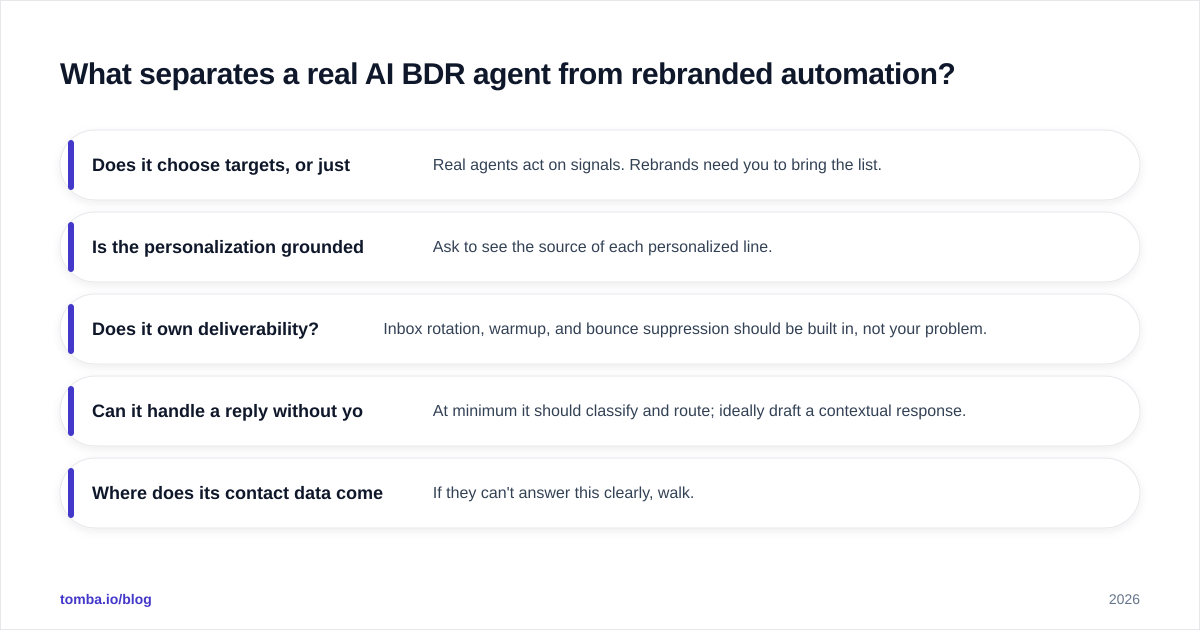
A lot of products renamed their sequence builder "AI BDR" in the last 18 months. Use these tests to tell them apart:
- Does it choose targets, or just message a list you upload? Real agents act on signals. Rebrands need you to bring the list.
- Is the personalization grounded in fresh research, or template variables? Ask to see the source of each personalized line.
- Does it own deliverability? Inbox rotation, warmup, and bounce suppression should be built in, not your problem.
- Can it handle a reply without you? At minimum it should classify and route; ideally draft a contextual response.
- Where does its contact data come from, and how is it verified? If they can't answer this clearly, walk.
That last point is the one buyers skip and regret. An agent that sends to stale or fabricated addresses will wreck your sender reputation in a week. Before you trust any agent's outreach, the underlying emails should pass through a real email verifier so you're not paying in domain health for the vendor's data gaps.
How accurate is the data behind an AI BDR agent?#
This is where most disappointment lives. An agent's output quality is capped by its input data, and contact data decays fast — roughly 2–3% of B2B contacts change jobs every month, which compounds to a meaningfully stale list within a year.
Two numbers decide whether your campaign helps or hurts:
- Email accuracy / bounce rate. Anything above a ~3% bounce rate signals deliverability trouble and tells mailbox providers your sending is sloppy.
- Coverage. What share of your ICP the agent can actually find valid contacts for.
Many all-in-one agents quietly trade accuracy for coverage — they'd rather hand you a guessed address than admit they don't have one. That's fine for a vanity "contacts found" stat and terrible for your domain. The fix is to decouple the layers: let the agent do orchestration and copy, but source and validate contacts through a dedicated email finder and verification step you control. If you run high volume, a bulk email finder plus verification before the agent ever hits send is the difference between a healthy inbox and a blacklisted one.
For a deeper look at why source quality varies so much between providers, vendor data sources documentation is worth reading before you commit.
How do I deploy an AI BDR agent without wrecking deliverability?#
Use a staged framework instead of flipping it to full autonomy on day one. The failure mode is always the same: someone turns on an agent, blasts 2,000 emails from their primary domain, and burns it.
Phase 1 — Infrastructure. Buy separate sending domains (never your primary), set up SPF, DKIM, and DMARC, and warm the inboxes for 2–4 weeks before real sending. Verify your records with an SPF checker and a spam checker.
Phase 2 — Data hygiene. Build the target list, then verify every address. Suppress bounces, catch-alls you can't confirm, and role accounts. This step alone removes most deliverability disasters.
Phase 3 — Supervised autonomy. Let the agent draft and queue, but have a human approve the first few hundred messages. You're checking for tone, accuracy of the "personalized" lines, and obvious hallucinations.
Phase 4 — Scaled autonomy. Once reply rates and bounce rates look healthy, widen the leash. Keep a human on reply handling for anything the classifier marks "interested" or ambiguous.
Skipping Phase 1 or 2 is how teams end up explaining to RevOps why the company domain is on a blacklist. Read more on protecting email deliverability before you scale volume.
What does an AI BDR agent cost in 2026?#
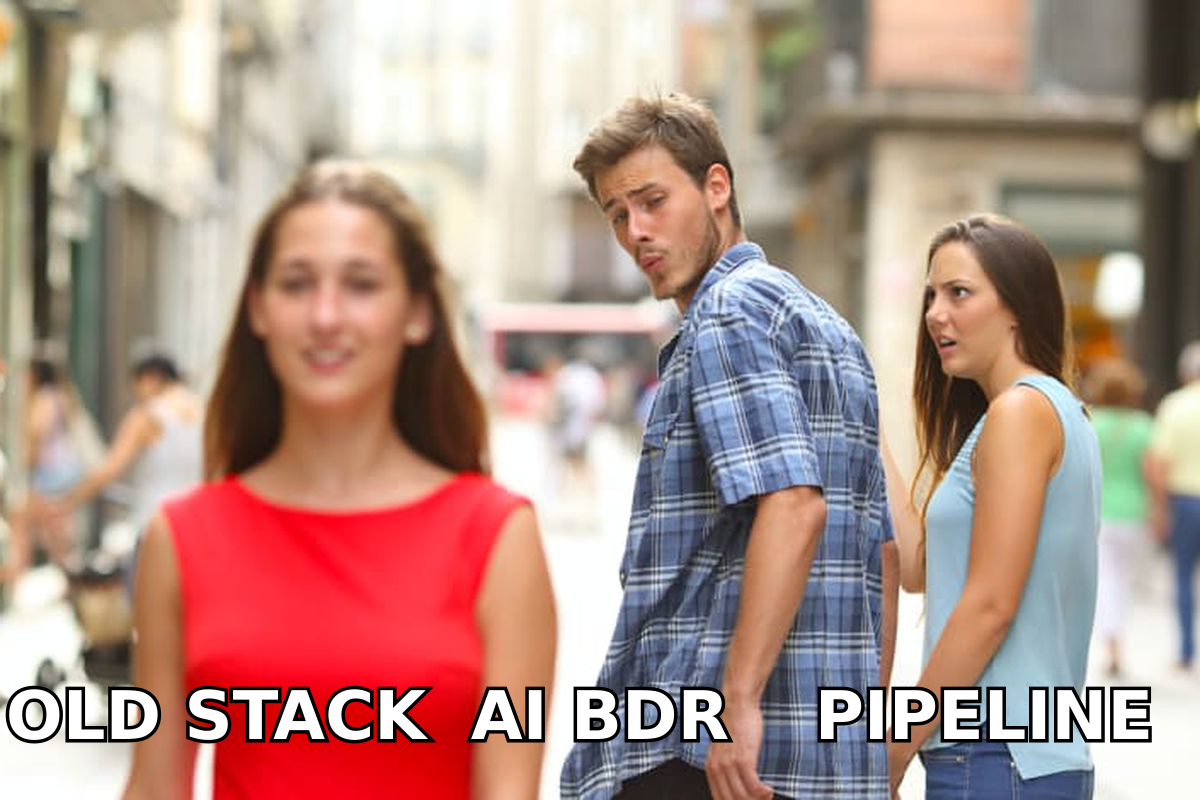
Pricing splits into three tiers, and the headline number is rarely the real number.
| Tier | Typical monthly cost | What you get | Hidden costs |
|---|---|---|---|
| Lightweight agent / copilot | $50–$300 | Drafting, sequencing, basic enrichment | You supply data + inboxes |
| Full autonomous agent | $1,000–$3,000+ | End-to-end prospecting, data, sending | Overages, per-seat add-ons |
| Enterprise platform | $3,000–$10,000+ | Multi-agent, integrations, support | Implementation, annual lock-in |
The hidden cost in every tier is data. Bundled contact data is convenient but often lower accuracy, and you pay for it again in bounces and lost reputation. Many teams land on a cleaner math: a mid-tier agent for orchestration plus a specialized data tool with transparent pricing for finding and verifying contacts. You get higher accuracy, you control the credits, and you can audit exactly what's being sent.
For comparison, a single loaded SDR runs $60k–$90k+ per year. An agent stack at $1k–$3k/month is cheaper on paper — just remember the agent doesn't close, qualify nuance, or invent the clever play that books the whale account.
What are the real limitations of AI BDR agents?#
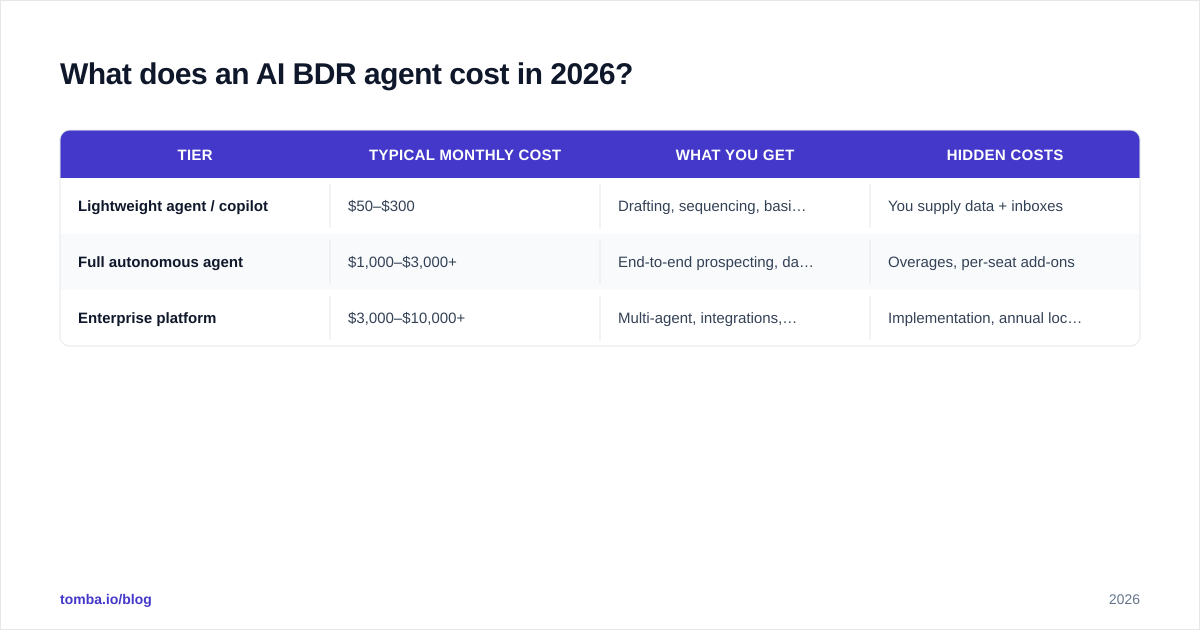
Set expectations with the failure modes vendors leave off the slide:
- Generic personalization at scale. Prospects now recognize "I saw your post about {{topic}}" as a tell. Over-automated personalization can perform worse than an honest, plain message.
- Hallucinated research. Agents sometimes invent a funding round or misattribute a quote. One wrong "fact" in a first touch ends the conversation.
- Reply nuance. "Interesting, but timing's off — circle back in Q3" is easy for a human and frequently fumbled by an agent.
- Deliverability blindness. Agents optimize for sends, not always for inbox placement. Without external verification, they happily mail dead addresses.
- Compliance. GDPR, CAN-SPAM, and regional rules don't pause because a bot wrote the email. You own the legal exposure, not the vendor.
- The "everyone has the same agent" problem. When competitors run the same models on the same data, output converges. Differentiation comes from your data, your offer, and your human judgment — not the agent.
None of these are dealbreakers. They're reasons to keep a human supervising and to own your data layer rather than outsourcing it blindly.
Who should use an AI BDR agent — and who shouldn't?#
Good fit: teams with a clear ICP, repeatable motion, and high outbound volume who are bottlenecked on rep capacity for research and follow-up logistics. Also lean teams that can't afford to ramp three SDRs.
Poor fit: complex enterprise sales with long, relationship-driven cycles where every touch is bespoke; brand-new companies still figuring out their ICP and messaging (an agent will just scale your wrong message faster); and anyone unwilling to invest in deliverability infrastructure.
If you're in the first group, start with the data and infrastructure layer, then add the agent. If you're in the second, fix the human-led motion first — automating an undefined process only produces faster failure.
The bottom line#
An AI BDR agent in 2026 is a genuine productivity unlock and an overhyped job-replacer at the same time. The agents earn their keep on research, drafting, sequencing, and follow-up. They stumble on data accuracy, reply nuance, and deliverability — exactly the areas that decide whether your outreach builds pipeline or burns your domain. Keep a human in the loop, and treat the data layer as the foundation the whole agent stands on.
That foundation is where you should spend first. Before you let any agent send a single message, source and verify your contacts with Tomba's Email Finder — find professional emails by domain, name, or company, verify them, and feed your AI BDR agent clean, deliverable data instead of guesses. Start free with 25 searches a month, then scale on the Starter plan at $49/mo when your agent is ready to run. The agent writes the message; accurate data is what gets it read.
Ready to find emails that actually work?
Join 150,000+ professionals who stopped guessing and started sending. Free credits on signup — no credit card required.
Get the Tomba newsletter
Practical outbound tactics and product updates — once every two weeks.
About the author