AI BDR Automation in 2026: The Complete Playbook and Tools
AI BDR automation can run sourcing, research, and first-touch outreach around the clock. Here's how the stack works in 2026, what it costs, and where human reps still win.
TL;DR
- AI BDR automation hands the repetitive parts of outbound — list building, account research, first-touch copy, and reply triage — to software agents that run 24/7, so human reps spend their hours on live conversations.
- It is not "fire the SDR team." The best 2026 setups pair one or two skilled reps with an agent stack, and measured pipeline-per-rep goes up, not headcount down.
- Your results live or die on data quality. A clever AI agent firing emails at stale, unverified addresses just burns your domain faster.
- Budget $300–$1,500/mo for a working stack once you add a verified data source, a sending platform, and an AI agent layer.
- Start narrow: automate one segment, one play, measure reply and meeting rates against your manual baseline, then expand.
What is AI BDR automation?#
AI BDR automation is software that performs the day-to-day work of a Business Development Representative — finding accounts, researching contacts, writing first-touch messages, sending sequences, and sorting replies — with minimal human input. Think of it like cruise control for a long highway drive: you still steer at the on-ramps and exits (strategy, live calls, deal nuance), but the agent holds the lane on the boring stretches.
A human BDR spends a large share of the week on tasks that do not require judgment: copying names into a sheet, guessing email formats, rewriting the same intro line for the 40th prospect. An AI BDR agent absorbs that load. The 2026 versions chain several models and data calls together: pull a target account, enrich the decision-maker, draft a message grounded in a recent trigger event, queue it in a warmed inbox, then read the reply and either book a meeting or route it to a person.
The phrase covers a spectrum. On one end, "automation" just means smart sequencing inside a sales engagement tool. On the other, fully agentic platforms like Artisan or 11x market an "AI employee" that owns a territory. Most teams land in the middle: human-owned strategy, agent-owned execution.
How does an AI BDR automation stack actually work?#
A working stack is four layers, and each one feeds the next. Break any layer and the whole pipeline degrades.
1. Sourcing. The agent pulls a target list from an ICP definition — industry, headcount, tech stack, recent funding, hiring signals. This is where intent and firmographic data enters the system.
2. Enrichment and verification. Names become reachable contacts. The agent needs a verified work email and ideally a direct phone number. This is the layer teams underinvest in, and it is the one that decides deliverability. An AI BDR sending to a list that is 30% invalid will torch its sender reputation inside a week. Run every address through an email verifier before the first send, and use a catch-all verifier for the domains that don't return a clean SMTP response.
3. Outreach and orchestration. The agent drafts copy grounded in a trigger (a job change, a funding round, a product launch), personalizes per contact, and schedules across warmed inboxes. Multichannel stacks add LinkedIn touches and call tasks.
4. Reply handling and handoff. Inbound replies get classified — interested, not now, wrong person, unsubscribe — and the hot ones get booked or escalated to a human. This is the layer where 2026 tools improved most; reply intent classification is far more reliable than it was two years ago.
The dependency chain matters: a brilliant message sent to a bad address never lands, and a verified address with a generic message gets ignored. You need all four layers competent, not one layer brilliant.
Is AI BDR automation better than hiring human SDRs?#
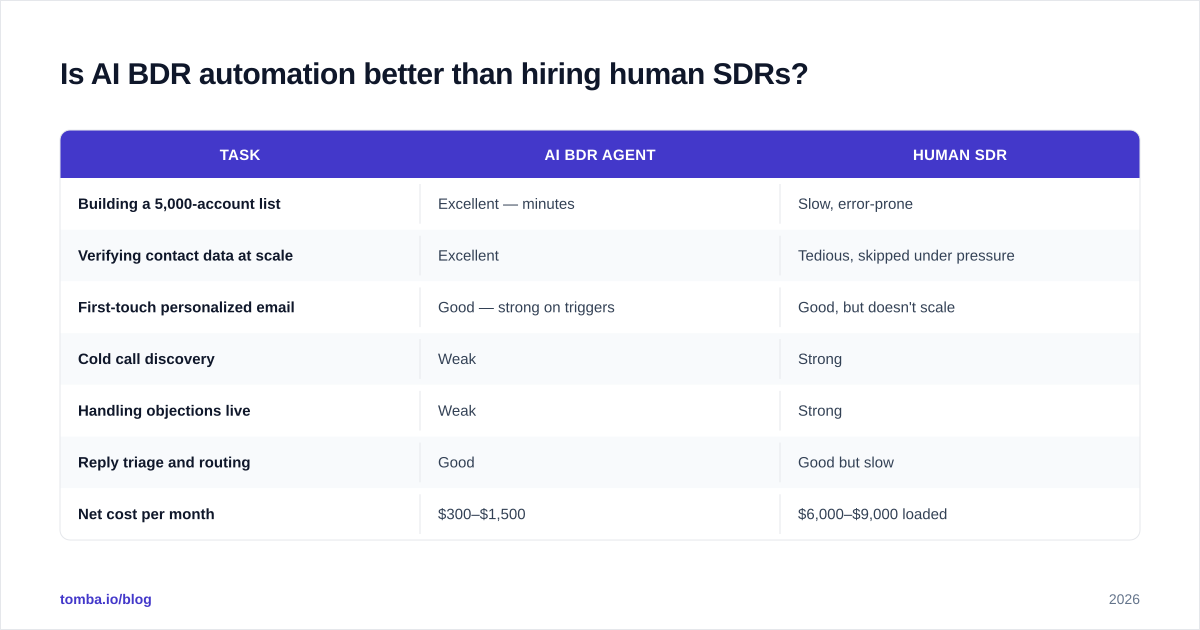
Short answer: it is better at volume and consistency, worse at judgment and trust. The right question is not "which one" but "which tasks go where."
A fully loaded SDR in North America costs $70,000–$110,000 per year with benefits and tooling, ramps for three to four months, and may churn inside 18. An AI agent stack costs a few hundred to a couple thousand dollars a month, ramps in days, and never has a bad Monday. But the agent cannot read a prospect's hesitation on a call, cannot improvise a value prop when the conversation veers, and cannot build the relationship that closes a six-figure deal.
Here is the honest split:
| Task | AI BDR agent | Human SDR |
|---|---|---|
| Building a 5,000-account list | Excellent — minutes | Slow, error-prone |
| Verifying contact data at scale | Excellent | Tedious, skipped under pressure |
| First-touch personalized email | Good — strong on triggers | Good, but doesn't scale |
| Cold call discovery | Weak | Strong |
| Handling objections live | Weak | Strong |
| Reply triage and routing | Good | Good but slow |
| Net cost per month | $300–$1,500 | $6,000–$9,000 loaded |
| Ramp time | Days | 3–4 months |
The teams getting real leverage in 2026 run a hybrid: agents handle layers 1–3 and the cold reply sorting, while one or two strong reps take every booked conversation and every account over a deal-size threshold. According to HubSpot's sales research, reps still spend roughly a third of their time on non-selling tasks — that third is exactly what automation reclaims.
What does an AI BDR automation stack cost in 2026?#
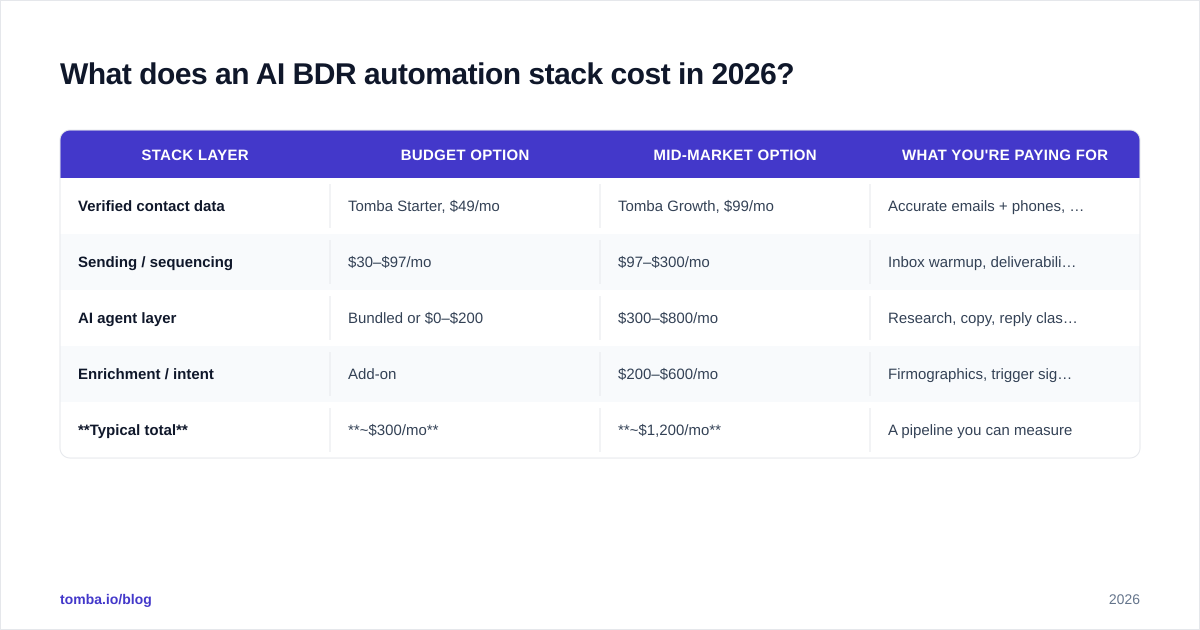
You are assembling three budgets: data, sending, and intelligence. Some platforms bundle all three; bundles are convenient but usually weakest on the data layer, which is the one you can least afford to skimp on.
| Stack layer | Budget option | Mid-market option | What you're paying for |
|---|---|---|---|
| Verified contact data | Tomba Starter, $49/mo | Tomba Growth, $99/mo | Accurate emails + phones, low bounce |
| Sending / sequencing | $30–$97/mo | $97–$300/mo | Inbox warmup, deliverability, multichannel |
| AI agent layer | Bundled or $0–$200 | $300–$800/mo | Research, copy, reply classification |
| Enrichment / intent | Add-on | $200–$600/mo | Firmographics, trigger signals |
| Typical total | ~$300/mo | ~$1,200/mo | A pipeline you can measure |
The data line is non-negotiable. A "free" all-in-one that ships you 40% invalid emails costs more than a paid verifier, because every bounce drags your domain reputation down and shrinks the deliverability of every future send. You can sanity-check any vendor's claims against independent reviews on G2 before you commit a budget. For teams that want pricing transparency on the data layer, the full Tomba pricing tiers run from a free 25-search tier up to Enterprise.
What separates a good AI BDR setup from a domain-burning one?#
The difference is almost never the AI. It is the discipline around it. Five rules separate the teams that book meetings from the teams that land in spam.
Verify before you send, every time. Treat your list as guilty until proven valid. Push every address through verification and quarantine anything that returns risky or unknown. A single bulk send to an unverified list can spike your bounce rate past the threshold where Google and Microsoft start throttling you. If you're sourcing by company, run a domain search to pull the live, pattern-matched addresses rather than guessing formats.
Warm the inboxes and cap the volume. A brand-new sending domain that fires 500 emails on day one looks exactly like a spammer to inbox providers. Warm gradually, keep per-inbox daily caps low, and spread volume across several inboxes. Monitor sender reputation continuously — Google Postmaster Tools is free and shows you the same reputation signal the filters use.
Ground the copy in a real trigger. "I saw you raised a Series B" beats "I wanted to reach out" every time. The AI is only as relevant as the signal you feed it. Generic mail-merge personalization is transparent to buyers now and gets ignored.
Keep a human on the hot replies. Auto-classify everything, but never auto-respond to a buying signal with a bot if you can route it to a person in minutes. The handoff speed is where deals are won or lost.
Measure against a manual baseline. Before you automate, record your current reply rate and meeting rate from manual outreach. If the agent stack doesn't beat that baseline within a month, you have a data or copy problem, not an AI problem.
These rules tie directly to your email deliverability — the metric that quietly governs whether any of this works. The most sophisticated agent in the world is useless if its mail never reaches the inbox.
Which tasks should you automate first?#
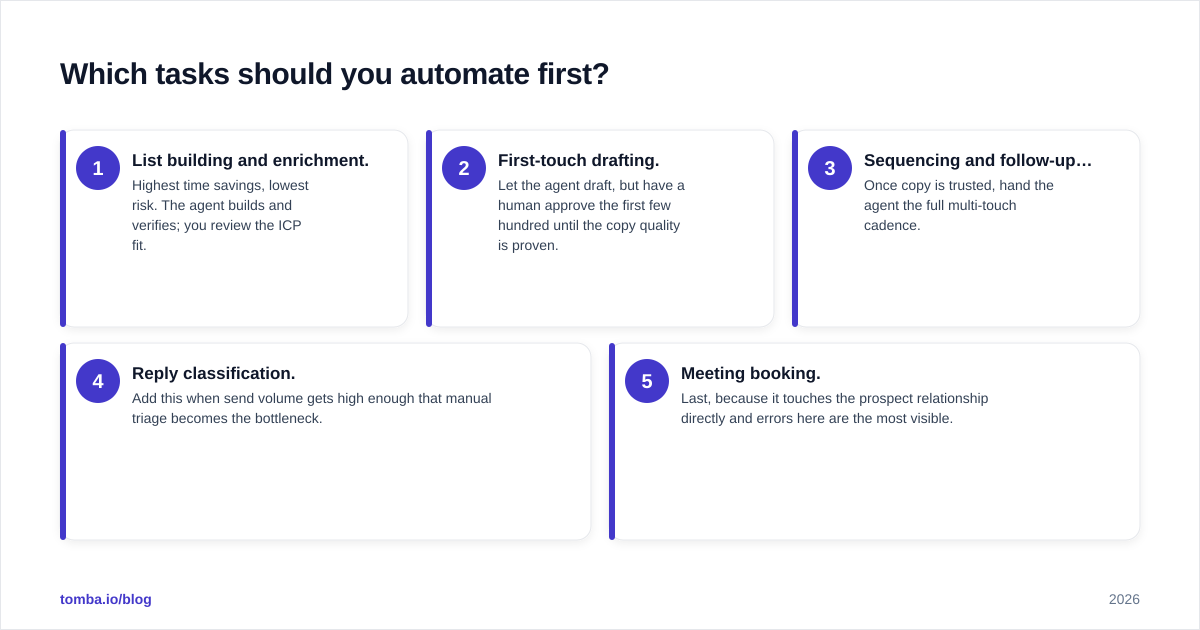
Sequence your rollout; do not flip everything on at once. The fastest path to a measurable win is to automate the single most repetitive, lowest-judgment task in your current motion and prove it before expanding.
Most teams should automate in this order:
- List building and enrichment. Highest time savings, lowest risk. The agent builds and verifies; you review the ICP fit.
- First-touch drafting. Let the agent draft, but have a human approve the first few hundred until the copy quality is proven.
- Sequencing and follow-up cadence. Once copy is trusted, hand the agent the full multi-touch cadence.
- Reply classification. Add this when send volume gets high enough that manual triage becomes the bottleneck.
- Meeting booking. Last, because it touches the prospect relationship directly and errors here are the most visible.
This staged approach means each layer earns trust before the next one goes live. It also isolates failures: if reply rates drop, you know which layer changed.
What are the limits and risks you should plan for?#
AI BDR automation has real failure modes, and pretending otherwise is how teams get burned.
Deliverability collapse from bad data. Covered above, but it bears repeating because it is the number-one killer. The economics of automation assume your mail reaches inboxes. Break that assumption and the ROI inverts.
Generic copy at scale. When everyone uses the same three AI writing tools, prospect inboxes fill with the same robotic openers. Differentiation now comes from the quality of your trigger data and your offer, not the fluency of the model.
Over-automation of relationships. Automating a discovery call or a nuanced objection is a mistake. Buyers can tell, and trust erodes. Keep humans on anything that requires reading a person.
Compliance. GDPR, CAN-SPAM, and regional rules apply to AI-sent mail exactly as they do to human-sent mail. Suppression lists, opt-outs, and consent are your responsibility, not the vendor's.
Vendor lock-in on bundled stacks. All-in-one "AI BDR" platforms make it hard to swap out a weak layer. Keeping your data source modular — a dedicated provider you can point at any sending tool via the Tomba API — protects you when one component underperforms.
The teams that win treat AI BDR automation as a force multiplier on a sound process, not a replacement for having one. If your manual outreach doesn't convert, automating it just helps you fail faster.
How do you get started this week?#
You can stand up a minimal stack in a few days. Pick one segment of your ICP — narrow enough to write sharp copy, broad enough to test. Build a list of 200–500 accounts. Verify every contact. Write three message variants grounded in a real trigger. Warm two or three inboxes. Send in small daily batches, classify replies, and route the hot ones to yourself. Compare reply and meeting rates to your manual baseline after two weeks.
The single highest-leverage decision is your data source, because every downstream layer inherits its quality. Start there.
Ready to build the data layer your AI BDR stack depends on? The Tomba Email Finder gives you verified, low-bounce work emails by name, company, or domain — the clean foundation that keeps your agent's outreach landing in inboxes instead of spam folders. Pair it with the built-in email verifier, start free with 25 searches, and scale to bulk when your pipeline proves out. Your AI agents are only as good as the contacts you feed them — feed them verified data.
Ready to find emails that actually work?
Join 150,000+ professionals who stopped guessing and started sending. Free credits on signup — no credit card required.
Get the Tomba newsletter
Practical outbound tactics and product updates — once every two weeks.
About the author