AI Powered Prospecting Tools: The 2026 Buyer's Guide
AI prospecting tools promise to find, score, and message leads faster than any SDR. Here's what they actually do, where they fail, and how to pick one in 2026.
AI-powered prospecting tools are software that uses machine learning to find, prioritize, and reach out to potential buyers — replacing the manual list-building and guesswork that used to eat half of a rep's week. The category is loud right now, and most of the marketing is indistinguishable. This guide cuts through it.
TL;DR#
- AI prospecting tools do three jobs: surface accounts that match your ICP, enrich and verify contact data, and draft or trigger outreach. Few tools do all three well.
- "AI" mostly means signal detection and copy generation — intent data, lookalike scoring, and LLM-written first lines. The underlying contact data still has to be accurate or none of it matters.
- Accuracy is the real moat. A tool that books meetings on bad emails just helps you burn your domain faster.
- You don't need one mega-platform. A focused stack — data source + signal layer + sequencer — usually beats an all-in-one suite on both cost and quality.
- Budget realistically: usable plans start around $49–$99/mo per seat; "unlimited AI" pricing usually hides credit caps.
What are AI powered prospecting tools?#
Think of prospecting like fishing. The old way was casting a net over the whole ocean and hoping. AI-powered prospecting tools are the sonar — they tell you where the fish actually are before you cast. Technically, they layer machine learning over a contact database and a set of behavioral signals to answer three questions: who should you contact, how do you reach them, and what should you say.
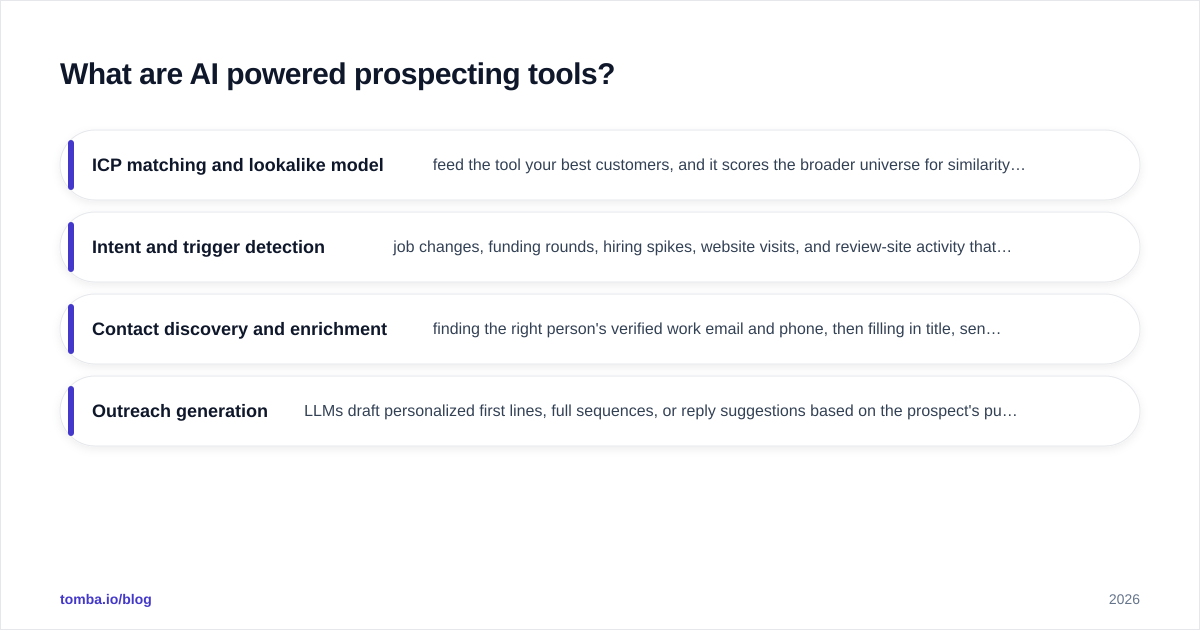
That breaks into a few concrete capabilities:
- ICP matching and lookalike modeling — feed the tool your best customers, and it scores the broader universe for similarity (firmographics, tech stack, headcount growth).
- Intent and trigger detection — job changes, funding rounds, hiring spikes, website visits, and review-site activity that signal a buying window.
- Contact discovery and enrichment — finding the right person's verified work email and phone, then filling in title, seniority, and LinkedIn.
- Outreach generation — LLMs draft personalized first lines, full sequences, or reply suggestions based on the prospect's public footprint.
The important distinction: data tools versus workflow tools. A data tool like a B2B database gives you accurate contacts. A workflow tool sequences and sends. Most "AI prospecting" platforms bolt a thin AI layer onto one of those two cores — and the quality of that core matters far more than the AI branding.
What does the "AI" actually do in these tools?#
Mostly two things: scoring and writing. Everything else marketed as AI is usually deterministic automation wearing a costume.
Scoring is where AI earns its keep. Instead of you manually filtering by industry and headcount, a model weighs dozens of features and ranks accounts by fit and timing. Good intent scoring genuinely shortens the list of "who to call today." This is the same machine-learning lineage behind a marketing qualified lead score, applied earlier in the funnel.
Writing is the flashy part. LLMs scan a prospect's LinkedIn, recent posts, and company news, then generate an opener like "Saw you just opened a second warehouse in Austin…" The catch: at scale, AI-written personalization converges on the same three templates everyone else's AI is generating. Prospects have learned to spot it. The lift over a decent human-written template is smaller than vendors claim — and sometimes negative.
What AI does not reliably do is invent accurate contact data. If a model "predicts" an email pattern, that's a guess, not a verified address. This is why the data foundation underneath the AI is non-negotiable — and why you should always run discovered contacts through an email verifier before they hit a sequence.
How do the main categories of AI prospecting tools compare?#
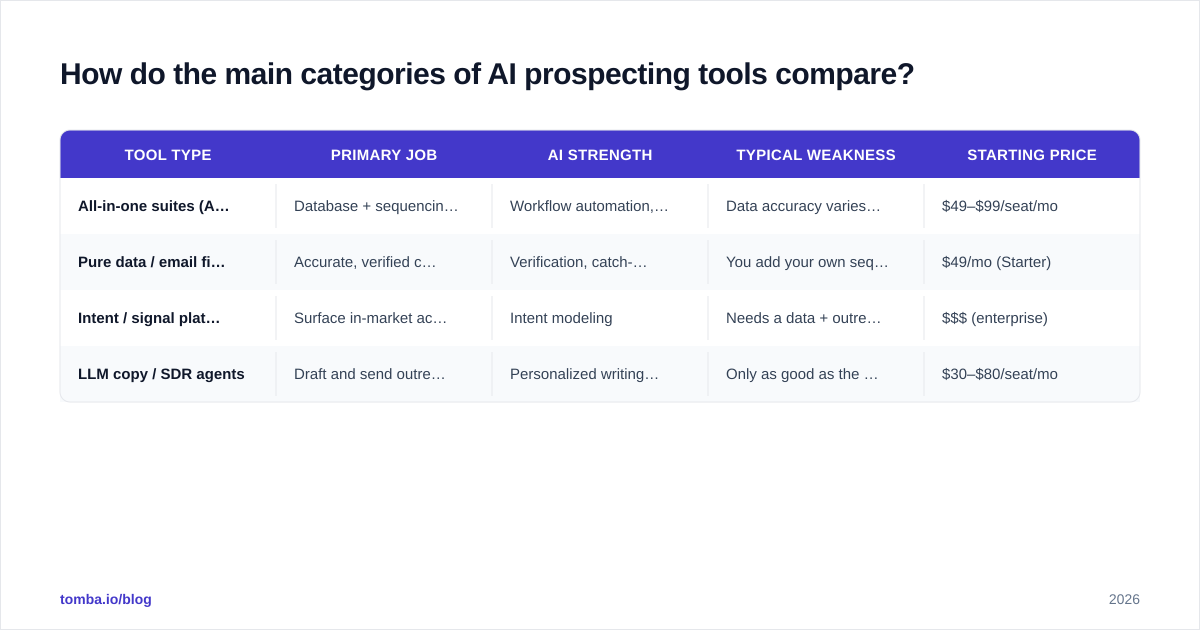
There's no single "best" tool because the category splits into four distinct jobs. Here's how the types stack up:
| Tool type | Primary job | AI strength | Typical weakness | Starting price |
|---|---|---|---|---|
| All-in-one suites (Apollo, Outreach) | Database + sequencing in one | Workflow automation, scoring | Data accuracy varies by region; pricey at scale | $49–$99/seat/mo |
| Pure data / email finders (Tomba) | Accurate, verified contacts | Verification, catch-all handling | You add your own sequencer | $49/mo (Starter) |
| Intent / signal platforms (6sense, Bombora) | Surface in-market accounts | Intent modeling | Needs a data + outreach layer downstream | $$$ (enterprise) |
| LLM copy / SDR agents | Draft and send outreach | Personalized writing at scale | Only as good as the list you feed it | $30–$80/seat/mo |
The honest takeaway: a "complete" AI prospecting motion almost always combines two or three of these. The suites win on convenience; the focused tools win on quality of each layer. If your outreach is suffering, the problem is rarely the sequencer — it's the data going into it.
For most teams the cheapest high-leverage move is to fix the data layer first. You can pair a precise email finder with whatever sequencer you already own and get more lift than buying a second all-in-one suite.
Are AI prospecting tools worth it for small teams?#
Yes — but only if you respect deliverability. The biggest risk with AI prospecting is volume. These tools make it trivial to send 1,000 emails a day, and that's exactly how you torch your sender reputation.
Here's the trap. AI surfaces more "qualified" leads, you load them into a sequencer, and you blast. But if 12% of those emails bounce because the data wasn't verified, mailbox providers flag you. Your sender reputation drops, and even your good emails land in spam. The AI didn't help — it accelerated the damage.
The teams that win with AI prospecting follow a discipline:
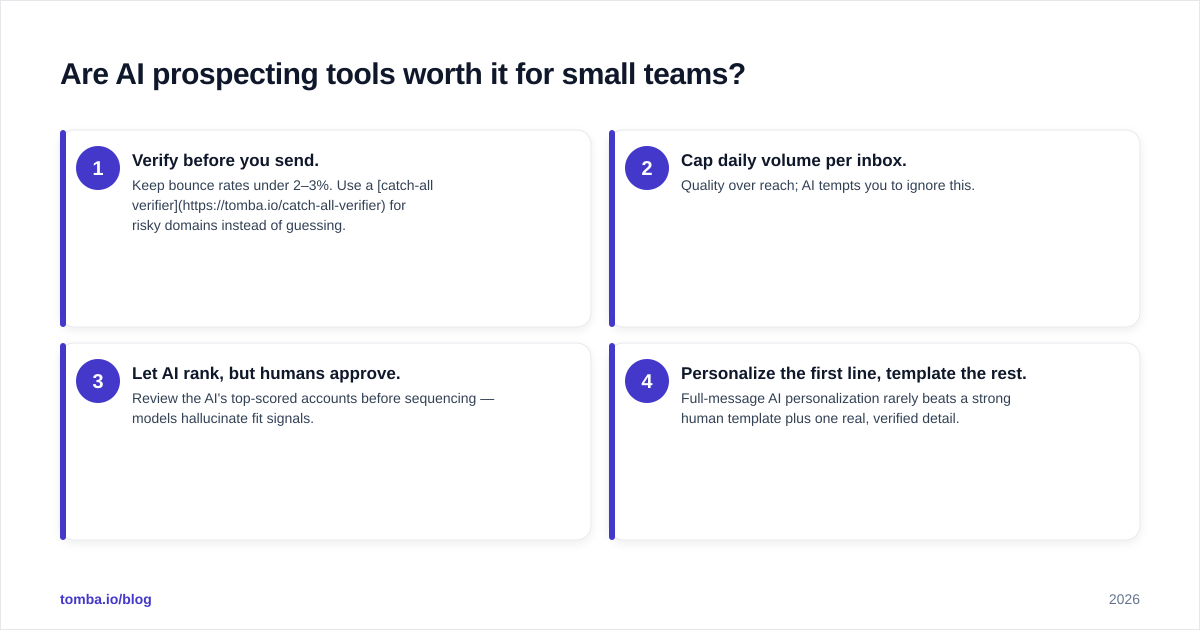
- Verify before you send. Keep bounce rates under 2–3%. Use a catch-all verifier for risky domains instead of guessing.
- Cap daily volume per inbox. Quality over reach; AI tempts you to ignore this.
- Let AI rank, but humans approve. Review the AI's top-scored accounts before sequencing — models hallucinate fit signals.
- Personalize the first line, template the rest. Full-message AI personalization rarely beats a strong human template plus one real, verified detail.
For a two-to-five person sales team, that workflow turns AI from a liability into a genuine multiplier. The math is simple: if AI saves each rep five hours of list-building a week and those hours go into live conversations, the tool pays for itself fast — provided the underlying data accuracy holds up.
What features actually matter when choosing one?#
Ignore the demo dazzle. Score tools on the things that survive contact with reality:
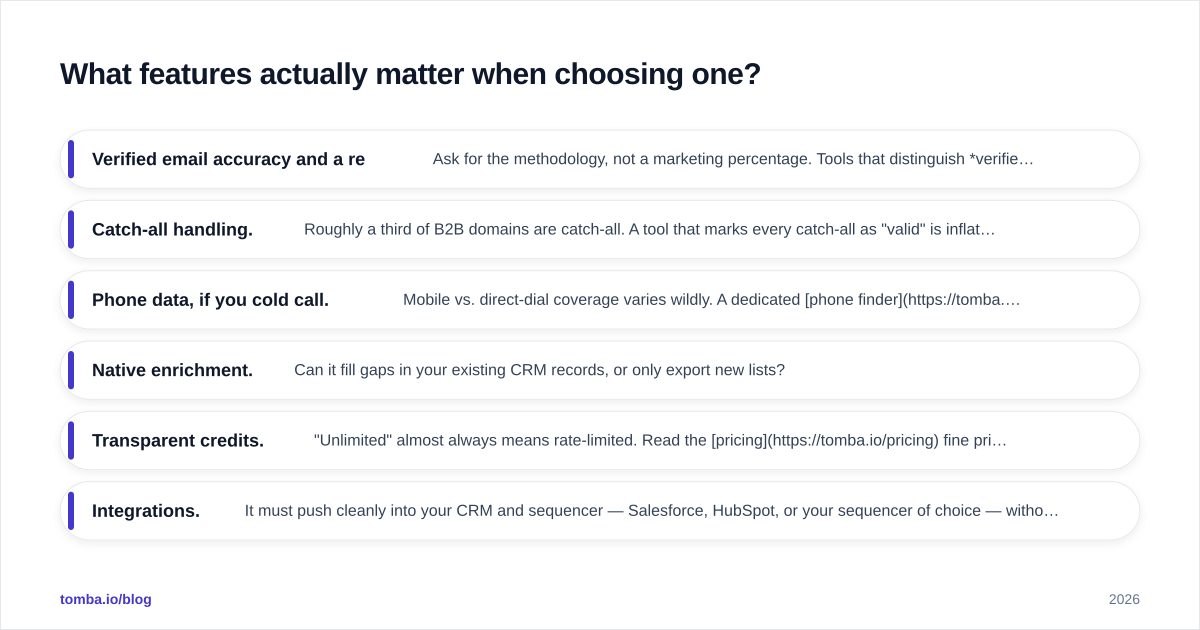
- Verified email accuracy and a real bounce guarantee. Ask for the methodology, not a marketing percentage. Tools that distinguish verified from guessed (pattern-predicted) emails are being honest with you.
- Catch-all handling. Roughly a third of B2B domains are catch-all. A tool that marks every catch-all as "valid" is inflating its accuracy number.
- Phone data, if you cold call. Mobile vs. direct-dial coverage varies wildly. A dedicated phone finder often beats a suite's bundled numbers.
- Native enrichment. Can it fill gaps in your existing CRM records, or only export new lists?
- Transparent credits. "Unlimited" almost always means rate-limited. Read the pricing fine print for monthly search caps.
- Integrations. It must push cleanly into your CRM and sequencer — Salesforce, HubSpot, or your sequencer of choice — without CSV gymnastics.
A useful gut-check from peer reviews: cross-reference any vendor's accuracy claim against third-party data on G2 before you trust it. Self-reported accuracy and verified accuracy are different sports.
How should you build an AI prospecting stack in 2026?#
Treat it as three layers, not one purchase.
Layer 1 — Signal. Decide who to contact. This can be an intent platform, your own product usage data, or simply lookalike scoring against closed-won deals. Start cheap; many teams over-invest here before they've nailed the basics.
Layer 2 — Data. Turn target accounts into accurate, verified contacts. This is the layer most teams under-invest in, and it's where deliverability is won or lost. A focused email finder plus verification is the backbone. If you're enriching at scale, a bulk email finder handles thousands of records at once.
Layer 3 — Outreach. Sequence, personalize, and send. Use AI for first-line personalization and reply drafting, but keep a human approving sends and watching deliverability metrics.
The reason to separate the layers: each one is replaceable. When a better signal source appears, you swap Layer 1 without rebuilding your whole motion. All-in-one suites lock you into one vendor's version of all three — convenient until one layer underperforms and you can't surgically replace it. Vendors like HubSpot and Salesforce increasingly bundle AI prospecting into their CRMs, which is fine for convenience but rarely best-in-class at the data layer.
A practical 2026 starter stack for a lean team: lightweight intent signals (job changes, funding) → a verified email-and-phone data provider → your existing sequencer with AI assist for copy. Add a heavier intent platform only once that base reliably books meetings.
What are the limits and risks?#
Three to keep in front of you.
Data decay. B2B contact data degrades roughly 25–30% per year as people change jobs. No AI fixes a stale record — it just confidently sends to it. Re-verify before every major campaign.
Compliance. GDPR, CCPA, and similar regimes govern how you source and use contact data. AI scraping at scale raises the stakes. Confirm your provider's data sourcing is documented and compliant; "we have everyone's data" is a red flag, not a feature.
Sameness. When everyone uses the same AI to write the same personalized openers, personalization stops being a differentiator. The edge shifts back to who you target and what you actually offer — which is exactly where good signal and clean data, not clever copy, make the difference.
The bottom line#
AI-powered prospecting tools are worth adopting in 2026 — as long as you remember that AI ranks and writes, but it does not manufacture truth. The accuracy of your contact data is the ceiling on everything the AI does on top of it. Buy the signal and outreach layers for convenience; never compromise on the data layer.
If you want to fix that data layer first — the highest-leverage move for most teams — start with the Tomba Email Finder. Find verified professional emails by name, company, or domain, run them through built-in verification to keep bounces low, and feed clean contacts into whatever AI sequencer you already use. The free tier gives you 25 searches a month to test accuracy against your own list before you commit to a paid plan. Build the stack on data you can trust, and let the AI do the rest.
// get started
Find, verify and enrich your first contacts today
Start on the free plan with 25 searches a month, then scale when your team is ready.
Free plan · No credit card required · GDPR & CCPA
// about the author