Aidentified vs GetProspect 2026: Which Data Tool Wins?
Aidentified and GetProspect solve different prospecting problems. We compare data, pricing, accuracy, and use cases so you pick the right one in 2026.
Choosing between Aidentified and GetProspect feels like an apples-to-apples comparison until you actually open both products. One is a relationship-intelligence engine built for wealth managers and enterprise sellers who close on warm introductions. The other is a high-volume email finder that turns a name and a company into a deliverable address. They overlap just enough to land on the same shortlist, and differ enough that picking the wrong one wastes a year of budget.
This guide breaks down where each tool actually wins, what you pay, how accurate the data is, and which one belongs in your stack.
TL;DR#
- Aidentified is a relationship-intelligence and wealth-data platform. It maps who your team already knows, layers on net-worth and life-event signals, and is priced for enterprise and financial-services teams. Pricing is quote-only.
- GetProspect is a self-serve email finder and B2B lead-gen tool with a 200M+ contact database, a LinkedIn Chrome extension, bulk search, and email verification. Plans start free and scale by credits.
- They are not direct competitors. Aidentified answers "who should I talk to and who can introduce me." GetProspect answers "what is this person's email so I can reach them."
- If your motion is warm-intro, advisor-led, or relationship-driven, lean Aidentified. If it's outbound volume — cold email, sequences, list building — lean GetProspect (or a sharper email finder).
- For most outbound and RevOps teams that just need accurate, verified contact data at a transparent price, a dedicated email finder like Tomba is the more cost-effective core.
What is Aidentified?#
Aidentified is a data-intelligence platform that scores and maps relationships at scale. Instead of starting with "find me an email," it starts with "show me the people in my orbit, rank them by fit and reachability, and tell me who on my team can make a warm introduction."
It blends B2B firmographic data with consumer-side signals — estimated net worth, home value, life events like a job change, liquidity event, or relocation. That mix is why it has strong traction in wealth management, financial advisory, insurance, and luxury verticals, where the buyer is an individual and timing matters more than volume. You can read more on its official site.
The core idea is the relationship graph. Aidentified ingests your team's connections and surfaces second-degree paths to a target — the warm-intro layer that high-trust sales motions live on.
What is GetProspect?#
GetProspect is a B2B email finder and lead-generation tool. The workflow is the opposite end of the funnel: you have a name, a domain, or a LinkedIn profile, and you want a verified email address to start outreach.
Its building blocks are familiar to anyone who has done outbound:
- A searchable database of 200M+ contacts filterable by title, industry, location, company size, and tech stack.
- A LinkedIn Chrome extension that pulls emails as you browse profiles and Sales Navigator lists.
- Bulk email finding from uploaded lists of names and companies.
- Built-in email verification to cut bounces before you send.
- A light CRM and list management layer, plus integrations and an API.
GetProspect is self-serve, transparent on pricing, and built for volume. Check current details on the GetProspect homepage.
How do Aidentified and GetProspect differ at the core?#
The cleanest way to think about it: Aidentified optimizes for who and when, GetProspect optimizes for how to reach them at scale. One is a targeting and warm-path engine; the other is a contact-data faucet.
That difference cascades into everything — data types, pricing model, ideal user, and how the tool fits your pipeline. A wealth advisor cares that a prospect just had a liquidity event and that her golf partner is a current client. A cold-email operator cares that 9,500 of 10,000 addresses are deliverable and the list exported cleanly into their sequencer.

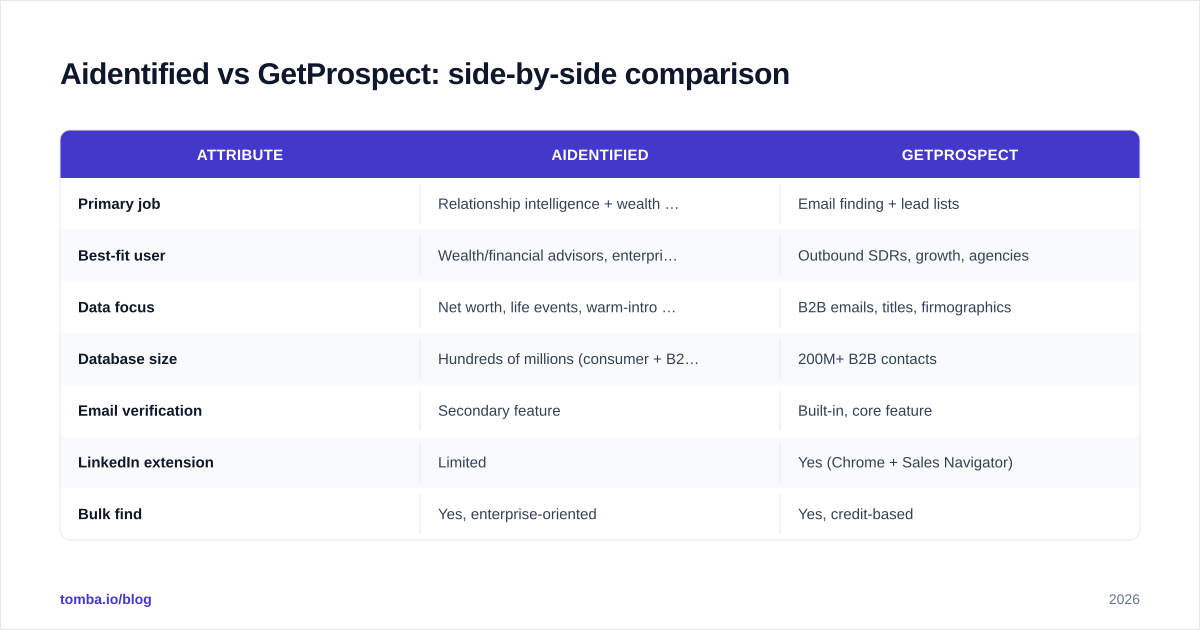
Aidentified vs GetProspect: side-by-side comparison#
| Attribute | Aidentified | GetProspect |
|---|---|---|
| Primary job | Relationship intelligence + wealth data | Email finding + lead lists |
| Best-fit user | Wealth/financial advisors, enterprise AEs | Outbound SDRs, growth, agencies |
| Data focus | Net worth, life events, warm-intro paths | B2B emails, titles, firmographics |
| Database size | Hundreds of millions (consumer + B2B) | 200M+ B2B contacts |
| Email verification | Secondary feature | Built-in, core feature |
| LinkedIn extension | Limited | Yes (Chrome + Sales Navigator) |
| Bulk find | Yes, enterprise-oriented | Yes, credit-based |
| Pricing model | Quote-only / enterprise | Free tier + transparent paid plans |
| Entry price | Custom (not published) | Free, then paid tiers |
| API access | Yes (enterprise) | Yes |
| Learning curve | Higher — onboarding-led | Low — self-serve in minutes |
Which one has better data accuracy?#
It depends on which data you mean — and that is the honest answer most comparison posts dodge.
For net-worth estimates, household data, and life-event triggers, Aidentified is in a class GetProspect doesn't compete in. Those signals are its reason to exist, and for an advisor qualifying a prospect's investable assets, that depth is the whole value.
For B2B email accuracy and deliverability, GetProspect is the more direct tool because verification is a first-class feature rather than a side effect. Still, like every database-first finder, accuracy decays as data ages, and catch-all domains remain a known weak spot across the category. Independent reviews on G2 show both tools drawing praise and the usual complaints about stale records — no provider is immune.
The practical move, regardless of which platform you choose, is to re-verify any list immediately before a send. Bounce rates above 3-5% drag down sender reputation fast, and a fresh verification pass plus a catch-all verifier protects deliverability more than any vendor's headline accuracy stat.
How does pricing compare?#
This is where the two diverge hardest, and where many buyers get surprised.
Aidentified does not publish pricing. It's a quote-driven, seat-and-data enterprise model, typically with annual commitments. That fits its buyer — a wealth-management firm rolling it out to a team of advisors — but it means you can't sign up on a Tuesday and test it Wednesday. Expect a demo, a scoping call, and a contract.
GetProspect is transparent and self-serve. There's a free tier (a small monthly allotment of valid emails) and paid plans that scale by the number of verified emails and features. That makes it easy to start small and grow, which is why solo operators and agencies gravitate to it.
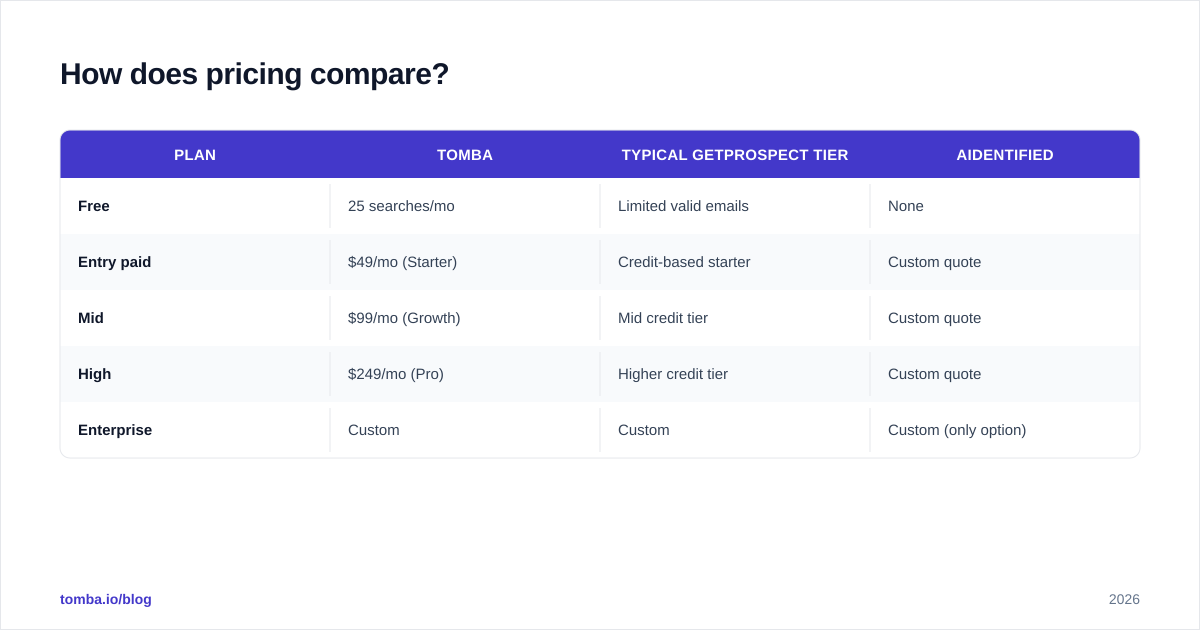
For context, here's how a transparent email-data stack tends to price out, using Tomba's pricing as a reference point:
| Plan | Tomba | Typical GetProspect tier | Aidentified |
|---|---|---|---|
| Free | 25 searches/mo | Limited valid emails | None |
| Entry paid | $49/mo (Starter) | Credit-based starter | Custom quote |
| Mid | $99/mo (Growth) | Mid credit tier | Custom quote |
| High | $249/mo (Pro) | Higher credit tier | Custom quote |
| Enterprise | Custom | Custom | Custom (only option) |
The takeaway: if predictable, published pricing matters — and for most SMB and mid-market outbound teams it does — GetProspect and dedicated finders win on transparency. Aidentified's model only makes sense when the relationship and wealth data justify an enterprise spend.
When should you choose Aidentified?#
Choose Aidentified when your sales motion runs on trust and timing rather than volume:
- You sell to individuals or households where net worth and life events drive the buying window — wealth management, private banking, insurance, high-ticket real estate.
- Your best deals come from warm introductions, and you want software to surface the second-degree paths your team already has.
- You're an enterprise team with budget for a relationship-intelligence platform and the onboarding it requires.
- You measure success in quality of conversations, not number of emails sent.
If that's you, GetProspect will feel thin — it simply doesn't carry the wealth and relationship layer.
When should you choose GetProspect?#
Choose GetProspect when you're running outbound at volume and need contact data fast:
- You're an SDR, growth marketer, or agency building lead lists every week.
- You live in LinkedIn and Sales Navigator and want emails captured as you prospect.
- You need bulk find + verify before pushing lists into a sequencer or CRM.
- You want to start free and scale on a published price, without a sales call.
GetProspect's LinkedIn email extractor workflow and bulk tooling map directly to a high-velocity outbound process.
Is there a better alternative for pure email finding?#
If your real need is the GetProspect job — accurate, verified B2B emails at a fair, transparent price — it's worth weighing a focused email-finder against both tools rather than overbuying on Aidentified or settling on credit-heavy plans.
A dedicated finder typically gives you a domain-search workflow, single and bulk email finding, real-time verification, data enrichment, and an API — without the enterprise contract or the wealth-data premium you won't use. For teams whose KPI is deliverable emails per dollar, that focus usually wins.
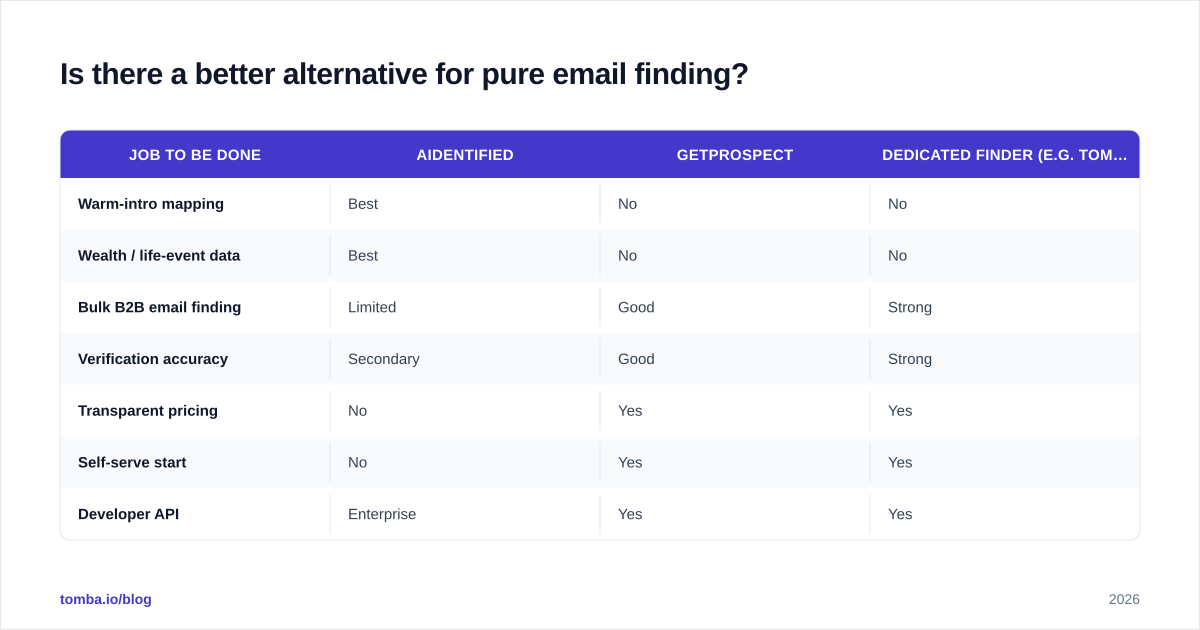
Here's how the three stack up by job-to-be-done:
| Job to be done | Aidentified | GetProspect | Dedicated finder (e.g. Tomba) |
|---|---|---|---|
| Warm-intro mapping | Best | No | No |
| Wealth / life-event data | Best | No | No |
| Bulk B2B email finding | Limited | Good | Strong |
| Verification accuracy | Secondary | Good | Strong |
| Transparent pricing | No | Yes | Yes |
| Self-serve start | No | Yes | Yes |
| Developer API | Enterprise | Yes | Yes |
None of these is "the best tool" in the abstract. The best tool is the one matched to your motion. Pay for the relationship graph only if you'll use it; pay for an email faucet if volume and deliverability are the bottleneck.
How do you decide in practice?#
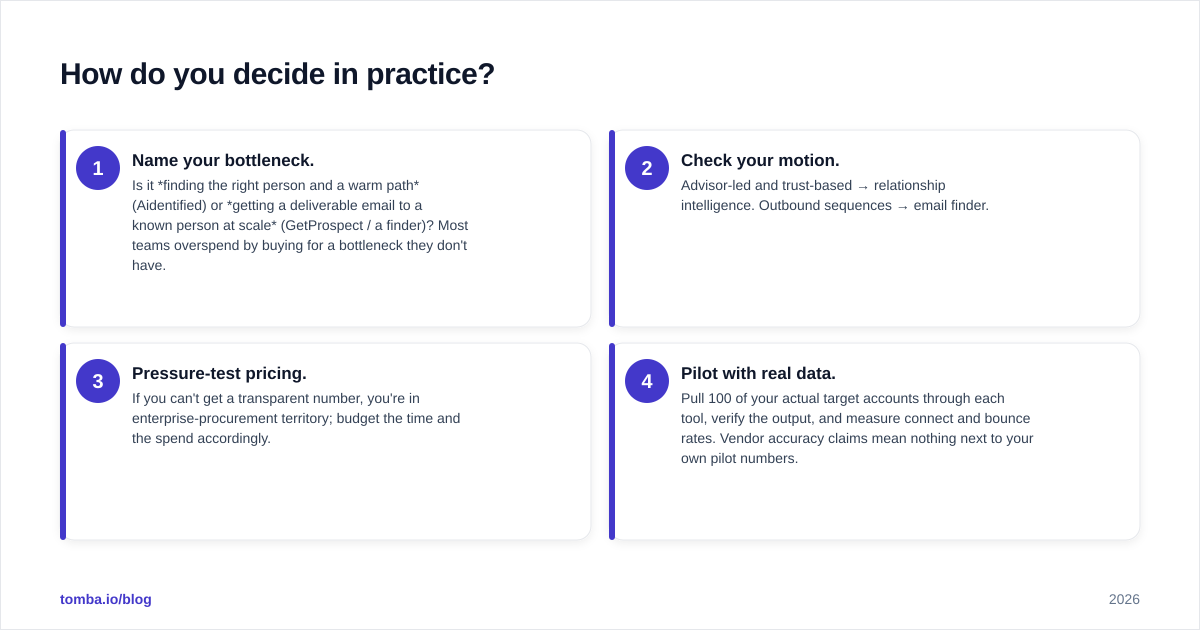
Run this quick test before you commit:
- Name your bottleneck. Is it finding the right person and a warm path (Aidentified) or getting a deliverable email to a known person at scale (GetProspect / a finder)? Most teams overspend by buying for a bottleneck they don't have.
- Check your motion. Advisor-led and trust-based → relationship intelligence. Outbound sequences → email finder.
- Pressure-test pricing. If you can't get a transparent number, you're in enterprise-procurement territory; budget the time and the spend accordingly.
- Pilot with real data. Pull 100 of your actual target accounts through each tool, verify the output, and measure connect and bounce rates. Vendor accuracy claims mean nothing next to your own pilot numbers.
That last step is the one teams skip and regret. A two-day pilot on your own ICP tells you more than any review site.
The bottom line#
Aidentified and GetProspect aren't really rivals — they're tools for two different problems that happen to share a shortlist. Aidentified is the pick for relationship-driven, wealth-centric, enterprise selling where warm intros and life-event timing decide deals. GetProspect is the pick for self-serve, high-volume B2B email finding and list building.
If your core need is the second one — accurate, verified contact data without the enterprise contract — start with a focused tool. Tomba's Email Finder gives you domain search, single and bulk email finding, real-time verification, and a developer-friendly API on transparent plans, with a free tier (25 searches/mo) to test before you pay. Match the tool to your bottleneck, verify everything before you send, and let your pipeline — not a sales rep — decide which platform earns the budget.
// get started
Find, verify and enrich your first contacts today
Start on the free plan with 25 searches a month, then scale when your team is ready.
Free plan · No credit card required · GDPR & CCPA
// about the author