B2B Cold Email Reply Rates: 2026 Benchmarks & Fixes
What counts as a good B2B cold email reply rate in 2026, the benchmarks by industry, and the seven levers that move replies from 1% to 8%+.
TL;DR
- A "good" B2B cold email reply rate in 2026 is 5–10%; anything above 10% is excellent, and most untuned campaigns sit below 1%.
- Reply rate is driven far more by list quality and targeting than by clever copy — bad data caps your ceiling no matter how good the email reads.
- The biggest, fastest win is verifying every address before send: bounces wreck deliverability, and undelivered email can't reply.
- Personalization at the first-line and offer level lifts replies 2–3x versus generic templates.
- Track positive reply rate, not just total replies — "unsubscribe" and "wrong person" are replies too.
What is a good B2B cold email reply rate in 2026?#
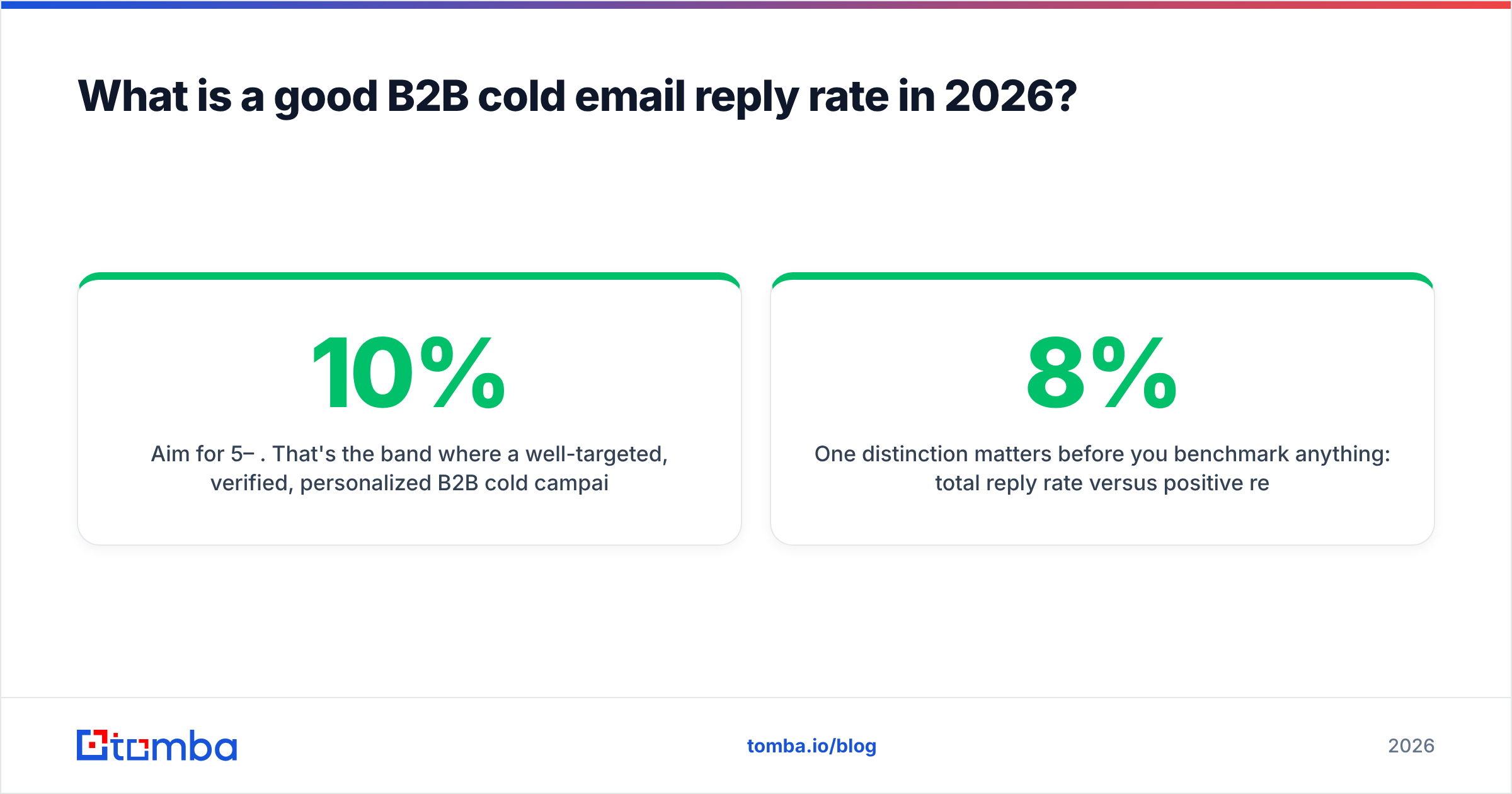
Aim for 5–10%. That's the band where a well-targeted, verified, personalized B2B cold campaign should land in 2026. Below 1% means something upstream is broken — usually the list, the deliverability, or both. Above 10% and you're in the top decile, the kind of number that comes from tight niche targeting and genuine relevance.
Reply rate is the percentage of recipients who answer your email at all — positive, negative, or neutral. It's a sharper signal than open rate, which became nearly impossible to measure accurately after Apple Mail Privacy Protection started inflating opens. A reply is a human action you can't fake, which is why modern outbound teams treat it as the primary top-of-funnel KPI.
One distinction matters before you benchmark anything: total reply rate versus positive reply rate. If 8% of recipients reply but half of those say "not interested" or "remove me," your real signal is 4%. Always segment.
What are the average reply rates by industry?#
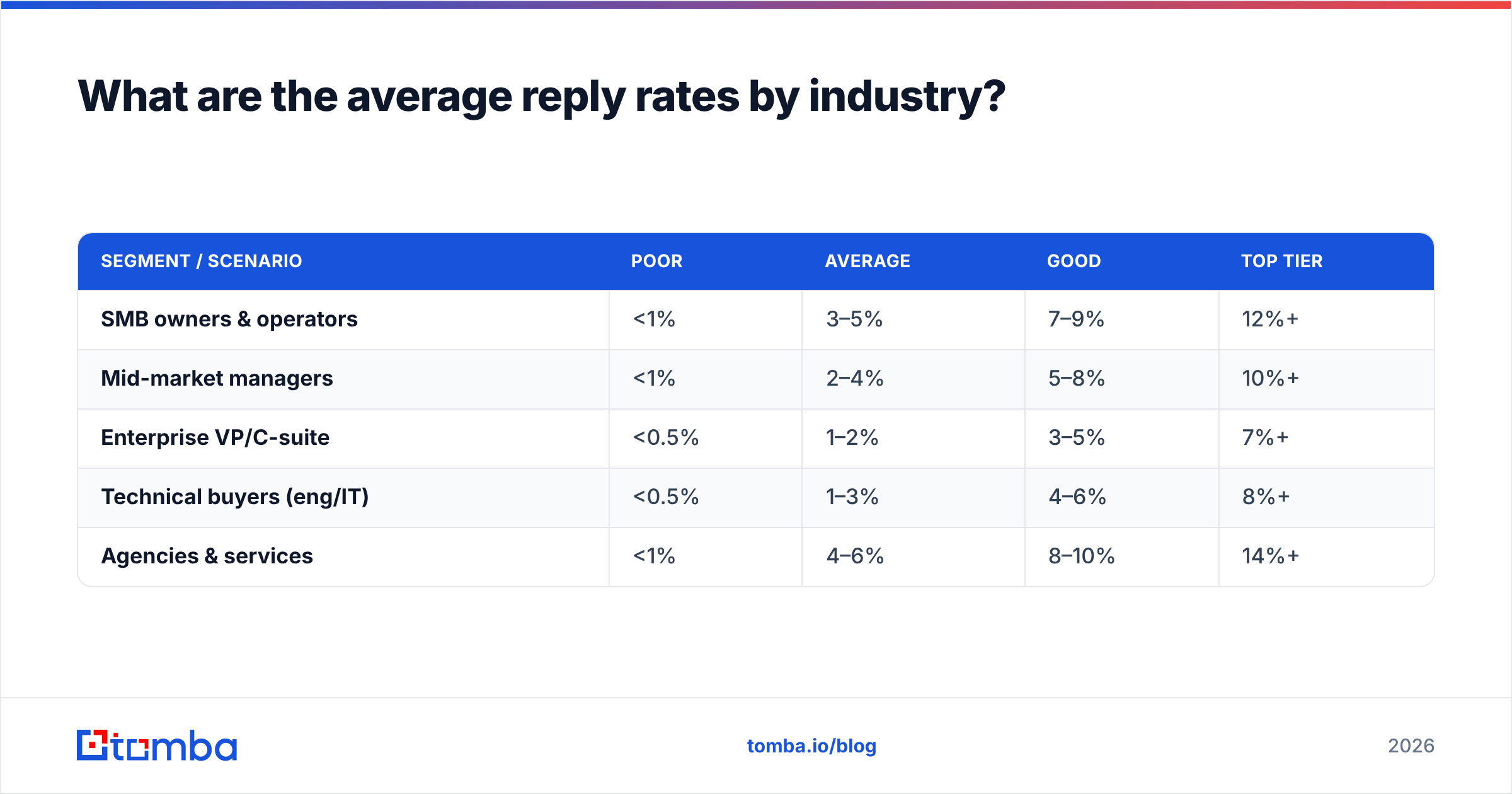
Benchmarks vary a lot by vertical, deal size, and how saturated the target inbox is. CTOs and VPs of Sales get hammered daily; office managers at regional firms don't. Use the table below as a directional baseline, not gospel — your own segmented data always wins.
| Segment / scenario | Poor | Average | Good | Top tier |
|---|---|---|---|---|
| SMB owners & operators | <1% | 3–5% | 7–9% | 12%+ |
| Mid-market managers | <1% | 2–4% | 5–8% | 10%+ |
| Enterprise VP/C-suite | <0.5% | 1–2% | 3–5% | 7%+ |
| Technical buyers (eng/IT) | <0.5% | 1–3% | 4–6% | 8%+ |
| Agencies & services | <1% | 4–6% | 8–10% | 14%+ |
Two patterns hold across every row. First, the higher the seniority, the lower the reply rate — but the higher the deal value, so a 2% reply rate to enterprise can out-earn a 9% rate to SMBs. Second, the spread between "poor" and "top tier" is roughly 10x, and almost all of that gap is controllable. According to HubSpot's sales research, response rates climb sharply when outreach is personalized and triggered by a relevant event rather than blasted on a fixed cadence.
Why are your cold email reply rates so low?#
Low replies almost always trace back to one of five root causes, in rough order of impact:
- Bad or unverified data — invalid addresses bounce, hurt your sender reputation, and obviously never reply. This is the single most common ceiling.
- Wrong targeting — the email is perfect, but the person has no reason to care. Relevance beats craft.
- Deliverability problems — your message lands in spam, so the reply rate you see is calculated on a denominator that never saw the email.
- Generic copy — a template that could've been sent to 10,000 people reads like it was, and gets treated accordingly.
- Weak or vague ask — no clear, low-friction next step, so even interested readers don't act.
Notice that three of the top four are about who and whether the email arrives, not what it says. Teams overweight copywriting and underweight data. You can A/B test subject lines all month, but if 20% of your list bounces, you're optimizing the wrong variable. Run your list through an email verifier before you touch a single word of copy.
How does list quality affect reply rates?#
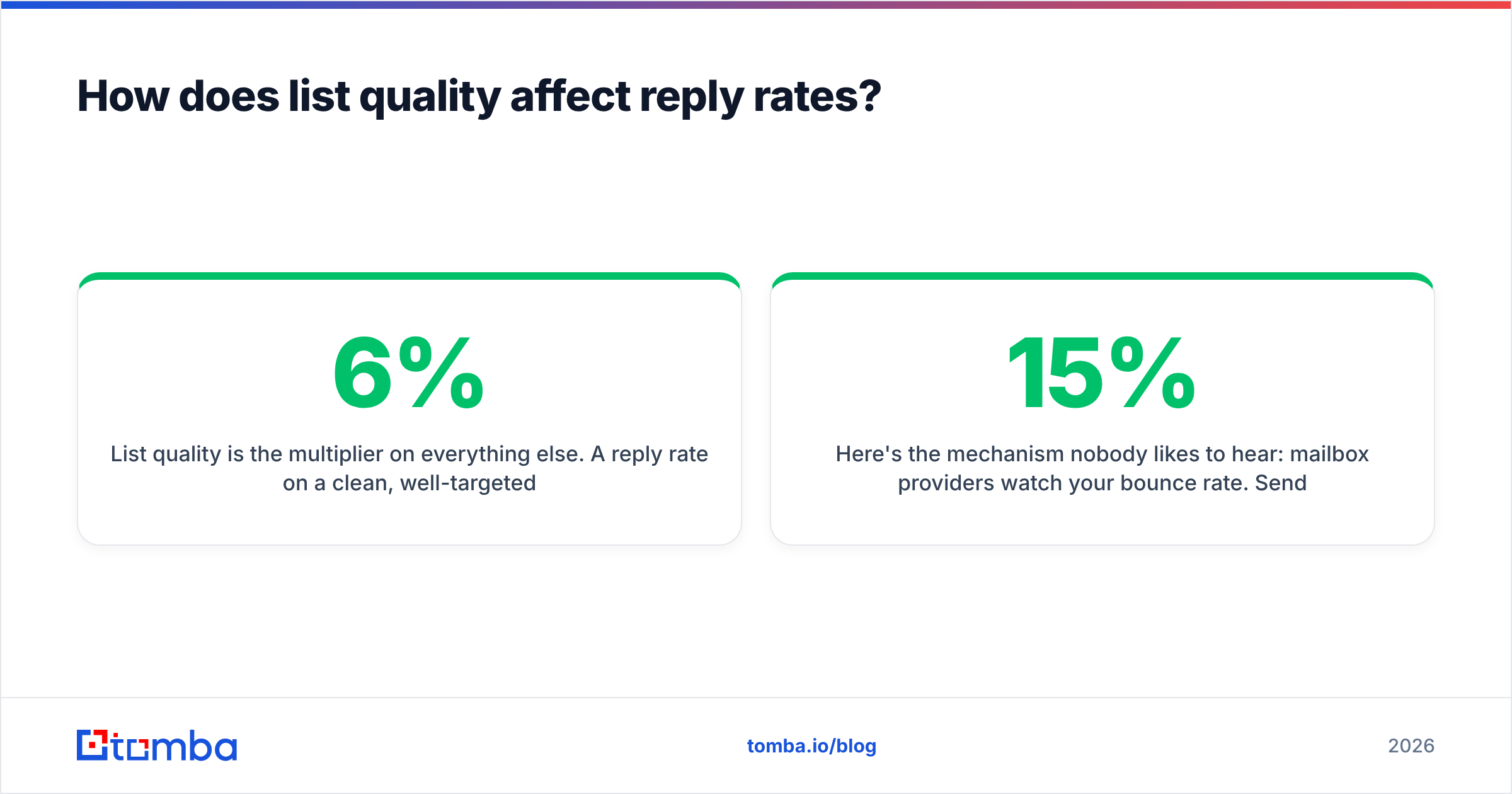
List quality is the multiplier on everything else. A 6% reply rate on a clean, well-targeted list of 500 produces 30 conversations. The same copy on a 2,000-record scraped list that's 30% invalid produces fewer real conversations and torches your domain reputation in the process.
Here's the mechanism nobody likes to hear: mailbox providers watch your bounce rate. Send to a list with 15% invalid addresses and Google and Microsoft start routing your valid mail to spam too. So bad data doesn't just waste the bounced sends — it suppresses replies from the good addresses. That's why email deliverability and list hygiene are the same problem wearing two hats.
The fix is a two-step pipeline: find accurate addresses, then verify them before send.
- Find the right contacts with a domain search or email finder so you're starting from real, role-matched people.
- Verify every address — including catch-all domains, which need a dedicated catch-all verifier because standard SMTP checks return ambiguous results.
- Enrich with firmographic and role data so personalization has something to grab onto.
How do you actually increase B2B cold email reply rates?#
Seven levers, ordered by return on effort. Work top to bottom — don't skip to copy tweaks before the data is clean.
- Verify the list first. Get bounce rate under 2%. This protects deliverability and removes the wasted denominator. It's the highest-ROI thing on this page.
- Tighten targeting. Narrow your ICP until every recipient has an obvious reason to care. A list of 200 perfect-fit prospects beats 2,000 maybes.
- Personalize the first line and the offer, not just the
{{first_name}}token. Reference something specific — a recent hire, a product launch, a tech-stack signal. - Lead with a relevant problem, not your product. The opening should make the reader think "how did they know that's my issue?"
- Make one small ask. "Worth a 12-minute call Thursday?" outperforms "let me know if you'd like to learn more." Specific and low-friction wins.
- Follow up 3–5 times. Most replies come from the second and third touch, not the first. Persistence with new angles, not nagging copy.
- Warm up the domain and rotate inboxes so volume doesn't trip spam filters.
How much does personalization really move the needle?#
A lot — but only after the data is right. Genuine, research-based personalization typically lifts reply rates 2–3x over a generic blast. The catch is that personalization at scale is expensive unless you automate the inputs. That's where enrichment and pattern detection earn their keep: pulling a verified role, company size, and recent trigger event for each contact so your merge fields actually mean something. G2's reviews of outbound tools consistently rank reply quality higher for teams that enrich before they personalize.
What's the difference between reply rate and positive reply rate?#
Positive reply rate is the only number that pays your salary. Total reply rate counts every response, including "stop emailing me." A campaign can show a healthy 9% total reply rate while quietly generating a wall of unsubscribes — that's not engagement, that's annoyance.
Track them separately:
- Total reply rate = all replies ÷ delivered. A deliverability and curiosity signal.
- Positive reply rate = interested replies ÷ delivered. The pipeline signal.
- Reply-to-meeting rate = meetings booked ÷ positive replies. The closing signal.
If total replies are high but positive replies are low, your targeting or offer is off — you're reaching people, but the wrong ones, or with the wrong pitch. If both are low, start with the data and deliverability. Tie these to your broader response rate tracking so trends are visible across campaigns, not just within one.
How do deliverability and verification connect to replies?#
Replies are impossible without delivery, and delivery depends on reputation. The chain is simple: clean list → low bounces → strong sender reputation → inbox placement → a real chance to reply. Break any link and the reply rate at the end collapses.
Concretely, before any send you want:
- Bounce rate under 2% — achieved by verifying every address, not sampling.
- Authentication in place — SPF, DKIM, and DMARC aligned so providers trust your domain.
- Catch-all handling — many B2B domains accept everything at the SMTP layer, so you need true catch-all verification to avoid guessing.
- Volume ramp — new domains warmed gradually rather than blasted day one.
The verification step is non-negotiable. It's cheap, fast, and it's the difference between your email reaching 980 of 1,000 inboxes versus 600. Free entry points like the free email checker let you spot-test before committing to a full run.
How should you benchmark and improve over time?#
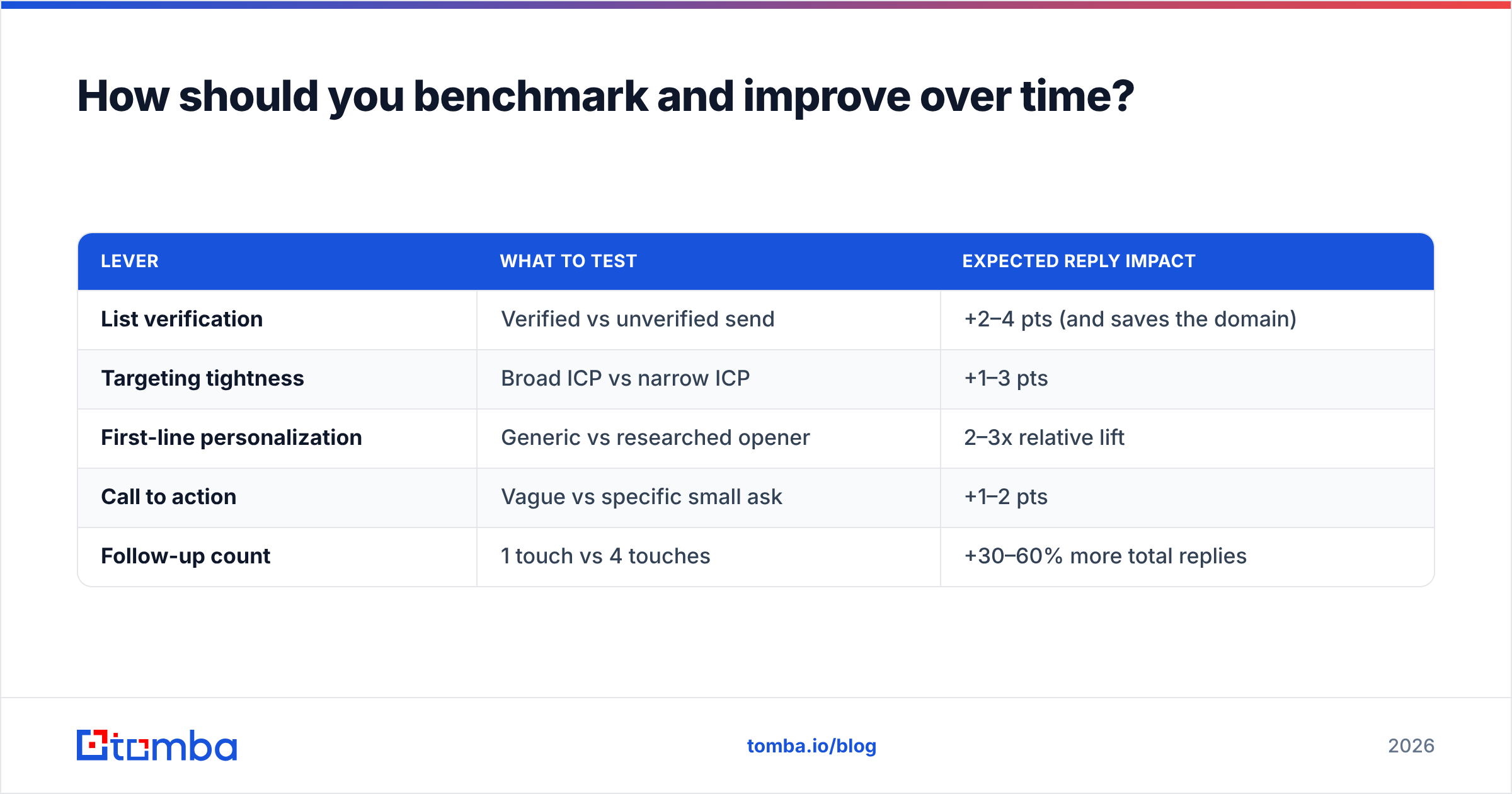
Treat reply rate as a controlled experiment, not a vanity metric. Change one variable per campaign so you know what moved the number.
| Lever | What to test | Expected reply impact |
|---|---|---|
| List verification | Verified vs unverified send | +2–4 pts (and saves the domain) |
| Targeting tightness | Broad ICP vs narrow ICP | +1–3 pts |
| First-line personalization | Generic vs researched opener | 2–3x relative lift |
| Call to action | Vague vs specific small ask | +1–2 pts |
| Follow-up count | 1 touch vs 4 touches | +30–60% more total replies |
Run each test on a sample large enough to be meaningful — at least a few hundred sends per variant — and always read the positive reply rate, not just total. Over a quarter, a team that systematically works this table moves from sub-1% to the 5–10% band. There's no single silver bullet; it's the stack of marginal gains, each multiplied by clean data underneath.
What's the fastest path from here?#
Start with the data, because it caps everything else. Use the Tomba Email Finder to source role-matched contacts by domain, name, or company, then verify the whole list so your bounce rate stays under 2% and your replies aren't quietly capped by addresses that never arrived. Pair it with the email verifier and catch-all checks before every send. The Free tier gives you 25 searches a month to test the workflow, and paid plans start at $49/mo (Starter) when you're ready to scale — a small price next to the pipeline a 5–10% reply rate generates. Get the list right first, and the copy work you do after it will actually pay off.
// get started
Find, verify and enrich your first contacts today
Start on the free plan with 25 searches a month, then scale when your team is ready.
Free plan · No credit card required · GDPR & CCPA
Get the Tomba newsletter
Product and data updates
// about the author