B2B Lead Generation Agency: Costs, ROI & Picks (2026)
What a B2B lead generation agency actually costs, when it beats in-house, and how to vet one in 2026 — with a pricing table and a build-vs-buy breakdown.
You are weighing a $5,000-a-month retainer against building pipeline yourself. The pitch deck looks great. The case studies are glossy. But you still do not know whether a B2B lead generation agency will actually move your number — or just bill you for activity.
This guide gives you the honest math. What these agencies cost, what they do well, where they quietly fail, and how to vet one before you sign. By the end you will know whether to hire, build, or run a hybrid.
TL;DR#
- A B2B lead generation agency typically costs $3,000–$15,000/mo on retainer, or $50–$500 per qualified appointment on performance deals.
- Agencies win on speed and infrastructure — they have warm domains, tooling, and SDR capacity ready on day one.
- In-house wins on margin and control — once you own the data and sequencing stack, cost-per-lead drops sharply over time.
- The biggest agency risk is opaque data quality: you pay for meetings that no-show because the contact data was scraped, not verified.
- The smartest 2026 setup is hybrid: an agency for top-of-funnel volume, an in-house stack (finder + verifier + CRM) you control for everything that touches your brand.
What is a B2B lead generation agency?#
A B2B lead generation agency is an outsourced team that fills your sales pipeline. Think of it like hiring a catering company for a wedding: instead of cooking yourself, you pay specialists who already own the kitchen, the staff, and the recipes. You get the meal faster — but you are renting their kitchen, not building your own.
In practice, agencies bundle some mix of these services:
- List building — sourcing target accounts and contacts that match your ICP (ideal customer profile).
- Data enrichment — appending emails, phone numbers, job titles, and firmographics. Good agencies run data enrichment and verification; weak ones hand you raw scrapes.
- Outbound execution — cold email, LinkedIn outreach, and cold calling at volume.
- Appointment setting — booking qualified meetings straight into your reps' calendars.
- Reporting — pipeline created, reply rates, cost per opportunity.
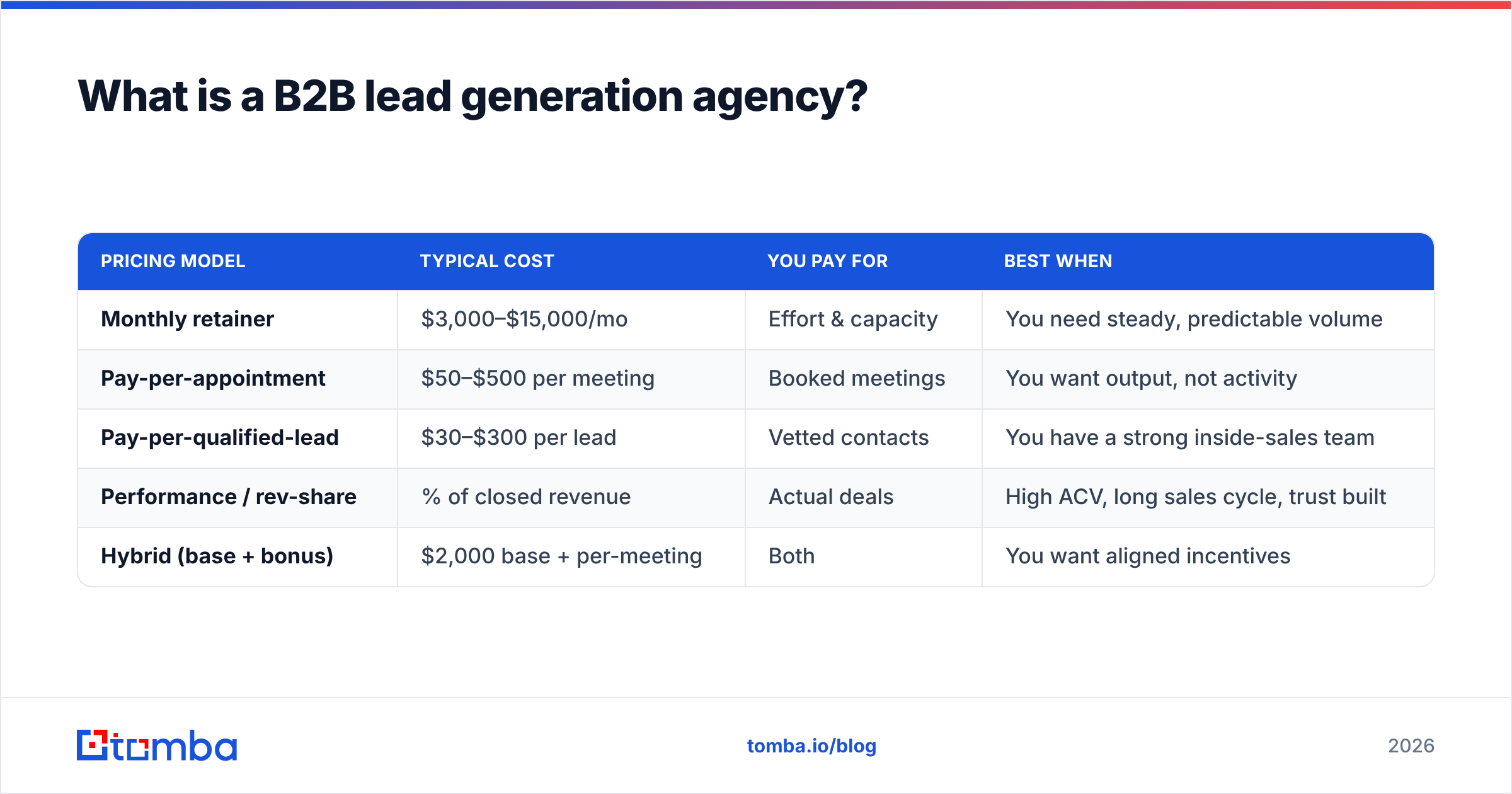
The model you pick changes everything about your risk. Here is how the common ones compare.
| Pricing model | Typical cost | You pay for | Best when |
|---|---|---|---|
| Monthly retainer | $3,000–$15,000/mo | Effort & capacity | You need steady, predictable volume |
| Pay-per-appointment | $50–$500 per meeting | Booked meetings | You want output, not activity |
| Pay-per-qualified-lead | $30–$300 per lead | Vetted contacts | You have a strong inside-sales team |
| Performance / rev-share | % of closed revenue | Actual deals | High ACV, long sales cycle, trust built |
| Hybrid (base + bonus) | $2,000 base + per-meeting | Both | You want aligned incentives |

How much does a B2B lead generation agency cost in 2026?#
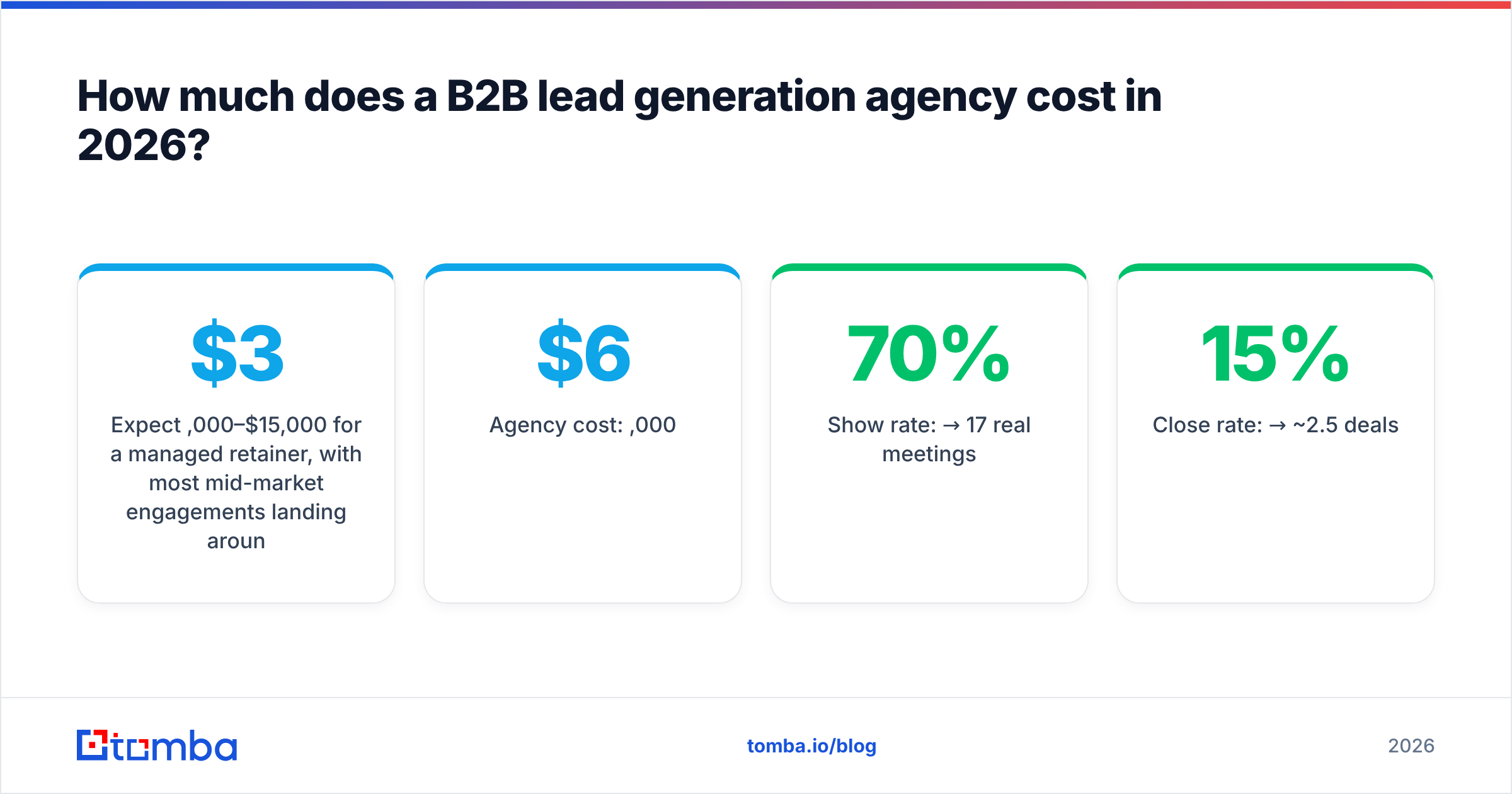
Expect $3,000–$15,000 per month for a managed retainer, with most mid-market engagements landing around $5,000–$8,000. Performance deals look cheaper per unit but add up fast: at $250 per appointment and 20 meetings a month, you are at $5,000 — and that is before you account for no-shows.
The number that actually matters is cost per closed deal, not cost per lead. Run it like this:
- Agency cost: $6,000/mo
- Meetings booked: 24
- Show rate: 70% → 17 real meetings
- Close rate: 15% → ~2.5 deals
- Cost per deal: roughly $2,400
If your average contract value is $20,000, that is a strong return. If it is $3,000, the agency is underwater for you and you should not sign. The math, not the case study, decides.
Watch for these add-ons that inflate the real price:
- Setup or onboarding fees ($1,000–$5,000 one-time)
- Tooling pass-through — they bill you for the email and data tools they use
- Minimum contract terms — 3 to 6 months is common, so a bad fit is expensive to exit
- Domain and inbox costs for cold email infrastructure
Is a B2B lead generation agency better than building in-house?#
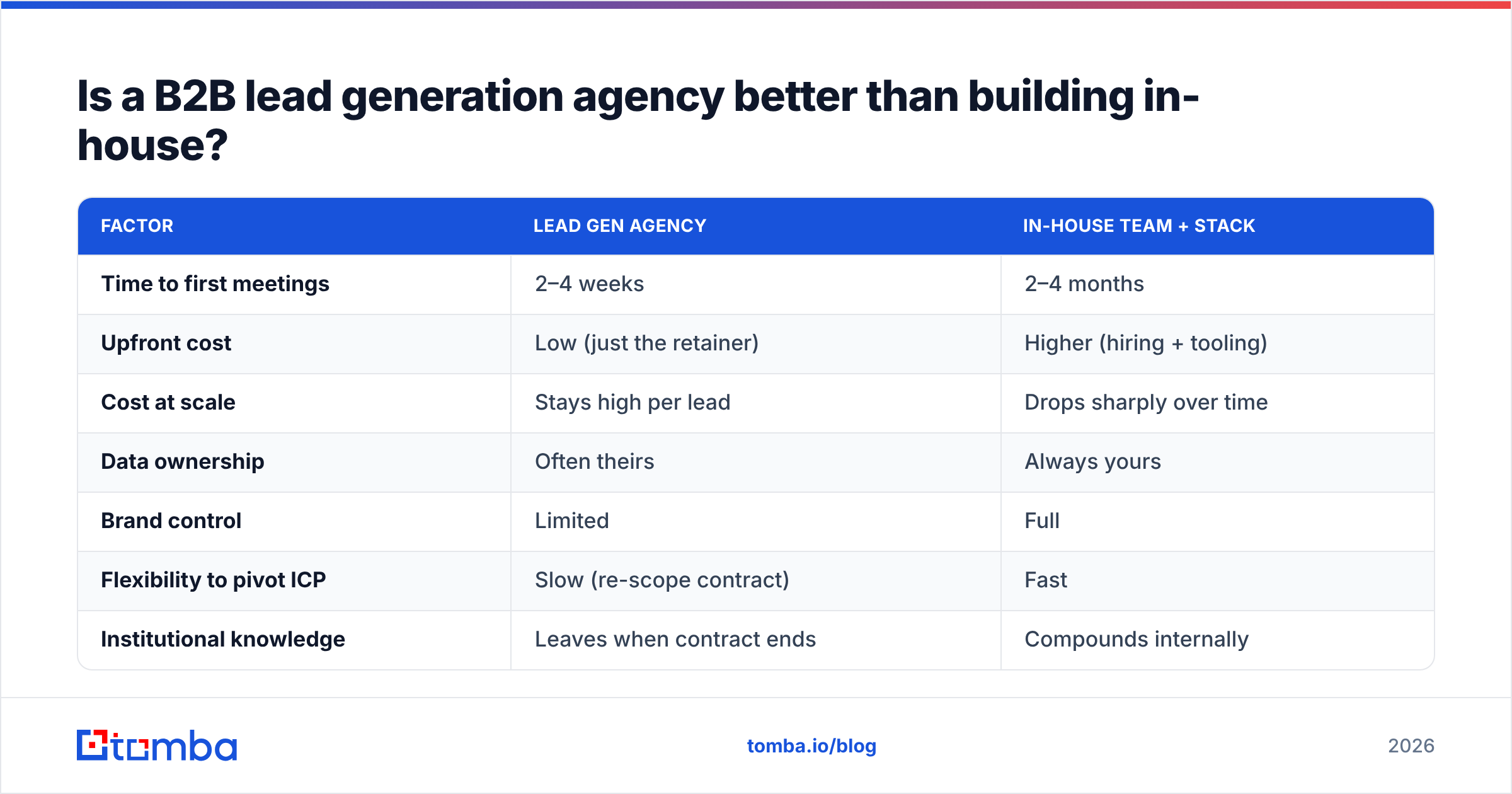
Neither is universally better — it depends on your timeline, margin targets, and how much control you need over your brand. The honest tradeoff comes down to speed versus ownership.
| Factor | Lead gen agency | In-house team + stack |
|---|---|---|
| Time to first meetings | 2–4 weeks | 2–4 months |
| Upfront cost | Low (just the retainer) | Higher (hiring + tooling) |
| Cost at scale | Stays high per lead | Drops sharply over time |
| Data ownership | Often theirs | Always yours |
| Brand control | Limited | Full |
| Flexibility to pivot ICP | Slow (re-scope contract) | Fast |
| Institutional knowledge | Leaves when contract ends | Compounds internally |
The agency advantage is real on day one: they already have warm sending domains, an SDR bench, and a tooling stack. Building that yourself takes months. But every month you outsource, the playbook lives in their building, not yours.
The in-house counterargument is margin. Once you own an email finder and email verifier, the marginal cost of the next 1,000 leads is close to zero. An agency charges you the same premium on lead 50,000 as on lead 50. For more on what this stack costs to run yourself, the Tomba pricing page lays out the credit tiers.

What separates a good agency from a lead mill?#
Data quality is the dividing line. A good agency verifies every contact before outreach; a lead mill scrapes a list, blasts it, and bills you for the noise. The difference shows up in your bounce rate and your reps' wasted hours.
Here is what to demand before you sign:
- Verified contact data, not raw scrapes. Ask how they verify emails and whether they handle catch-all domains. If they cannot explain their catch-all verifier process, your bounce rate will punish your sending reputation.
- A defined, written ICP. If the agency does not push you to narrow your ICP, they are optimizing for volume they can bill, not deals you can close.
- Transparent tooling. You should know exactly which tools touch your domain. Hidden infrastructure means hidden risk to your sender reputation.
- Realistic benchmarks. Anyone promising "10x pipeline in 30 days" is selling a story. Reply rates of 1–5% on cold outbound are normal in 2026.
- Data ownership in writing. When the contract ends, do you keep the contacts and the sequences? Get it in the agreement.
- References you can actually call. Not logos on a slide — two customers in your industry you can reach by phone.
For broader vendor-vetting frameworks, G2's lead generation category and HubSpot's research on outbound benchmarks are useful neutral references.
What questions should you ask before signing?#
Treat the sales call like a job interview, because you are hiring a team. The right questions surface a lead mill in ten minutes.
- Where does your contact data come from, and how fresh is it?
- What is your email verification process before a single send?
- What guarantees exist around no-shows and replacements?
- Who owns the data, sequences, and domains when we part ways?
- What does a realistic month-three pipeline look like for a company our size?
- Can I see anonymized reporting from a current client?
- How do you protect my domain's deliverability?
If the answers are vague on data and deliverability, walk. Those two things determine whether the whole engagement works, and a serious agency will have crisp answers ready.
When does the hybrid model win?#
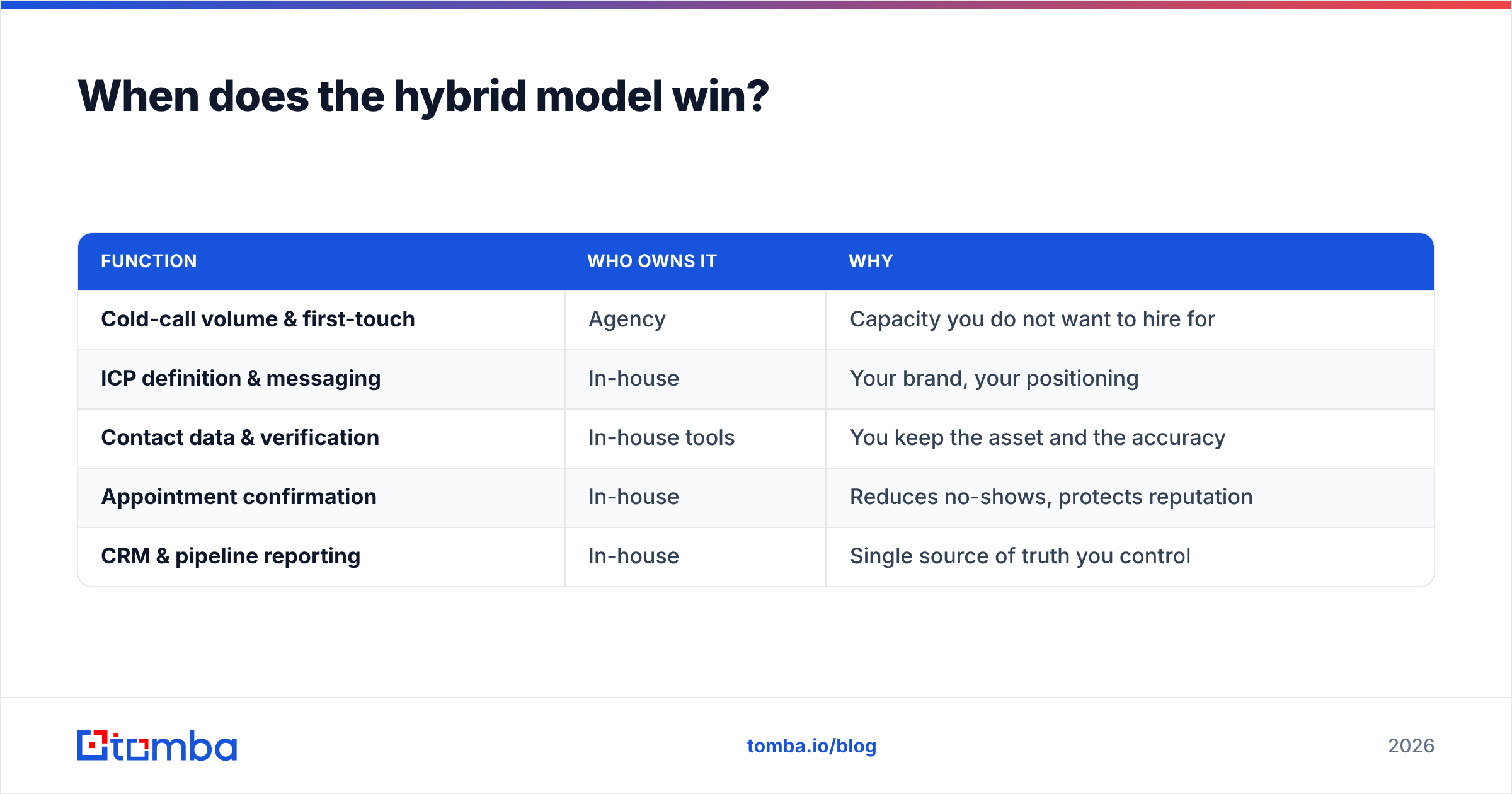
Most scaling B2B teams in 2026 land on a hybrid: an agency drives raw top-of-funnel volume while you keep a lean in-house stack for anything that touches your brand and your data. It is the best of both — outside capacity plus internal ownership.
A practical hybrid split looks like this:
| Function | Who owns it | Why |
|---|---|---|
| Cold-call volume & first-touch | Agency | Capacity you do not want to hire for |
| ICP definition & messaging | In-house | Your brand, your positioning |
| Contact data & verification | In-house tools | You keep the asset and the accuracy |
| Appointment confirmation | In-house | Reduces no-shows, protects reputation |
| CRM & pipeline reporting | In-house | Single source of truth you control |
The unlock here is owning your own data layer. When you can run find email addresses and verification yourself, you stop paying agency margin on the most valuable, most repeatable part of the funnel — and you can audit every list an agency hands you against your own source of truth.
Build your own lead engine with Tomba#
Whether you hire an agency, build in-house, or run a hybrid, the foundation is the same: accurate, verified contact data you actually own. That is exactly what Tomba gives you. Use the Tomba Email Finder to source professional emails by name, company, or domain, then verify them before a single send so your bounce rate stays low and your sender reputation stays clean.
Start free with 25 searches a month, then scale on the Starter plan at $49/mo as your pipeline grows. If you are vetting an agency, run their sample list through Tomba first — the verification results will tell you in minutes whether you are buying real leads or someone else's scrape. Stop renting your pipeline. Own it.
// get started
Find, verify and enrich your first contacts today
Start on the free plan with 25 searches a month, then scale when your team is ready.
Free plan · No credit card required · GDPR & CCPA
// about the author