B2B Outbound Lead Generation Strategies That Win in 2026
Outbound still beats inbound for net-new pipeline when you run it right. Here are the B2B outbound lead generation strategies, channels, and data tactics that actually book meetings in 2026.
Outbound is not dead. Bad outbound is dead. The teams still booking meetings in 2026 are the ones who pair tight targeting with clean data and a multi-channel cadence — not the ones blasting 5,000 unverified addresses and hoping. This guide breaks down the b2b outbound lead generation strategies that survive spam filters, buyer fatigue, and a tighter budget.
TL;DR#
- Outbound wins on net-new pipeline you can't get from inbound — specific accounts, specific roles, on your timeline.
- Data quality is the whole game. A 3% bounce rate protects your domain; a 15% bounce rate burns it. Verify before you send.
- Multi-channel beats single-channel. Email + LinkedIn + phone in a coordinated sequence lifts reply rates well above email alone.
- Personalization at the segment level scales better than one-off custom notes or full automation. Group by trigger, then tailor.
- Track booked meetings and reply rate, not open rate. Apple Mail Privacy Protection made opens a vanity metric years ago.
What is B2B outbound lead generation?#
Outbound lead generation is you reaching out to a buyer first, instead of waiting for them to find you. Inbound is fishing — you bait the hook and wait. Outbound is spearfishing — you pick the exact fish and go get it.
In practice that means building a list of accounts and contacts that match your ideal customer profile (ICP), then contacting them across email, phone, LinkedIn, and sometimes direct mail with a relevant message. The "relevant" part is what separates a 4% reply rate from a 0.3% one.
Outbound matters in 2026 for one reason: control. Inbound depends on content compounding over months and on search and social algorithms you don't own. When you need pipeline this quarter, from named accounts, outbound is the only lever you fully control.
What are the core B2B outbound channels in 2026?#
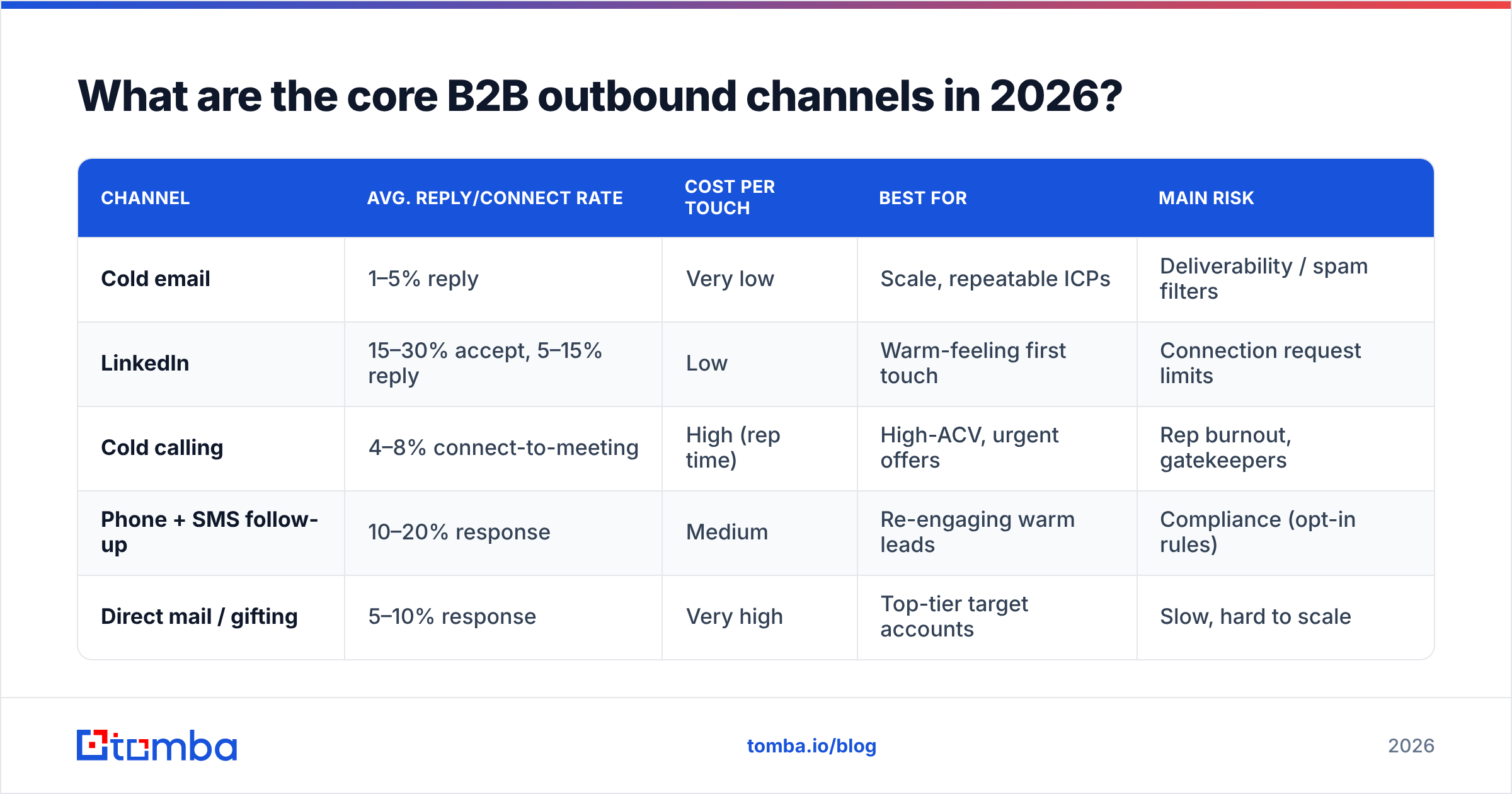
No single channel carries a program anymore. The buyers worth winning are spread across inboxes, phones, and feeds, and they ignore any channel that feels like a broadcast. Here's how the main channels compare on the dimensions that decide your mix.
| Channel | Avg. reply/connect rate | Cost per touch | Best for | Main risk |
|---|---|---|---|---|
| Cold email | 1–5% reply | Very low | Scale, repeatable ICPs | Deliverability / spam filters |
| 15–30% accept, 5–15% reply | Low | Warm-feeling first touch | Connection request limits | |
| Cold calling | 4–8% connect-to-meeting | High (rep time) | High-ACV, urgent offers | Rep burnout, gatekeepers |
| Phone + SMS follow-up | 10–20% response | Medium | Re-engaging warm leads | Compliance (opt-in rules) |
| Direct mail / gifting | 5–10% response | Very high | Top-tier target accounts | Slow, hard to scale |
The pattern: email gives you reach and low cost, LinkedIn gives you a softer entry, phone gives you the highest-quality conversations, and physical touches reserve themselves for accounts where a meeting is worth hundreds of dollars. The winning move is to sequence them, not choose one.
How do you build a high-quality outbound list?#
Your list determines your ceiling. You can have the best copy on earth and still fail if you're emailing the wrong 2,000 people. Build the list in this order.
- Define the ICP tightly. Industry, company size, tech stack, and the specific trigger (new funding, a key hire, a job posting for the problem you solve). "B2B SaaS, 50–500 employees, hired a VP of Sales in the last 90 days" is a list. "Tech companies" is not.
- Source the accounts. Pull from a B2B database, intent data, or a competitor's customer list. Aim for accounts showing a buying signal, not just accounts that exist.
- Find the right contacts. Map the buying committee — economic buyer, champion, and end user. Use a domain search to pull every relevant role at a target company in one pass instead of guessing one address at a time.
- Find and verify the emails. This is where most programs leak. Use an email finder to get the address, then run an email verifier to confirm it's deliverable before it ever enters a sequence.
- Enrich the record. Add phone, LinkedIn URL, and firmographics so your reps can run multi-channel without re-researching. A round of data enrichment turns a thin list into something your sequences can actually use.
- Dedupe and segment. Remove duplicates, suppress existing customers and open opportunities, then split the list by trigger so each segment gets a tailored angle.
The discipline that separates good lists from bad ones is verification. According to HubSpot's research on email marketing, list hygiene is one of the largest controllable factors in deliverability — and outbound lives or dies on whether your messages land in the inbox at all.
Why does data accuracy decide whether outbound works?#
Bad data doesn't just waste sends — it actively poisons your domain. Every hard bounce tells mailbox providers your sending behavior looks like a spammer's. Stack up enough and even your verified, well-targeted emails start landing in spam.
The math is brutal and simple:
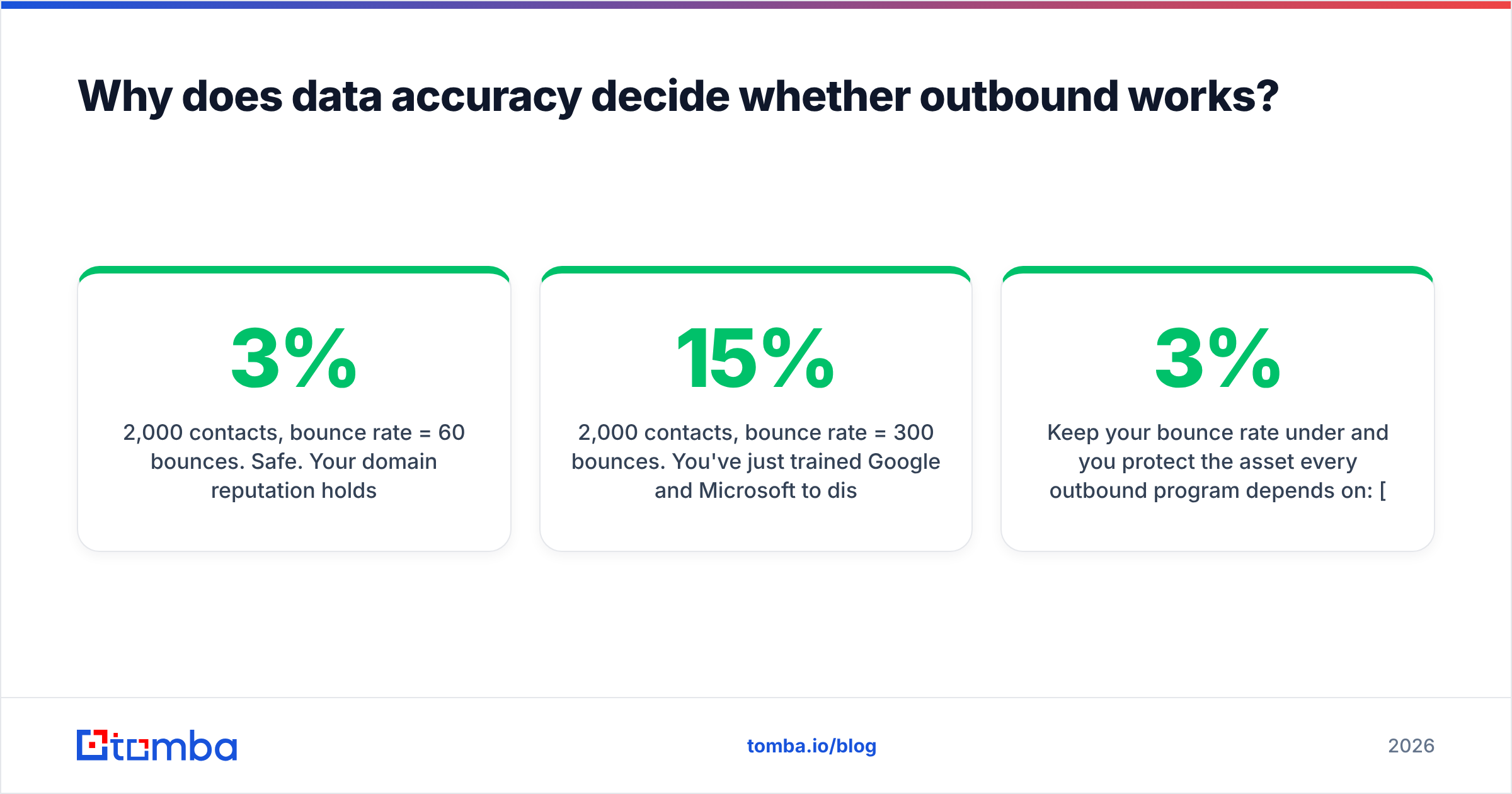
- 2,000 contacts, 3% bounce rate = 60 bounces. Safe. Your domain reputation holds.
- 2,000 contacts, 15% bounce rate = 300 bounces. You've just trained Google and Microsoft to distrust you.
Keep your bounce rate under 3% and you protect the asset every outbound program depends on: sender reputation. That's why verification isn't an optional polish step — it's the gate every contact passes through before a sequence touches it. For catch-all domains, where standard verification returns "unknown," a dedicated catch-all verifier reduces the guesswork instead of letting you fire blind.
This is also the reason buying static lists almost always backfires. The data decays the moment it's compiled — people change jobs, companies rebrand, domains lapse. Roughly a quarter of B2B contact data goes stale every year. Fresh, verified-at-send-time data beats a cheap bulk list every time.
How should you sequence a multi-channel cadence?#
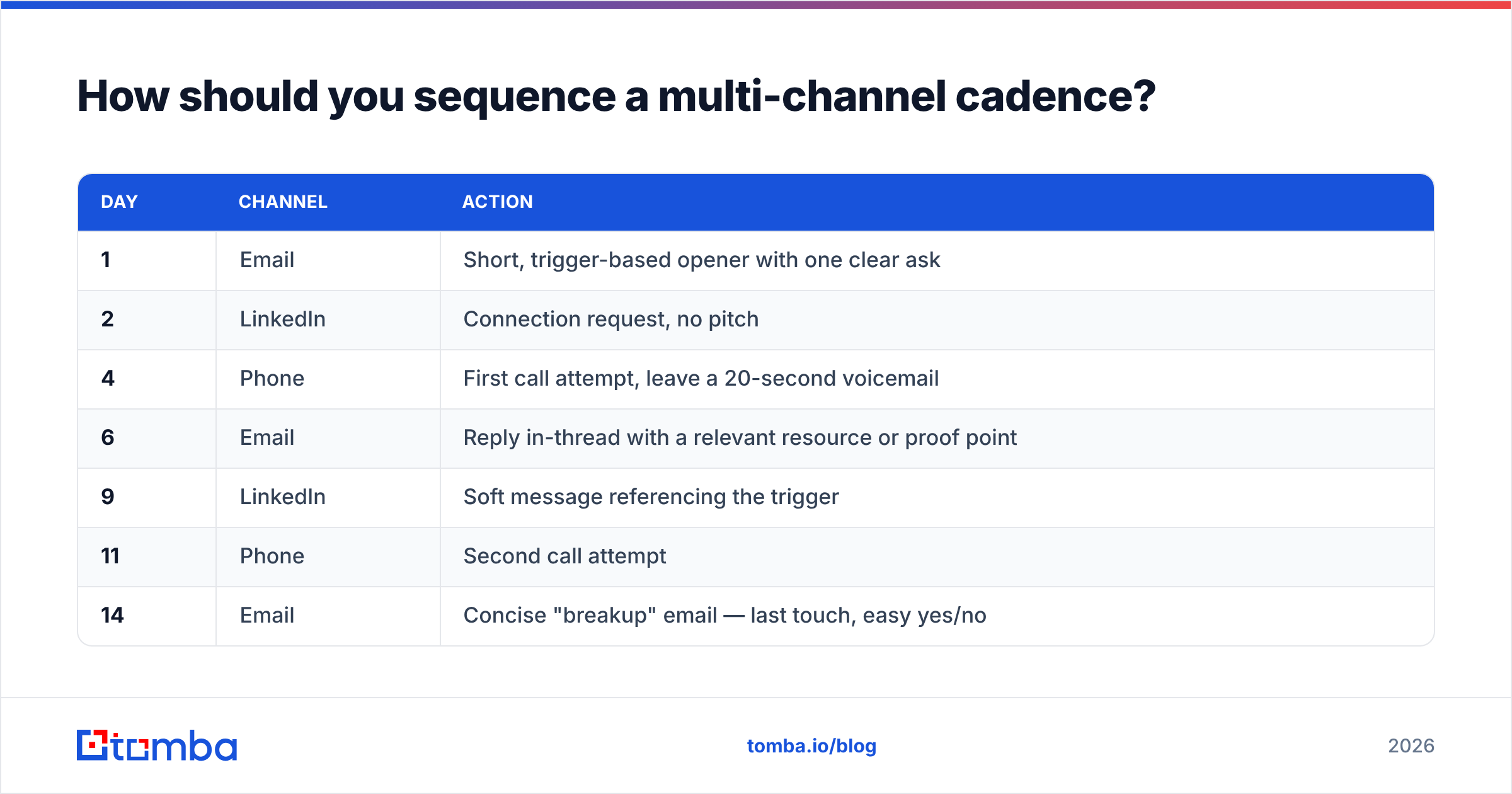
A sequence is a planned series of touches across channels over a set window — not a single email you resend. The best-performing B2B cadences in 2026 run 10–14 touches over 3–4 weeks and mix at least three channels.
Here's a proven structure you can adapt:
| Day | Channel | Action |
|---|---|---|
| 1 | Short, trigger-based opener with one clear ask | |
| 2 | Connection request, no pitch | |
| 4 | Phone | First call attempt, leave a 20-second voicemail |
| 6 | Reply in-thread with a relevant resource or proof point | |
| 9 | Soft message referencing the trigger | |
| 11 | Phone | Second call attempt |
| 14 | Concise "breakup" email — last touch, easy yes/no |
Three rules make or break the cadence:
- Vary the channel, not just the day. Seven emails in a row is noise. Email, then a call, then a LinkedIn touch feels like a person, not a script.
- Reference one trigger per contact. "Saw you're hiring three AEs" beats "I wanted to reach out about our platform." The trigger is your permission to interrupt.
- Make the ask small. Ask for 15 minutes or a yes/no, not a demo, a discovery call, and three stakeholders on a Zoom. Lower the activation energy.
How much should you personalize at scale?#
Personalize at the segment level, not the individual level. Fully custom notes to every prospect don't scale; fully automated templates don't convert. The middle path wins.
Group your list by shared trigger — "raised a Series B in the last 60 days," "posted a role for a data engineer," "uses a competitor's tool." Then write one strong template per segment that speaks to that exact situation, with two or three variable fields (name, company, the specific trigger detail). One rep can run hundreds of genuinely relevant touches a week this way.
The opening line carries most of the weight. Lead with something true about them before anything about you. A line that proves you did 30 seconds of homework — "Congrats on the Lagos office opening" — earns the next sentence. A generic "I hope this email finds you well" gets deleted. If you want a starting framework, Tomba's cold email templates give you segment-ready structures you can adapt rather than write from scratch.
Which metrics actually tell you outbound is working?#
Stop reporting open rate. Apple's Mail Privacy Protection inflates opens by auto-loading images, so the number is fiction for a large share of your list. Track outcomes instead.
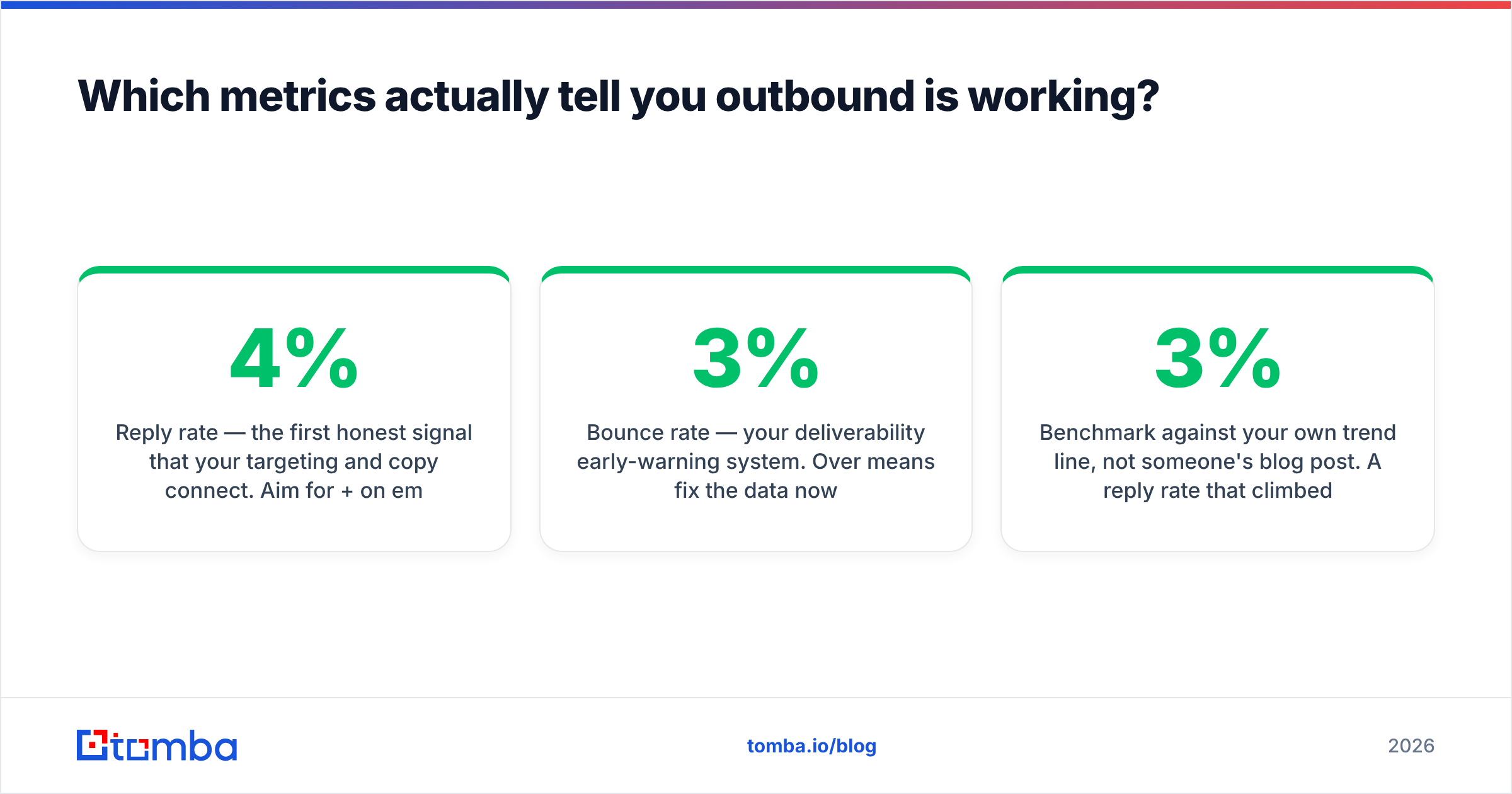
- Reply rate — the first honest signal that your targeting and copy connect. Aim for 4%+ on email; below 1% means your list or message is off.
- Positive reply rate — replies that aren't "unsubscribe." This is the real quality gauge.
- Meetings booked — the only metric that pays rent. Everything upstream is a means to this.
- Bounce rate — your deliverability early-warning system. Over 3% means fix the data now.
- Opportunity-to-meeting ratio — tells you whether you're booking the right meetings or just any meeting.
Benchmark against your own trend line, not someone's blog post. A 3% reply rate that climbed from 1.5% last quarter is a winning program. For definitions of the funnel metrics that feed these, G2's sales analytics resources are a solid reference point, and Tomba's response-rate glossary entry breaks down how to calculate and improve the headline number.
What outbound mistakes still kill pipeline in 2026?#
The failure modes are predictable, which means they're avoidable:
- Sending to unverified lists. The single fastest way to torch a domain. Verify first, always.
- Pitching in the first line. Buyers can smell a template opener. Earn the read before you sell.
- One channel only. Email-only programs leave the highest-quality conversations — phone — on the table.
- No suppression list. Emailing current customers and open opps makes you look disorganized and erodes trust internally.
- Quitting after two touches. Most replies come after touch four. Short sequences are just expensive list-burning.
- Optimizing opens. You're tuning a broken gauge. Optimize replies and meetings.
Build vs. buy: where does tooling fit?#
You can stitch outbound together from a database, a separate verifier, an enrichment vendor, and a sequencer — or consolidate the data layer so reps stop tab-hopping. For most teams under 50 reps, consolidation wins on both cost and data freshness.
The non-negotiables in your stack:
- A finder + verifier so every contact is real before it enters a sequence.
- Enrichment so reps run multi-channel without manual research.
- A sequencer to orchestrate the cadence and log replies.
- A CRM as the system of record.
Tomba covers the first two and slots into the rest through native integrations with the CRMs and sequencers you already run. Pricing scales with volume — the free tier covers 25 searches a month for testing, and paid plans start at $49/mo; full Tomba pricing lays out each tier so you can match spend to send volume.
Start with the data layer#
Every outbound strategy in this guide depends on one thing: reaching real people at real addresses. The targeting, the sequencing, the channel mix — none of it matters if your list bounces. Start there.
Use the Tomba Email Finder to build accurate, verified contact lists from a name and domain, then verify and enrich before a single send. Clean data first, clever sequences second — that's the order that turns cold outbound into booked meetings. Spin up the free tier, pull your first 25 contacts, and run them through a verified cadence this week.
// get started
Find, verify and enrich your first contacts today
Start on the free plan with 25 searches a month, then scale when your team is ready.
Free plan · No credit card required · GDPR & CCPA
// about the author