B2B Outreach Strategy in 2026: A Complete Playbook
Most outbound fails before the first email sends. Here's a B2B outreach strategy for 2026 that fixes targeting, channels, and timing so reps book real meetings.
Most B2B outreach doesn't fail in the inbox. It fails on the spreadsheet, weeks earlier, when someone decided that "blast 5,000 contacts and see what sticks" was a strategy. In 2026, buyers are better at ignoring you than your team is at reaching them. This playbook fixes that.
TL;DR#
- A B2B outreach strategy is a system, not a send button. Targeting, data quality, channel mix, message relevance, and timing all compound — weakness in one kills the rest.
- Volume is dead; precision pays. A tight list of 200 well-researched accounts beats 5,000 scraped contacts on every metric that matters (reply rate, meetings, pipeline).
- Multi-channel is the default. Email + LinkedIn + phone, sequenced deliberately, outperforms any single channel by a wide margin.
- Deliverability is a prerequisite, not a tactic. Verified data, warmed domains, and authentication (SPF/DKIM/DMARC) decide whether anyone ever sees your message.
- Measure replies and meetings, not opens. Apple Mail Privacy Protection broke open tracking years ago — optimize for booked conversations.
What is a B2B outreach strategy?#
A B2B outreach strategy is the repeatable system you use to identify the right companies and people, reach them through the right channels, with a message relevant enough to earn a reply, at a cadence that respects their attention. Think of it like fishing: spray-and-pray is dumping bait across a whole lake and hoping. A real strategy is knowing which lake holds the fish you want, what they're biting on this season, and casting where they actually are.
The shift in 2026 is that buyers have effectively unlimited filters — spam folders, LinkedIn "ignore," call screening, and AI assistants that triage their inbox. Generic outreach now has a near-zero hit rate. Relevance is the only thing that survives the filter.
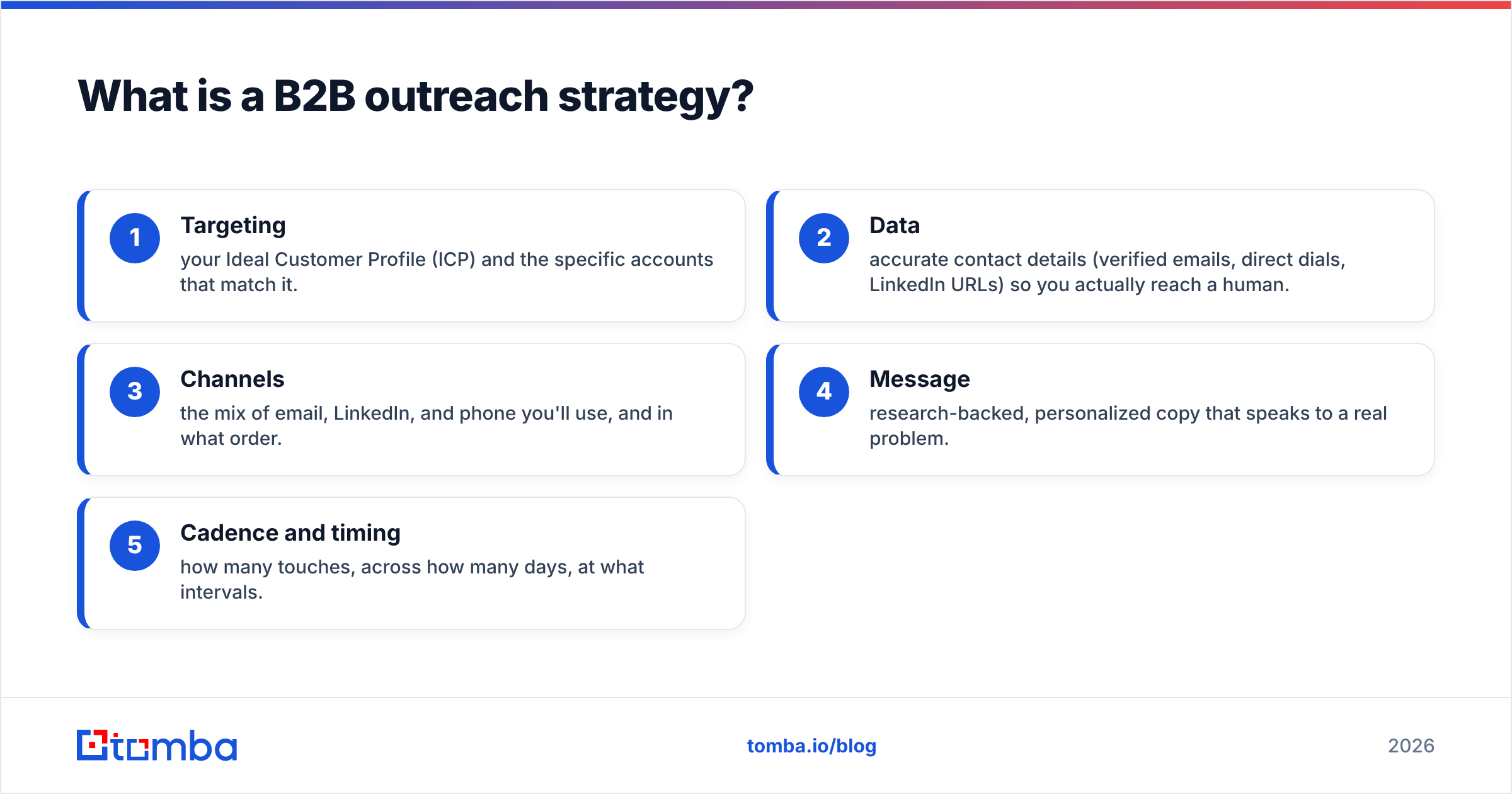
A complete strategy has five layers, and each depends on the one before it:
- Targeting — your Ideal Customer Profile (ICP) and the specific accounts that match it.
- Data — accurate contact details (verified emails, direct dials, LinkedIn URLs) so you actually reach a human.
- Channels — the mix of email, LinkedIn, and phone you'll use, and in what order.
- Message — research-backed, personalized copy that speaks to a real problem.
- Cadence and timing — how many touches, across how many days, at what intervals.
Skip the first two and the rest is wasted effort. You can write the best email of your life, but if it lands on a bounced address or the wrong VP, none of it counts.
Wait — that's the wrong reference. Here's the visual that fits:
Why do most B2B outreach strategies fail?#
They fail for boring, fixable reasons. The exciting part — clever subject lines, AI copy — is almost never the bottleneck. The bottleneck is upstream.
- Bad data. Industry bounce rates routinely sit between 5% and 15% on unverified lists. Every bounce trains spam filters to distrust your domain, so even your good emails stop landing. Run lists through an email verifier before you ever load them into a sequence.
- No real ICP. "Anyone who might buy" is not a target. If you can't name the title, company size, trigger event, and pain in one sentence, your message will be generic.
- Single channel. Email-only reps cap out fast. The prospect who ignores three emails will sometimes accept a LinkedIn connection or answer a well-timed call.
- Pitch-first messaging. Leading with your product instead of their problem is the fastest way to the trash. Buyers don't care what you sell; they care what breaks if they don't fix something.
- Giving up too early. A large share of booked meetings come after the fourth or fifth touch, yet most reps stop at two.
The pattern is clear: outreach is a chain, and teams obsess over the last link (copy) while the first links (data and targeting) quietly snap.
How do you build a B2B outreach list that converts?#
Start narrow. Quality of list determines the ceiling of every downstream metric, so this is where your effort earns the most.
The build sequence:
- Define the ICP precisely. Industry, headcount band, revenue band, tech stack, and the buying trigger (new funding, a key hire, a tooling migration). Write it down.
- Source the accounts. Pull a target list of companies that match — not contacts yet, companies. Aim for depth over breadth.
- Find the right people. For each account, identify the decision-maker and one or two influencers. Use domain search to pull every known email pattern at a company, then narrow to the roles you want.
- Get the contact details. Use an email finder to resolve a name-plus-domain into a deliverable address, and a phone finder for accounts worth a call.
- Verify everything. Validate each email and flag catch-all domains so you know which sends are risky before they cost you reputation.
- Enrich. Add the context you'll personalize on — recent role change, company news, shared connections — via data enrichment.
A 200-account list built this way will out-perform a 5,000-row scraped dump on reply rate, meeting rate, and — critically — sender reputation. The math isn't intuitive until you've watched a clean list quietly outpace a list ten times its size.
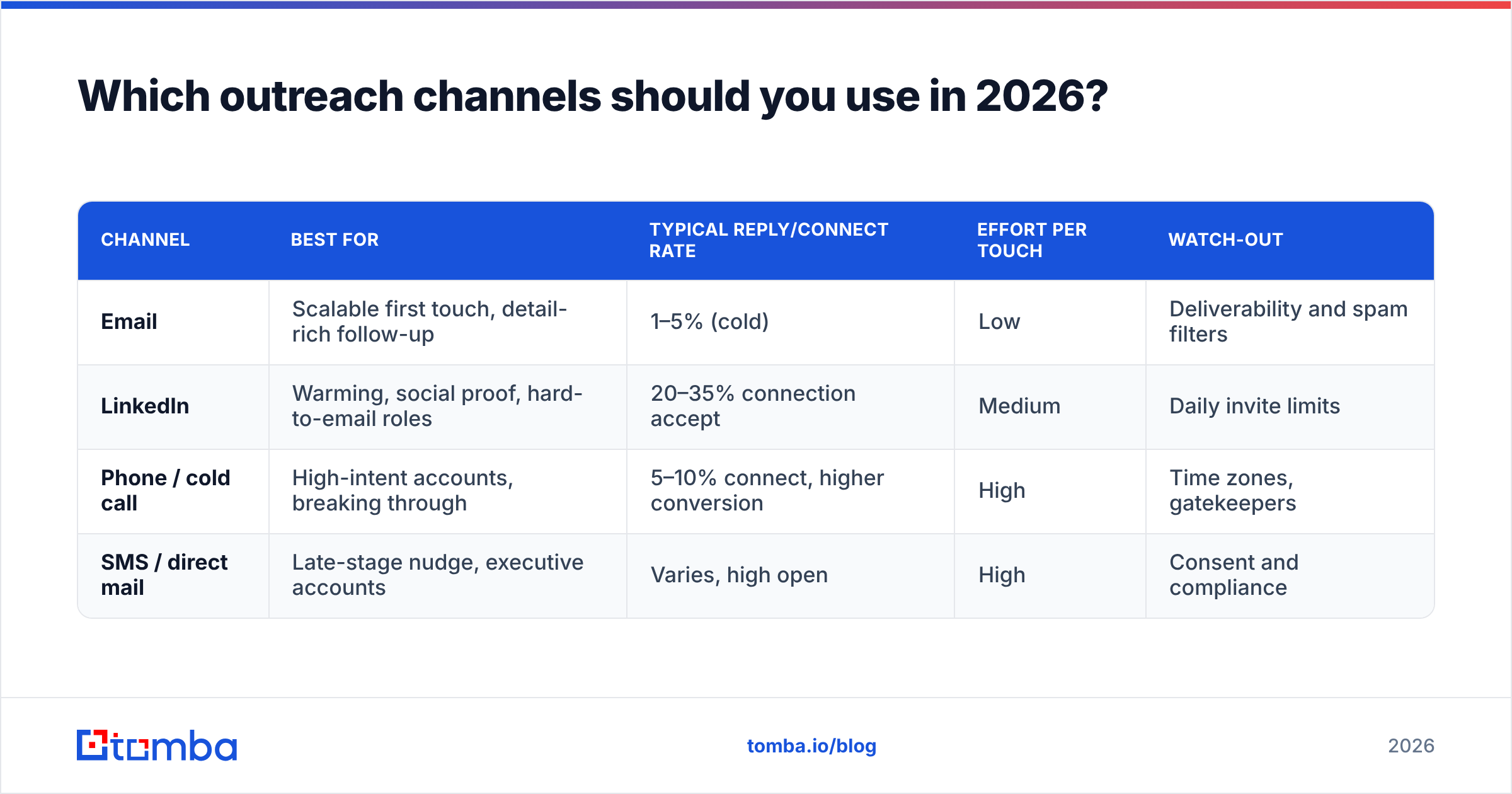
Which outreach channels should you use in 2026?#
All three of the main ones, sequenced — not one in isolation. Each channel does a different job, and the combination is what compounds.
| Channel | Best for | Typical reply/connect rate | Effort per touch | Watch-out |
|---|---|---|---|---|
| Scalable first touch, detail-rich follow-up | 1–5% (cold) | Low | Deliverability and spam filters | |
| Warming, social proof, hard-to-email roles | 20–35% connection accept | Medium | Daily invite limits | |
| Phone / cold call | High-intent accounts, breaking through | 5–10% connect, higher conversion | High | Time zones, gatekeepers |
| SMS / direct mail | Late-stage nudge, executive accounts | Varies, high open | High | Consent and compliance |
The winning pattern is a sequenced mix: a personalized email opens, a LinkedIn view-and-connect reinforces a day or two later, a call targets the accounts that engaged, and follow-up emails keep the thread alive. No single channel carries the load. According to HubSpot's sales research, multi-touch, multi-channel sequences consistently beat single-channel outreach on conversion — which matches what every disciplined outbound team already sees in its own numbers.
What does a high-converting outreach sequence look like?#
A sequence is a pre-planned series of touches across channels over a fixed window. Here's a proven 14-day, multi-channel structure you can adapt:
- Day 1 — Email #1. Short, personalized, problem-first. One clear ask (a 15-minute call). No attachments, no pitch deck.
- Day 2 — LinkedIn. View the profile, then send a connection request with a one-line, context-specific note.
- Day 4 — Email #2. New angle or a relevant resource. Reference the trigger event you found during enrichment.
- Day 6 — Phone call. For tier-one accounts. Leave a 20-second voicemail that points back to your email.
- Day 9 — Email #3. Social proof — a peer company, a quick result, a specific number.
- Day 12 — LinkedIn message. Soft, value-add, no pressure.
- Day 14 — Email #4 (break-up). "Should I close the loop?" These quietly produce some of the highest reply rates in any sequence.
Two rules make or break it. First, every touch adds value or context — never just "bumping this to the top of your inbox." Second, personalize the first line and the relevance, not just the {{first_name}} token. Buyers can smell a mail-merge from the preview pane.
How do you write outreach messages that get replies?#
Lead with their problem, keep it short, make one ask. That's the whole formula, and almost nobody follows it.
A reliable structure for a cold email:
- Opener (1 line): a specific, true observation about them — a recent hire, a product launch, a job posting that signals pain.
- Problem (1–2 lines): the challenge that observation implies, framed in their language.
- Value (1 line): how you've helped someone like them, ideally with a number.
- Ask (1 line): a single, low-friction call to action.
Keep the whole thing under 120 words. Long cold emails get skimmed and dropped. If you need help tightening copy, a cold email AI can draft variants, and a subject line tester helps you avoid the spam-trigger phrasing that tanks deliverability.
Avoid the obvious tells: no "I hope this email finds you well," no three-paragraph company history, no five different links. Every extra element is a reason to not reply.
How do you make sure your outreach actually lands?#
Deliverability is the silent killer of B2B outreach. You can do everything else right and still land in spam if your technical setup and data hygiene are weak. Treat it as a prerequisite.
The non-negotiables:
- Authenticate your domain. Set up SPF, DKIM, and DMARC. These are the records mailbox providers check to decide you're legitimate. Google and Yahoo now effectively require them for bulk senders — see Google's sender guidelines for the current rules.
- Warm up new domains and inboxes. Ramp sending volume gradually over weeks so providers build trust. Don't blast 500 cold emails from a week-old domain.
- Verify before you send. This is where data quality and deliverability meet. Clean lists keep bounce rates low, which keeps your sender reputation high. Pay special attention to catch-all domains with a dedicated catch-all verifier so you can route risky addresses separately.
- Cap volume per inbox. Spread sending across multiple inboxes and keep daily per-inbox volume modest. Overloading one address is a fast track to the spam folder.
- Monitor and adjust. Watch bounce rate, spam complaints, and reply rate. Rising bounces or complaints mean stop and fix the data, not push harder.
The connection most teams miss: your data tool is a deliverability tool. Verified, accurate contacts are the foundation that keeps your domain trusted enough for the next campaign to even reach the inbox.
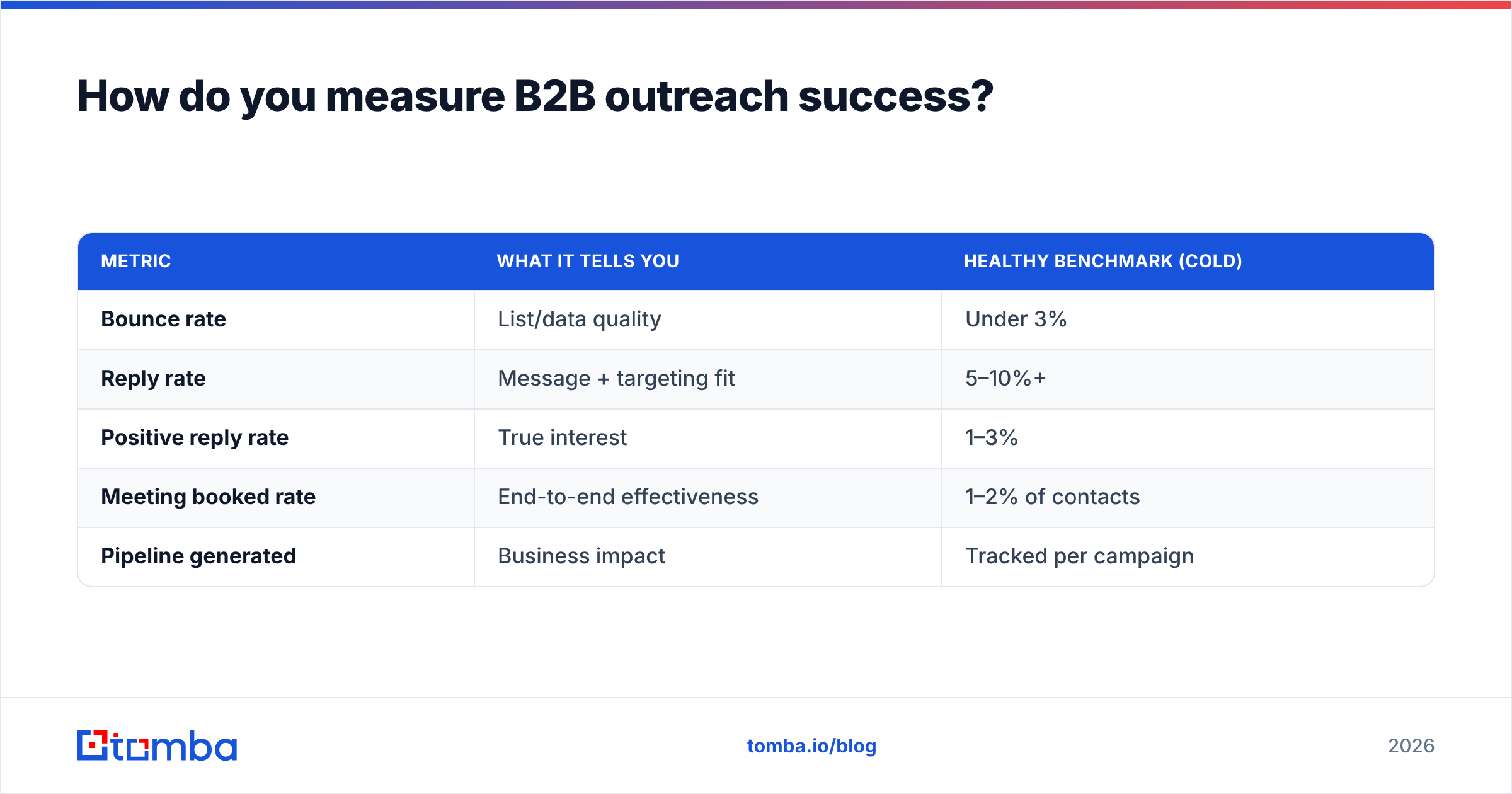
How do you measure B2B outreach success?#
Stop reporting open rates. Apple's Mail Privacy Protection inflates and falsifies opens, so they tell you almost nothing in 2026. Measure the metrics tied to revenue.
| Metric | What it tells you | Healthy benchmark (cold) |
|---|---|---|
| Bounce rate | List/data quality | Under 3% |
| Reply rate | Message + targeting fit | 5–10%+ |
| Positive reply rate | True interest | 1–3% |
| Meeting booked rate | End-to-end effectiveness | 1–2% of contacts |
| Pipeline generated | Business impact | Tracked per campaign |
Read these as a chain. High bounces point to bad data — fix verification. Good deliverability but low replies points to weak targeting or copy. Replies but no meetings points to a broken call-to-action or qualification problem. Each metric isolates a different layer of the strategy, which is exactly why you track all of them instead of one vanity number.
For benchmarking against the broader market, peer-reviewed software comparison sites like G2 are useful for seeing how tools and tactics stack up, but your own historical numbers are the only benchmark that truly matters.
What tools does a modern outreach strategy need?#
You need three categories of tooling, and they should integrate cleanly:
- Data and contact discovery — find and verify the people you want to reach. This is the foundation; everything else builds on it.
- Sequencing and sending — manage multi-channel cadences and automate follow-up.
- CRM and tracking — record activity, manage your pipeline, and measure outcomes.
The mistake is starting with the sending tool and bolting data on later. Reverse it. Get clean, verified, enriched data first — through a platform like Tomba that combines an email finder, verifier, domain search, phone finder, and enrichment in one place — then feed that into your sequencer and CRM. You can pull contacts at scale with a bulk email finder or wire it directly into your stack with the Tomba API and native integrations for HubSpot, Salesforce, Pipedrive, and more.
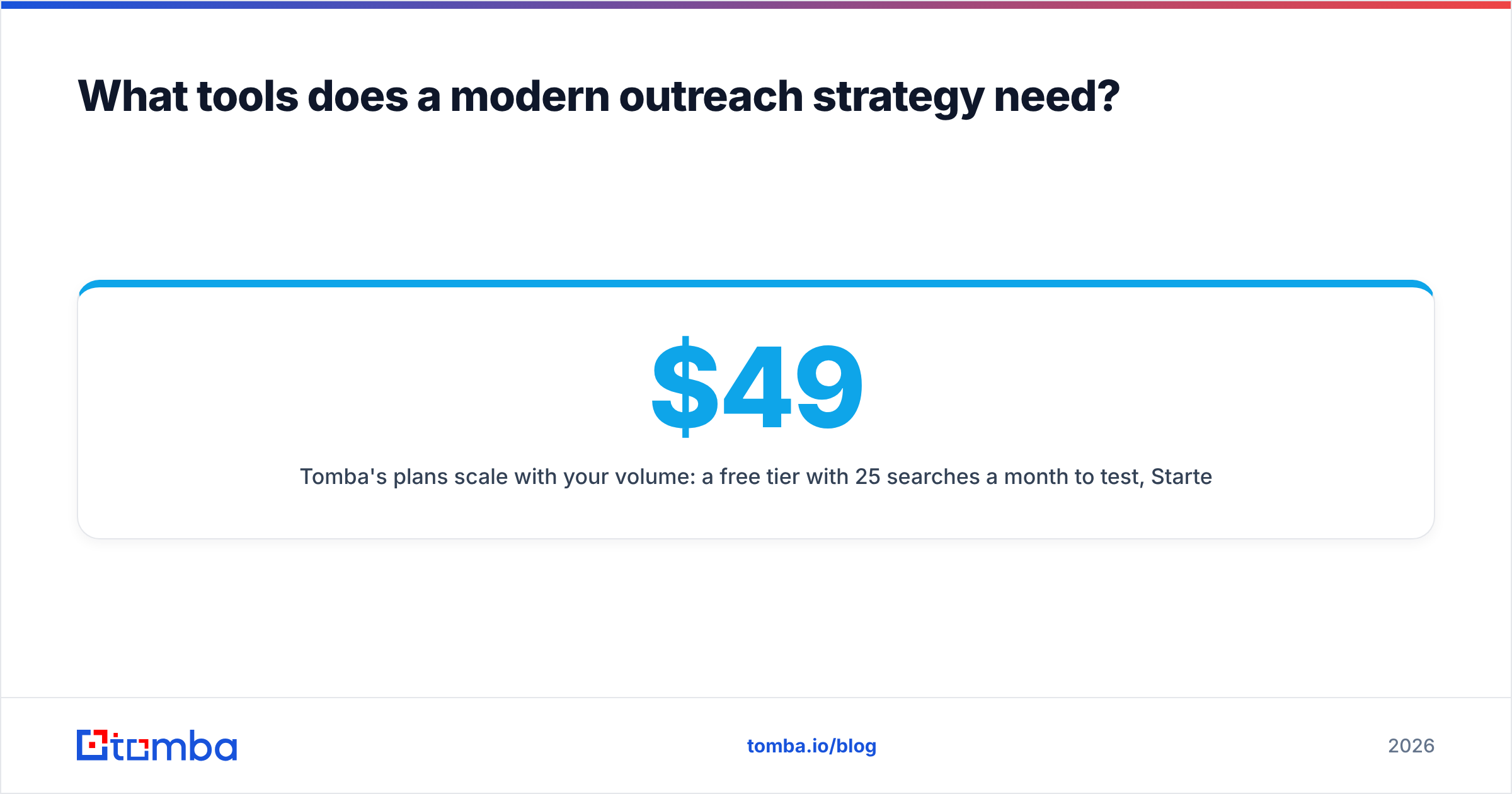
Tomba's plans scale with your volume: a free tier with 25 searches a month to test, Starter at $49/mo, Growth at $99/mo, and Pro at $249/mo for larger teams. See the full Tomba pricing for credit breakdowns.
Put the strategy to work#
A B2B outreach strategy lives or dies on the quality of the people you reach. The cleverest sequence in the world is worthless if it's pointed at bounced addresses and the wrong titles. Get the foundation right and every other layer — channels, copy, timing — finally has something solid to stand on.
Start there. Use the Tomba Email Finder to turn your target account list into verified, deliverable contacts, then build your multi-channel sequence on top of data you can actually trust. Spin up the free tier, find your first 25 contacts, and see how a precise list changes your reply rate before you scale. Precision is the strategy — the tools just make it repeatable.
// get started
Find, verify and enrich your first contacts today
Start on the free plan with 25 searches a month, then scale when your team is ready.
Free plan · No credit card required · GDPR & CCPA
// about the author