B2B Pain Points in 2026: How to Find, Map, and Solve Them
A practical guide to the most common B2B pain points in 2026 — how to uncover them in discovery, map your solution to each, and turn pain into pipeline.

TL;DR
- A B2B pain point is a specific, recurring business problem that costs a company money, time, or risk — and it is the single strongest lever in any sales conversation.
- The four buckets that cover almost every deal: financial, productivity, process, and support pain. Learn to spot all four.
- You cannot sell to pain you cannot name. Discovery, not pitching, is where deals are won or lost.
- Mapping each pain point to a measurable outcome ("cut 6 hours/week" beats "improves efficiency") is what moves a prospect from interested to budgeted.
- Bad contact data is itself a pain point that quietly kills outbound — fix the input before you optimize the message.
What is a B2B pain point?#
A B2B pain point is a specific, recurring problem inside a company that is costing it money, time, or risk — and that someone with a budget is motivated to fix. That last clause matters. A mild annoyance is not a pain point. A problem nobody owns is not a pain point. A pain point is friction that someone is accountable for and frustrated by.
Think of it like a pebble in a runner's shoe. The runner can keep going, but every stride hurts, performance drops, and eventually they stop to deal with it. Your job in B2B sales is to find the pebble, prove how much it is slowing them down, and show that your solution removes it cleanly. Technically, you are identifying a quantifiable gap between the prospect's current state and their desired state, then attaching your product to closing that gap.
The mistake most reps make is leading with features. Features answer "what does it do," but buyers fund answers to "what does it fix." When you anchor every conversation to a real, owned, expensive problem, your pitch stops sounding like a pitch and starts sounding like relief.
Hold on — that image is a placeholder the renderer swaps. Here is the actual embed:
)
What are the most common B2B pain points in 2026?#
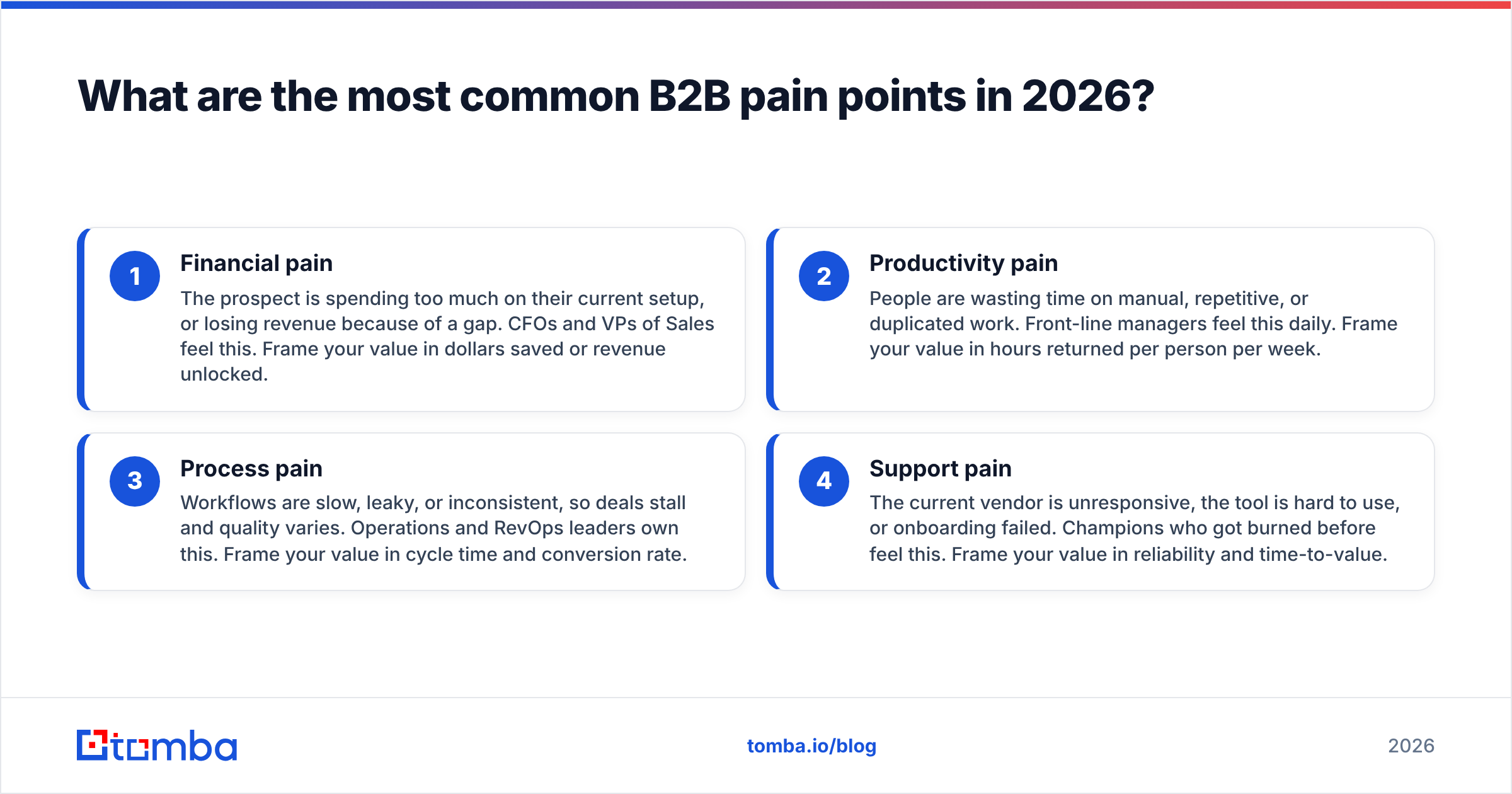
Most pain in a B2B deal falls into four buckets. Sorting a prospect's complaints into these categories tells you who to talk to and how to frame your value.
- Financial pain — The prospect is spending too much on their current setup, or losing revenue because of a gap. CFOs and VPs of Sales feel this. Frame your value in dollars saved or revenue unlocked.
- Productivity pain — People are wasting time on manual, repetitive, or duplicated work. Front-line managers feel this daily. Frame your value in hours returned per person per week.
- Process pain — Workflows are slow, leaky, or inconsistent, so deals stall and quality varies. Operations and RevOps leaders own this. Frame your value in cycle time and conversion rate.
- Support pain — The current vendor is unresponsive, the tool is hard to use, or onboarding failed. Champions who got burned before feel this. Frame your value in reliability and time-to-value.
In 2026, a few pains show up again and again across outbound and revenue teams:
- Fragmented data across too many tools. The average GTM stack has ballooned, and no single source of truth exists. Reps copy-paste between a CRM, a sequencer, and three databases.
- Falling email deliverability. Tighter inbox-provider rules mean sloppy lists get filtered before a human ever sees the message. This connects directly to email deliverability and sender reputation.
- Wasted SDR time on bad records. Bounced sends, wrong titles, and stale phone numbers burn the most expensive resource you have.
- Unpredictable pipeline. Leadership cannot forecast because the inputs are noisy and the win rate swings month to month.
How do you identify a prospect's pain points?#
The conclusion first: you find pain points by asking better questions and listening for cost, not by pitching and hoping. Discovery is the highest-leverage skill in B2B sales, and it is mostly about restraint.
Here is a simple structure that works in a first call:
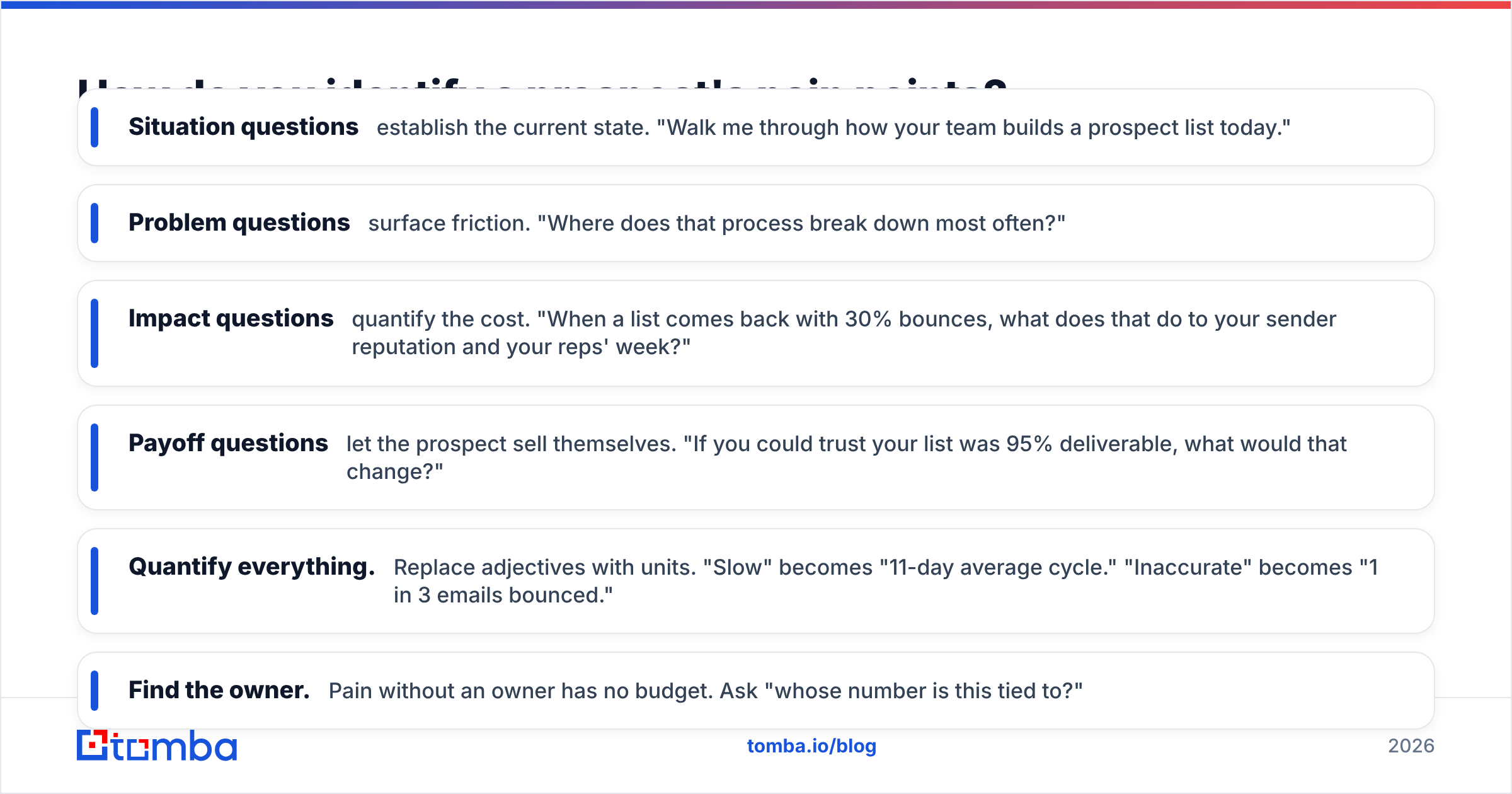
- Situation questions establish the current state. "Walk me through how your team builds a prospect list today."
- Problem questions surface friction. "Where does that process break down most often?"
- Impact questions quantify the cost. "When a list comes back with 30% bounces, what does that do to your sender reputation and your reps' week?"
- Payoff questions let the prospect sell themselves. "If you could trust your list was 95% deliverable, what would that change?"
Notice the move from situation to impact. A prospect saying "our data is a little messy" is not a deal. A prospect saying "messy data cost us a domain blacklisting last quarter and we lost two weeks of outbound" is a funded initiative. Your job is to walk them from the first sentence to the second using their numbers, not yours.
Three field-tested tips:
- Quantify everything. Replace adjectives with units. "Slow" becomes "11-day average cycle." "Inaccurate" becomes "1 in 3 emails bounced."
- Find the owner. Pain without an owner has no budget. Ask "whose number is this tied to?"
- Confirm the cost of inaction. If nothing changes, what happens in six months? If the answer is "nothing much," you have a vitamin, not a painkiller.
For a deeper framework on qualification language, HubSpot's sales discovery guidance is a solid, vendor-neutral reference, and Gartner's B2B buying research explains why buyers now arrive with most of the journey already done.
How do you map a solution to each pain point?#
Map pain to outcome, then outcome to feature — in that order. Most reps do it backwards.
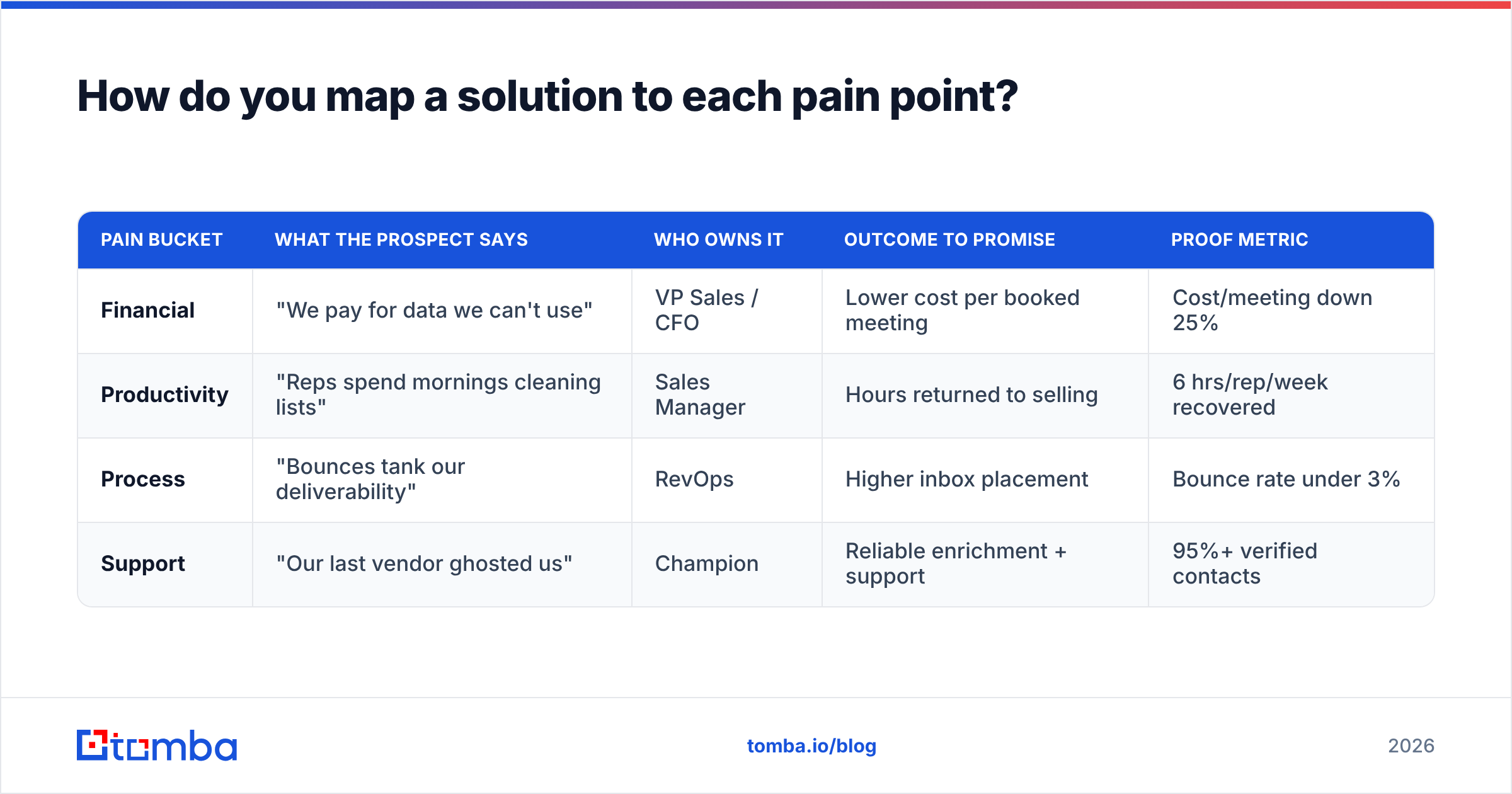
The table below shows how a single root problem (unreliable contact data) cascades into pain across four roles, and how each maps to a measurable outcome you can put in a business case.
| Pain bucket | What the prospect says | Who owns it | Outcome to promise | Proof metric |
|---|---|---|---|---|
| Financial | "We pay for data we can't use" | VP Sales / CFO | Lower cost per booked meeting | Cost/meeting down 25% |
| Productivity | "Reps spend mornings cleaning lists" | Sales Manager | Hours returned to selling | 6 hrs/rep/week recovered |
| Process | "Bounces tank our deliverability" | RevOps | Higher inbox placement | Bounce rate under 3% |
| Support | "Our last vendor ghosted us" | Champion | Reliable enrichment + support | 95%+ verified contacts |
Once the table is filled in for a real prospect, your proposal writes itself: you are not selling an "email tool," you are selling a 25% lower cost per meeting and six recovered hours per rep. The feature list becomes the appendix.
This is also where data quality becomes the hinge of the whole deal. If your prospect's pain is fragmented or unreliable contact data, the fix is a single, verified source. A combined email finder and email verifier workflow attacks the productivity and process buckets at the same time — reps stop hand-cleaning lists, and bounces drop before they ever reach the inbox provider.
)
Which B2B pain points are easiest to monetize?#
The easiest pains to monetize are the ones that are frequent, measurable, and tied to revenue. A problem that happens once a year is a hard sell; a problem that burns an hour every single morning is an easy one.
Rank your prospect's pains on three axes:
- Frequency — daily friction beats quarterly friction.
- Measurability — if they already track the metric, you do not have to convince them it matters.
- Revenue proximity — pain near the money (pipeline, conversion, churn) gets funded faster than pain in a back office.
Bad contact data scores high on all three for outbound teams, which is why it is one of the most reliable wedges in B2B sales. It hurts every day, it is trivially measurable (bounce rate, connect rate), and it sits directly on the pipeline. When a prospect sees that a verified list lifts their response rate and protects their domain, the budget conversation gets short.
Compare that to a "nice to have" like a slightly prettier reporting dashboard — infrequent value, fuzzy measurement, far from revenue. Same effort to sell, a fraction of the urgency.
What B2B pain points does outbound itself create?#
Here is the uncomfortable part: your own outbound motion is often the source of new pain, both for you and your prospects.
For your team, the classic self-inflicted pains are:
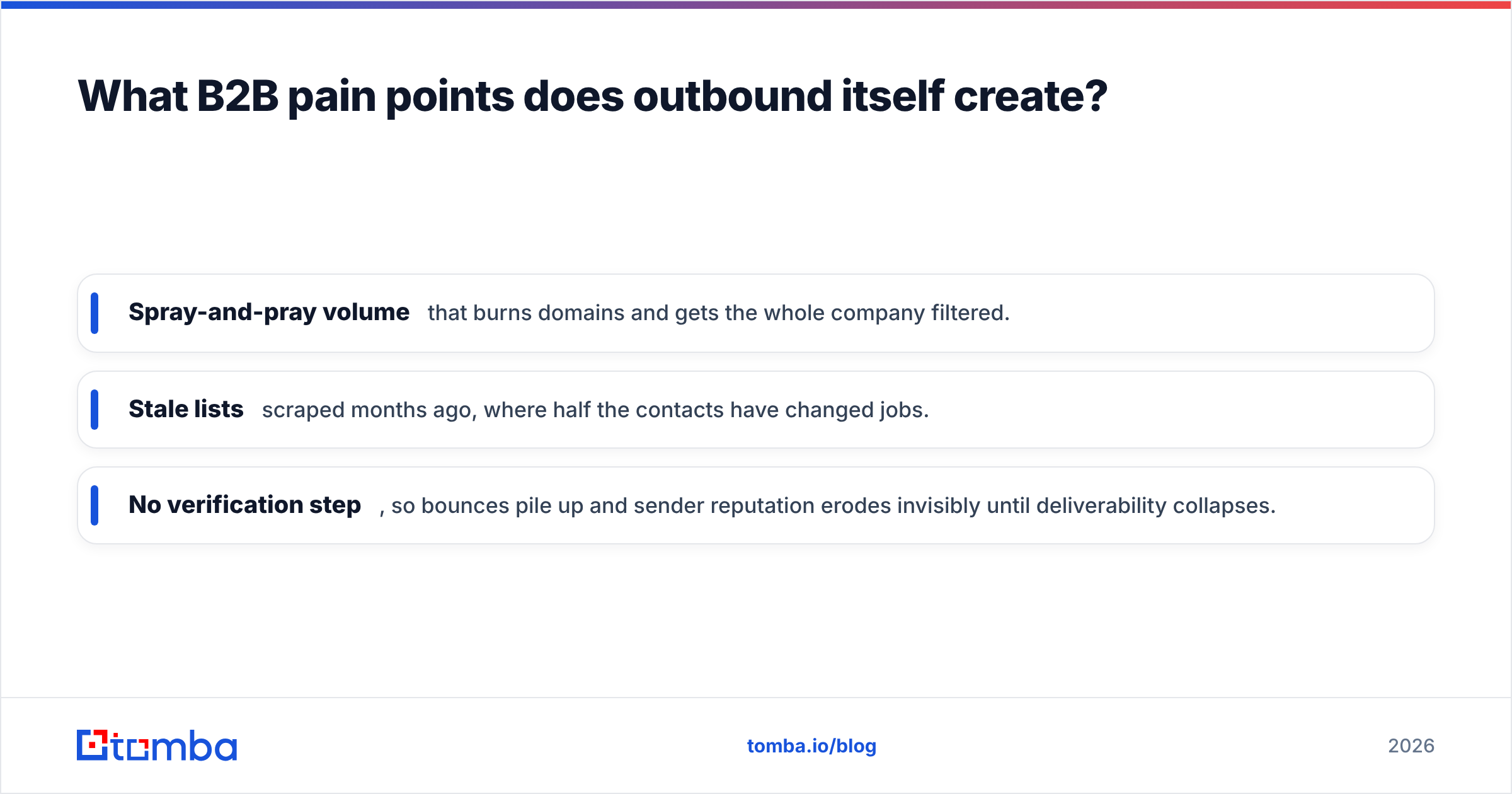
- Spray-and-pray volume that burns domains and gets the whole company filtered.
- Stale lists scraped months ago, where half the contacts have changed jobs.
- No verification step, so bounces pile up and sender reputation erodes invisibly until deliverability collapses.
For your prospects, irrelevant, untargeted outreach is itself a pain point — it trains buyers to ignore the channel entirely. The fix is the same on both sides: fewer, more accurate, more relevant touches built on clean data.
A disciplined outbound team treats data hygiene as a recurring process, not a one-time import. Before any send, run the list through verification and dedupe it. Tools like the bulk email finder and a catch-all verifier let you process thousands of records at once so reps work from a list they can trust instead of one they have to apologize for.
If you are evaluating where bad data is leaking into your funnel, peer-review sites like G2 are useful for seeing how teams describe the exact pains a category of tools is meant to solve — read the one- and two-star reviews, because that is where the real pain points live.
How do you turn pain points into a repeatable sales process?#
Systematize discovery so every rep finds and frames pain the same way. The conclusion: a pain-point library plus a qualification gate turns a star performer's instinct into a team-wide motion.
Build it in three steps:
- Catalog the pains. Interview your best reps and your last 20 closed-won deals. Write down the exact words buyers used. Group them into the four buckets.
- Attach outcomes and proof. For each pain, define the metric you move and the evidence you cite. This becomes your discovery cheat sheet and your proposal language.
- Gate the pipeline. No deal advances past discovery without a named, owned, quantified pain in the CRM. This single rule cleans up forecasting more than any new dashboard.
Feed this loop with reliable inputs. The cleanest pain library in the world fails if reps build lists from guesswork. Connect your enrichment directly into the workflow — a HubSpot integration or Salesforce integration keeps verified contacts flowing into the same place your pain-point fields live, so discovery and data never drift apart.
The teams that win in 2026 are not the ones with the slickest pitch. They are the ones who consistently find the pebble in the shoe, prove what it costs, and remove it before a competitor even understands what was hurting.
Start with data your reps can trust#
Every framework above assumes one thing: that the contacts your team works are real, current, and deliverable. That is the input most teams skip — and the pain point that quietly caps everything else. Fix it first.
Tomba's Email Finder gives you verified, professional email addresses by name, domain, or company, with a built-in verification layer so bounces and blacklistings stop draining your outbound. Start free with 25 searches a month, then scale to the Starter plan at $49/mo as your pipeline grows — see full Tomba pricing for Growth and Pro tiers. Solve the data pain point first, and every other conversation about cost, productivity, and process gets dramatically easier.
// get started
Find, verify and enrich your first contacts today
Start on the free plan with 25 searches a month, then scale when your team is ready.
Free plan · No credit card required · GDPR & CCPA
// about the author