B2B Prospecting Strategies That Actually Work in 2026
A practical 2026 playbook of B2B prospecting strategies — from list building and multichannel sequencing to data quality — with a framework comparison table.
TL;DR
- The best B2B prospecting strategies in 2026 are multichannel, data-led, and ruthlessly account-prioritized — not high-volume spray-and-pray.
- Pipeline quality starts with list quality: bad contact data wastes 20-30% of rep time before a single email goes out.
- Layer email, phone, and LinkedIn into coordinated sequences instead of treating each as a separate campaign.
- Use intent and trigger signals to decide who to contact and when, then personalize the first line — not the whole message.
- Verify every address before you send so deliverability and sender reputation stay intact.
What is B2B prospecting in 2026?#
B2B prospecting is the work of finding and qualifying potential buyers before they enter your formal sales pipeline. Think of it as scouting before a hike: you decide which trail is worth your legs before you start walking. In 2026, that scouting is mostly digital — you identify accounts that fit your profile, find the right people inside them, confirm their contact details, and open a relevant conversation across channels.
What changed is the bar. Buyers ignore generic outreach faster than ever, inbox providers punish sloppy senders, and reps have less time per account. So modern prospecting is less about how many contacts you can blast and more about how precisely you can target, how clean your data is, and how well your channels reinforce each other.
The strategies below are the ones that consistently book meetings. None of them are exotic. The edge comes from executing the fundamentals with discipline.
Which B2B prospecting strategies work best?#
Here are the seven approaches worth your time this year, ordered roughly by how much leverage they give a small team.
- Ideal Customer Profile (ICP) targeting — Define the firmographic and technographic traits of accounts that close fast and stay. Every other strategy gets cheaper when you point it at the right list.
- Account-based prospecting (ABM-lite) — Pick a tight set of high-value accounts, map 3-5 stakeholders in each, and run coordinated touches instead of single-contact outreach.
- Multichannel sequencing — Combine email, phone, and LinkedIn touches on a planned cadence so a prospect sees you in more than one place.
- Intent and trigger-based outreach — Reach out when something changes: a funding round, a new hire in a relevant role, a tech-stack change, or a content download.
- Referral and warm-intro mining — Use existing customers and second-degree LinkedIn connections to turn cold contacts into warm ones.
- Inbound-led prospecting — Identify and route the anonymous companies visiting your site, then prospect them while interest is fresh.
- Data enrichment and verification — Treat contact data as a living asset: enrich thin records, verify addresses, and re-check before every send.
How do you build a high-quality prospect list?#
Conclusion first: a great list beats a great pitch. You can recover from a mediocre email to the right person; you cannot recover from a perfect email to the wrong one.
Start with your ICP, then work outward in three layers:
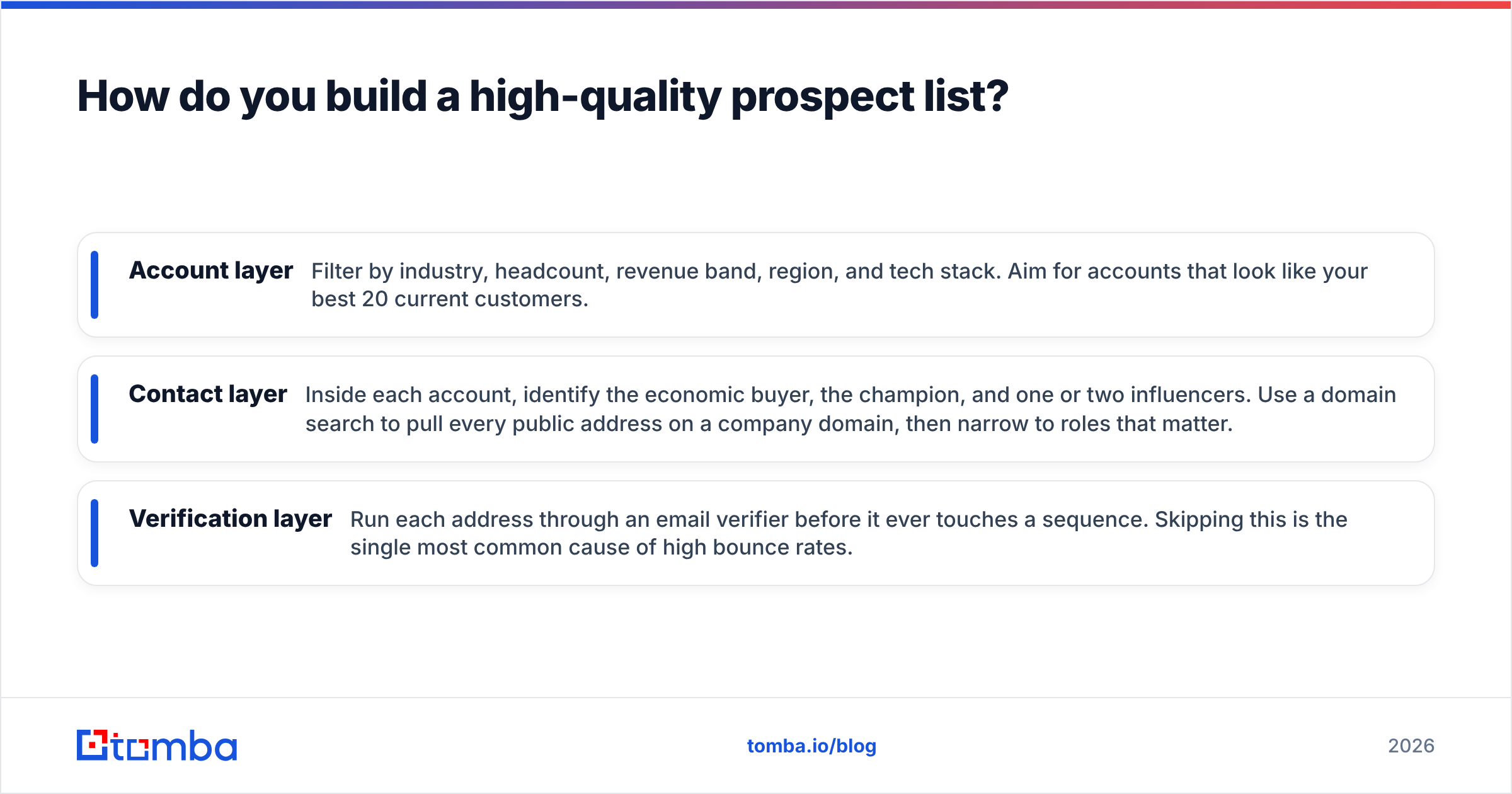
- Account layer — Filter by industry, headcount, revenue band, region, and tech stack. Aim for accounts that look like your best 20 current customers.
- Contact layer — Inside each account, identify the economic buyer, the champion, and one or two influencers. Use a domain search to pull every public address on a company domain, then narrow to roles that matter.
- Verification layer — Run each address through an email verifier before it ever touches a sequence. Skipping this is the single most common cause of high bounce rates.
For finding the actual addresses, an email finder that searches by name and company domain will resolve most B2B contacts in seconds. For volume work — say, a list of 500 accounts exported from a CRM — a bulk email finder keeps you from doing it one row at a time.
One rule that pays for itself: never buy static lists. They decay at roughly 22-30% per year as people change jobs, and they tank your sender reputation when half the addresses bounce. Build fresh, verify, and refresh.
Is multichannel outreach better than email-only?#
Yes — and it is not close. Email alone still works, but a prospect who sees a relevant email, then a connection request, then a well-timed call is far more likely to respond than one who gets three emails in a row.
The reason is simple: different buyers prefer different channels, and repetition across channels reads as persistence rather than spam. A LinkedIn comment plus an email feels like a person reaching out. Three identical emails feel like a robot.
A workable five-touch sequence over two weeks looks like this:
- Day 1 — Personalized email referencing a specific trigger
- Day 2 — LinkedIn connection request, no pitch
- Day 4 — Short follow-up email with one piece of value
- Day 7 — Phone call (or voicemail) referencing the email
- Day 11 — Breakup email that makes it easy to say "not now"
Keep phone in the mix even in 2026. A phone finder that returns verified B2B numbers turns the call step from a guess into a real touch, and connect rates on direct-dial mobiles remain far higher than on switchboards.
How do you compare B2B prospecting frameworks?#
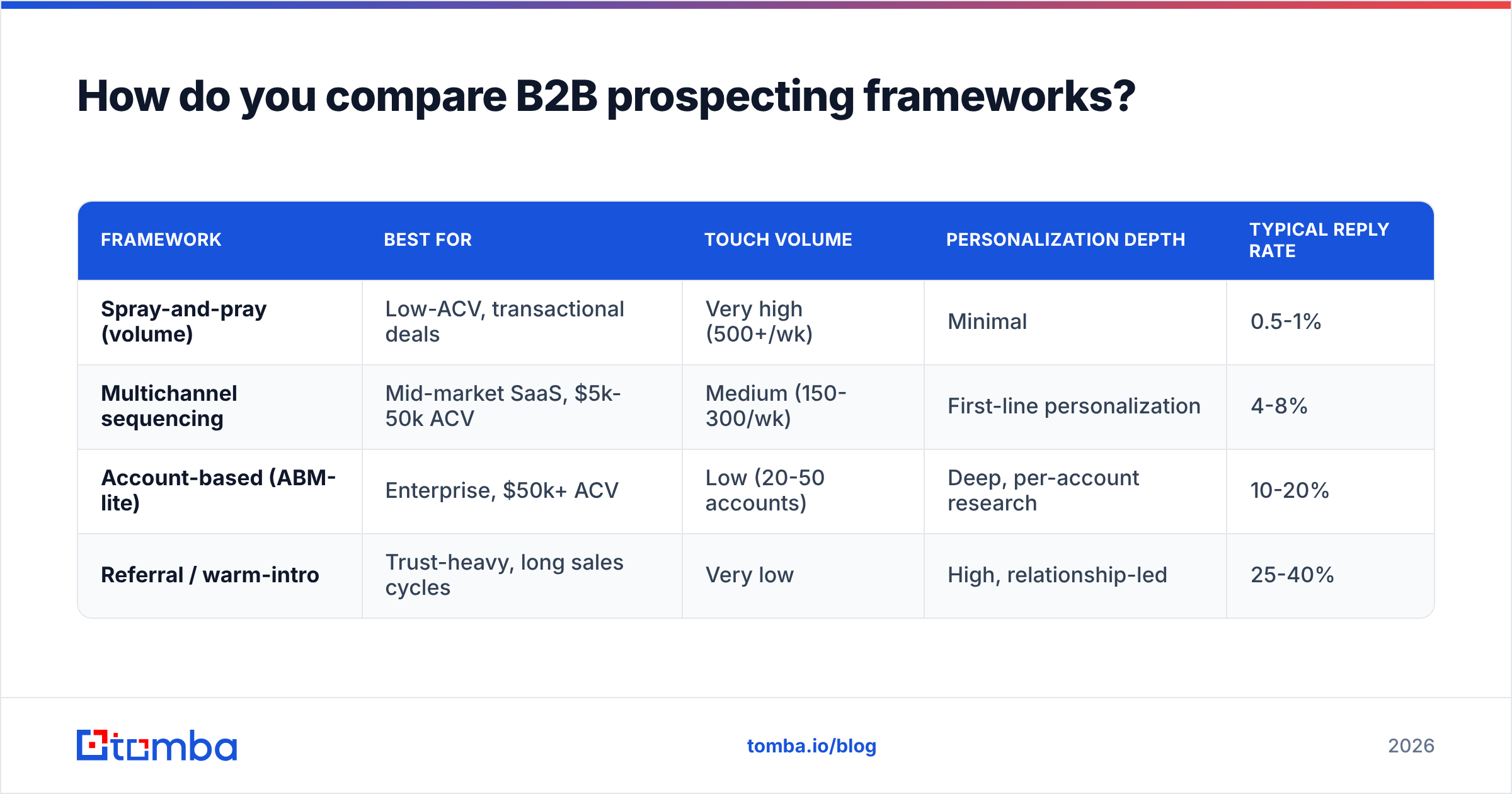
Different teams need different operating models. The table below compares the four most common frameworks so you can match one to your motion, deal size, and headcount.
| Framework | Best for | Touch volume | Personalization depth | Typical reply rate |
|---|---|---|---|---|
| Spray-and-pray (volume) | Low-ACV, transactional deals | Very high (500+/wk) | Minimal | 0.5-1% |
| Multichannel sequencing | Mid-market SaaS, $5k-50k ACV | Medium (150-300/wk) | First-line personalization | 4-8% |
| Account-based (ABM-lite) | Enterprise, $50k+ ACV | Low (20-50 accounts) | Deep, per-account research | 10-20% |
| Referral / warm-intro | Trust-heavy, long sales cycles | Very low | High, relationship-led | 25-40% |
Read it diagonally: as touch volume drops, personalization and reply rate rise. Most teams over-invest in volume and under-invest in the right-hand columns. If you only have two reps, ABM-lite plus referral mining will almost always out-produce a high-volume motion, because your scarce hours go into fewer, better-researched conversations.
For a deeper look at how outbound motions fit into a wider go-to-market plan, HubSpot's sales prospecting guide and the analyst frameworks from Gartner are solid neutral references.
What role does data quality play?#
It is the foundation everything else sits on. You can have the best sequence in the world, but if 25% of your addresses are wrong, you have quietly thrown away a quarter of your effort — and damaged your domain in the process.
Three data habits separate teams that scale cleanly from teams that stall:
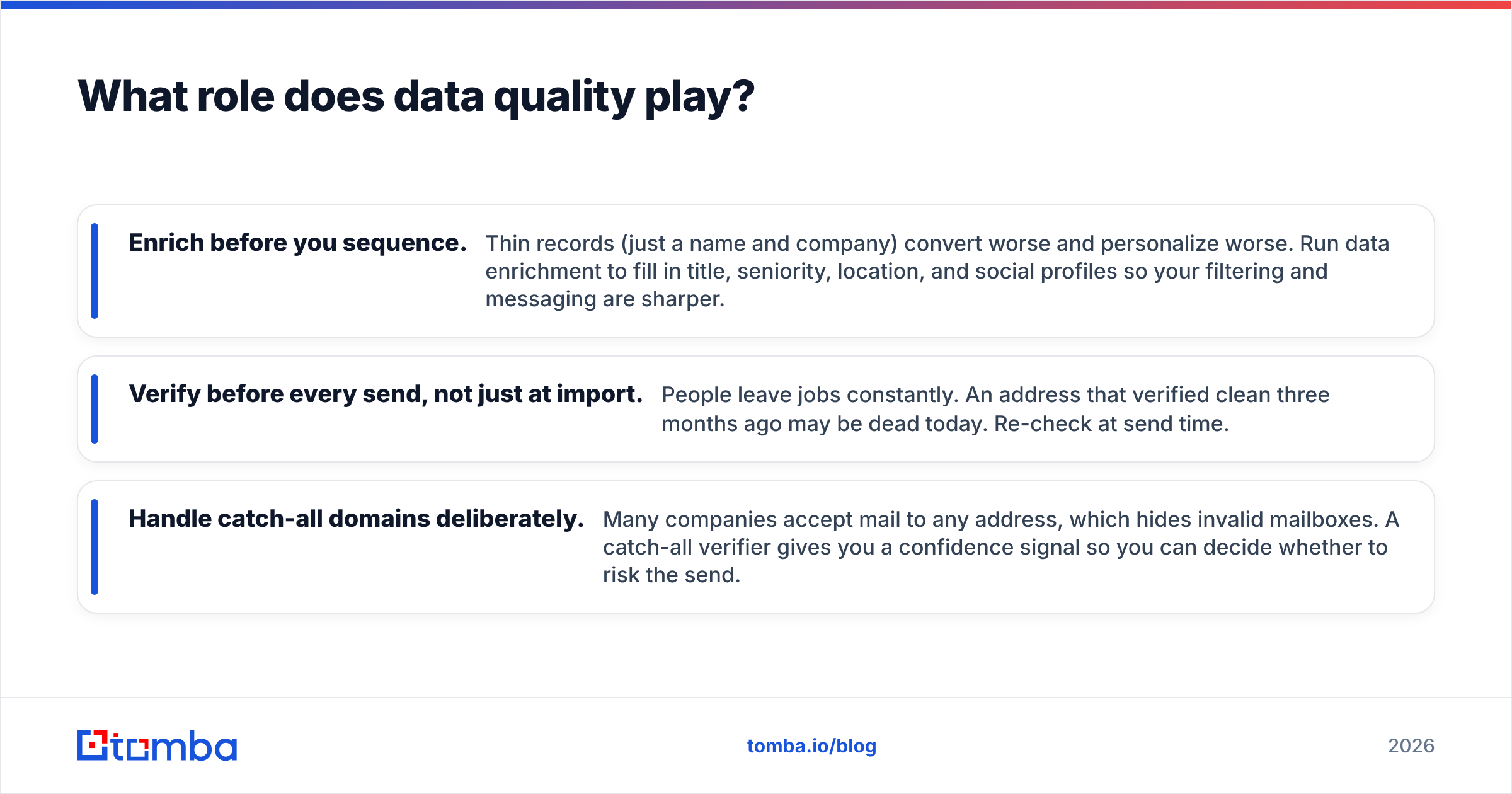
- Enrich before you sequence. Thin records (just a name and company) convert worse and personalize worse. Run data enrichment to fill in title, seniority, location, and social profiles so your filtering and messaging are sharper.
- Verify before every send, not just at import. People leave jobs constantly. An address that verified clean three months ago may be dead today. Re-check at send time.
- Handle catch-all domains deliberately. Many companies accept mail to any address, which hides invalid mailboxes. A catch-all verifier gives you a confidence signal so you can decide whether to risk the send.
Clean data also protects email deliverability. Mailbox providers track bounce and complaint rates per sending domain; a spike from a bad list can push your real, wanted emails into spam folders for weeks. The cheapest deliverability fix is simply not sending to addresses that do not exist.
How do you personalize at scale without burning hours?#
The trap is thinking personalization means writing a custom essay for every prospect. It does not. Conclusion first: personalize the opening, templatize the body.
A first line that proves you did 30 seconds of homework — a reference to their recent funding, a job posting, a product launch, a podcast they were on — earns the right to a templated value proposition underneath. That structure scales because the variable part is short and the constant part is reusable.
Practical ways to source those opening lines fast:
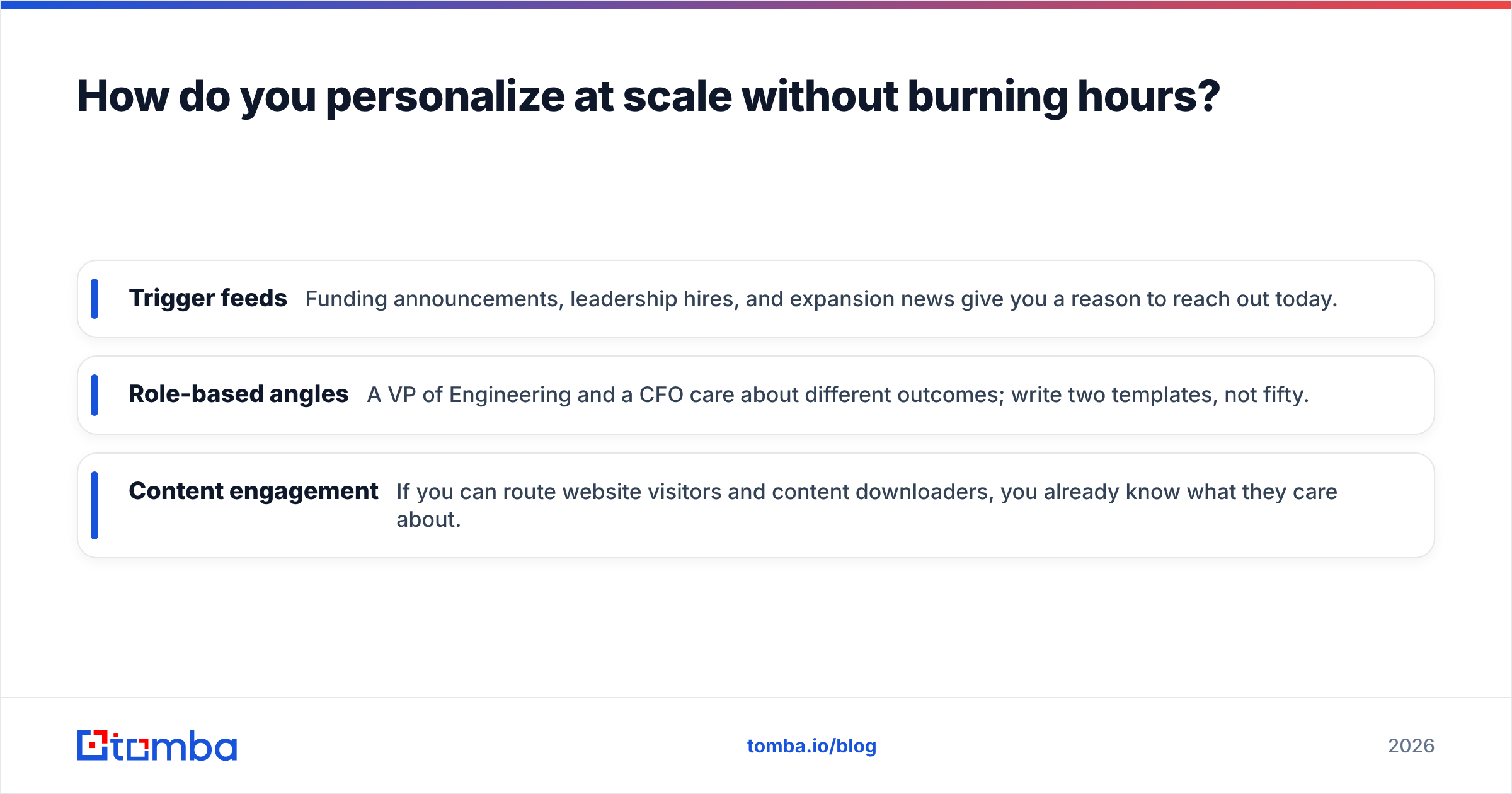
- Trigger feeds — Funding announcements, leadership hires, and expansion news give you a reason to reach out today.
- Role-based angles — A VP of Engineering and a CFO care about different outcomes; write two templates, not fifty.
- Content engagement — If you can route website visitors and content downloaders, you already know what they care about.
If you run inbound, identifying anonymous traffic with a website visitor reveal tool lets you prospect companies that already showed interest — the warmest cold outreach there is. Pair that signal with a verified contact and your first line writes itself.
What metrics tell you a prospecting strategy is working?#
Track leading indicators, not just closed deals — by the time revenue moves, you have lost months of feedback. Watch these four:
- Bounce rate — Should stay under 2-3%. Higher means your verification step is failing.
- Reply rate — The truest signal of message-market fit. Below 2% means your targeting or copy is off, not your volume.
- Positive reply rate — Replies that move toward a meeting. Vanity replies ("unsubscribe") do not count.
- Meetings booked per 100 contacts — The number that actually predicts pipeline. Optimize everything else toward this.
If reply rate is healthy but meetings are not, your problem is qualification or the offer. If bounce rate is high, fix data before touching copy. Diagnosing in that order saves weeks of guessing. For benchmarking your numbers against peers, G2's sales software category and the reviews there give a realistic read on what tools and rates teams actually report.
Common B2B prospecting mistakes to avoid#
- Sending before verifying. The fastest way to wreck a new domain.
- Single-channel reliance. Email-only leaves response on the table from buyers who live on the phone or LinkedIn.
- Personalizing everything or nothing. Both extremes waste time; personalize the hook only.
- Ignoring follow-up. Most replies come on touches 3-5, yet most reps stop at touch 2.
- Treating the list as static. Refresh and re-verify on a schedule, or watch your numbers decay.
Putting it together#
A strong 2026 prospecting engine is a loop, not a campaign: define your ICP, build and enrich a clean list, verify it, run coordinated multichannel sequences triggered by real signals, measure replies and meetings, and feed what you learn back into targeting. Each turn of the loop gets cheaper and sharper because your data and your messaging improve together.
The teams that win are not the ones sending the most messages. They are the ones sending the right message, to the right verified person, at the right moment — repeatedly.
If you want the data layer of that loop handled, start with the Tomba Email Finder. It resolves professional addresses by name and domain, verifies them in the same workflow, and scales from a single lookup to a bulk list — so your reps spend their hours on conversations, not on chasing dead addresses. The Free plan gives you 25 searches a month to test it; paid plans start at $49/mo, with full Tomba pricing laid out by volume. Build the clean list first, and every other strategy in this guide works harder.
// get started
Find, verify and enrich your first contacts today
Start on the free plan with 25 searches a month, then scale when your team is ready.
Free plan · No credit card required · GDPR & CCPA
// about the author