B2B Sales Engagement in 2026: Platforms, Tactics & Data
A practical 2026 guide to B2B sales engagement: how the platforms work, the metrics that matter, and why clean contact data decides whether your sequences ever land.
TL;DR
- B2B sales engagement is the discipline of orchestrating every rep touch — email, call, LinkedIn, SMS — into measurable, repeatable sequences instead of one-off guesswork.
- The platform you pick (Outreach, Salesloft, Apollo, Instantly) matters less than the contact data feeding it. Bad data sinks even a perfect sequence.
- Track reply rate, meetings booked, and sequence completion — not vanity "emails sent" counts.
- Multichannel cadences beat email-only by a wide margin, but only when each channel is personalized to the prospect, not copy-pasted.
- Start with verified emails and direct dials; an email verifier and a clean data source protect your sender reputation before a single send.
What is B2B sales engagement?#
B2B sales engagement is the structured way a revenue team plans, executes, and measures every interaction with a prospect across channels. Think of it like a flight plan rather than a paper airplane: instead of throwing emails into the air and hoping, you map the exact sequence of touches — day one email, day two LinkedIn view, day four call, day six follow-up — and you track what happens at each step.
The term covers three things at once: the process (your cadences and playbooks), the platform (the software that automates and logs touches), and the data (the contacts you're actually reaching). Teams that obsess over the platform while ignoring the data are the ones wondering why a "proven" sequence returns a 0.4% reply rate.
The shift over the last few years has been from volume to precision. Blasting 1,000 generic emails used to work because inboxes were emptier and spam filters were dumber. In 2026, Google and Microsoft both score sender reputation aggressively, and a single spammy campaign can torch your domain. Engagement is now about reaching the right person, on the right channel, with a message that proves you did your homework.
How does a sales engagement platform actually work?#
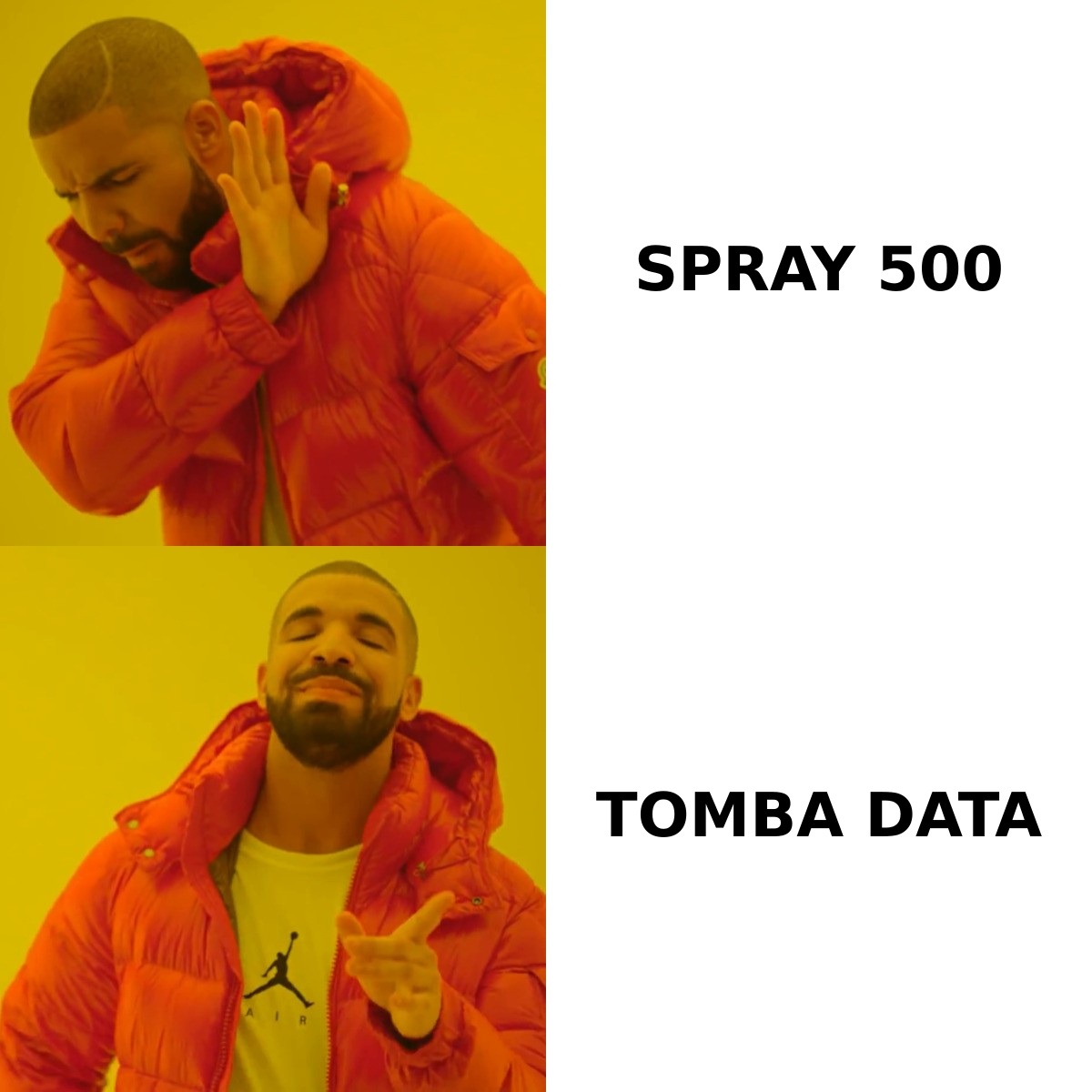
A sales engagement platform sits between your CRM and your prospects. It pulls contact records, drops them into sequences, automates the sends, and writes every open, click, reply, and call disposition back to the CRM. The rep works a single "to-do" queue instead of juggling tabs.
Here's the core loop most platforms run:
- Import contacts — from your CRM, a CSV, or an enrichment tool. This is where data quality is won or lost.
- Assign to a sequence — a predefined series of steps with timing rules (e.g., "wait 2 business days").
- Execute touches — automated emails fire on schedule; manual steps (calls, LinkedIn) surface as tasks.
- Capture signals — opens, clicks, replies, and meeting bookings are logged automatically.
- Branch and optimize — positive replies pull contacts out of the sequence; A/B tests reveal which subject lines and steps convert.
The automation is the easy part. The hard part is step one: if 30% of your imported emails bounce, your sender reputation craters and steps two through five never get a fair shot. This is why mature teams run every list through an email verification pass and confirm direct dials with a phone validator before the first send.
Which B2B sales engagement platforms should you compare in 2026?#
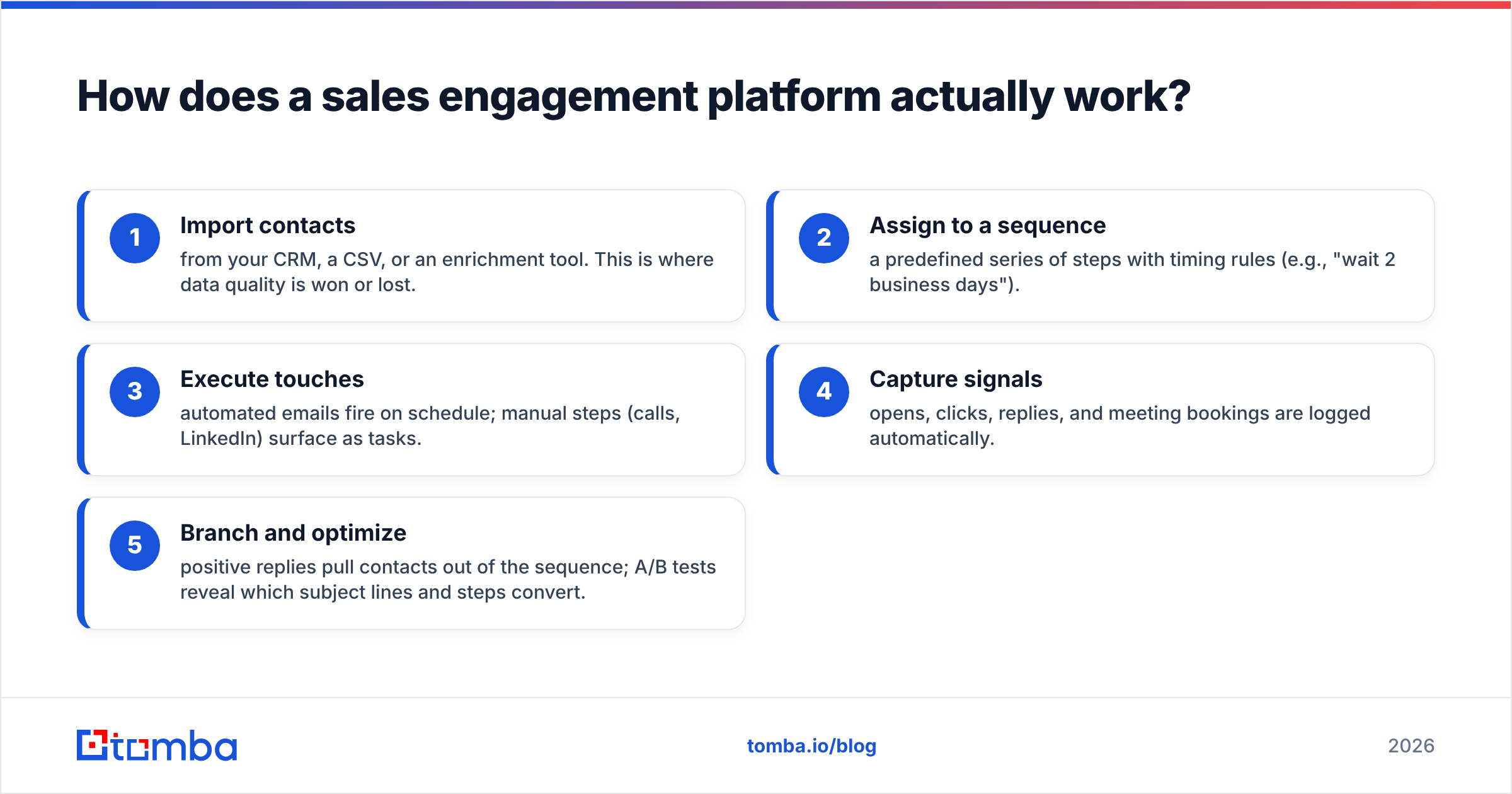
There's no single "best" platform — the right pick depends on team size, motion (high-velocity SMB vs. enterprise ABM), and whether you need built-in data or bring your own. Here's how the main contenders stack up.
| Platform | Best for | Built-in data | Starting price | Multichannel |
|---|---|---|---|---|
| Outreach | Enterprise sales orgs | No (BYO data) | ~$100/user/mo | Email, call, LinkedIn, SMS |
| Salesloft | Mid-market to enterprise | Limited | ~$75/user/mo | Email, call, LinkedIn |
| Apollo | SMB / high-velocity | Yes (B2B database) | $49/user/mo | Email, call, LinkedIn |
| Instantly | Cold email at scale | Add-on | ~$37/mo | Email-focused |
| Tomba (data layer) | Verified contacts for any platform | Yes | $49/mo | Feeds all of the above |
A key distinction: Outreach and Salesloft are engagement engines but expect you to supply data. Apollo bundles a database, which is convenient but its accuracy varies by region and seniority. Tomba isn't a sequencer — it's the verified data layer that keeps whichever engagement engine you choose from running on garbage contacts. You can pull emails by company with domain search, then push the clean list into Outreach or Instantly.
For deeper feature breakdowns, G2's sales engagement category and HubSpot's sales engagement overview are solid neutral references before you commit to a contract.
What does a high-converting sales engagement cadence look like?#
A strong cadence balances persistence with respect — enough touches to break through, spread across channels so you're not just another ignored email. The classic mistake is an 8-step email-only sequence; the inbox is the most crowded channel you have.
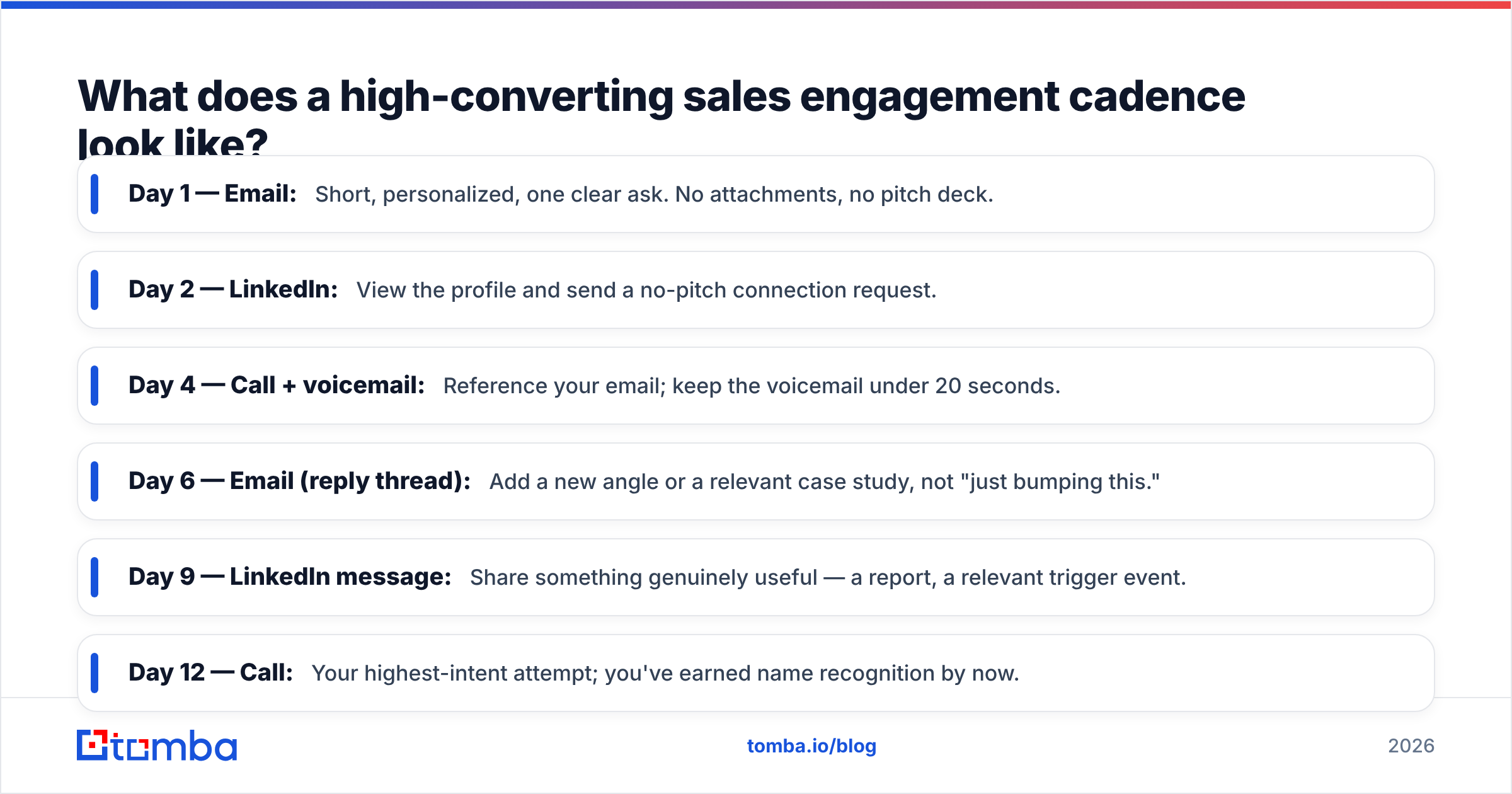
Here's a proven multichannel skeleton for a 14-day B2B cadence:
- Day 1 — Email: Short, personalized, one clear ask. No attachments, no pitch deck.
- Day 2 — LinkedIn: View the profile and send a no-pitch connection request.
- Day 4 — Call + voicemail: Reference your email; keep the voicemail under 20 seconds.
- Day 6 — Email (reply thread): Add a new angle or a relevant case study, not "just bumping this."
- Day 9 — LinkedIn message: Share something genuinely useful — a report, a relevant trigger event.
- Day 12 — Call: Your highest-intent attempt; you've earned name recognition by now.
- Day 14 — Breakup email: Polite, low-pressure, leaves the door open. These get surprising reply rates.
The reason multichannel wins is simple: people respond on different channels. A CFO might ignore email but answer a direct dial; a VP of Engineering lives in LinkedIn. Reaching them everywhere — without being a pest — is what separates a 12% reply rate from a 2% one. To make the LinkedIn steps work, you need accurate profile-to-email matching, which is exactly what a LinkedIn finder handles.
Which sales engagement metrics actually matter?#
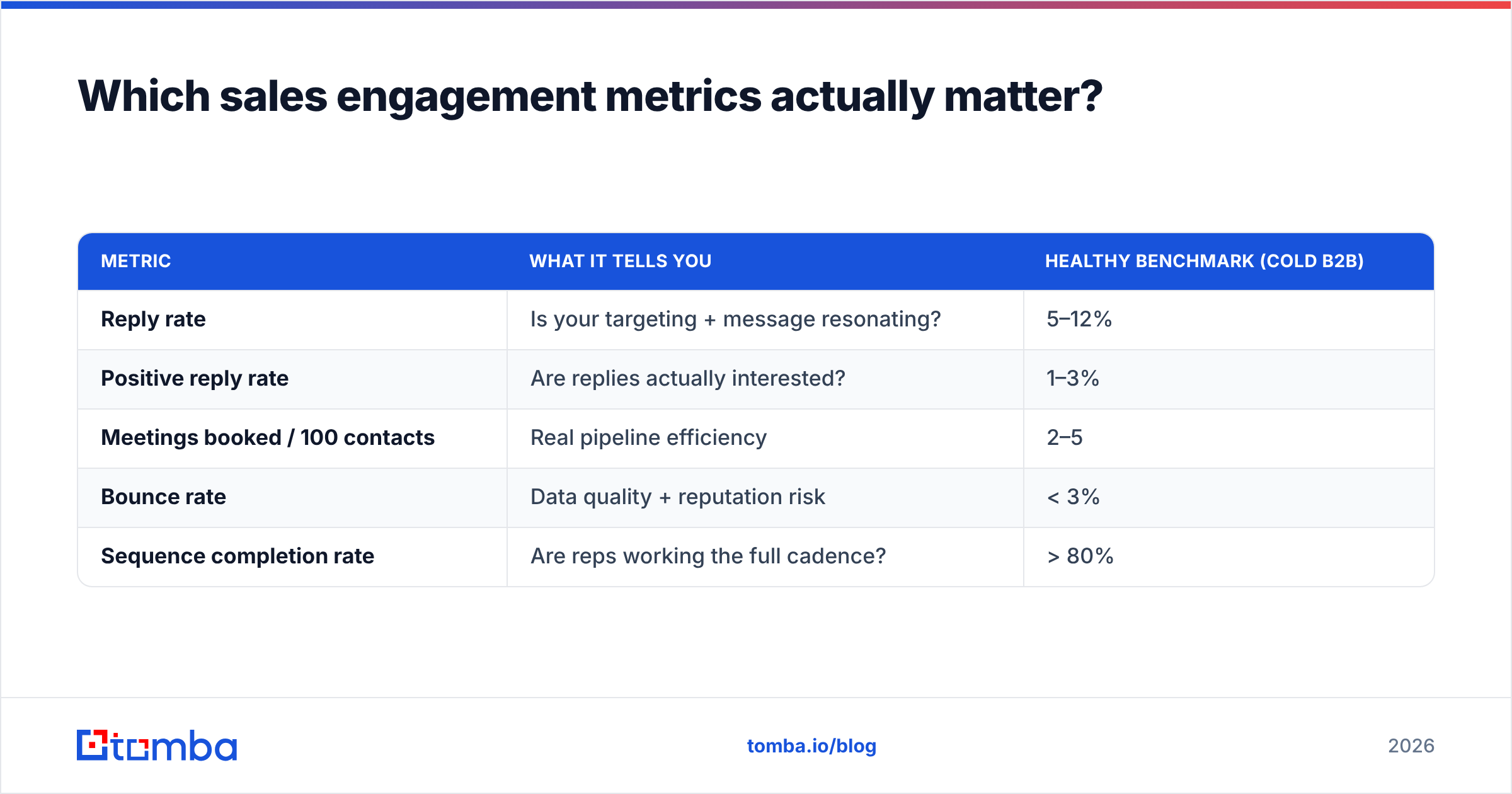
Stop reporting "emails sent." It measures activity, not outcomes. The metrics that predict pipeline are the ones tied to human responses and booked time.
| Metric | What it tells you | Healthy benchmark (cold B2B) |
|---|---|---|
| Reply rate | Is your targeting + message resonating? | 5–12% |
| Positive reply rate | Are replies actually interested? | 1–3% |
| Meetings booked / 100 contacts | Real pipeline efficiency | 2–5 |
| Bounce rate | Data quality + reputation risk | < 3% |
| Sequence completion rate | Are reps working the full cadence? | > 80% |
Bounce rate deserves special attention because it's a leading indicator, not a lagging one. A climbing bounce rate means your data is decaying and your sender reputation is about to follow. Keep it under 3% by verifying before you send and re-verifying lists that have been sitting in a CRM for months — B2B data decays at roughly 2–3% per month as people change jobs.
Sequence completion rate exposes a different problem: reps cherry-picking the "easy" steps and skipping calls. If completion is below 60%, your platform's reporting is showing you a coaching opportunity, not a data problem.
Why does contact data make or break sales engagement?#
Data quality is the single highest-leverage input in the entire system, and it's the one most teams underfund. You can buy the best platform and write brilliant copy, but if the email is wrong, none of it matters — the message never arrives.
Consider the compounding math. Say you load 1,000 contacts:
- At 95% deliverability, ~950 land and your reputation stays healthy.
- At 75% deliverability (a typical unverified list), 250 bounce. Mailbox providers notice, start routing your good emails to spam, and your effective reach drops far below 750.
That second scenario is how a campaign quietly dies. The fix is unglamorous but decisive: verify every address, confirm catch-all domains with a catch-all verifier, and enrich thin records before they enter a sequence. For teams running large lists, a bulk email finder plus verification turns a noisy spreadsheet into a deliverable campaign.
This is also where build-vs-buy on data comes in. Scraping and guessing email patterns yourself is cheap up front and expensive later, in bounced sends and a damaged domain. A dedicated email-finding tool with transparent data sources costs less than the reputation recovery you'd otherwise pay for.
How do you build a sales engagement workflow that scales?#
Scaling engagement isn't about sending more — it's about removing the manual steps that break as headcount grows. A workflow that works for two reps falls apart at twenty unless it's systematized.
Start with these foundations:
- One source of truth. Your CRM is the system of record. Engagement data flows back into it automatically; no rep updates spreadsheets by hand.
- Templated but personalized. Build sequence templates per persona, then require a personalized first line. The template saves time; the custom opener earns the reply.
- Enrichment at the point of import. Don't let a contact enter a sequence without a verified email and, ideally, a direct dial. Bake data enrichment into the import step.
- Tight feedback loops. Review reply and meeting rates weekly, kill the bottom-quartile sequences, and double down on what converts.
The teams that scale cleanly treat data and process as a system, not an afterthought. They'd rather reach 400 verified, well-researched contacts and book 15 meetings than spray 4,000 unverified ones and book 8 while burning their domain. Quality of input governs quality of output — there's no automation that rescues a bad list.
One more practical note: integrate, don't duplicate. Your engagement platform, CRM, and data tools should talk to each other through native integrations or an API so a contact verified once stays verified everywhere. Re-keying data across tools is where errors and wasted spend hide.
Putting it together#
B2B sales engagement in 2026 rewards precision over volume at every layer. Pick a platform that fits your motion, build multichannel cadences that respect the prospect's time, measure replies and meetings rather than activity — and above all, feed the whole machine with verified, current contact data.
That last layer is where most teams quietly lose. Before your next campaign, make sure every contact is real and reachable. Tomba's Email Finder gives you verified professional emails by name, company, or domain, with verification and enrichment built in — so whatever engagement platform you run, it runs on data that actually lands. Start free with 25 searches a month, and check the Tomba pricing plans (from $49/mo) when you're ready to scale your outreach without scaling your bounce rate.
// get started
Find, verify and enrich your first contacts today
Start on the free plan with 25 searches a month, then scale when your team is ready.
Free plan · No credit card required · GDPR & CCPA
// about the author