B2B Sales Presentation: How to Build a Deck That Closes in 2026
A great B2B sales presentation is not a feature dump. Here is the structure, data, and slide-by-slide framework that turns a deck into a closed deal in 2026.
Most B2B sales presentations lose the deal before slide three. The rep opens with a company-history timeline, walks through a logo wall, and reads bullet points off a feature grid while the buyer quietly checks email. By the time the "value" slide arrives, attention is gone.
A B2B sales presentation is not a brochure you narrate. It is a structured argument that moves a specific buyer from their current pain to a believable future, using their language and their numbers. This guide breaks down the structure, the slide-by-slide framework, the prep work, and the mistakes that quietly kill otherwise good pitches.
TL;DR#
- A winning B2B sales presentation is buyer-centric, not product-centric — it leads with their problem, not your features.
- Use a proven arc: status quo → tension → vision → proof → path forward, in roughly 10–15 slides.
- Discovery comes first. A deck built on accurate contact and account data converts far better than a generic template sprayed at every lead.
- Cut the feature dump. Buyers remember one story and one number, not 40 bullet points.
- Always close with a clear, low-friction next step — never "any questions?"
What is a B2B sales presentation?#
A B2B sales presentation is the structured pitch a seller delivers to a buying group — usually mid-funnel, after discovery and before negotiation — to build the business case for purchase. Unlike a B2C ad, it is built for a committee: champions, economic buyers, technical evaluators, and skeptics who each weigh the decision differently.
That committee reality is what makes B2B decks hard. According to Gartner research, the typical B2B buying group involves six to ten decision-makers, each arriving with their own information. Your presentation is not persuading one person in the room — it is arming your champion to re-sell internally when you are not there.
So the job of the deck is twofold: persuade the people present, and survive the forwarded PDF that lands in the inbox of someone who never saw you speak.
What makes a B2B sales presentation actually close deals?#
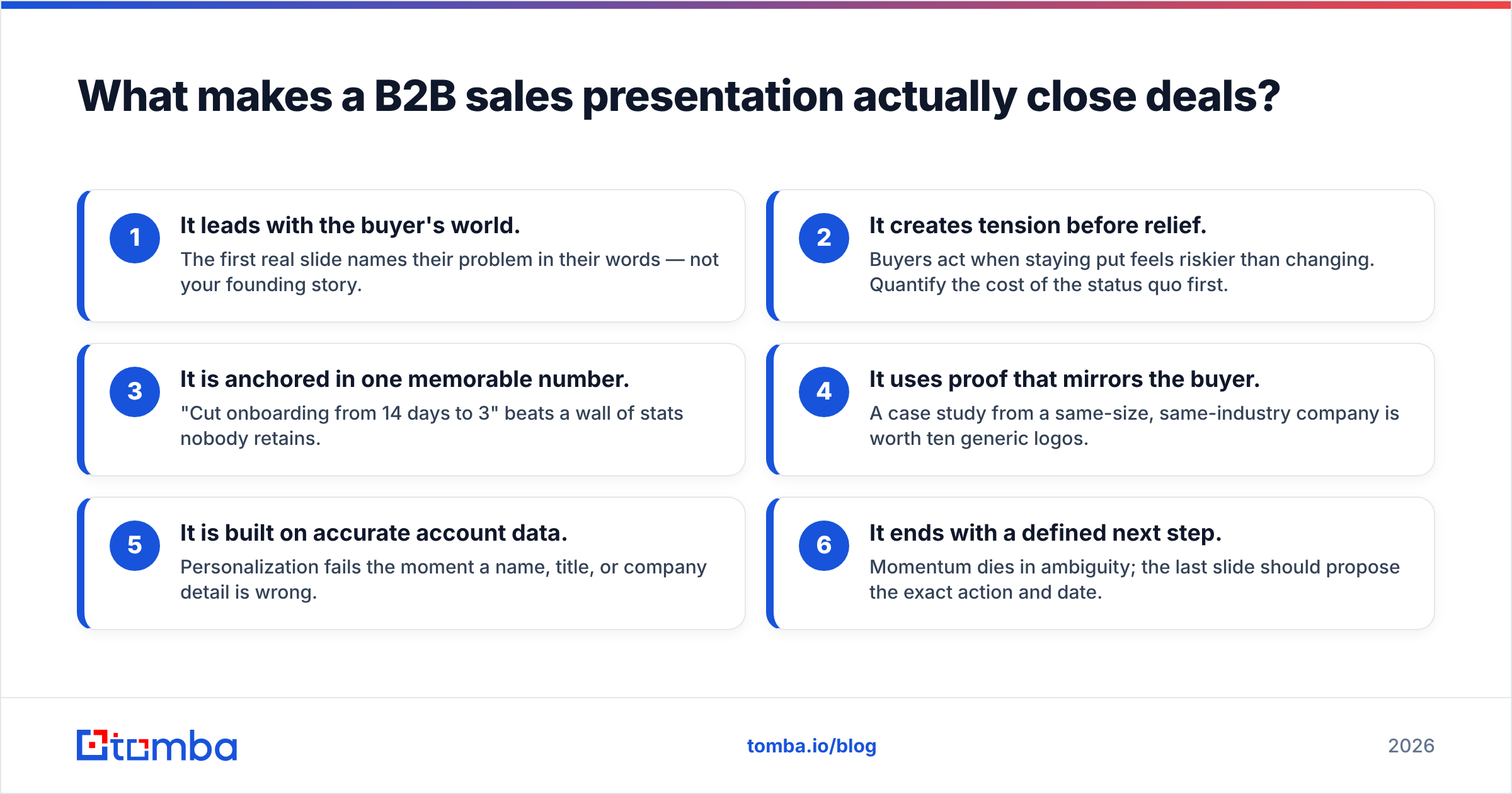
The deals that close share a pattern, and it has almost nothing to do with how polished the animations are. Here are the six attributes that separate a closing deck from a forgettable one:
- It leads with the buyer's world. The first real slide names their problem in their words — not your founding story.
- It creates tension before relief. Buyers act when staying put feels riskier than changing. Quantify the cost of the status quo first.
- It is anchored in one memorable number. "Cut onboarding from 14 days to 3" beats a wall of stats nobody retains.
- It uses proof that mirrors the buyer. A case study from a same-size, same-industry company is worth ten generic logos.
- It is built on accurate account data. Personalization fails the moment a name, title, or company detail is wrong.
- It ends with a defined next step. Momentum dies in ambiguity; the last slide should propose the exact action and date.
Notice that two of the six are about data and research, not slide design. You cannot personalize a presentation for a buyer you do not understand, and you cannot reach the right buyer with a stale contact record. That is why the strongest reps spend more time in data enrichment and discovery than in PowerPoint.
What is the ideal B2B sales presentation structure?#
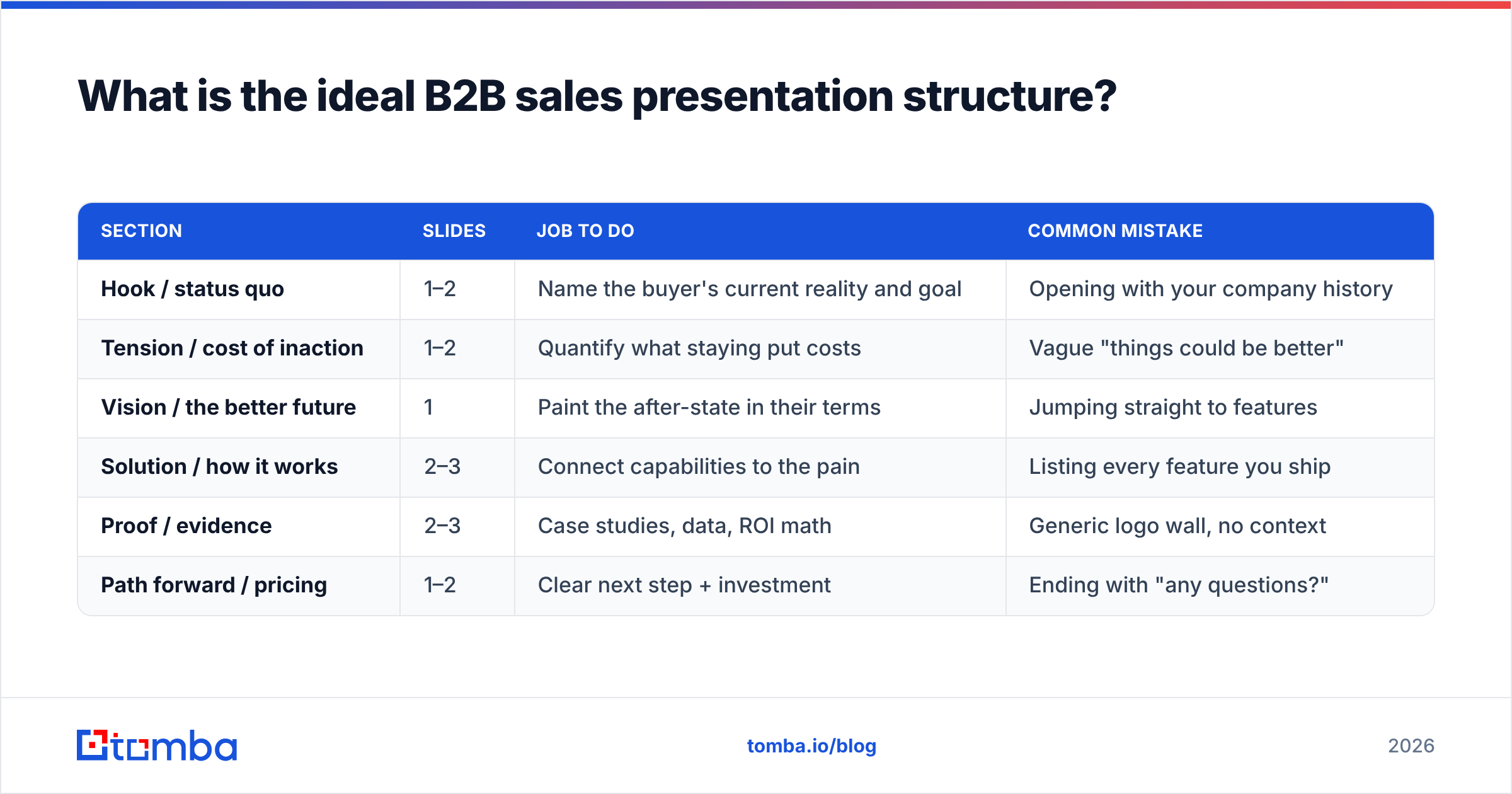
The most reliable structure follows a narrative arc borrowed from classic storytelling, adapted for a buying committee. Each section has a job, and skipping one weakens the whole.
| Section | Slides | Job to do | Common mistake |
|---|---|---|---|
| Hook / status quo | 1–2 | Name the buyer's current reality and goal | Opening with your company history |
| Tension / cost of inaction | 1–2 | Quantify what staying put costs | Vague "things could be better" |
| Vision / the better future | 1 | Paint the after-state in their terms | Jumping straight to features |
| Solution / how it works | 2–3 | Connect capabilities to the pain | Listing every feature you ship |
| Proof / evidence | 2–3 | Case studies, data, ROI math | Generic logo wall, no context |
| Path forward / pricing | 1–2 | Clear next step + investment | Ending with "any questions?" |
Keep the whole thing to 10–15 slides. A 40-slide deck is a confession that you do not know which three points matter. Anything you cannot say out loud in 20 minutes belongs in a leave-behind appendix, not the live pitch.
A slide-by-slide skeleton#
- Slide 1 — Title + outcome. Not "About Acme Corp." Instead: "How [Buyer] can cut churn 18% by Q4."
- Slide 2 — Their world today. A snapshot of the buyer's current process and goal, validated in discovery.
- Slide 3 — The cost of staying here. The quantified tension. Money, time, risk, or missed revenue.
- Slides 4–5 — The vision. What their world looks like once the problem is solved.
- Slides 6–8 — How you get them there. Only the capabilities that map to slides 2–3.
- Slides 9–11 — Proof. A same-profile customer story with before/after numbers, plus ROI math.
- Slide 12 — The path forward. Specific next step, timeline, and pricing range.
How do you prepare a B2B sales presentation before building slides?#
You earn the right to present by doing the research first. The single biggest predictor of a deck that lands is whether discovery actually happened — and whether the data behind your personalization is correct.
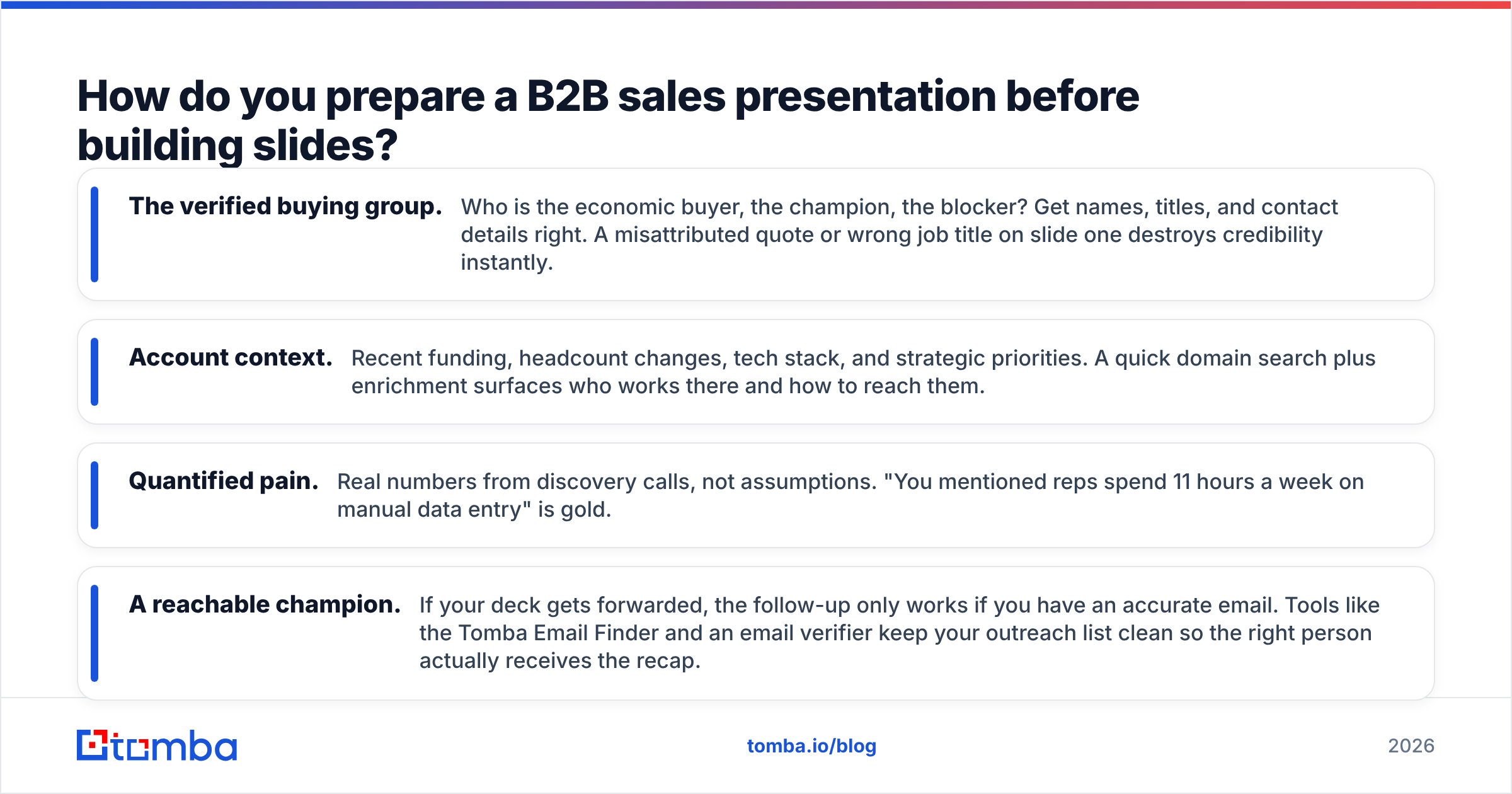
Before you open a slide template, you should have:
- The verified buying group. Who is the economic buyer, the champion, the blocker? Get names, titles, and contact details right. A misattributed quote or wrong job title on slide one destroys credibility instantly.
- Account context. Recent funding, headcount changes, tech stack, and strategic priorities. A quick domain search plus enrichment surfaces who works there and how to reach them.
- Quantified pain. Real numbers from discovery calls, not assumptions. "You mentioned reps spend 11 hours a week on manual data entry" is gold.
- A reachable champion. If your deck gets forwarded, the follow-up only works if you have an accurate email. Tools like the Tomba Email Finder and an email verifier keep your outreach list clean so the right person actually receives the recap.
This is where the spray-and-pray approach quietly fails. Reps who blast a generic deck to a list of unverified contacts get low engagement and blame the slides. The deck was never the problem — the targeting was.
Product-centric vs. buyer-centric: which presentation wins?#
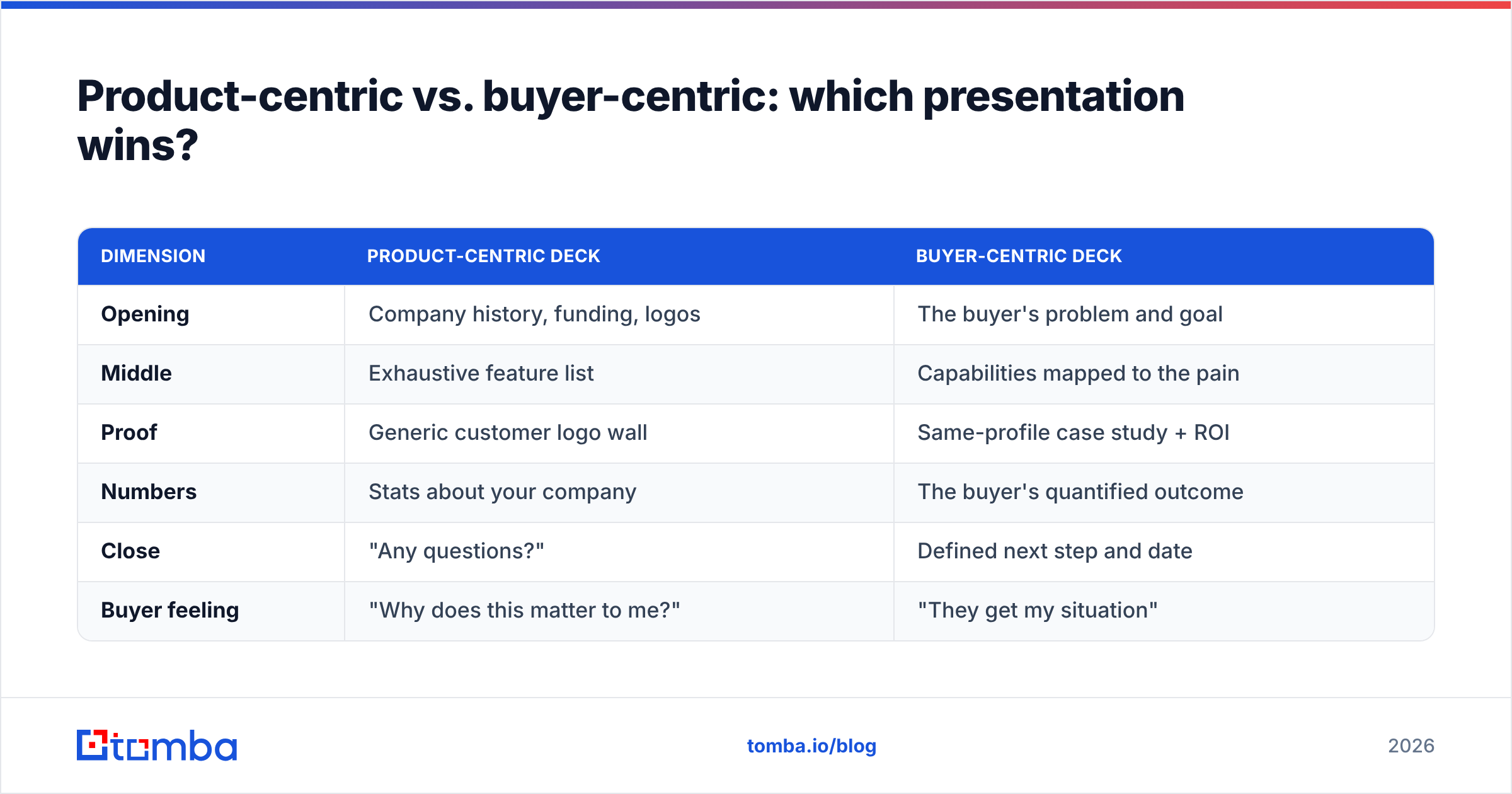
This is the core tension in B2B selling, and it is worth seeing the two approaches side by side.
| Dimension | Product-centric deck | Buyer-centric deck |
|---|---|---|
| Opening | Company history, funding, logos | The buyer's problem and goal |
| Middle | Exhaustive feature list | Capabilities mapped to the pain |
| Proof | Generic customer logo wall | Same-profile case study + ROI |
| Numbers | Stats about your company | The buyer's quantified outcome |
| Close | "Any questions?" | Defined next step and date |
| Buyer feeling | "Why does this matter to me?" | "They get my situation" |
The buyer-centric deck wins almost every time, and the research backs it. HubSpot and Salesforce both report that buyers increasingly expect personalized, consultative interactions and tune out generic pitches. The mechanics are simple: people pay attention when they recognize themselves in the story.
What are the most common B2B sales presentation mistakes?#
Even experienced reps repeat the same handful of errors. Watch for these:
- The feature dump. Listing 40 capabilities signals you do not know which three solve their problem. Cut ruthlessly.
- Burying the cost of inaction. Without tension, there is no urgency, and "no decision" wins. Always quantify the status quo.
- Generic proof. A logo wall with no context is wallpaper. Use a customer who looks like the buyer and show real before/after numbers.
- Reading the slides. If you read bullets aloud, the buyer reads ahead and stops listening. Slides support you; they are not the script.
- Bad data behind personalization. Wrong name, wrong title, wrong company fact — one error and your credibility is gone. Verify before you present.
- No clear next step. Ending with "any questions?" hands control to the room. End by proposing the exact action and date.
- Too many slides. Length is not thoroughness. A tight 12-slide story beats a 40-slide marathon every time.
Most of these trace back to two root causes: skipping discovery and skipping data hygiene. Fix those and half the list disappears on its own.
How do you measure whether a B2B sales presentation worked?#
A presentation is not "good" because it felt smooth. It is good if it moves the deal. Track these signals:
- Advance rate — did the meeting end with a committed next step? This is the single most honest metric. Tie it back to your sales win rate over time.
- Multi-threading — did you get introduced to additional stakeholders afterward? A deck that earns forwards is doing its job.
- Recap engagement — did the champion open and reply to your follow-up? A clean, verified email list makes this measurable rather than a guess.
- Time to next stage — buyer-centric decks compress the cycle because they reduce internal re-selling friction.
If your advance rate is low across many pitches, the problem is usually upstream — targeting and discovery — not your delivery. That is why pairing a strong deck with accurate prospecting data matters so much; you can review how data quality affects the funnel on the Tomba pricing page to see where verified volume fits your team's motion.
How does data quality change your presentation results?#
Here is the part most "how to present" guides skip: the best deck in the world fails if it reaches the wrong inbox or names the wrong person. B2B presentations live and die on the data that surrounds them.
Three places where data quality directly changes outcomes:
- Targeting. Verified, well-segmented contact lists mean your deck reaches buyers who actually have the problem you solve — instead of being forwarded to a void.
- Personalization. Accurate titles, company facts, and recent triggers let you tailor the opening so the buyer immediately feels understood.
- Follow-up. The deal is usually won in the recap, not the room. A verified email ensures your follow-up and the forwarded PDF land where they should.
Reps who treat prospecting data and presentation craft as one connected system close more than reps who polish slides in isolation. The deck is the visible 10%; the research and data behind it are the 90% that decides the result.
Bringing it together#
A B2B sales presentation that closes is buyer-centric, tightly structured, anchored in one memorable number, backed by same-profile proof, and ended with a concrete next step. But none of that works without the foundation: knowing exactly who you are talking to and being able to reach them.
That foundation is data. Before you build your next deck, make sure you are presenting to the right buying group with the right contact details. The Tomba Email Finder helps you find and verify professional email addresses by name, company, or domain — so your perfectly structured presentation reaches the decision-makers who can actually say yes, and your follow-up never bounces. Start on the free tier with 25 searches a month, then scale to a Starter plan at $49/mo when your pipeline grows. Build the deck buyers remember, and put it in front of the people who matter.
Ready to find emails that actually work?
Join 150,000+ professionals who stopped guessing and started sending. Free credits on signup — no credit card required.
Get the Tomba newsletter
Practical outbound tactics and product updates — once every two weeks.
About the author