Sales Battle Card: How to Build One That Wins Deals in 2026
A sales battle card turns scattered competitive intel into a one-page weapon reps actually use. Here's how to build, structure, and maintain one in 2026.
TL;DR
- A battle card is a one-page reference that arms reps with positioning, objection handling, and competitor weaknesses for a specific deal scenario — so they stop improvising on live calls.
- The best battle cards are short, scenario-specific, and updated constantly. A 12-page PDF nobody reads is worse than no card at all.
- There are four core types: competitor cards, persona cards, objection cards, and win/loss cards. Most teams need all four.
- Battle cards only work when the underlying data is accurate — fresh contact, firmographic, and competitive intel beats clever talk tracks every time.
- Build your first card in an afternoon, test it on five calls, then iterate. Treat it as a living document, not a deliverable.
What is a sales battle card?#
A sales battle card is a single-page cheat sheet that gives a rep everything they need to win a specific competitive or objection-heavy moment. Think of it like a boxer's corner between rounds: the coach doesn't recite the entire training manual, they give three sharp instructions that change the next two minutes of the fight.
That's the whole point. A battle card is not documentation. It's ammunition. When a prospect says "but we're already evaluating Competitor X," your rep should not be scrolling through a wiki or pinging Slack. They should glance at a card that tells them exactly how X loses, what to say, and what proof to drop.
According to HubSpot's sales research, reps spend a large chunk of their week on non-selling activities — hunting for information is a big slice of that. A good battle card collapses that search time to zero for the moments that matter most.
The format is deliberately constrained. One screen. Scannable. Written in the rep's voice, not marketing's. If you can't read it in 15 seconds mid-call, it's too long.
Why do sales teams use battle cards?#
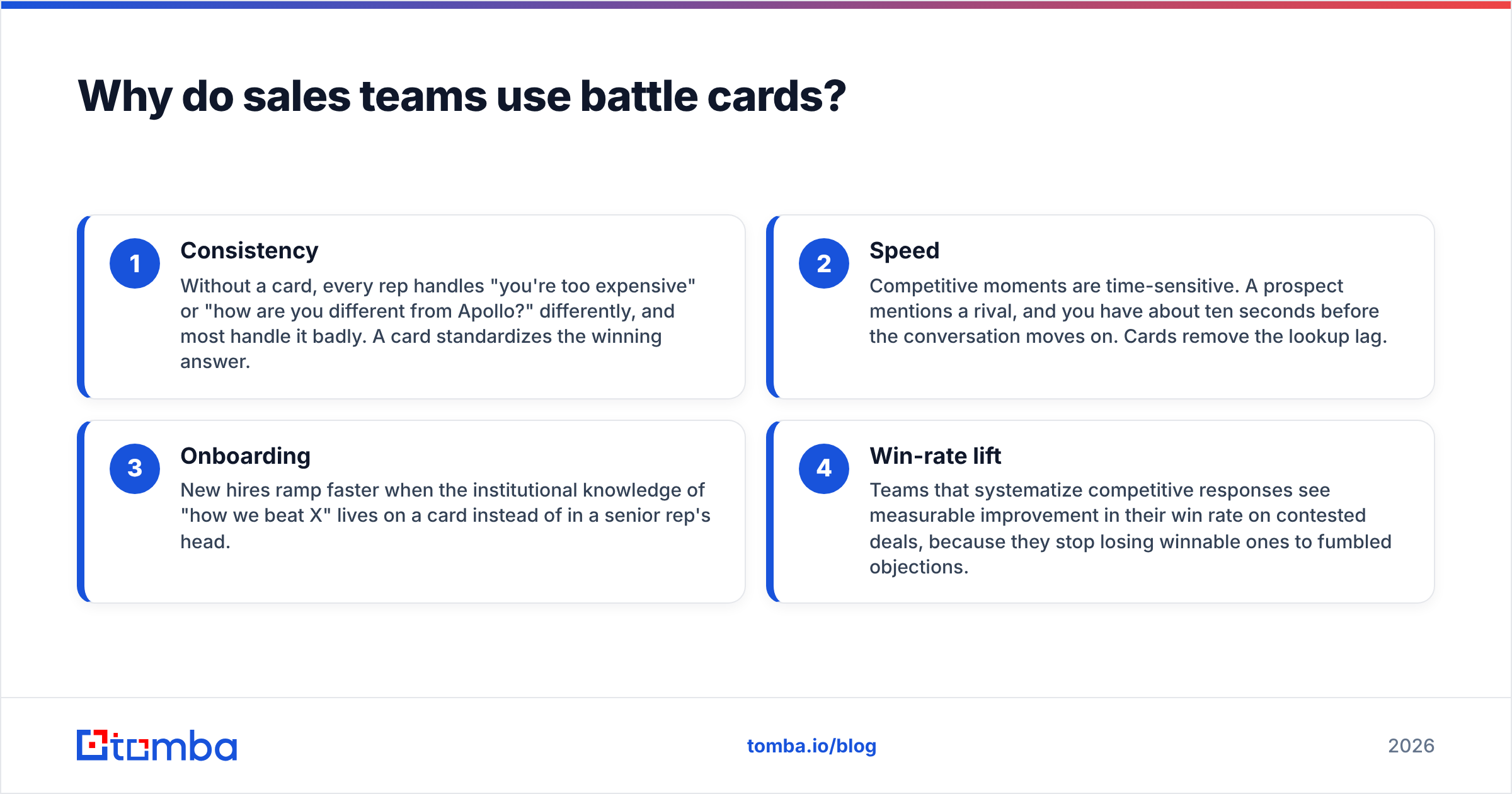
Battle cards exist to make your weakest rep sound like your strongest rep in the situations that decide deals. Three reasons they earn their keep:
- Consistency — Without a card, every rep handles "you're too expensive" or "how are you different from Apollo?" differently, and most handle it badly. A card standardizes the winning answer.
- Speed — Competitive moments are time-sensitive. A prospect mentions a rival, and you have about ten seconds before the conversation moves on. Cards remove the lookup lag.
- Onboarding — New hires ramp faster when the institutional knowledge of "how we beat X" lives on a card instead of in a senior rep's head.
- Win-rate lift — Teams that systematize competitive responses see measurable improvement in their win rate on contested deals, because they stop losing winnable ones to fumbled objections.
The hidden benefit is feedback. When reps use a shared card, you learn fast which talk tracks land and which don't. That turns the card into a flywheel: deals feed the card, the card improves, the next deals go better.
What are the types of battle cards?#
Most teams think "battle card" means "competitor card" and stop there. That's a mistake. You need a small family of cards, each tuned to a different moment in the deal.
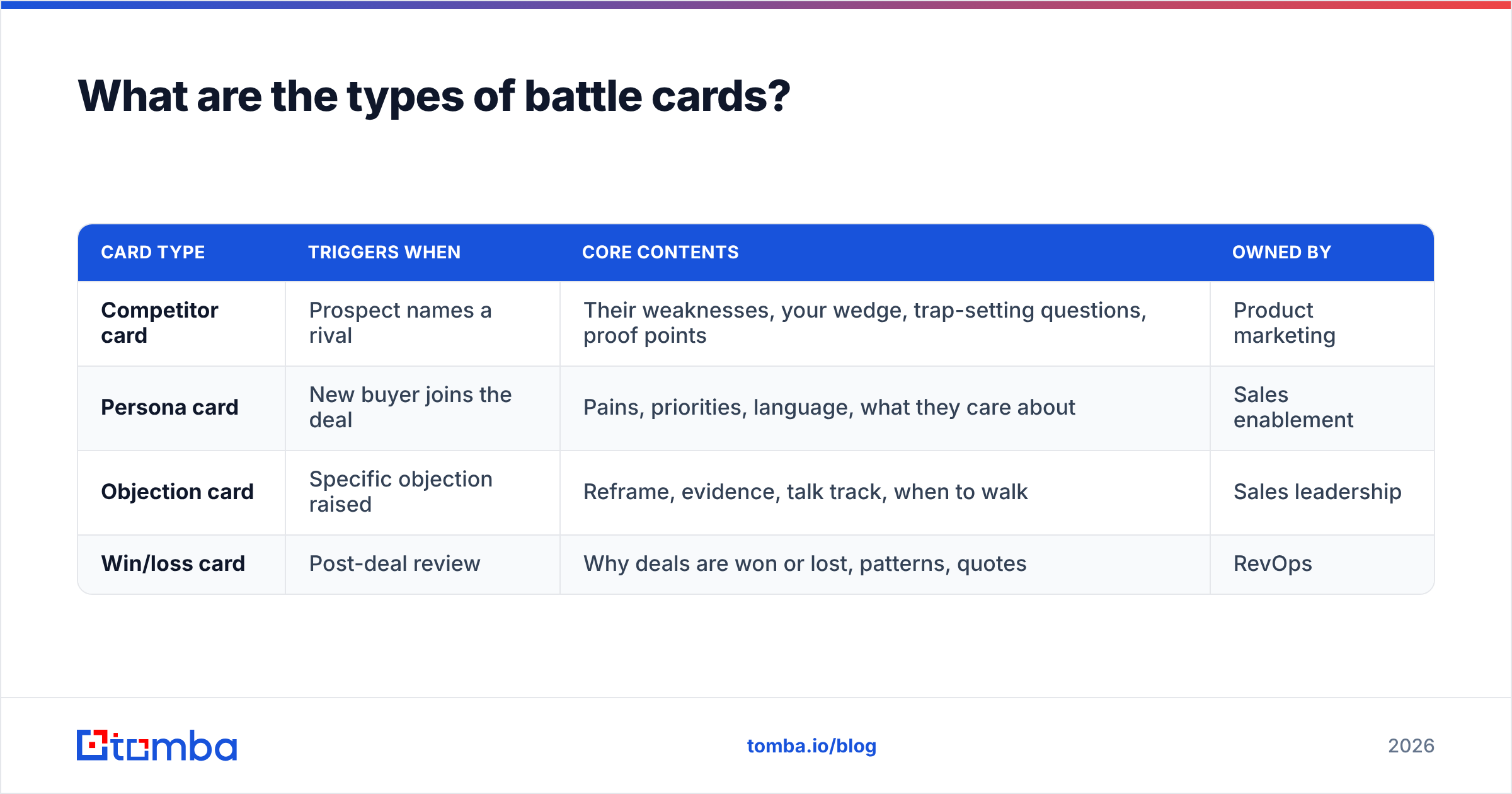
Here is how the four core types compare:
| Card type | Triggers when | Core contents | Owned by |
|---|---|---|---|
| Competitor card | Prospect names a rival | Their weaknesses, your wedge, trap-setting questions, proof points | Product marketing |
| Persona card | New buyer joins the deal | Pains, priorities, language, what they care about | Sales enablement |
| Objection card | Specific objection raised | Reframe, evidence, talk track, when to walk | Sales leadership |
| Win/loss card | Post-deal review | Why deals are won or lost, patterns, quotes | RevOps |
A competitor card is your most-used weapon, but a persona card wins the multi-threaded enterprise deal where a new VP suddenly appears on the call. An objection card saves the deal that's stalling on price. And win/loss cards are the raw material that keeps the other three honest — without them you're guessing.
If you only build one to start, build the competitor card for your single most common rival. Then expand.
What goes on a competitor battle card?#
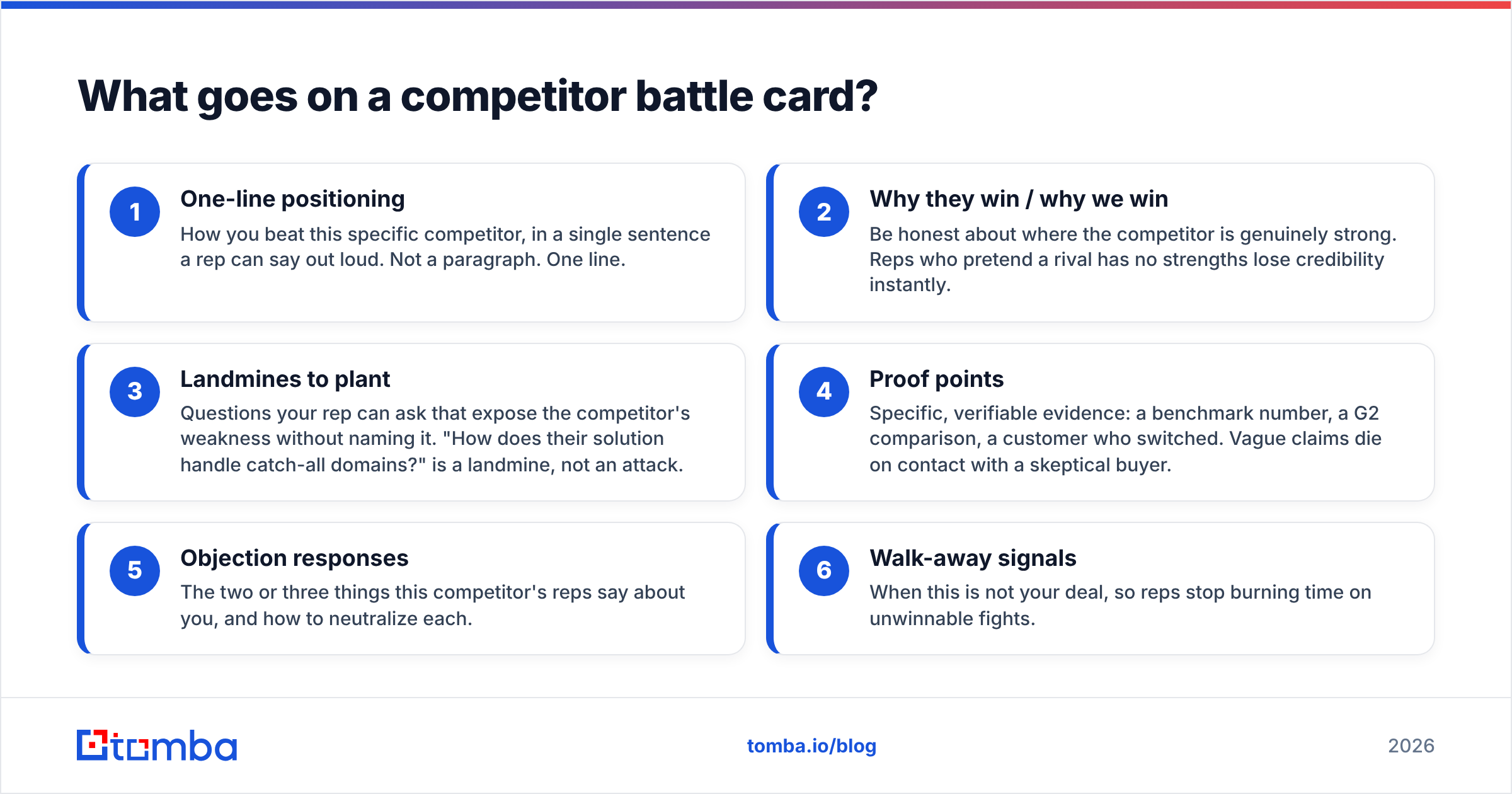
A competitor battle card has a fixed anatomy. Skip any section and reps will feel the gap on a live call. Here's the structure that works, with bold leads so reps can jump straight to what they need:
- One-line positioning — How you beat this specific competitor, in a single sentence a rep can say out loud. Not a paragraph. One line.
- Why they win / why we win — Be honest about where the competitor is genuinely strong. Reps who pretend a rival has no strengths lose credibility instantly.
- Landmines to plant — Questions your rep can ask that expose the competitor's weakness without naming it. "How does their solution handle catch-all domains?" is a landmine, not an attack.
- Proof points — Specific, verifiable evidence: a benchmark number, a G2 comparison, a customer who switched. Vague claims die on contact with a skeptical buyer.
- Objection responses — The two or three things this competitor's reps say about you, and how to neutralize each.
- Walk-away signals — When this is not your deal, so reps stop burning time on unwinnable fights.
The hardest section to get right is "why they win." Teams want to skip it. Don't. Buyers can smell a one-sided pitch, and acknowledging a competitor's real strength is what makes the rest of your card believable. Gartner's research on B2B buying consistently shows that buyers trust sellers who demonstrate honest understanding of the full landscape.
How do you build a battle card?#
Build it in four passes, not one. The mistake teams make is trying to write the perfect card in a vacuum. You can't. You write a rough one, then let real calls sharpen it.
Pass 1 — Gather raw intel. Pull from win/loss interviews, lost-deal notes in your CRM, recorded calls, and competitor websites. Talk to your three best reps; they already carry an informal card in their heads. Your job is to extract it.
Pass 2 — Draft tight. Force everything onto one page. If it doesn't fit, the card is trying to do too much — split it into two scenario cards instead. Write in the imperative: "Ask them about X," not "Reps may wish to consider asking about X."
Pass 3 — Pressure-test on calls. Give the draft to five reps for a week. Sit in on calls. Watch which lines get used and which get ignored. The ignored lines are dead weight — cut them.
Pass 4 — Operationalize. Put the card where the work happens. Embed it in your CRM, your sales engagement tool, or a battle-card platform like Klue or Crayon. A card in a Google Drive folder nobody opens is a card that doesn't exist.
The whole first cycle takes about a week. Resist the urge to build twelve cards before testing one.

How is accurate data the foundation of every battle card?#
A battle card is only as good as the intel underneath it, and most cards rot because the data does. The conclusion first: invest in fresh data before you invest in clever talk tracks, because a confident rep working from wrong information loses faster than a hesitant one working from the truth.
Three places data quality makes or breaks a card:
- Knowing who you're actually selling to. A persona card is useless if you have the wrong contact or an outdated title. Reaching the real decision-maker starts with a reliable email finder and verified contact details, not a stale list scraped two years ago.
- Firmographic context. Your "why we win" depends on company size, stack, and segment. Pulling current data enrichment into the deal record means the card's advice is tuned to this account, not a generic average.
- Competitive displacement signals. Knowing which accounts already run a competitor — and who the buying committee is — turns a generic competitor card into a targeted play. A solid B2B database is what makes that targeting possible at scale.
This is the unglamorous part of competitive selling. Everyone wants to argue about talk tracks. The teams that actually win quietly fix their data first. A landmine question lands only if you're asking the right person at the right company about the right pain.
Battle card tools: build vs buy in 2026#
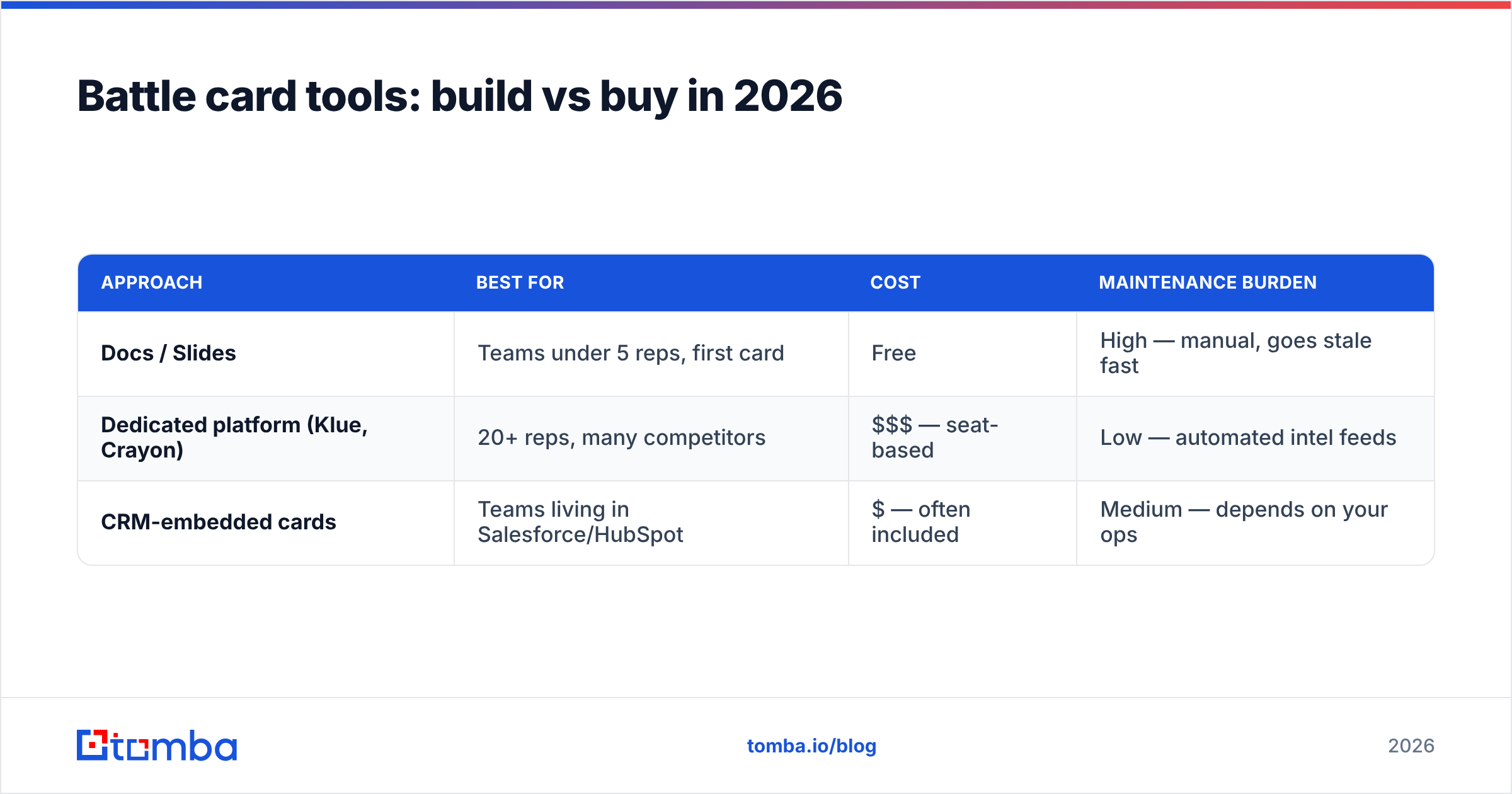
You have three realistic options for housing your cards. Here's how they stack up:
| Approach | Best for | Cost | Maintenance burden |
|---|---|---|---|
| Docs / Slides | Teams under 5 reps, first card | Free | High — manual, goes stale fast |
| Dedicated platform (Klue, Crayon) | 20+ reps, many competitors | $$$ — seat-based | Low — automated intel feeds |
| CRM-embedded cards | Teams living in Salesforce/HubSpot | $ — often included | Medium — depends on your ops |
For most growing teams, the honest answer is: start in a shared doc, prove the card drives wins, then graduate to a platform once you're maintaining more than three or four cards. Buying a competitive-intelligence platform before you've validated a single card is a classic way to spend money on shelfware.
Whatever housing you choose, the card must connect to live data. If you use Tomba's integrations to push verified contact and company data into your CRM, your cards inherit that freshness automatically instead of drifting out of date the moment they're written.
How often should you update a battle card?#
Update competitor and objection cards monthly at minimum, and immediately after any major competitor release, pricing change, or pattern of lost deals. Persona and win/loss cards can refresh quarterly.
The trigger-based rule matters more than the calendar. The moment three reps lose deals to the same new objection, that's a card update — not next month, now. Set up a lightweight loop: a shared channel where reps drop competitive intel from calls, and an owner who folds it into the card weekly. Cards die from neglect, not from being wrong on day one.
A practical signal to watch: if your reps have stopped opening a card, it's either stale or it was never useful. Both are fixable, but only if you're tracking usage. Most modern enablement tools show you open rates per card — treat a falling open rate as a maintenance alarm.
Common battle card mistakes to avoid#
- Too long. The single most common failure. If it's not one page, it's a document, and documents don't get used mid-call.
- Marketing voice. Cards written in polished brand language don't survive contact with a real conversation. Write how reps actually talk.
- No "why they win." A card that pretends the competitor is garbage trains reps to sound dishonest.
- Set and forget. A card built once and never touched is actively harmful within a quarter.
- Built on bad data. Confident delivery of wrong information is the fastest way to lose a deal you should have won.
Avoid these five and you're already ahead of most teams, because most teams make at least three of them.
Frequently asked questions#
Who should own battle cards? Usually product marketing or sales enablement owns the build, but front-line reps must own the feedback. The best cards are co-authored — marketing structures them, reps supply the reality.
How many battle cards do I need? Start with one, for your top competitor. Most teams settle around one card per major competitor, plus a handful of persona and objection cards. If you have forty cards, you have a maintenance problem, not a coverage advantage.
Are battle cards only for competitive deals? No. Objection and persona cards help in any deal, competitive or not. The competitive card is just the most famous member of the family.
Put your battle cards on a foundation of real data#
A battle card wins deals only when the rep using it is talking to the right person, armed with current information about the right account. That foundation is contact and company data you can actually trust — and that's where Tomba's Email Finder earns its place in your stack. Find verified decision-maker emails by name, company, or domain, enrich the account record, and feed your battle cards live intel instead of last year's guesses.
Start free with 25 searches a month, then scale up as your competitive program grows — see the full Tomba pricing to match a plan to your team. Build the card, but build it on the truth.
// get started
Find, verify and enrich your first contacts today
Start on the free plan with 25 searches a month, then scale when your team is ready.
Free plan · No credit card required · GDPR & CCPA
// about the author