Battle Card Examples: 7 Sales Templates That Win Deals (2026)
Seven real sales battle card examples — competitor, objection, win-loss, and persona cards — plus a template and the data sources that keep them accurate in 2026.
You lose more deals to a confused rep than to a better product. When a prospect says "but Competitor X does this for half the price," the answer can't be a Slack message three hours later. It has to be on a card, in front of the rep, right now. That card is a battle card — and below are seven examples you can copy this week.
TL;DR#
- A battle card is a one-screen reference that gives reps the exact answer to a competitive question, objection, or persona pain point during a live conversation.
- The seven examples in this post cover competitor, objection-handling, win-loss, persona, pricing, landmine, and discovery cards.
- Good battle cards are short (one screen), current (updated quarterly), and specific (real quotes, real numbers — not marketing fluff).
- The hardest part isn't the layout; it's the data. Outdated competitor pricing or wrong contact info kills credibility faster than no card at all.
- Pair your cards with clean contact and company data — tools like data enrichment keep the "who" and "where" accurate while your enablement team owns the "what to say."
What is a sales battle card?#
A sales battle card is a short, structured cheat sheet that helps a rep handle one specific competitive situation. Think of it like a chef's mise en place: everything you need is prepped and within arm's reach before the rush, so you're not chopping onions while three orders burn. The rep isn't researching mid-call — they're reading the card and talking.
Most battle cards live inside the CRM or a sales enablement tool so they pop up contextually. The format matters less than the discipline: one card, one job.
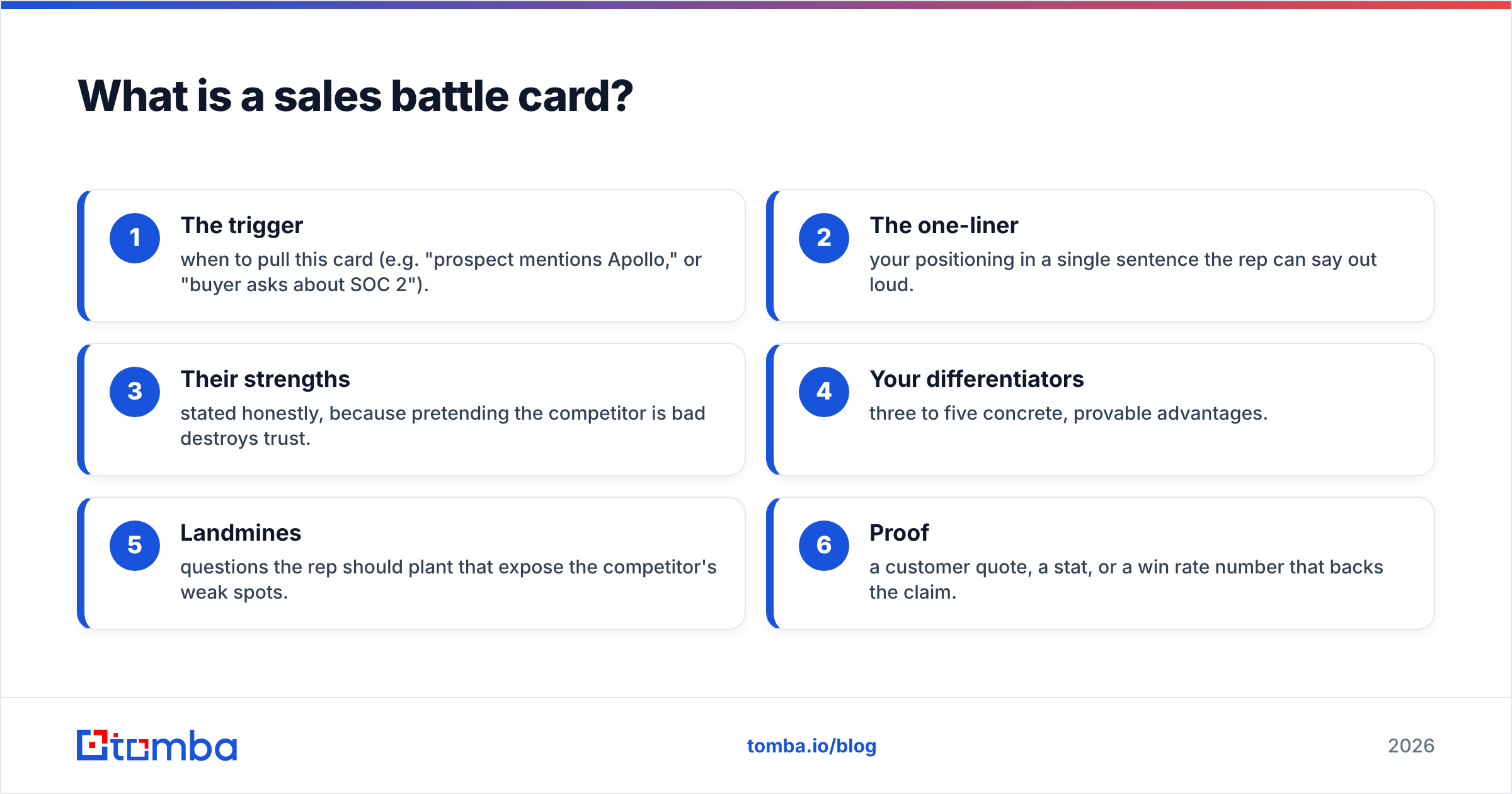
A useful battle card almost always contains these six elements:
- The trigger — when to pull this card (e.g. "prospect mentions Apollo," or "buyer asks about SOC 2").
- The one-liner — your positioning in a single sentence the rep can say out loud.
- Their strengths — stated honestly, because pretending the competitor is bad destroys trust.
- Your differentiators — three to five concrete, provable advantages.
- Landmines — questions the rep should plant that expose the competitor's weak spots.
- Proof — a customer quote, a stat, or a win rate number that backs the claim.
If a card can't fit those six things on a single screen, it's trying to do too much. Split it.
Why do battle cards matter in 2026?#
Buyers now do most of their research before they ever talk to you. By the time a rep is on the call, the prospect has already read G2 reviews, compared pricing pages, and formed opinions. The rep's job shifted from "educate" to "reframe" — and reframing fast requires pre-built ammunition.
According to Gartner research on B2B buying, customers spend only a small fraction of their journey with any single sales rep. That tiny window is where battle cards earn their keep. A rep who fumbles the "why you over them" question wastes the most valuable minutes in the entire cycle.
The other shift is speed of change. Competitors reprice, rebrand, and ship features monthly. A battle card written in 2024 that still quotes a $39 starter price (when the real number moved) doesn't just fail to help — it actively misleads your reps. Freshness is now a feature.
What are the main types of battle cards?#
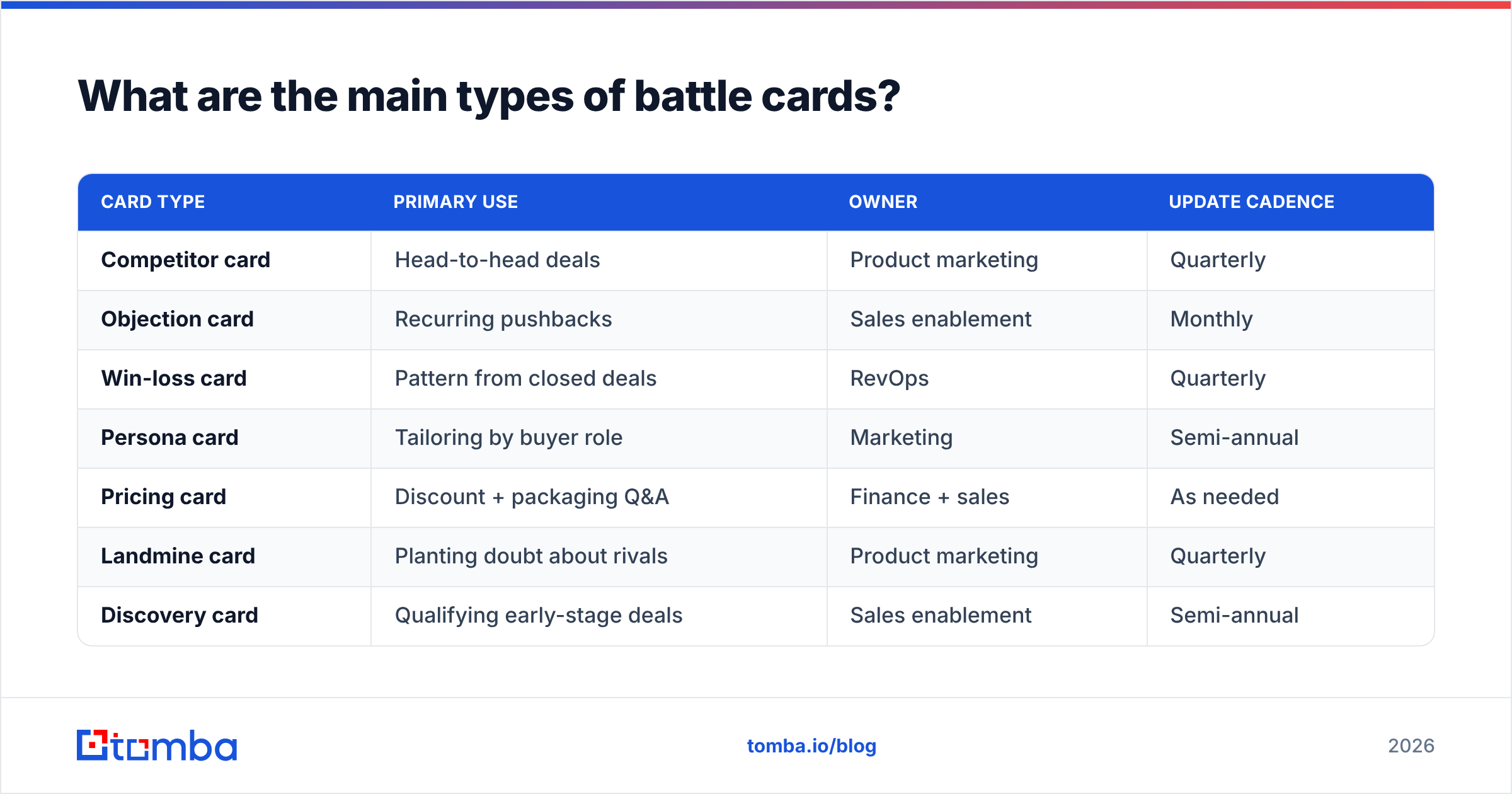
Not every situation needs the same card. Here's how the most common types compare:
| Card type | Primary use | Owner | Update cadence |
|---|---|---|---|
| Competitor card | Head-to-head deals | Product marketing | Quarterly |
| Objection card | Recurring pushbacks | Sales enablement | Monthly |
| Win-loss card | Pattern from closed deals | RevOps | Quarterly |
| Persona card | Tailoring by buyer role | Marketing | Semi-annual |
| Pricing card | Discount + packaging Q&A | Finance + sales | As needed |
| Landmine card | Planting doubt about rivals | Product marketing | Quarterly |
| Discovery card | Qualifying early-stage deals | Sales enablement | Semi-annual |
You don't need all seven on day one. Most teams start with a competitor card and an objection card, then expand as patterns emerge from real calls.
What are the best battle card examples?#
Here are the seven examples in practical form. Copy the structure, swap in your own data.
1. The competitor battle card#
This is the classic. Pick your top rival and build a one-screen face-off.
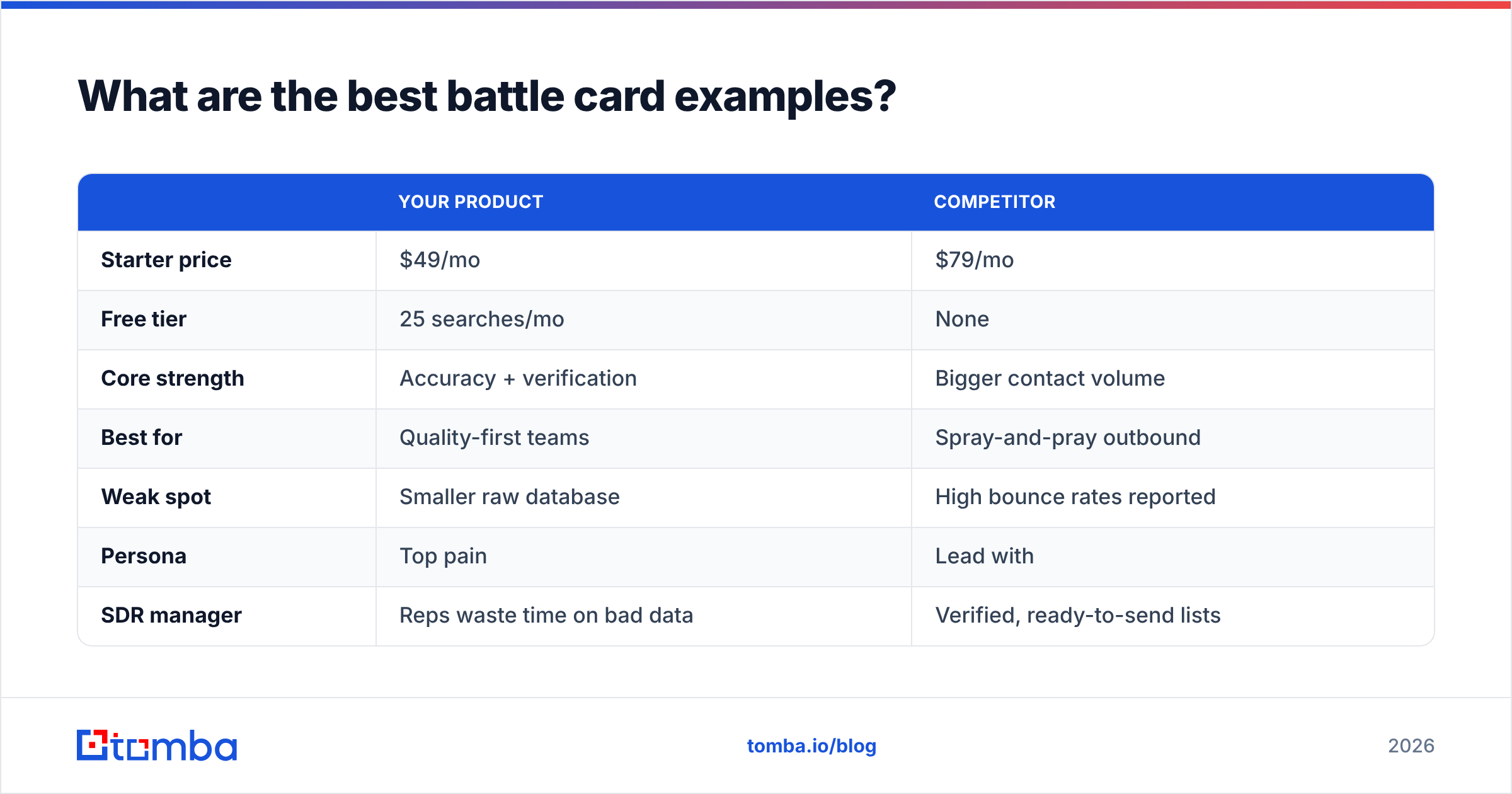
| Your product | Competitor | |
|---|---|---|
| Starter price | $49/mo | $79/mo |
| Free tier | 25 searches/mo | None |
| Core strength | Accuracy + verification | Bigger contact volume |
| Best for | Quality-first teams | Spray-and-pray outbound |
| Weak spot | Smaller raw database | High bounce rates reported |
One-liner: "They give you more rows; we give you rows that actually deliver." The card then lists two landmine questions and one customer quote about bounce rate.
2. The objection-handling card#
Structure every objection card as Objection → Don't say → Do say → Proof.
- Objection: "You're more expensive than the alternative."
- Don't say: "No we're not." (You'll lose a price argument you can't win.)
- Do say: "Cheaper per record, more expensive per usable record. Let's compare bounce rates."
- Proof: A case study showing a higher response rate after switching.
3. The win-loss battle card#
Built from real closed deals, this card summarizes why you won or lost against a specific competitor over the last two quarters. Example summary line: "Won 7/10 when deliverability was a stated priority; lost 6/8 when buyer optimized purely on database size." That single insight tells a rep which deals to lean into.
4. The persona battle card#
Same product, different buyer. A persona card reframes value by role:
| Persona | Top pain | Lead with |
|---|---|---|
| SDR manager | Reps waste time on bad data | Verified, ready-to-send lists |
| RevOps lead | Tool sprawl, messy CRM | API + native integrations |
| Founder | Cost per booked meeting | Free tier to prove ROI first |
5. The pricing battle card#
This one keeps reps consistent on packaging and discounting. It lists each tier, what triggers a discount, and the walk-away floor. Linking the card to your live pricing page prevents the "I think it's around $40?" guesswork that erodes buyer confidence.
6. The landmine card#
A landmine card is purely offensive: it lists questions a rep should ask so the prospect discovers the competitor's weakness on their own. Example: "Ask them what their email bounce rate looks like at scale — then ask how that affects their domain reputation." You never bad-mouth the rival; you let the question do the work.
7. The discovery battle card#
Used early, this card lists the five qualifying questions that predict a good fit, plus the disqualifiers. It keeps reps from burning cycles on deals that pattern-match to past losses.
What should every competitor battle card include?#
If you only build one card, make it the competitor card and make it complete. Use this checklist:
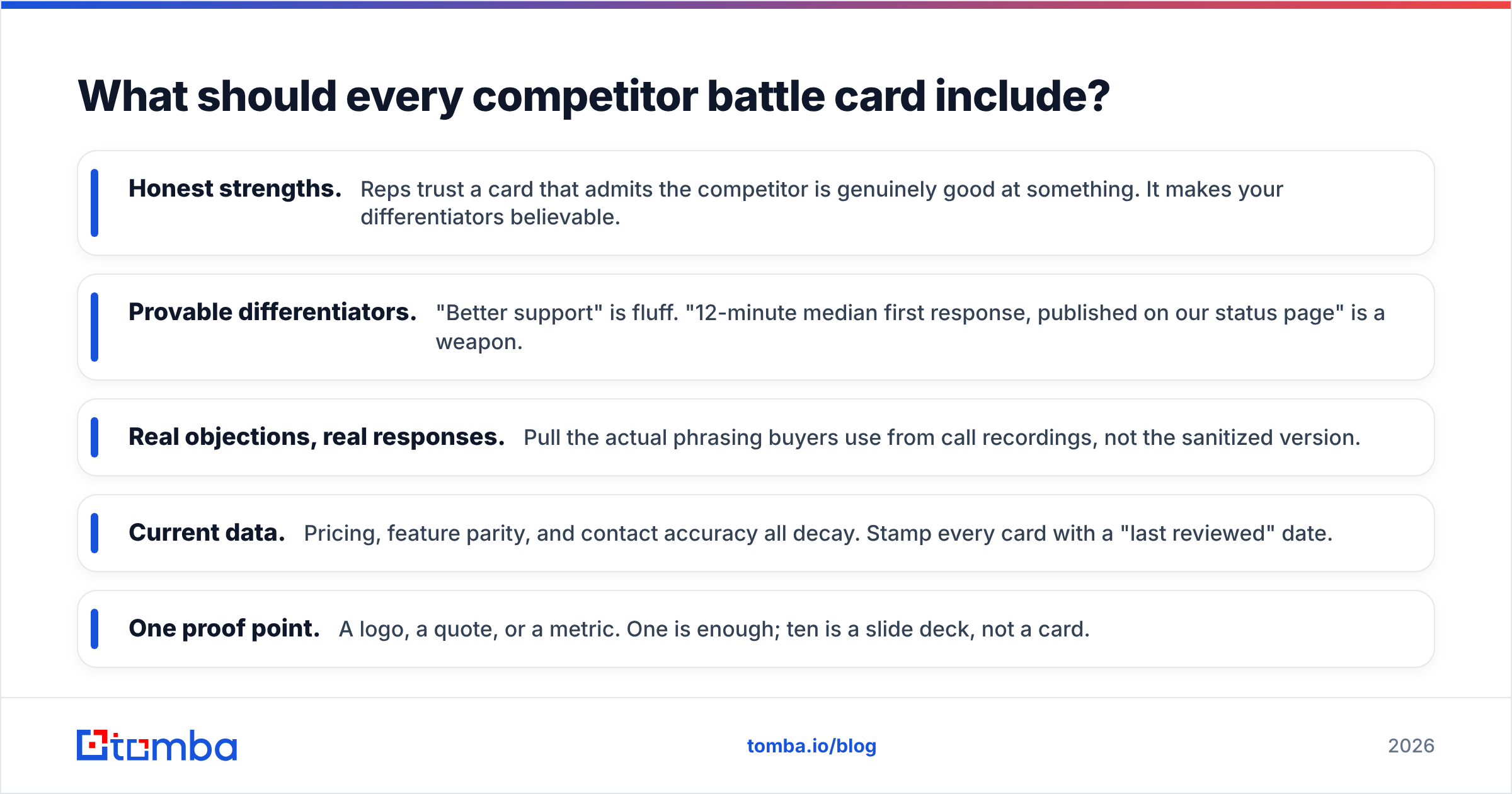
- Honest strengths. Reps trust a card that admits the competitor is genuinely good at something. It makes your differentiators believable.
- Provable differentiators. "Better support" is fluff. "12-minute median first response, published on our status page" is a weapon.
- Real objections, real responses. Pull the actual phrasing buyers use from call recordings, not the sanitized version.
- Current data. Pricing, feature parity, and contact accuracy all decay. Stamp every card with a "last reviewed" date.
- One proof point. A logo, a quote, or a metric. One is enough; ten is a slide deck, not a card.
The fastest way to lose a rep's trust is a card that's wrong. If a prospect corrects your rep on the competitor's current pricing, the rep stops using the card entirely — and you're back to Slack-message-three-hours-later.
Where does battle card data come from?#
A battle card is only as good as the intelligence behind it. The "what to say" comes from your enablement and product marketing teams. The "who and where" — accurate contacts, company firmographics, and current org structures — comes from your data layer.
This is where a lot of cards quietly rot. Your persona card assumes you're reaching the RevOps lead, but if your contact data is stale, the rep is emailing someone who left eight months ago. Keeping a clean B2B database underneath your enablement content is the unglamorous half of competitive selling.
Teams typically blend three sources:
- First-party CRM history — your own win-loss patterns and call notes.
- Public competitive signals — pricing pages, HubSpot-style review aggregators, changelogs, and job postings that hint at roadmap.
- Verified contact and company data — so the rep reaches the right buyer with the right card. An email finder plus verification keeps outreach landing while your battle card handles the conversation.
How do you build a battle card reps actually use?#
Most battle cards die in a Google Drive folder nobody opens. Here's how to keep yours alive:
| Failure mode | Fix |
|---|---|
| Too long | One screen, max. Split multi-purpose cards. |
| Out of date | Assign an owner and a quarterly review date. |
| Hard to find | Embed in the CRM where the rep already works. |
| Too generic | Use real buyer quotes and exact competitor numbers. |
| No proof | Attach one metric or customer story per claim. |
Start small. Build the two cards you need most — usually your top competitor and your most common objection — and ship them rough. A rough card in front of a rep on a live call beats a perfect card that's still in review. Iterate from the calls themselves: every time a rep gets stumped, that's the next card.
One more discipline: kill cards that don't get used. If a card hasn't been opened in a quarter, either the situation isn't real or the card is bad. Both are reasons to delete it. A lean deck of cards reps trust beats a sprawling library they ignore.
Frequently asked questions#
How many battle cards should a sales team have? Fewer than you think. Start with one competitor card and one objection card. Most healthy teams stabilize around five to ten cards covering their top rivals and recurring objections. Past that, reps stop reading.
Who should own battle cards? Product marketing usually owns competitor and landmine cards; sales enablement owns objection and discovery cards; RevOps owns win-loss. The key is that someone owns each card's review date — ownerless cards go stale.
How often should battle cards be updated? Competitor and pricing cards need at least a quarterly review because rivals reprice and ship features constantly. Objection cards can update monthly as new pushbacks surface from calls. Stamp every card with a "last reviewed" date.
What's the difference between a battle card and a sales playbook? A playbook is the whole strategy — process, stages, messaging, the full book. A battle card is a single page for a single moment. You consult a playbook between calls; you glance at a battle card during one.
Build your cards on accurate data#
The seven examples above give you the structure. The thing that makes them win deals — and not just fill a folder — is accuracy. A persona card pointed at the wrong contact, or a competitor card quoting last year's price, costs you the credibility you built the card to protect.
Get the data layer right first. Use the Tomba Email Finder to reach the exact buyer your persona card targets, verify before you send so your outreach actually lands, and keep your contact records current so reps spend their energy on the conversation instead of the lookup. Start free with 25 searches a month, then scale to the Starter plan at $49/mo when your battle cards start closing. The card tells your rep what to say; clean data makes sure the right person is on the other end to hear it.
// get started
Find, verify and enrich your first contacts today
Start on the free plan with 25 searches a month, then scale when your team is ready.
Free plan · No credit card required · GDPR & CCPA
// about the author