11 Best Cold Email Examples That Get Replies in 2026
The best cold email examples aren't clever — they're relevant. Here are 11 templates that book meetings, plus the exact structure behind each one.
You can find a hundred "best cold email examples" lists online. Most hand you a clever subject line and a witty opener, then leave out the part that actually decides whether you get a reply: who you sent it to and why it was relevant to them. This guide fixes that. Below are 11 cold email examples that consistently book meetings, each with a structure breakdown you can copy — plus the data and deliverability work that makes them land.
TL;DR#
- The best cold email examples are short, specific, and built on one clear trigger — a hiring signal, a funding round, a competitor mention, a website visit.
- Subject lines under 5 words and 50–125 word bodies outperform long, ornate pitches in nearly every reply-rate study.
- A single, low-friction call to action ("worth a chat?") beats stacking a calendar link, a deck, and a demo ask in one send.
- Personalization only works on accurate data. A perfect template sent to a guessed, bouncing address gets you nothing — verified contacts come first.
- Use the templates below as skeletons, not scripts. Swap in a real observation about the prospect and you have a sendable email in two minutes.
What makes a cold email "good" in 2026?#
A good cold email earns a reply because it is relevant, fast to read, and easy to say yes to. That's the whole game. Buyers are drowning in automated outreach, so the bar is no longer "polished" — it's "obviously written for me."
Think of cold email like knocking on a stranger's door. If you open with a five-minute monologue about your company, the door closes. If you say, "I noticed your team just posted three SDR roles — I help teams ramp new reps faster, worth 10 minutes?" you get a conversation. Same product, completely different result.
Three things separate the best cold email examples from the spam folder:
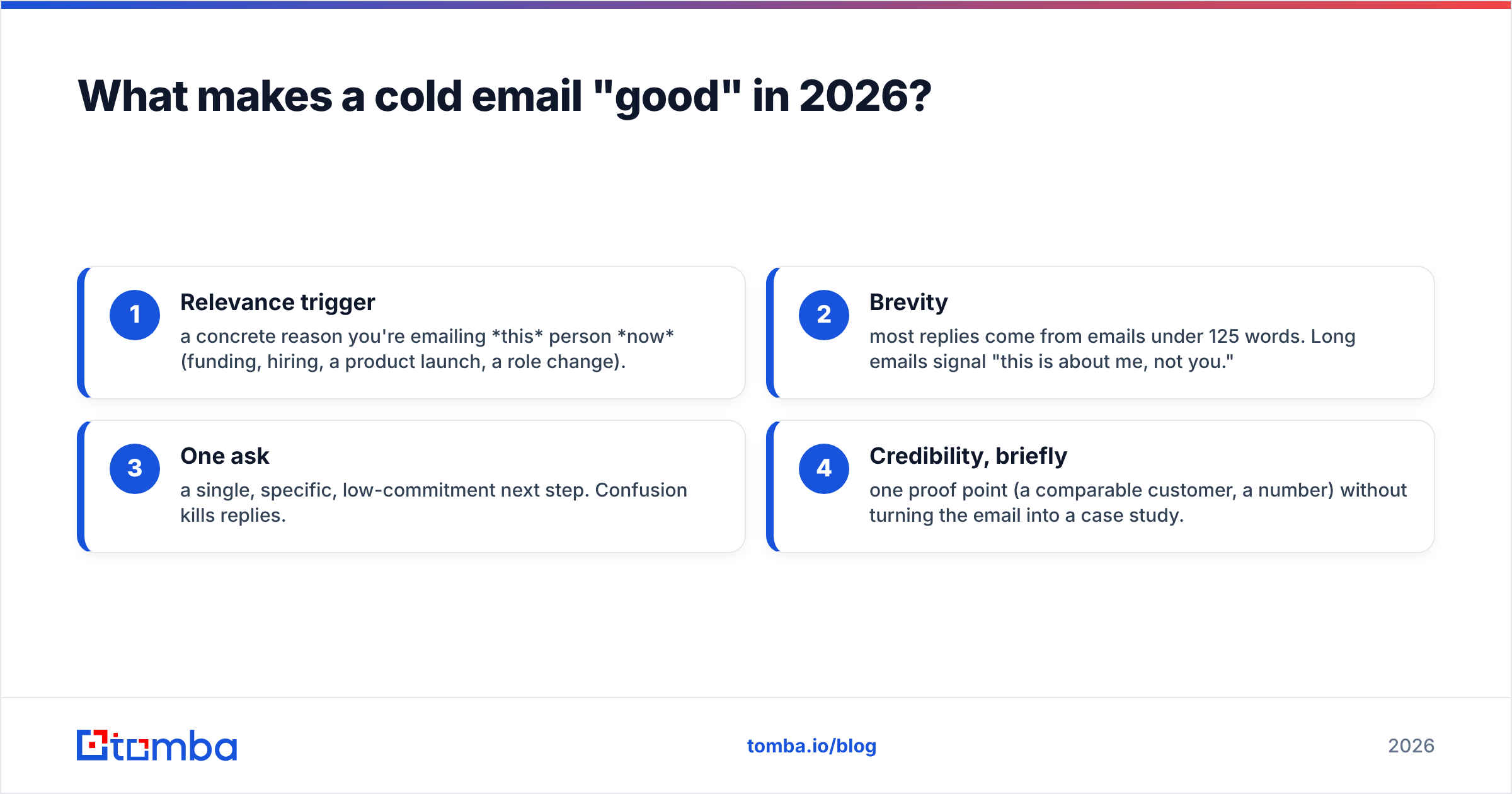
- Relevance trigger — a concrete reason you're emailing this person now (funding, hiring, a product launch, a role change).
- Brevity — most replies come from emails under 125 words. Long emails signal "this is about me, not you."
- One ask — a single, specific, low-commitment next step. Confusion kills replies.
- Credibility, briefly — one proof point (a comparable customer, a number) without turning the email into a case study.
Before any of that matters, though, the email has to reach a real inbox. That's where most campaigns quietly fail.
Why does data quality decide whether your examples work?#
Because the cleverest copy in the world bounces off a dead address. If 20% of your list is invalid or guessed, you're not running a cold email campaign — you're slowly torching your sender reputation. Mailbox providers watch bounce rates closely, and a spike pushes even your good emails to spam.
Here's the order of operations the best senders follow:
- Find accurate addresses. Use a real source, not a permutation tool that guesses
first.last@. Tomba's email finder pulls professional addresses from verified public sources rather than guessing patterns. - Verify before sending. Run the list through an email verifier to strip invalids and catch-alls. This single step protects your sender reputation more than any subject-line tweak.
- Enrich for personalization. Pull role, company size, and recent signals so your "relevance trigger" is real, not invented. Data enrichment turns a bare email into a sendable, personalized message.
A template is a vessel. Data is the fuel. The examples below assume you've done this part.
What are the best cold email examples? (11 templates)#
Each example includes the subject line, the body, and why it works. Replace the bracketed parts with a real observation — never send these verbatim.
1. The trigger-event email#
Subject: congrats on the raise
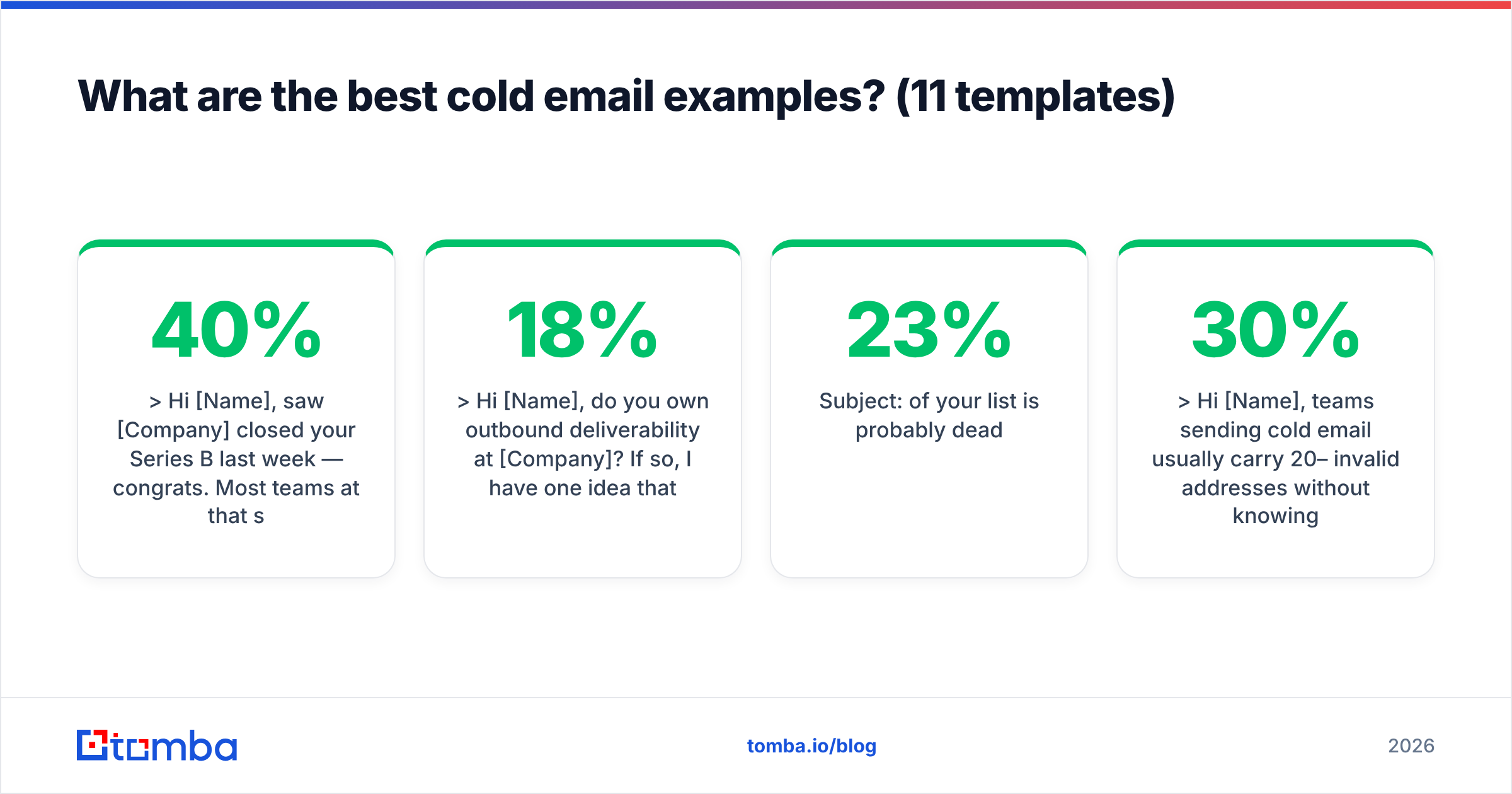
Hi [Name], saw [Company] closed your Series B last week — congrats. Most teams at that stage hit a wall scaling outbound past the founding AEs. We helped [Comparable Company] add 40% pipeline without adding headcount. Worth a quick chat next week?
Why it works: The funding round is a real, time-sensitive trigger. You're not selling — you're connecting a known pain at their exact stage to a proof point.
2. The "noticed your job posting" email#
Subject: your open SDR roles
Hi [Name], noticed [Company] is hiring three SDRs. Ramp time is usually the hidden cost there — new reps take ~4 months to hit quota. We cut that to under 8 weeks for [Customer]. Open to seeing how?
Why it works: Hiring signals are gold. They tell you the buyer has a budget and a fresh, urgent problem.
3. The competitor-switch email#
Subject: switching off [Competitor]?
Hi [Name], a lot of [Industry] teams have moved from [Competitor] to us this year, usually over [specific gap]. Not assuming you're unhappy — but if data accuracy is ever a headache, I'd love 10 minutes.
Why it works: It names a real alternative and a specific gap, which signals you understand their stack.
4. The short-and-direct email#
Subject: quick question
Hi [Name], do you own outbound deliverability at [Company]? If so, I have one idea that lifted reply rates ~18% for a similar team. Happy to share — interested?
Why it works: Under 40 words. It respects time and asks one easy question. See more in our breakdown of cold email templates.
5. The "I read your post" email#
Subject: your take on [topic]
Hi [Name], your LinkedIn post on [topic] nailed something most teams miss. We built [product] around that exact problem. No pitch — would value your perspective on a 15-min call.
Why it works: Genuine engagement with their content. The "I value your view" framing flips the power dynamic.
6. The mutual-connection email#
Subject: [Mutual Name] suggested I reach out
Hi [Name], [Mutual] mentioned you're rethinking how [Company] sources B2B data. We work with teams like yours on exactly that. Worth comparing notes?
Why it works: Borrowed trust. A warm referent, even a loose one, raises reply rates sharply.
7. The data-point email#
Subject: 23% of your list is probably dead
Hi [Name], teams sending cold email usually carry 20–30% invalid addresses without knowing it — which quietly tanks deliverability. We clean lists in bulk. Want a free sample audit of yours?
Why it works: A surprising, specific number creates curiosity and offers value before asking for anything.
8. The "wrong person?" email#
Subject: are you the right person?
Hi [Name], I'm trying to reach whoever owns [function] at [Company]. If that's not you, could you point me the right way? If it is — I have something relevant to share.
Why it works: Disarmingly honest. It often gets a forward or a "that's me, what is it?"
9. The case-study email#
Subject: how [Customer] did [result]
Hi [Name], [Customer], a [similar company], lifted [metric] by [number] in [timeframe]. The play maps almost directly to [Company]. Want the one-page breakdown?
Why it works: Specific, comparable, and the CTA asks for a document, not a meeting — lower friction.
10. The break-up email#
Subject: closing the loop
Hi [Name], I've reached out a few times and don't want to clutter your inbox. I'll assume the timing's off and close this out — but if [problem] becomes a priority, you know where to find me.
Why it works: Loss aversion. Break-up emails frequently outperform the original send because they remove pressure.
11. The hyper-personalized one-liner#
Subject: [specific detail]
Hi [Name], saw [Company] just launched [feature]. We help teams turn launches like that into pipeline within 30 days. 10 minutes this week?
Why it works: It proves you did homework in one sentence, then gets straight to the ask.
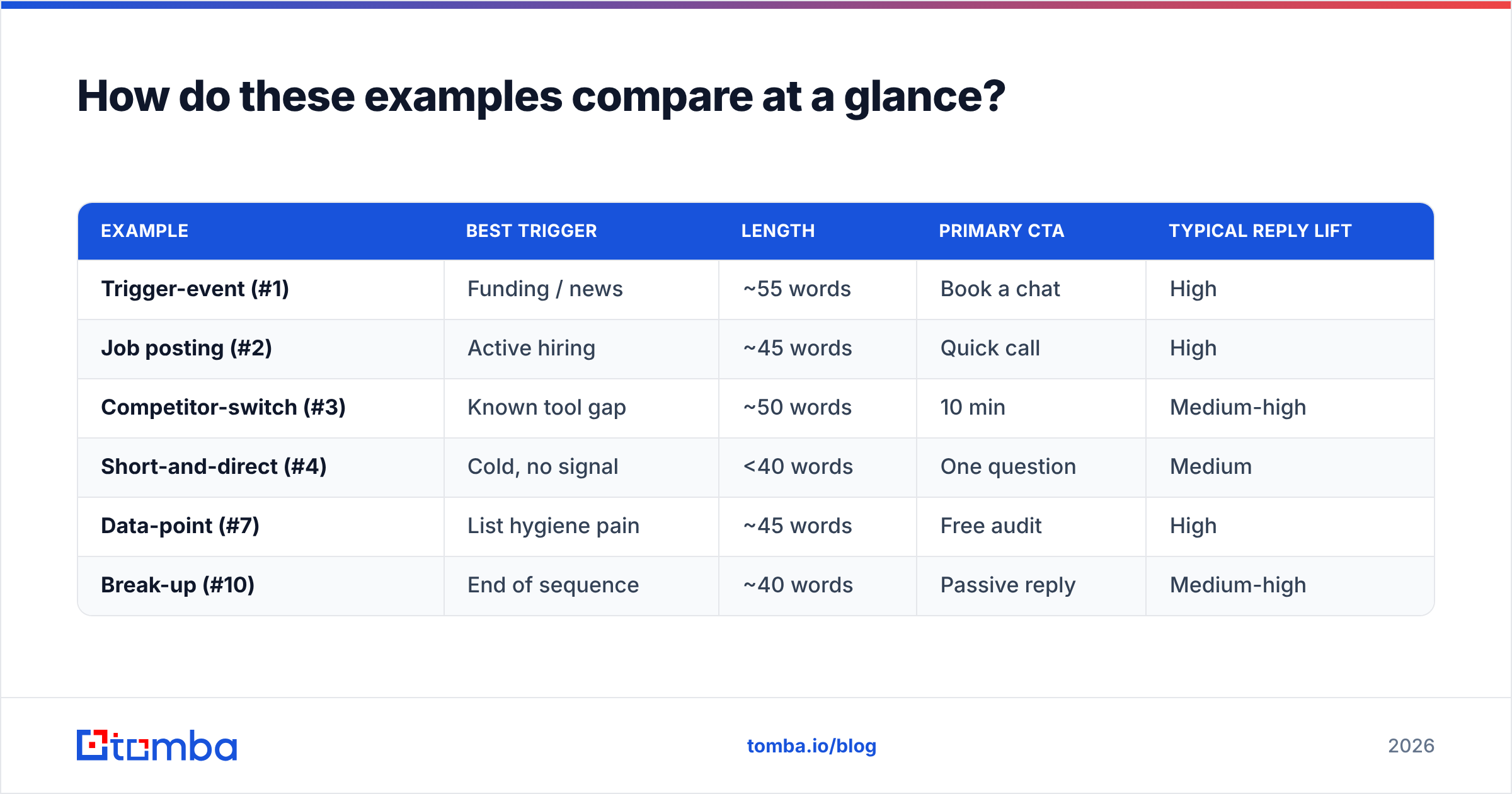
How do these examples compare at a glance?#
Different examples fit different moments in your sequence. Use this as a quick selector:
| Example | Best trigger | Length | Primary CTA | Typical reply lift |
|---|---|---|---|---|
| Trigger-event (#1) | Funding / news | ~55 words | Book a chat | High |
| Job posting (#2) | Active hiring | ~45 words | Quick call | High |
| Competitor-switch (#3) | Known tool gap | ~50 words | 10 min | Medium-high |
| Short-and-direct (#4) | Cold, no signal | <40 words | One question | Medium |
| Data-point (#7) | List hygiene pain | ~45 words | Free audit | High |
| Break-up (#10) | End of sequence | ~40 words | Passive reply | Medium-high |
The pattern is clear: the strongest performers pair a real trigger with a tiny ask. Generic, signal-free emails (like #4) still work as fillers, but they should never be your opener to a high-value account.
How should you structure any cold email?#
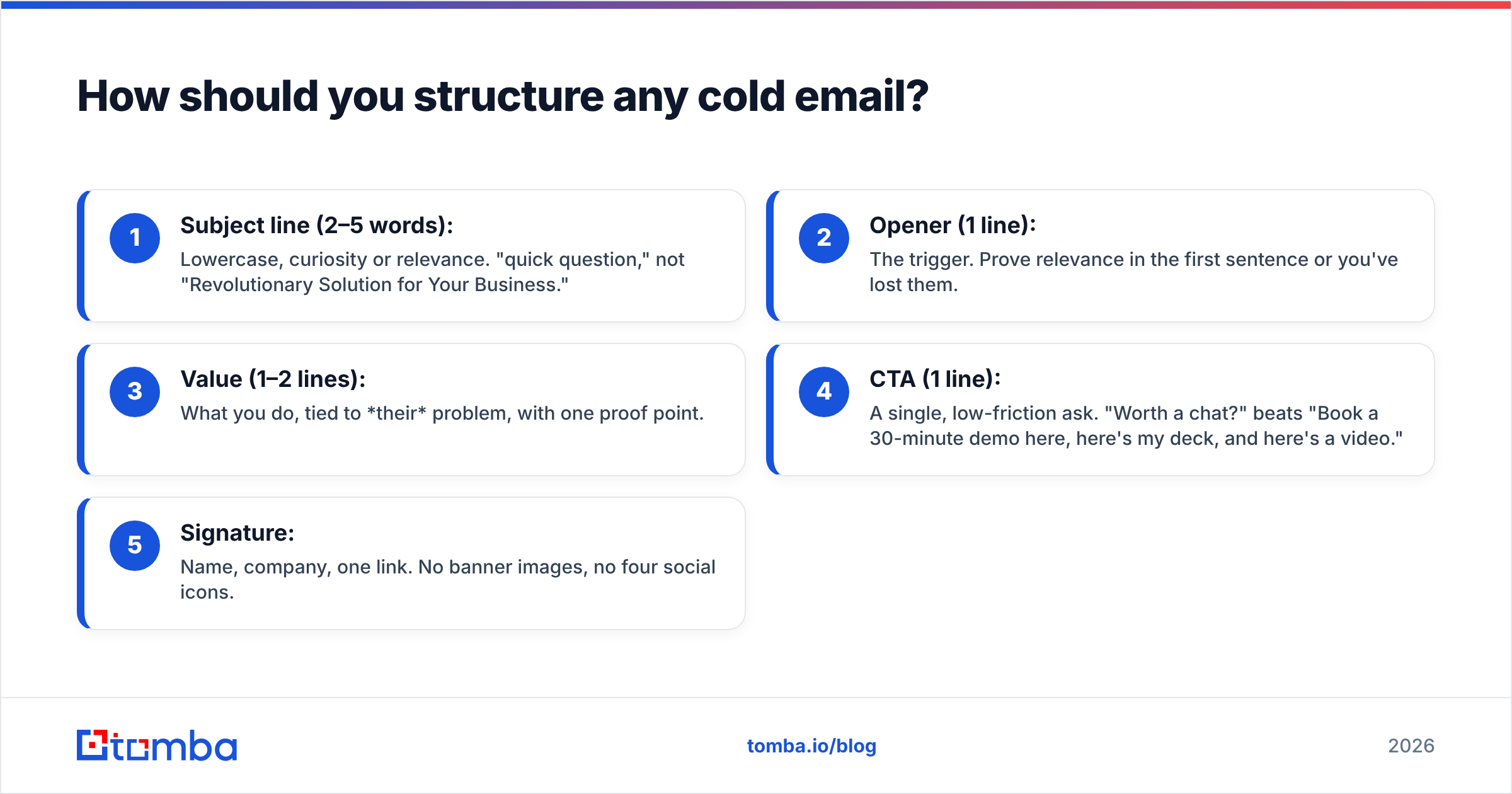
Every example above follows the same five-part skeleton. Internalize this and you can write a sendable email about anything:
- Subject line (2–5 words): Lowercase, curiosity or relevance. "quick question," not "Revolutionary Solution for Your Business."
- Opener (1 line): The trigger. Prove relevance in the first sentence or you've lost them.
- Value (1–2 lines): What you do, tied to their problem, with one proof point.
- CTA (1 line): A single, low-friction ask. "Worth a chat?" beats "Book a 30-minute demo here, here's my deck, and here's a video."
- Signature: Name, company, one link. No banner images, no four social icons.
Keep the whole thing scannable on a phone without scrolling. If you need a subject-line head start, the subject line generator and cold email AI tools draft variants you can test.
What mistakes kill cold email reply rates?#
Even great templates fail when paired with these habits. Avoid them:
- Guessing addresses. Permutators produce a lot of
john.smith@guesses that bounce. Always verify. - Front-loading your company. "We are a leading platform..." in line one is an instant delete. Lead with them.
- Multiple CTAs. A demo link and a calendar and a deck splits attention and lowers action.
- No follow-up. Most replies come from emails 2–4, not the first send. One-and-done outreach wastes your list.
- Ignoring deliverability. Authenticate your domain and warm it up. A perfect email in the spam folder is worth zero. Check your setup with an SPF checker and review email deliverability basics before scaling.
For broader benchmarks on what "good" looks like, HubSpot's annual sales statistics and the cold-email reviews on G2 are useful neutral references. Vendor docs like Google's Postmaster Tools are the authority on how providers actually judge your sending.
How many follow-ups should a cold sequence have?#
Three to four touches over 10–14 days is the sweet spot for most B2B sequences. Each follow-up should add a new angle — a fresh proof point, a different trigger, or the break-up email (#10) — not just "bumping this to the top of your inbox." A polite cadence respects the prospect while accounting for the simple reality that people are busy and miss the first email.
Track your response rate per step so you know which message in the sequence is actually pulling its weight. If step one drives most replies, your targeting is sharp. If the break-up email outperforms, your earlier asks were probably too heavy.
Put the best cold email examples to work#
The templates above are only half the equation. The other half — the half that decides whether any of them get read — is reaching real, verified people at the right moment. Start by building a clean, accurate list with Tomba's Email Finder: find professional addresses by name, company, or domain, verify them, and enrich each contact with the role and signal data that makes your "relevance trigger" genuine. You can begin on the free tier (25 searches a month) and scale up through the Starter plan at $49/mo as your outreach grows — full Tomba pricing is transparent and credit-based. Get the data right, drop in the right template, and your cold emails stop being ignored and start booking meetings.
// get started
Find, verify and enrich your first contacts today
Start on the free plan with 25 searches a month, then scale when your team is ready.
Free plan · No credit card required · GDPR & CCPA
// about the author