Best Sales Prospecting Strategies and Tools for 2026
Prospecting isn't about more activity — it's about better data and tighter targeting. Here's the 2026 playbook for finding, qualifying, and reaching buyers who actually convert.
Prospecting is the part of sales everyone claims to hate and nobody can skip. The reps hitting quota in 2026 aren't sending more emails than you — they're sending fewer, to the right people, with cleaner data behind every send. This guide breaks down what "best sales prospecting" actually means today, the methods that still work, and how to build a stack that fills your pipeline without torching your sender reputation.
TL;DR#
- Targeting beats volume. A 200-contact list matched to your ICP outperforms a 5,000-contact blast every quarter.
- Data quality is the whole game. Bad emails cause bounces, bounces kill deliverability, and dead deliverability means even your perfect pitch never lands.
- Multi-channel is the default now — email, phone, and LinkedIn working together, not email alone.
- Tooling splits into three jobs: find contacts, verify them, and sequence the outreach. Don't pay one bloated platform to do all three badly.
- Tomba covers the find-and-verify half cheaply (free tier, then $49/mo), so your budget goes to the sequencing and signal tools that actually need it.
What is sales prospecting in 2026?#
Sales prospecting is the work of identifying and reaching potential buyers before they raise their hand. Think of it like fishing: you can drag a net through the whole ocean and exhaust yourself sorting trash from fish, or you can learn where your fish school and cast there. Modern prospecting is all about the second approach.
The shift over the last few years is simple — buyers got harder to reach and more annoyed by bad outreach. Inbox providers tightened spam filters, LinkedIn throttled automation, and prospects learned to smell a mail-merge from the subject line. The reps who win now treat every touch as expensive and spend their effort up front, on research and data, instead of downstream on volume.
That makes prospecting less of a numbers grind and more of a precision exercise. You still need scale, but scale applied to a qualified universe, not a scraped one.
What are the best sales prospecting methods?#
There's no single best channel — the best prospecting system combines a few, sequenced deliberately. Here are the methods carrying weight in 2026:
- ICP-driven list building. Start from a written ideal customer profile (industry, headcount, tech stack, trigger events) and build lists to it. Everything downstream depends on this filter.
- Email outreach with verified data. Still the highest-leverage channel per hour, but only if your list is clean. One bad batch can tank your domain for weeks.
- Phone and cold calling. Underused because it's uncomfortable, which is exactly why it works — a connected call converts several times better than a cold email.
- LinkedIn and social selling. Warm the account before the ask. Comment, connect, then reach out. Social selling shortens the gap between stranger and meeting.
- Intent and trigger signals. Job changes, funding rounds, new hires, and website visits tell you when to reach out — timing beats persistence.
The mistake most teams make is running these as separate motions. A strong prospecting play uses all of them in a single coordinated sequence: a LinkedIn view, then a verified email, then a call, then a follow-up — same prospect, four touches, one story.
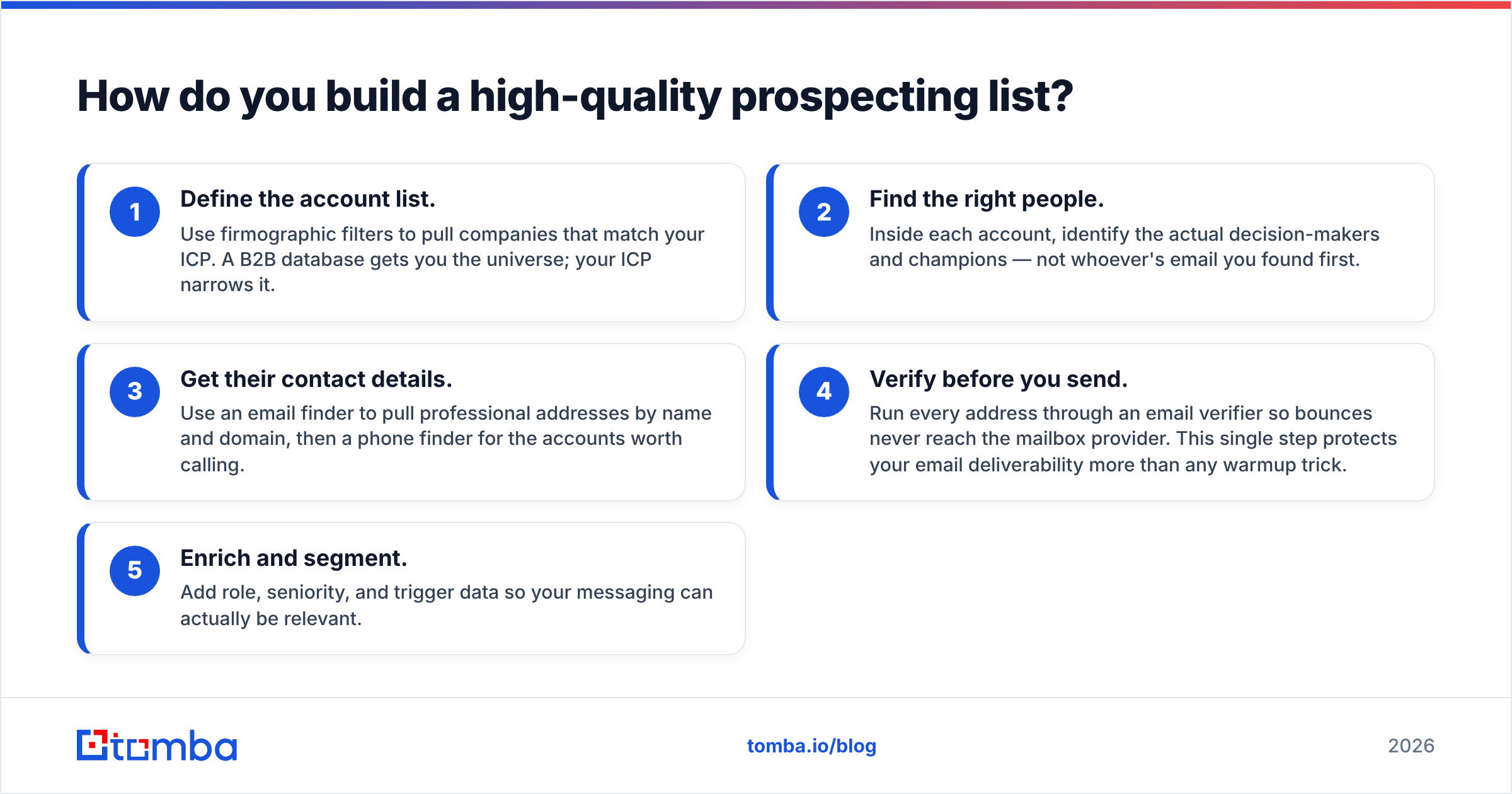
How do you build a high-quality prospecting list?#
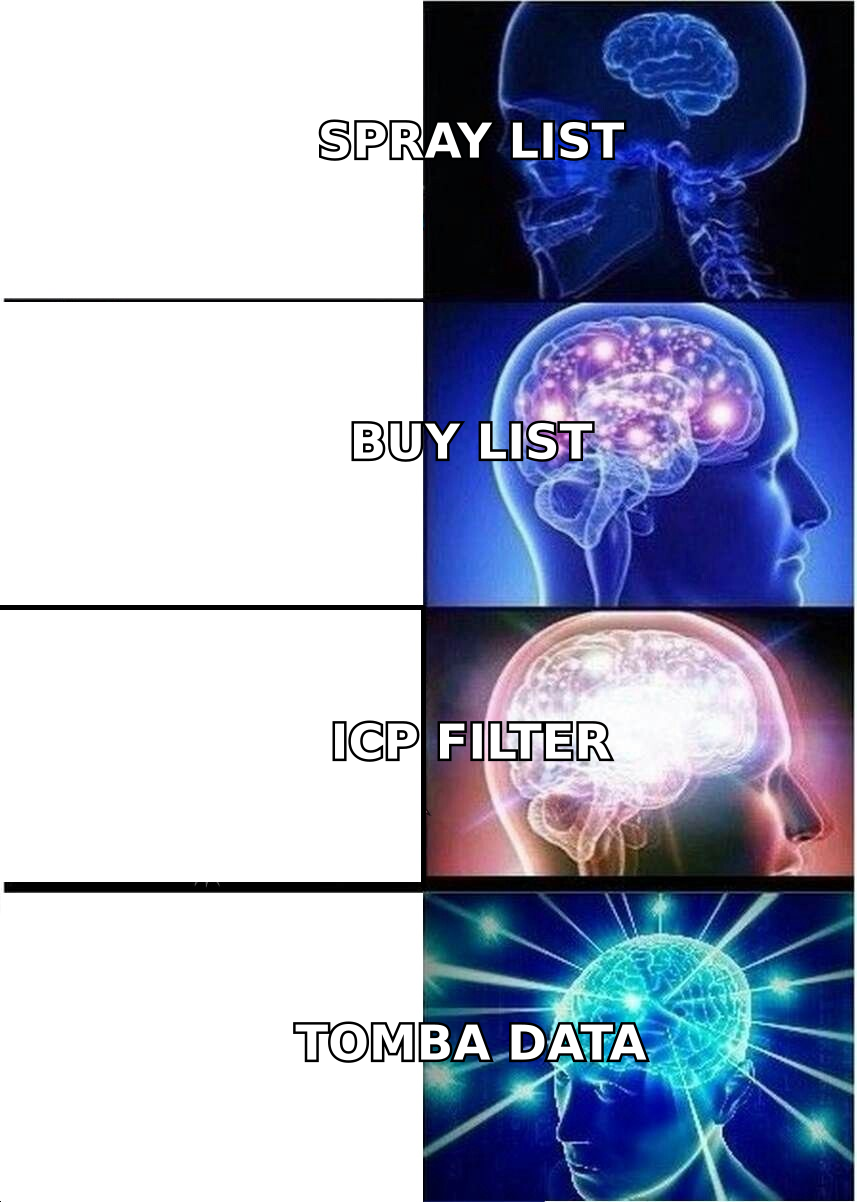
Conclusion first: your list is only as good as the data underneath it, so spend most of your prospecting time here. A clean list of 300 named buyers will out-book a purchased list of 10,000 every single time.
The workflow that holds up:
- Define the account list. Use firmographic filters to pull companies that match your ICP. A B2B database gets you the universe; your ICP narrows it.
- Find the right people. Inside each account, identify the actual decision-makers and champions — not whoever's email you found first.
- Get their contact details. Use an email finder to pull professional addresses by name and domain, then a phone finder for the accounts worth calling.
- Verify before you send. Run every address through an email verifier so bounces never reach the mailbox provider. This single step protects your email deliverability more than any warmup trick.
- Enrich and segment. Add role, seniority, and trigger data so your messaging can actually be relevant.
The reason verification matters so much: mailbox providers track your bounce rate as a trust signal. A bounce rate above 2-3% tells Gmail and Outlook you're working a dirty list, and they start routing you to spam — including the messages to valid prospects. You can write the best cold email of your career and never know it failed because the gatekeeper filtered it before a human saw it.
What tools do you need for prospecting?#
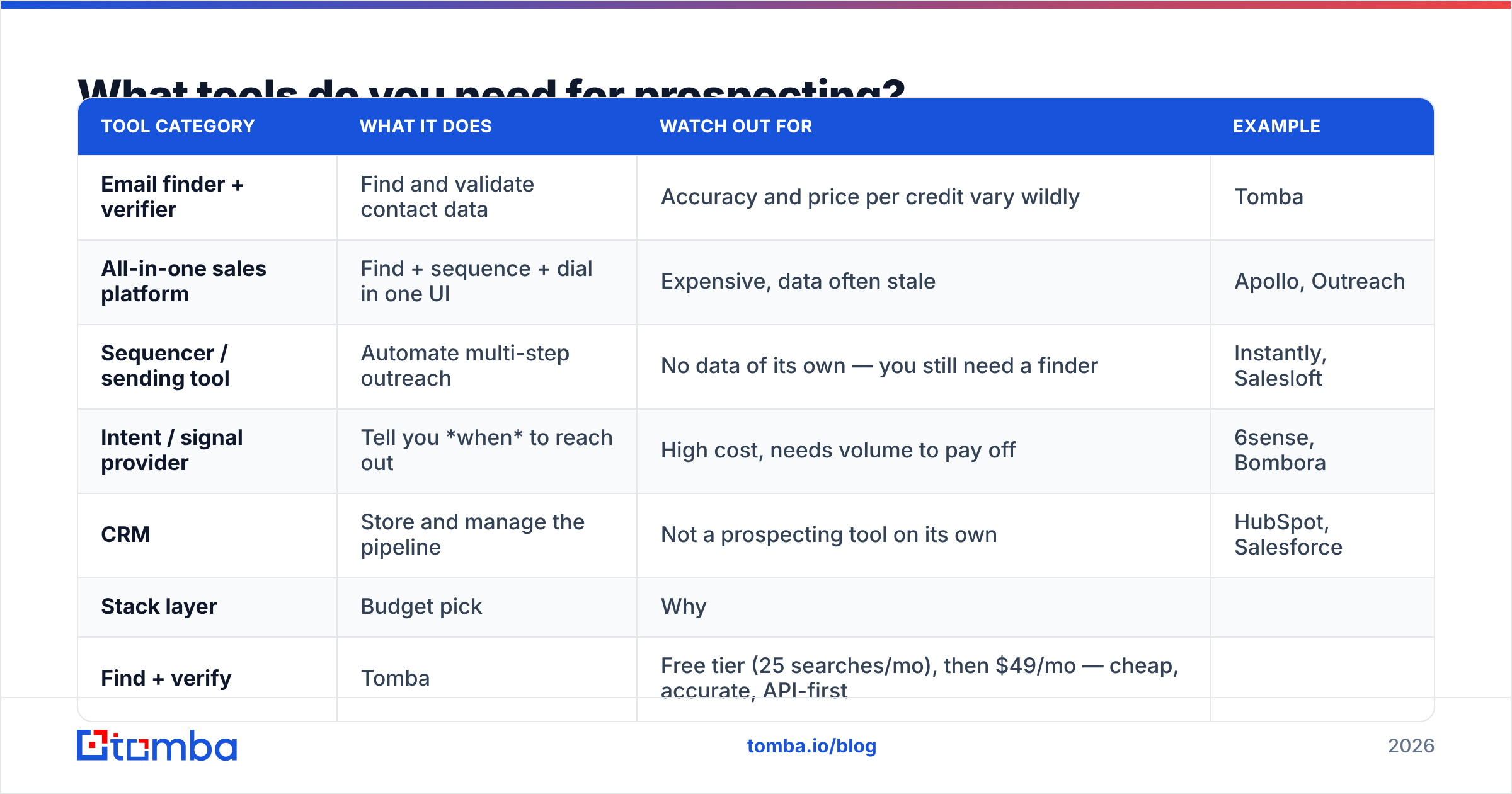
You need three jobs covered: finding contacts, verifying them, and sequencing the outreach. Some platforms bundle all three, but bundles usually mean you overpay for the weakest module. Here's how the main categories compare.
| Tool category | What it does | Watch out for | Example |
|---|---|---|---|
| Email finder + verifier | Find and validate contact data | Accuracy and price per credit vary wildly | Tomba |
| All-in-one sales platform | Find + sequence + dial in one UI | Expensive, data often stale | Apollo, Outreach |
| Sequencer / sending tool | Automate multi-step outreach | No data of its own — you still need a finder | Instantly, Salesloft |
| Intent / signal provider | Tell you when to reach out | High cost, needs volume to pay off | 6sense, Bombora |
| CRM | Store and manage the pipeline | Not a prospecting tool on its own | HubSpot, Salesforce |
A practical, cost-aware stack for most teams in 2026 looks like this:
| Stack layer | Budget pick | Why |
|---|---|---|
| Find + verify | Tomba | Free tier (25 searches/mo), then $49/mo — cheap, accurate, API-first |
| Sequence | Instantly or Saleshandy | Purpose-built sending with inbox rotation |
| Dial | Any VoIP + verified numbers | Phone still converts best |
| CRM | HubSpot free or Pipedrive | Keep the pipeline clean |
| Signals (optional) | Website visitor reveal | Catch in-market accounts early |
The point of splitting it up: you stop paying enterprise prices for an all-in-one whose contact data is two years stale. Compare the math against any Apollo alternative and the savings on the data layer alone usually fund your entire sending tool.
For teams already in HubSpot or Salesforce, the data layer should feed straight in — Tomba's HubSpot integration and Salesforce integration push verified contacts into the CRM so reps aren't copy-pasting between tabs.
How do you measure prospecting effectiveness?#
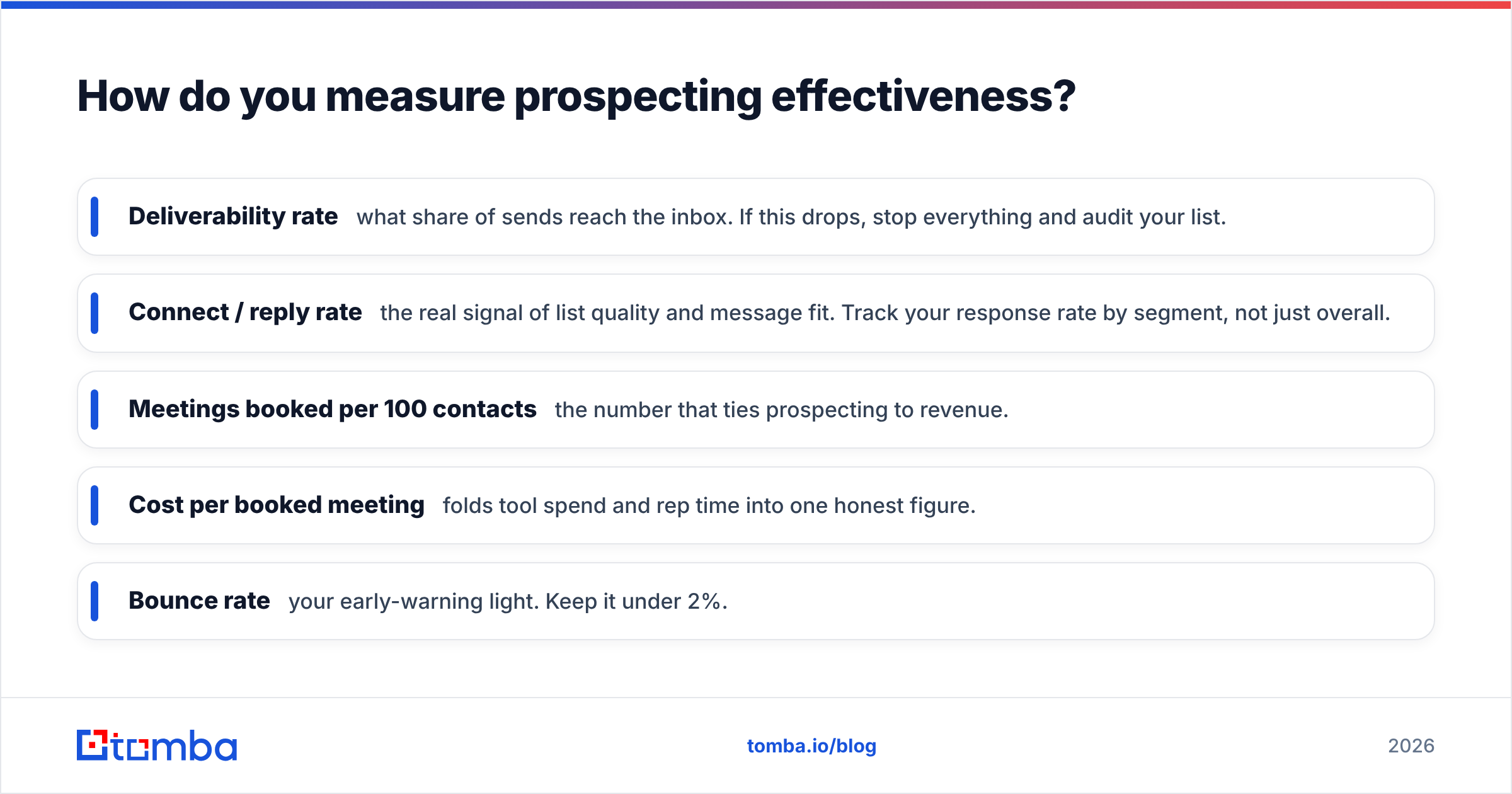
Activity metrics lie. "200 emails sent" tells you nothing if 40 bounced and 100 went to spam. Measure the outcomes that actually move pipeline:
- Deliverability rate — what share of sends reach the inbox. If this drops, stop everything and audit your list.
- Connect / reply rate — the real signal of list quality and message fit. Track your response rate by segment, not just overall.
- Meetings booked per 100 contacts — the number that ties prospecting to revenue.
- Cost per booked meeting — folds tool spend and rep time into one honest figure.
- Bounce rate — your early-warning light. Keep it under 2%.
When a campaign underperforms, the cause is almost always upstream: wrong ICP, stale data, or unverified emails. Fix the list before you rewrite the copy. According to G2's category data, data accuracy is the single most cited differentiator in buyer reviews of prospecting tools — ahead of features, UI, or price.
Is more outreach always better?#
No — and this is the trap most teams fall into. Conclusion first: past a point, more volume reduces your results because it degrades your sender reputation and trains prospects to ignore you.
Here's the mechanism. Every send from a new or warming domain spends a little of your reputation. Send to verified, engaged prospects and you build trust; the inbox provider learns your mail is wanted. Blast a scraped list and you burn it — spam complaints and bounces pile up, and the provider quietly starts filtering everything you send. The cruel part is you won't see it. Your open rates just slowly fade while you assume the market went cold.
This is why the "best sales prospecting" approach in 2026 is counterintuitively about doing less, better. Fewer accounts, deeper research, cleaner data, more personalization per touch. A rep working 50 well-researched accounts a week will consistently beat one spraying 500 — not because they work harder, but because every touch lands and every send protects the channel for the next one.
Quality compounds. Volume on a dirty list decays. Pick the side that compounds.
How does Tomba fit into a prospecting workflow?#
Tomba owns the part of the workflow everything else depends on: getting accurate, verified contact data into your pipeline before you spend a cent on sequencing or dialing.
The typical flow: use domain search to pull every relevant contact at a target company, the email finder to get specific decision-makers by name, and the email verifier to confirm each address is live before it ever hits your sender. For higher-volume teams, the bulk email finder processes whole account lists at once, and the Tomba API wires the whole thing into your existing automation.
Because the free tier covers 25 searches a month and paid plans start at $49/mo, you can validate the workflow before committing budget — then scale on the Growth or Pro plans as your list grows. The data layer stays cheap so the rest of your stack gets the budget it actually needs.
Start prospecting on cleaner data. Spin up a free Tomba account, run your next target account through the Tomba Email Finder, and watch your bounce rate drop on the very first campaign. Better data in means more meetings out — that's the whole equation, and it starts with the list.
// get started
Find, verify and enrich your first contacts today
Start on the free plan with 25 searches a month, then scale when your team is ready.
Free plan · No credit card required · GDPR & CCPA
// about the author