Best Time To Send Prospecting Emails: 2026 Data Guide
Tuesday 8 AM or Thursday 4 PM? Here is what the 2026 data actually says about the best time to send prospecting emails — plus how to find your own window.

Ask ten sales reps when to send a cold email and you'll get ten confident, contradictory answers. "Tuesday morning." "Never on Monday." "Right after lunch." Most of those are gut feel dressed up as strategy. The truth is that the best time to send prospecting emails is a moving target that depends on your prospect's role, time zone, and inbox habits — and the only way to win it consistently is to combine aggregate benchmarks with your own testing.
This guide gives you both: what the 2026 data says about days and hours, and a repeatable method to find the window that works for your list.
TL;DR#
- Mid-week mornings win on average. Tuesday, Wednesday, and Thursday between 8–10 AM local time consistently show the highest open and reply rates for B2B prospecting.
- A second window exists in the late afternoon (around 3–5 PM) when prospects clear their inbox before logging off — useful for follow-ups.
- Time zone beats clock time. Sending at "8 AM" means nothing if your list spans four zones. Segment by the recipient's local time, not yours.
- Timing is a multiplier, not a fix. A perfectly timed email to a wrong or unverified address still bounces. Clean data first, then optimize send time.
- Your benchmark is the average; your test is the answer. Use the numbers below as a starting hypothesis, then A/B test against your own audience.
What is the best time to send prospecting emails?#
The short answer: Tuesday through Thursday, 8–10 AM in the recipient's local time zone. That window repeatedly outperforms because it catches decision-makers while they're triaging their inbox at the start of the workday, before meetings stack up and attention fragments.
But "best" is an average, and averages hide a lot. A VP of Engineering checks email differently than a retail store owner. An 8 AM send that lands first in the stack on a quiet Tuesday can get buried under 40 newer messages by 11 AM. So treat the mid-week-morning rule as your default hypothesis, not gospel — the rest of this post is about refining it.
Why does send time matter for cold outreach?#
Because inbox attention is a queue, and timing decides your place in line.
Think of a cold email like a flyer handed out at a train station. Hand it over while commuters are rushing past with headphones in, and it hits the bin. Hand it over while they're standing still waiting for a delayed train, and they actually read it. Your prospect's inbox has the same rhythm: moments of focused triage and moments of total noise.
Send time influences three things that compound:
- Open rate — emails near the top of the inbox when the prospect opens it get seen. Land at 2 AM and you're 30 messages deep by morning.
- Reply rate — even an opened email needs the prospect to have a free minute. Mornings and post-lunch lulls give them that minute.
- Deliverability signals — consistent sending into engaged windows improves your sender reputation, which keeps you out of spam over time.
That third point matters more than most reps realize. Mailbox providers watch when your recipients engage. Sending when people actually open and reply trains the algorithm to trust you.
What does the data say about the best days and times?#
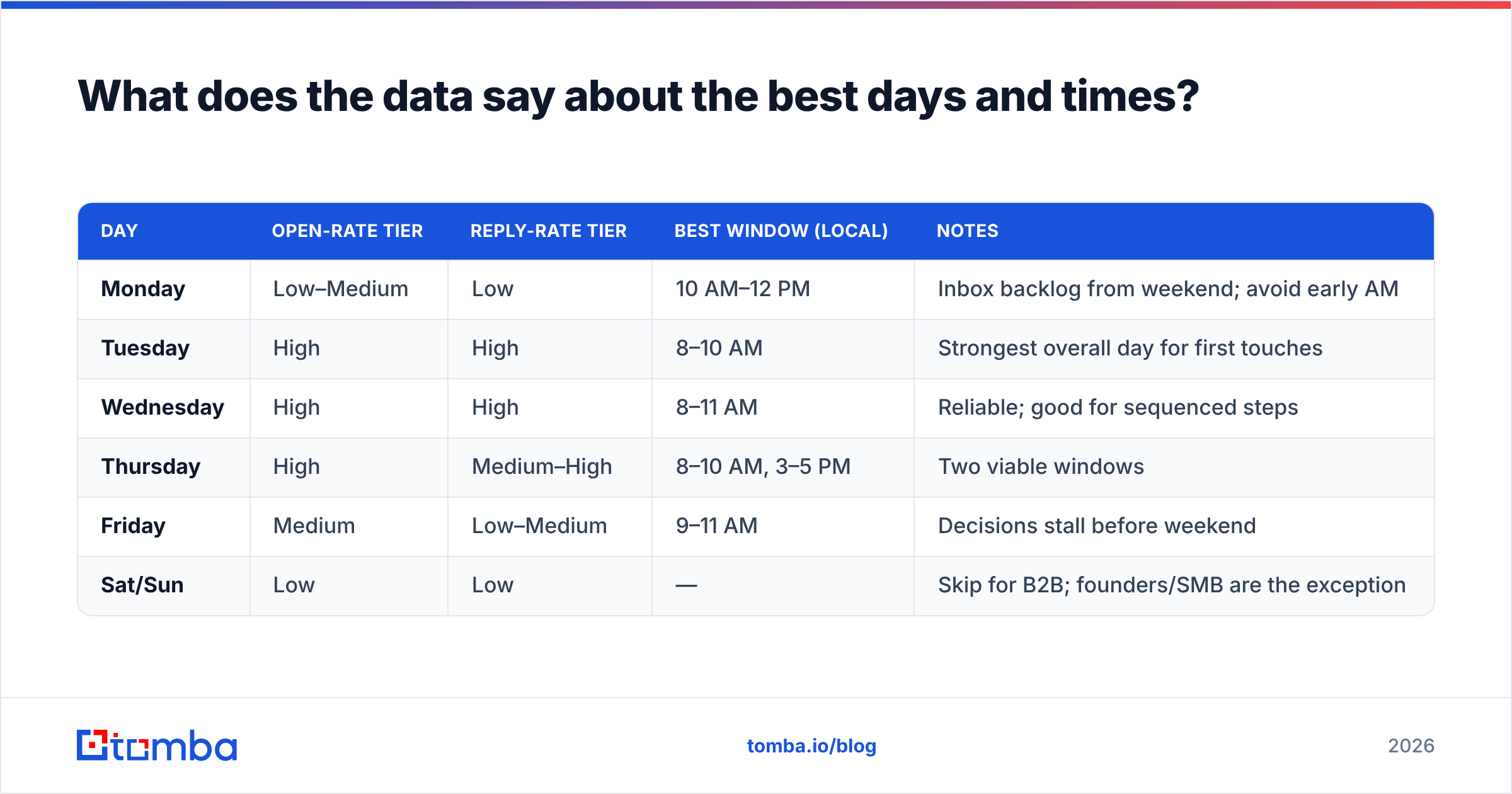
Aggregated B2B outreach studies from vendors like HubSpot and email platforms broadly agree on the shape of the week, even when exact percentages differ. Here's the consensus pattern for 2026:
| Day | Open-rate tier | Reply-rate tier | Best window (local) | Notes |
|---|---|---|---|---|
| Monday | Low–Medium | Low | 10 AM–12 PM | Inbox backlog from weekend; avoid early AM |
| Tuesday | High | High | 8–10 AM | Strongest overall day for first touches |
| Wednesday | High | High | 8–11 AM | Reliable; good for sequenced steps |
| Thursday | High | Medium–High | 8–10 AM, 3–5 PM | Two viable windows |
| Friday | Medium | Low–Medium | 9–11 AM | Decisions stall before weekend |
| Sat/Sun | Low | Low | — | Skip for B2B; founders/SMB are the exception |
A few patterns worth internalizing:
- Tuesday is the safe default for a first-touch email when you have no other data.
- Thursday afternoon is underrated for follow-ups — prospects clearing their desk before the weekend will action quick replies.
- Monday morning is a trap. Your email competes with the weekend backlog and gets archived in bulk.
- Friday afternoon and weekends are dead zones for most B2B segments. The exception: founders and small-business owners who blur work/personal hours.
Keep in mind these are population averages. They tell you where to start, not where to stop.
How do time zones change the best time to send prospecting emails?#
Time zone is the single biggest reason "8 AM" advice fails in practice. If your list spans New York, Denver, and San Francisco and you blast everyone at 8 AM Eastern, your West Coast prospects get hit at 5 AM — well before they're awake, guaranteeing inbox burial.
The fix is to segment your send by the recipient's local time, not the sender's clock. Most sequencing tools support this if your records include a location or time-zone field. If they don't, you're sending blind.
This is where data quality and timing intersect. To localize sends you need reliable company and contact location data — which is exactly the kind of field you get from data enrichment rather than guessing from an email domain. Enriched records let you bucket prospects into zones and schedule each batch for its own 8–10 AM window.
A simple operational rule: build one sequence per major time zone rather than one global sequence. It's a little more setup, and it routinely lifts open rates by double digits because every send lands in the morning-triage window for that recipient.
Does send time matter more than your list quality?#
No — and this is the trap that costs reps the most.
You can nail Tuesday at 9:03 AM and still get a 2% reply rate if half your addresses are stale, role-based, or unverified. Timing optimizes the emails that land. It does nothing for the ones that bounce, hit a spam trap, or reach a person who left the company two years ago.
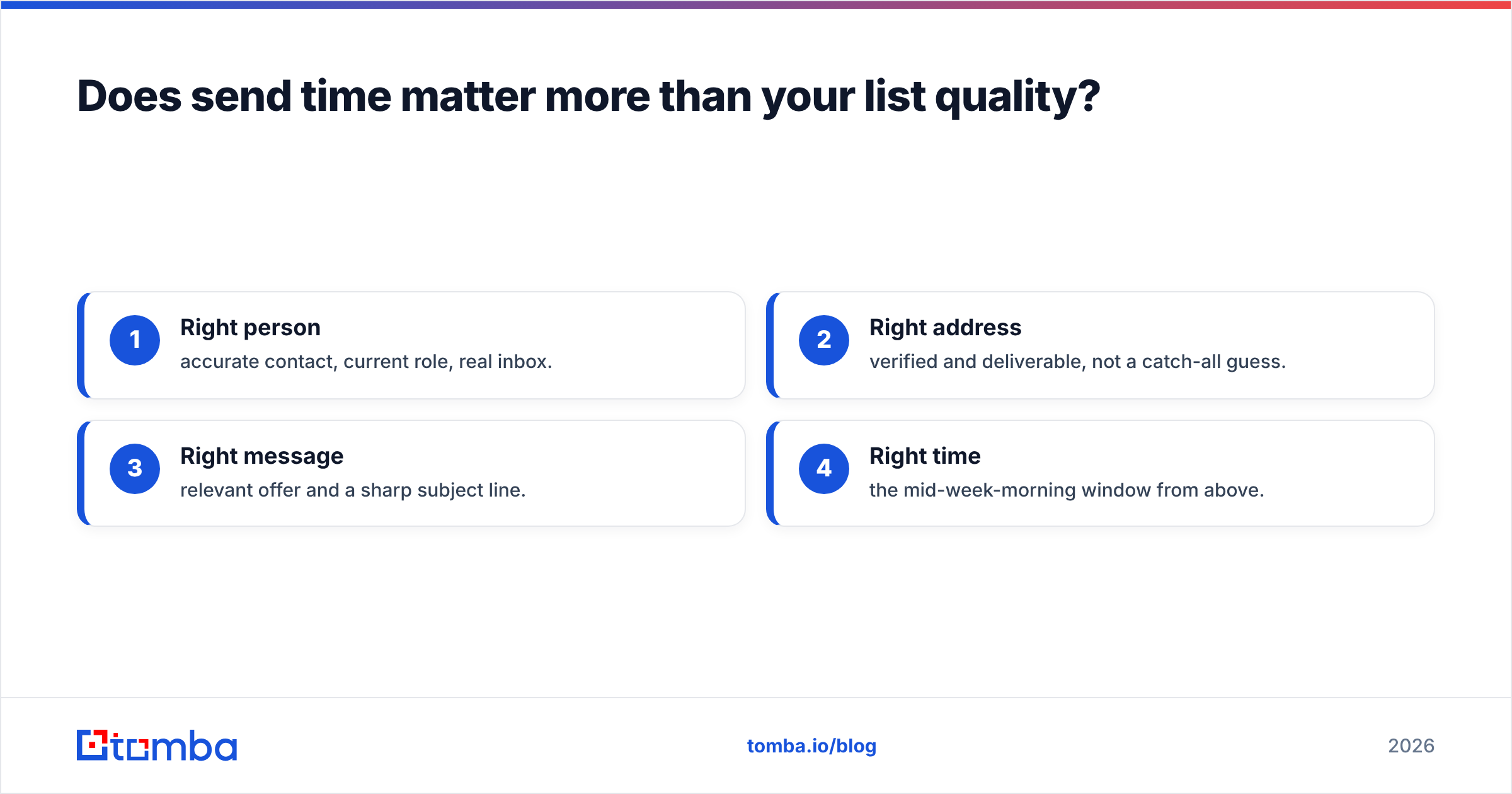
Run the priorities in this order:
- Right person — accurate contact, current role, real inbox.
- Right address — verified and deliverable, not a catch-all guess.
- Right message — relevant offer and a sharp subject line.
- Right time — the mid-week-morning window from above.
Timing is step four for a reason. Before you obsess over the minute, make sure the email is going to a verified address. Running your list through an email verifier removes the bounces that wreck your sender reputation — and a damaged reputation means even your perfectly timed emails route to spam. Protect deliverability first; the clock is the last 10%.
How do you find your own best send time?#
Benchmarks get you to a starting hypothesis. A two-to-three-week test gets you the real answer for your audience. Here's the method:
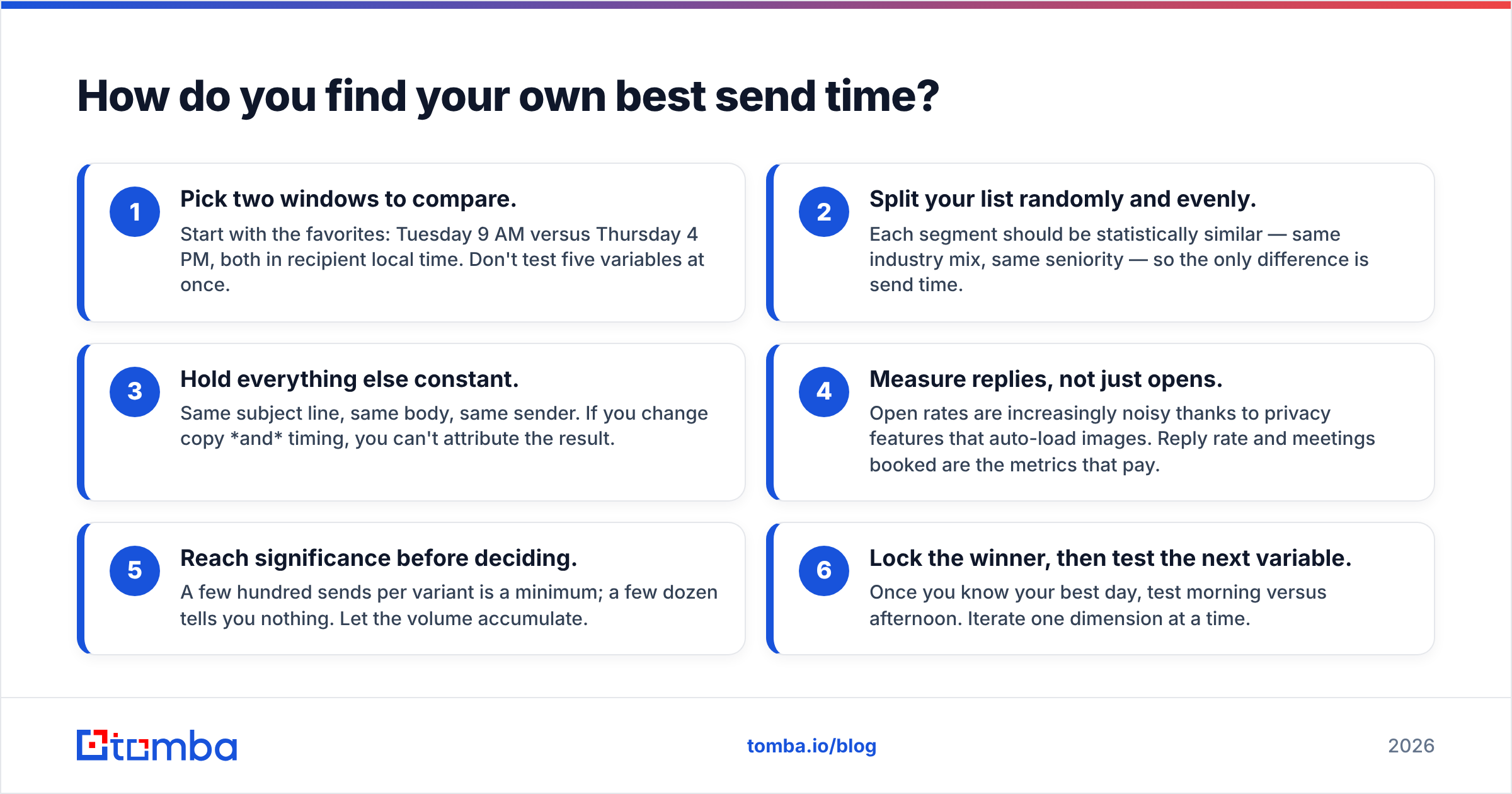
- Pick two windows to compare. Start with the favorites: Tuesday 9 AM versus Thursday 4 PM, both in recipient local time. Don't test five variables at once.
- Split your list randomly and evenly. Each segment should be statistically similar — same industry mix, same seniority — so the only difference is send time.
- Hold everything else constant. Same subject line, same body, same sender. If you change copy and timing, you can't attribute the result.
- Measure replies, not just opens. Open rates are increasingly noisy thanks to privacy features that auto-load images. Reply rate and meetings booked are the metrics that pay.
- Reach significance before deciding. A few hundred sends per variant is a minimum; a few dozen tells you nothing. Let the volume accumulate.
- Lock the winner, then test the next variable. Once you know your best day, test morning versus afternoon. Iterate one dimension at a time.
This is also where a free email warmup calculator helps: if you're ramping a new sending domain, your volume ceiling constrains how fast you can run these tests. Warm up first, then scale the experiment.
What's the difference between batch blasting and timed sending?#
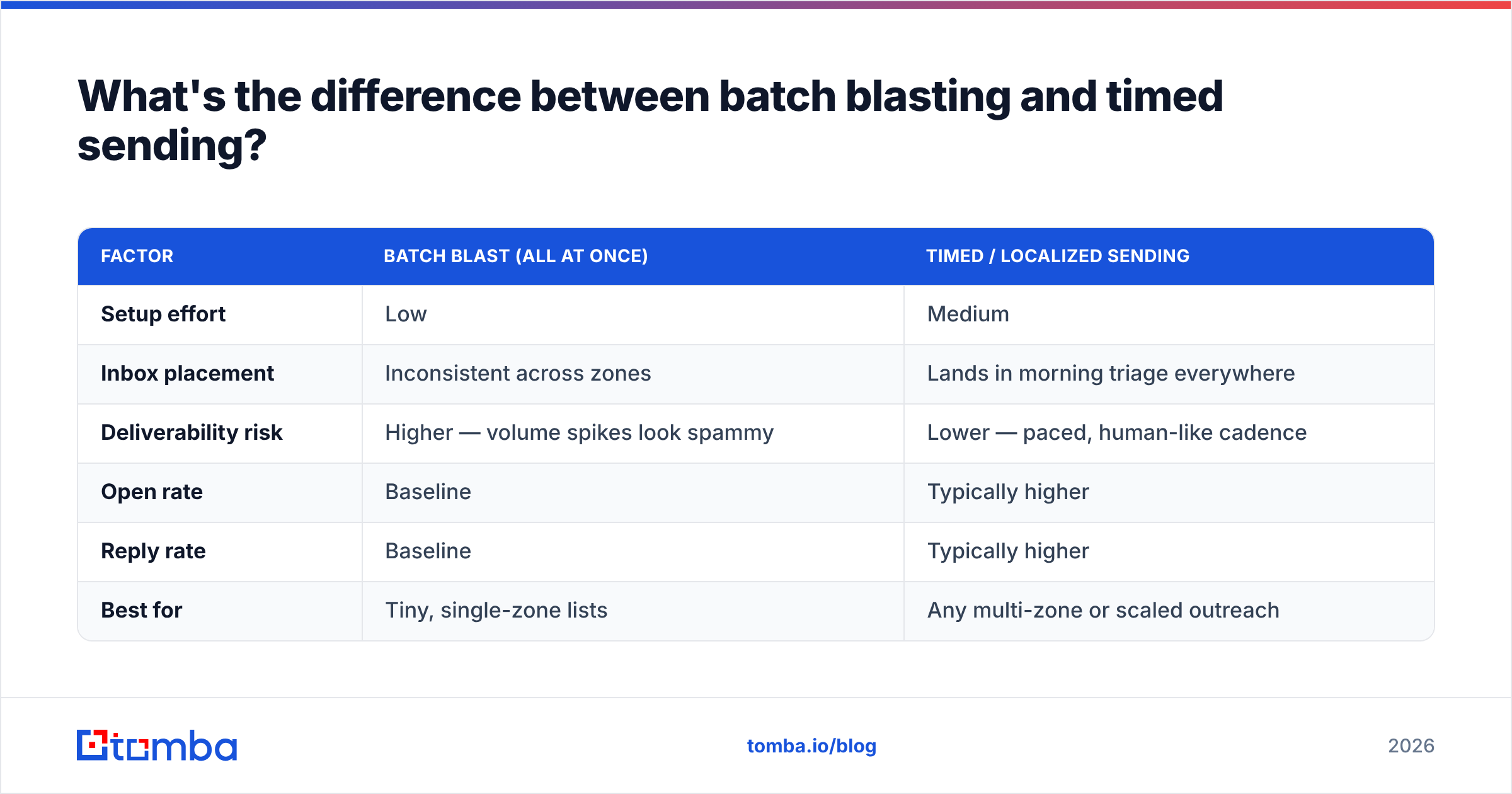
The two approaches produce very different inbox outcomes, even with identical copy:
| Factor | Batch blast (all at once) | Timed / localized sending |
|---|---|---|
| Setup effort | Low | Medium |
| Inbox placement | Inconsistent across zones | Lands in morning triage everywhere |
| Deliverability risk | Higher — volume spikes look spammy | Lower — paced, human-like cadence |
| Open rate | Baseline | Typically higher |
| Reply rate | Baseline | Typically higher |
| Best for | Tiny, single-zone lists | Any multi-zone or scaled outreach |
The takeaway: batching is fine for a 30-contact list in one city. The moment your outreach spans zones or scales past a few hundred contacts, timed and localized sending wins on both deliverability and response — and the setup cost is a one-time investment in your sequence templates.
What are the most common send-time mistakes?#
Even teams that know the benchmarks sabotage themselves with avoidable errors:
- Sending on the sender's clock. Covered above, but it's the number-one mistake. Always localize.
- Front-loading Monday. Reps eager to "start the week strong" blast Monday at 8 AM and land in the weekend backlog. Wait for Tuesday.
- Ignoring the role. Executives often read email early (6–7 AM) or late (8 PM). Individual contributors skew to standard hours. Segment by seniority when you can.
- Optimizing timing on a dirty list. No send time saves a 40% bounce rate. Verify first.
- Testing too many things. Changing subject line, offer, and send time in the same experiment means you learn nothing. Isolate variables.
- Treating "best time" as permanent. Inbox behavior shifts with seasons, product launches, and your own list's makeup. Re-test quarterly.
For more context on what "good" looks like, benchmark your numbers against your segment's typical response rate before assuming timing is your problem — sometimes the message, not the minute, is what's underperforming.
Quick reference: where to start in 2026#
If you want a single, defensible default to use today while you build your own data:
- First-touch cold email: Tuesday or Wednesday, 8–10 AM recipient local time.
- Follow-ups: Thursday, 3–5 PM local — catches the end-of-day inbox sweep.
- Avoid: Monday before 10 AM, Friday after noon, and weekends (unless your ICP is founders/SMB).
- Always: verify the address and localize the send before you fine-tune the hour.
Cross-check your own results against external benchmarks on sites like G2 and your sending platform's reports, but trust your own A/B data over any blog statistic — including this one.
Start with the right data, then nail the timing#
The best time to send prospecting emails is real and worth optimizing — but it's the final 10% of a campaign that's already built on accurate, verified contacts. Get the foundation wrong and the clock won't save you.
That foundation starts with reaching real people at real addresses. Tomba's Email Finder lets you find and verify professional email addresses by name, company, or domain, so the contacts entering your sequence are deliverable from day one. Layer enrichment on top to localize your sends by time zone, run your Tuesday-versus-Thursday test on a clean list, and let the timing data compound. Start free with 25 searches a month, and check Tomba pricing when you're ready to scale — Starter is $49/mo and includes the verification you need to protect every perfectly timed send.
// get started
Find, verify and enrich your first contacts today
Start on the free plan with 25 searches a month, then scale when your team is ready.
Free plan · No credit card required · GDPR & CCPA
// about the author