Biotech Sales in 2026: The Complete Life Sciences Playbook
Biotech sales means long cycles, scientific buyers, and committees of PhDs. Here's how to map accounts, find verified contacts, and close in life sciences in 2026.
Biotech sales is not SaaS sales with lab coats. You are selling into organizations where the person who loves your product (a bench scientist) rarely controls the budget, the buying cycle can run 9 to 18 months, and a single bad data point in a regulated environment can kill a deal you spent two quarters building. If you treat a biotech buyer like a generic B2B lead, you will burn your pipeline and your credibility at the same time.
This playbook breaks down how biotech sales actually works in 2026: who you are really selling to, why the cycle is so long, the metrics that matter, and the prospecting and data stack that lets a lean team punch above its weight.
TL;DR#
- Biotech sales is the practice of selling instruments, reagents, software, CROs/CDMO services, or consumables into life sciences companies, research institutions, and pharma — characterized by scientific buyers, committee decisions, and long, evidence-driven cycles.
- The champion (a scientist) and the economic buyer (a director, VP, or procurement) are almost never the same person — you must sell to both.
- Cycles run 6 to 18 months; grant funding, capital budgets, and validation requirements drive the timeline more than your urgency does.
- Data quality is non-negotiable: titles, lab affiliations, and emails go stale fast in academia and biotech, so verified contact data beats volume every time.
- A focused account-based motion with clean, enriched contact data outperforms spray-and-pray outbound in this market by a wide margin.
What is biotech sales?#
Biotech sales is the process of selling products and services into the life sciences ecosystem — biotech startups, large pharma, academic research labs, contract research organizations (CROs), and contract development and manufacturing organizations (CDMOs). What you sell varies enormously: lab instruments and consumables, reagents and antibodies, lab informatics and LIMS software, sequencing services, or outsourced research and manufacturing.
What unites all of it is the buyer. Your day-to-day contact is usually a scientist — a principal investigator, a lab manager, a research associate, a director of R&D. These are technical, skeptical people who evaluate claims the way they evaluate experiments: with data, controls, and a healthy distrust of marketing language. The fastest way to lose a biotech deal is to oversell. The fastest way to win one is to help your champion build an internal case that survives scrutiny from finance and procurement.
Think of it like selling to a research team that has to peer-review your pitch. They won't accept "trust me" — they want the methods section.
Who actually makes the buying decision?#
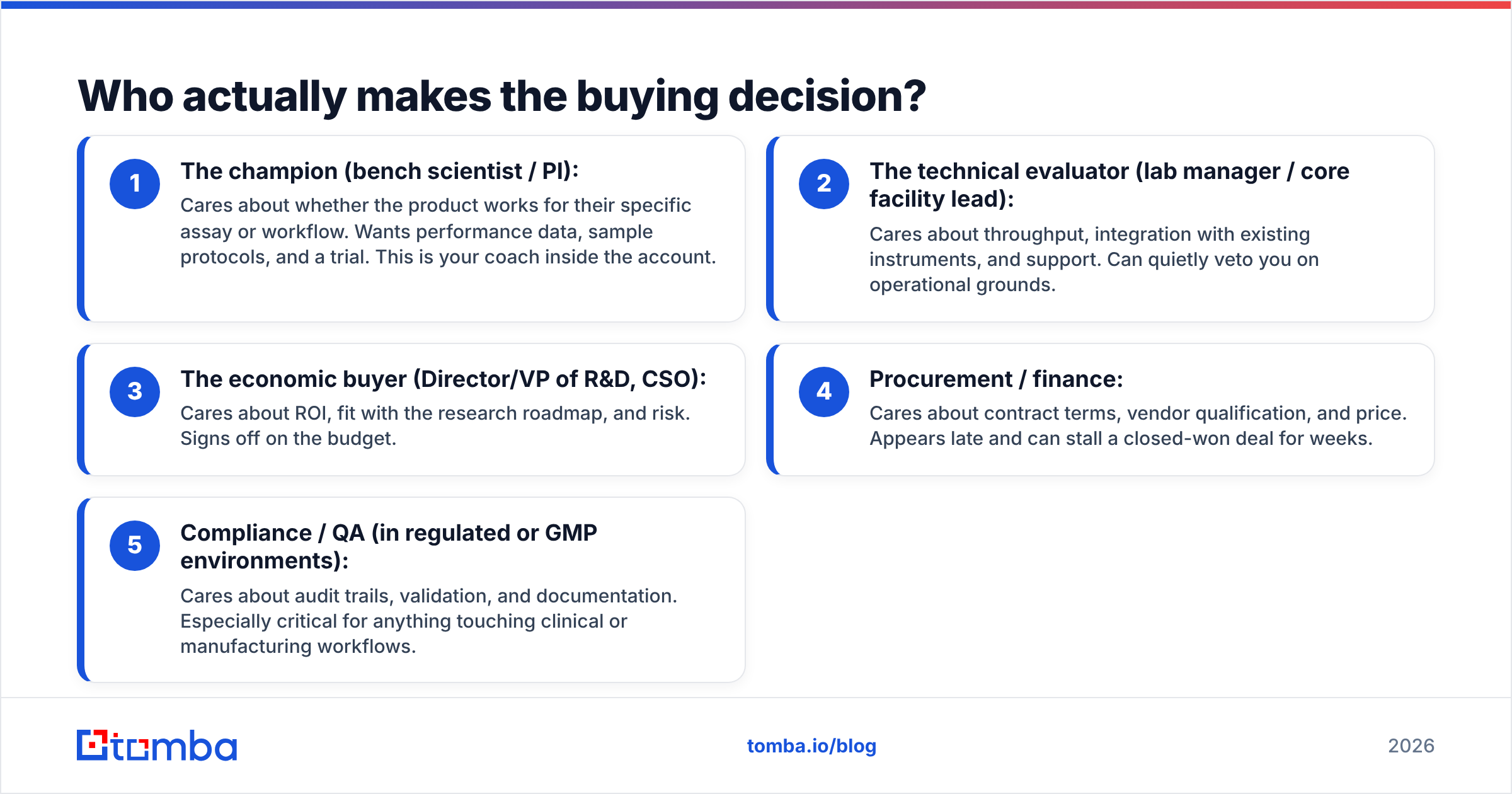
The central challenge of biotech sales is that the person who wants your product and the person who pays for it are different humans with different incentives. Mapping that committee early is the single highest-leverage thing you can do.
Here's the typical cast and what each one cares about:
- The champion (bench scientist / PI): Cares about whether the product works for their specific assay or workflow. Wants performance data, sample protocols, and a trial. This is your coach inside the account.
- The technical evaluator (lab manager / core facility lead): Cares about throughput, integration with existing instruments, and support. Can quietly veto you on operational grounds.
- The economic buyer (Director/VP of R&D, CSO): Cares about ROI, fit with the research roadmap, and risk. Signs off on the budget.
- Procurement / finance: Cares about contract terms, vendor qualification, and price. Appears late and can stall a closed-won deal for weeks.
- Compliance / QA (in regulated or GMP environments): Cares about audit trails, validation, and documentation. Especially critical for anything touching clinical or manufacturing workflows.
If you only sell to the champion, you will get enthusiastic emails and no purchase order. If you only sell to procurement, you will get ground down on price with no technical advocate. You have to arm the champion with what the economic buyer and procurement need.
)
Why is the biotech sales cycle so long?#
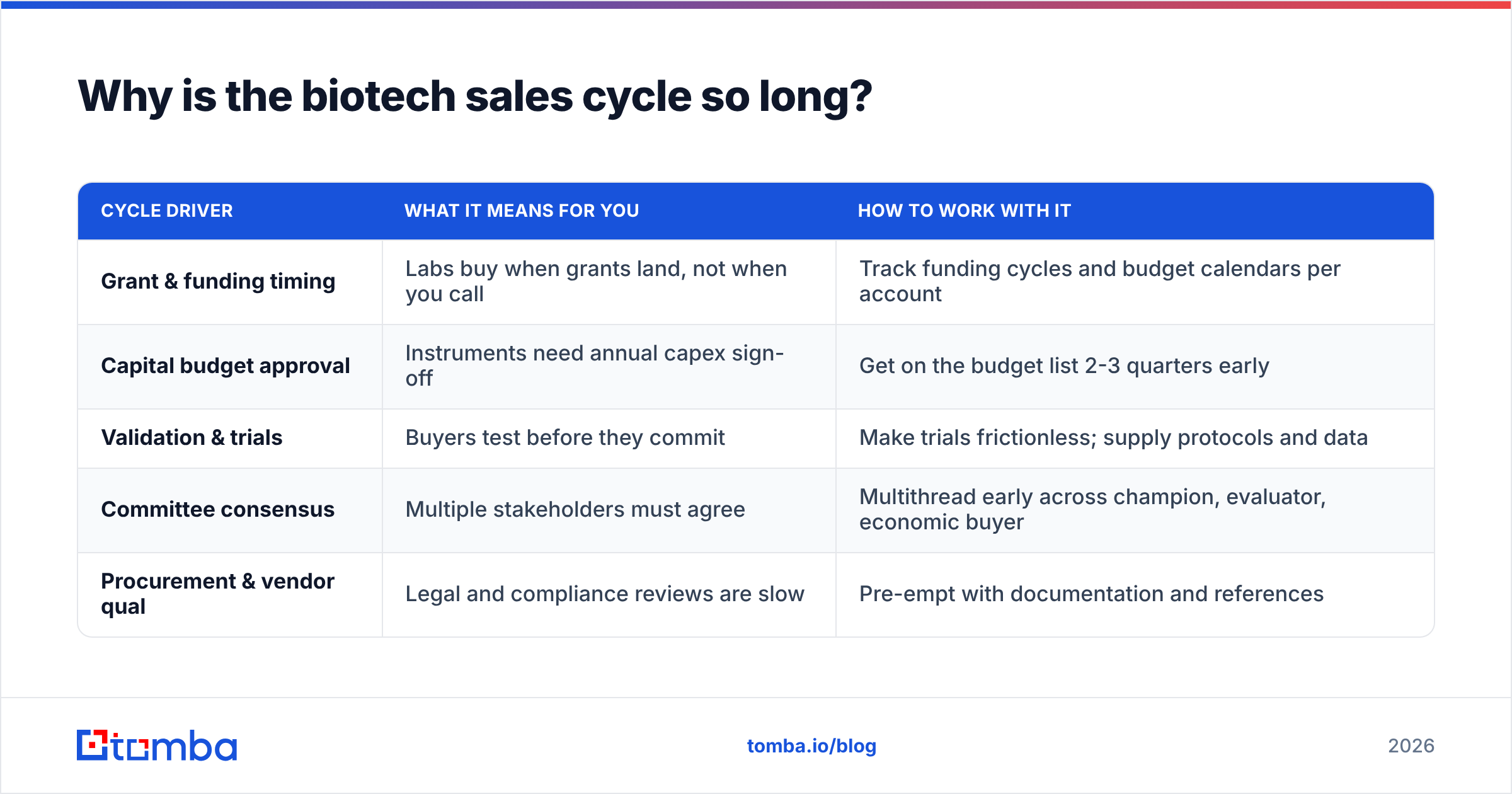
Biotech sales cycles run 6 to 18 months, and sometimes longer for capital equipment. This is not your rep being slow — it is structural. Understanding the drivers lets you forecast honestly instead of sandbagging or over-promising.
| Cycle driver | What it means for you | How to work with it |
|---|---|---|
| Grant & funding timing | Labs buy when grants land, not when you call | Track funding cycles and budget calendars per account |
| Capital budget approval | Instruments need annual capex sign-off | Get on the budget list 2-3 quarters early |
| Validation & trials | Buyers test before they commit | Make trials frictionless; supply protocols and data |
| Committee consensus | Multiple stakeholders must agree | Multithread early across champion, evaluator, economic buyer |
| Procurement & vendor qual | Legal and compliance reviews are slow | Pre-empt with documentation and references |
The practical takeaway: forecast based on the buyer's calendar, not yours. A deal that looks "stuck" in month four may be perfectly on track for a grant disbursement in month seven. The reps who win in biotech are the ones who map these gates explicitly and keep the deal warm through them rather than pushing for an unnatural close.
What metrics actually matter in biotech sales?#
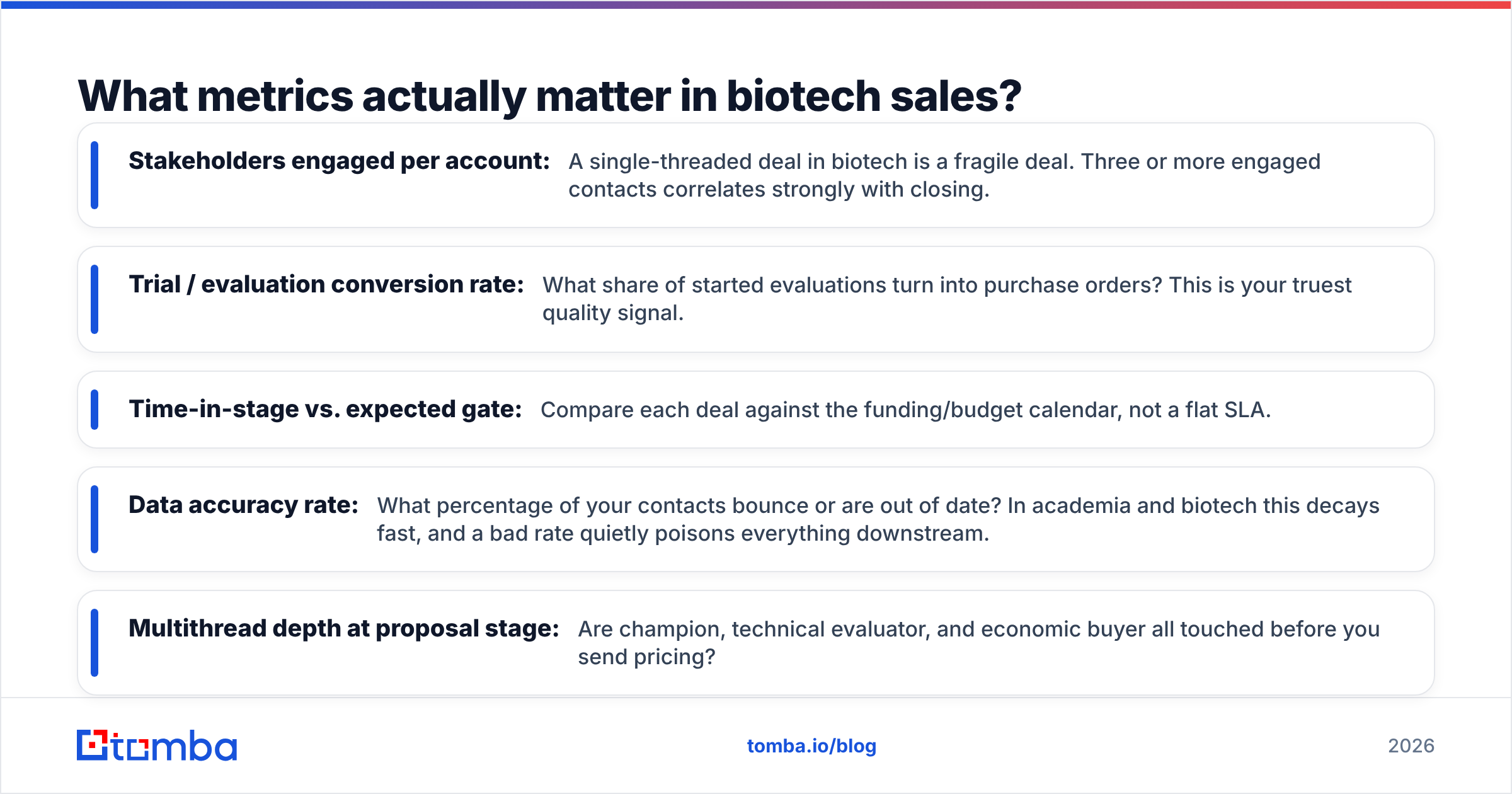
Because cycles are long, you cannot manage a biotech pipeline on closed-won revenue alone — you'd be flying blind for two quarters. You need leading indicators that tell you whether deals are progressing through the real gates.
- Stakeholders engaged per account: A single-threaded deal in biotech is a fragile deal. Three or more engaged contacts correlates strongly with closing.
- Trial / evaluation conversion rate: What share of started evaluations turn into purchase orders? This is your truest quality signal.
- Time-in-stage vs. expected gate: Compare each deal against the funding/budget calendar, not a flat SLA.
- Data accuracy rate: What percentage of your contacts bounce or are out of date? In academia and biotech this decays fast, and a bad rate quietly poisons everything downstream.
- Multithread depth at proposal stage: Are champion, technical evaluator, and economic buyer all touched before you send pricing?
That fourth metric — data accuracy — deserves special attention. Researchers move labs, postdocs graduate, startups rebrand, and titles shift. A contact list that was 95% accurate a year ago may be 70% accurate today. Running outreach on stale data doesn't just waste effort; it damages your sender reputation and your email deliverability, which makes every future campaign worse.
How do you prospect into biotech accounts?#
The winning motion in biotech is account-based, not volume-based. The total addressable market is finite and well-defined — there are only so many oncology labs, antibody-discovery startups, or gene-therapy CDMOs — so depth beats breadth. Here is a practical sequence.
1. Build a tight account list. Define your ICP by research area, funding stage, headcount, and tech stack. A 200-account list you understand deeply will outperform a 5,000-account list you spray.
2. Map the committee per account. For each target, identify the likely champion, technical evaluator, and economic buyer by name and role before you send a single email. Use a domain search to pull the people and email patterns at each organization in one pass.
3. Find and verify contact data. This is where most biotech outreach quietly fails. You need a real, deliverable email for each mapped stakeholder. Use an email finder to locate the address, then an email verifier to confirm it before you send. Skipping verification in a market with this much data decay is how you end up on blocklists.
4. Enrich before you write. Pull recent publications, funding announcements, conference talks, and tech-stack signals. A scientist can tell within one sentence whether you actually understand their work. Data enrichment turns a name and email into context you can personalize against.
5. Lead with evidence, not adjectives. Your first touch should reference their specific work and offer a concrete, relevant data point or protocol — not a demo request. Earn the trial.
)
For author-driven outreach — say you're targeting researchers who published a specific method — an author finder lets you go from a paper byline to a verified contact. And when you need to reach the same person on a different channel, a phone finder adds a fallback for the accounts that matter most.
What does the biotech sales tech stack look like?#
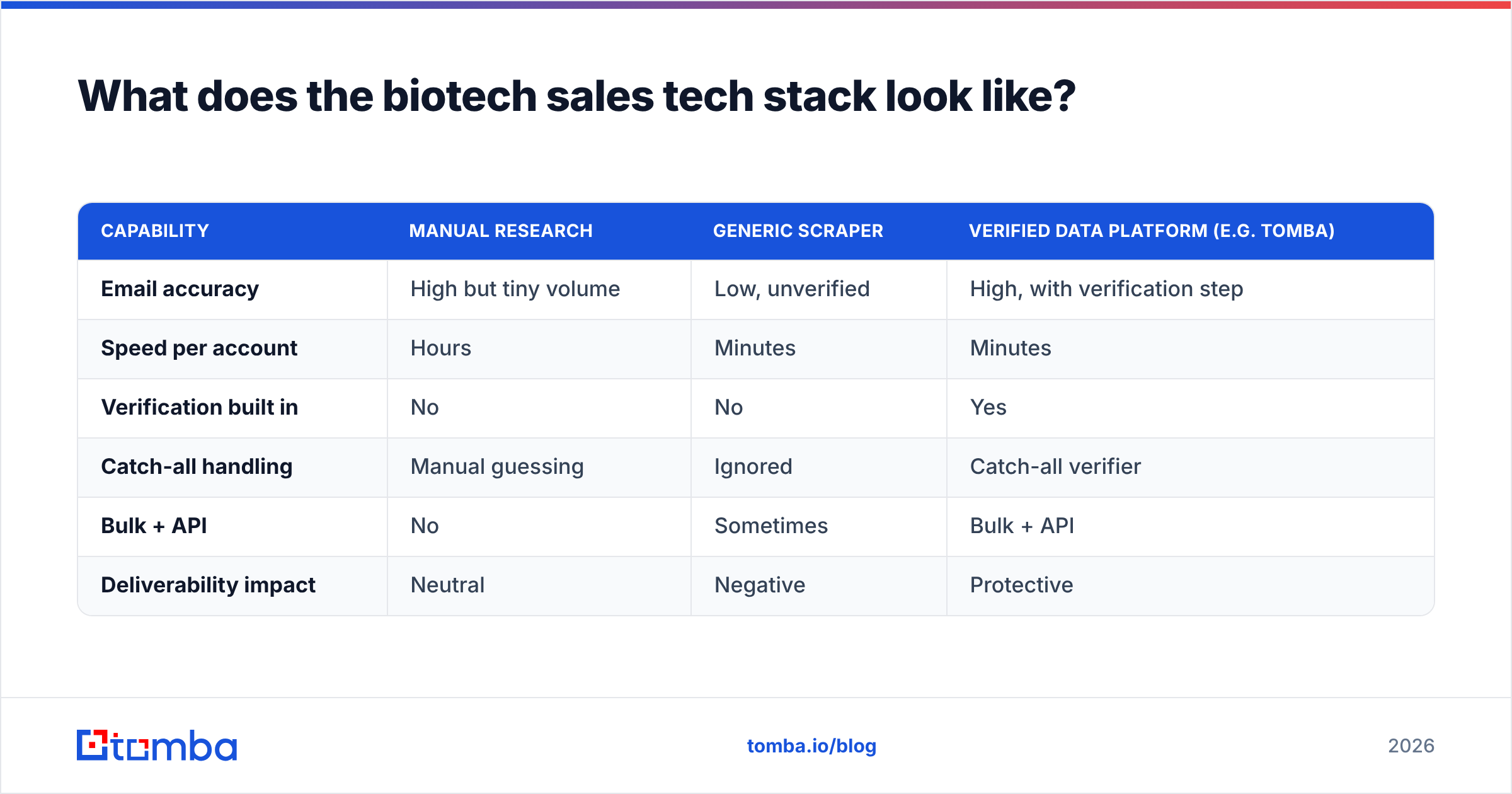
You don't need a 14-tool stack. You need clean data, a way to multithread, and a CRM that reflects the real buying committee. Here's how the core data layer compares across common approaches.
| Capability | Manual research | Generic scraper | Verified data platform (e.g. Tomba) |
|---|---|---|---|
| Email accuracy | High but tiny volume | Low, unverified | High, with verification step |
| Speed per account | Hours | Minutes | Minutes |
| Verification built in | No | No | Yes |
| Catch-all handling | Manual guessing | Ignored | Catch-all verifier |
| Bulk + API | No | Sometimes | Bulk + API |
| Deliverability impact | Neutral | Negative | Protective |
The point isn't that automation replaces research — in biotech, deep account research is the job. The point is that you shouldn't spend your scarce research hours hunting for an email address that a tool can find and verify in seconds. Spend them reading your prospect's last three papers instead.
For teams running outbound at scale, push verified contacts into your sequencing tool and CRM through the Tomba API or a no-code HubSpot integration, so enrichment happens automatically as new accounts enter the pipeline rather than as a manual chore.
How is biotech sales different from standard B2B SaaS sales?#
If you're moving into life sciences from a horizontal SaaS background, recalibrate these instincts:
- Urgency is mostly out of your control. You can't manufacture urgency around a grant cycle. You align to it.
- Technical depth is table stakes. Your champion expects you to understand their science, or at least respect it enough to learn. Generic value props bounce.
- Free trials are evaluations, not demos. A trial in biotech is a controlled experiment. Treat it with rigor — supply protocols, controls, and support.
- References carry enormous weight. Scientists trust peers. One credible reference from a respected lab can do more than ten case studies.
- Procurement is a real stage, not a formality. Build vendor qualification and documentation into your forecast from the start.
This is why honest forecasting and disciplined multithreading matter more here than in faster markets. You can read more about structuring outbound around these realities in any solid outbound sales strategy framework, but the core idea is simple: match your motion to the buyer's reality, not your quota's calendar.
How do you keep biotech contact data clean over time?#
Because of how fast life sciences contact data decays, treat data hygiene as an ongoing process, not a one-time list buy.
- Re-verify before every major campaign. Run your list through an email verifier before each send, especially for lists older than a quarter.
- Watch your bounce and reputation signals. Use a sender reputation check and remove risky addresses before they cost you deliverability.
- Enrich on a schedule. Roles change; re-run data enrichment periodically so your CRM reflects who actually holds the budget today.
- Deduplicate. Merged accounts and re-orgs create duplicates fast in this space; clean them so multithreading data stays accurate.
Authoritative buyer-research from firms like Gartner consistently shows that B2B buying groups have grown larger and more complex over the last decade — and biotech sits at the far end of that curve. Pairing that committee complexity with decaying data is what makes clean, verified contact information the foundation everything else is built on. Vendor directories like G2 are useful for benchmarking the tools, but accuracy in your own market is something you have to verify, not assume.
Putting it together#
Biotech sales rewards patience, scientific respect, and operational discipline. Map the committee early. Forecast against the buyer's funding and budget calendar, not your own. Multithread before you send pricing. And build the whole motion on contact data you have actually verified, because in a market this slow and this technical, a bounced email or a wrong title doesn't just cost a reply — it costs credibility you spent months earning.
If you're building or cleaning the data layer underneath your biotech pipeline, start with the Tomba Email Finder. Find verified professional emails for the scientists, lab managers, and R&D leaders in your target accounts, confirm them before you send, and enrich them with the context that makes a scientist actually reply. You can map an entire organization with domain search, scale it through the bulk email finder, and check Tomba pricing — there's a free tier with 25 searches a month to test it against your own account list before you commit.
// get started
Find, verify and enrich your first contacts today
Start on the free plan with 25 searches a month, then scale when your team is ready.
Free plan · No credit card required · GDPR & CCPA
// about the author