Biscred vs Hunter (2026): Which B2B Data Tool Wins?
Biscred targets commercial real estate teams; Hunter is a general email finder. See how they compare on data, coverage, pricing, and accuracy in 2026 — plus a leaner alternative.
Choosing between Biscred and Hunter is really a choice between two different jobs. Biscred is a niche intelligence platform built for commercial real estate (CRE) teams. Hunter is a general-purpose email finder that works across any industry. Picking the "winner" depends entirely on who you sell to and how broad your prospecting needs to be.
This guide breaks down both tools on data coverage, accuracy, pricing, and real-world use cases for 2026 — and shows where a leaner alternative beats both on cost-per-verified-contact.
TL;DR: Biscred vs Hunter at a glance#
- Biscred is purpose-built for commercial real estate — owners, brokers, lenders, and investors. If you live and breathe CRE, its tagged contact data is hard to beat.
- Hunter is a horizontal email finder and verifier. It works for any domain, any industry, and plugs into almost any workflow.
- Pricing models differ: Hunter sells monthly search/verification credits; Biscred sells seats with CRE database access. Hunter is cheaper to start.
- Accuracy: both rely on verification, but neither publishes a single universal accuracy number you should take at face value — test on your own list.
- Best alternative: if you want Hunter-style breadth at a lower cost-per-credit with strong verification, Tomba is the option most teams overlook.
What is Biscred?#
Biscred is a B2B data platform focused exclusively on the commercial real estate industry. Instead of trying to cover every company on earth, it indexes the people and firms that matter in CRE: brokerage shops, owners and operators, lenders, property managers, REITs, and investment firms.
The pitch is depth over breadth. Because the dataset is narrow, Biscred can tag contacts by CRE-specific attributes — asset class, role, transaction history, and firm type — that a general database simply doesn't store. For a CRE business development rep, that tagging is the product. You can build a list of "acquisitions leads at multifamily owner-operators in the Sunbest" instead of filtering a generic database by guesswork.
The trade-off: if your buyers sit outside commercial real estate, most of that specialized tagging is wasted, and you're paying for coverage you can't use.
What is Hunter?#
Hunter (hunter.io) is one of the most recognized email-finding tools on the market. It's horizontal by design: give it a company domain and it returns the email addresses associated with that domain, the most likely pattern (like first.last@company.com), and a confidence score for each result.
Hunter's core modules are domain search, email finder, and email verification, wrapped with a Chrome extension, a Google Sheets add-on, and a well-documented API. It's the kind of tool a generalist SDR, recruiter, or founder reaches for when they need an email for anyone, not just one vertical.
Where Biscred says "we know CRE cold," Hunter says "we work everywhere." Both positions are defensible — they just serve different buyers.
Biscred vs Hunter: the core comparison#
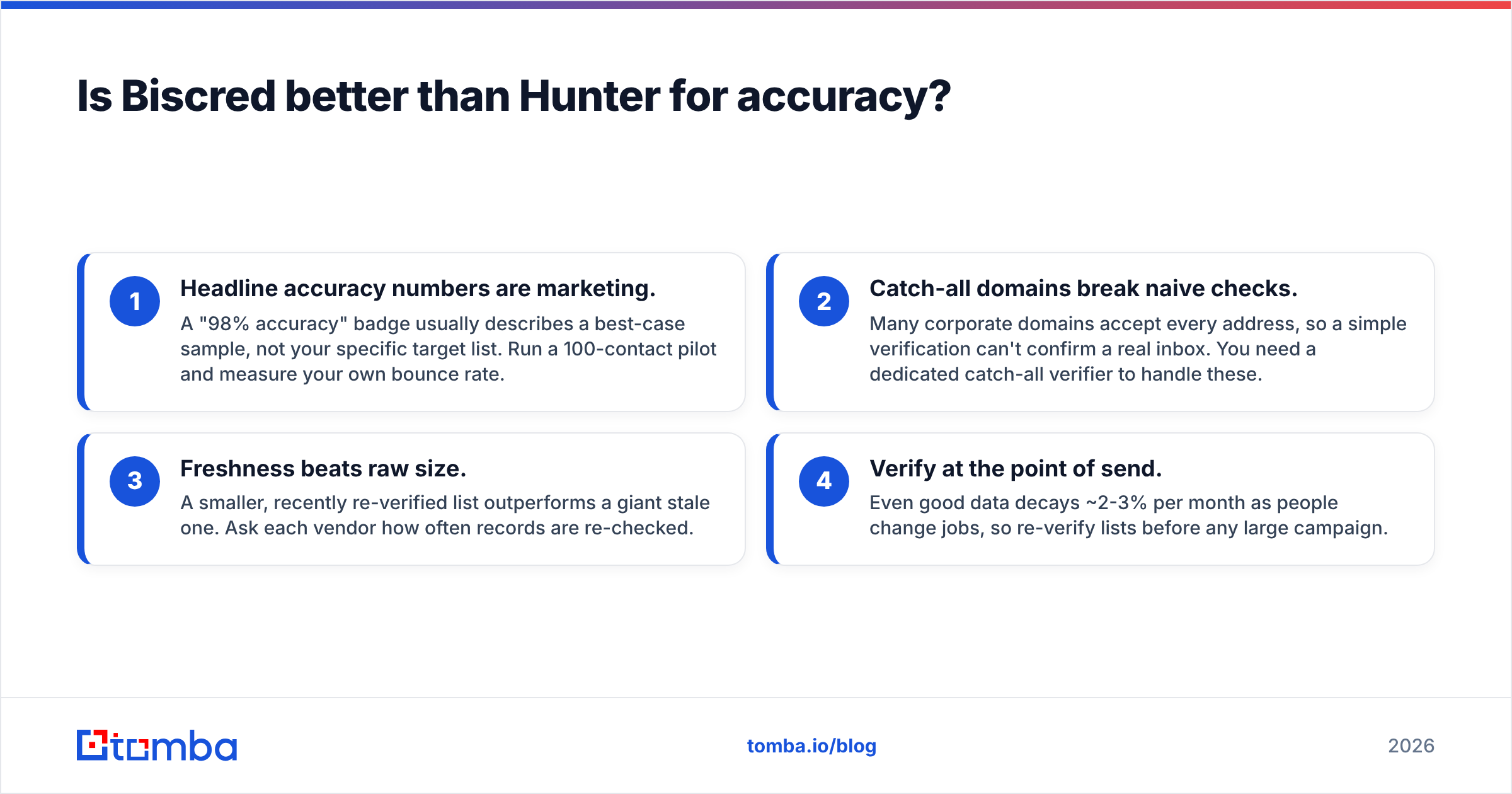
Here is the side-by-side that matters most when you're deciding. Pricing reflects publicly listed entry tiers as of 2026; always confirm current numbers on each vendor's pricing page before you buy.
| Attribute | Biscred | Hunter |
|---|---|---|
| Primary focus | Commercial real estate only | All industries (horizontal) |
| Core data | CRE firms, owners, brokers, lenders | Business emails by domain |
| Best for | CRE business development teams | Generalist SDRs, recruiters, founders |
| Pricing model | Seat-based, database access | Credit-based, monthly tiers |
| Entry price | Custom / quote-based | Free tier, paid from ~$49/mo |
| Free tier | Limited / demo | Yes (25 searches/mo) |
| Email verification | Included | Included |
| API access | Yes | Yes |
| Niche tagging (asset class, role) | Strong | None |
| Learning curve | Higher (CRE-specific) | Low |
The pattern is clear: Biscred wins on depth inside one vertical, Hunter wins on breadth and ease of entry. Neither is "better" in the abstract — they're optimized for different go-to-market motions.
)
Is Biscred better than Hunter for accuracy?#
Accuracy depends on what you're measuring. Biscred's strength is relevance accuracy — when it says someone is an acquisitions lead at a multifamily owner, that tag is usually right because the dataset is hand-curated for CRE. Hunter's strength is deliverability accuracy — its job is to make sure the email it hands you actually exists and won't bounce.
A few honest caveats before you trust any vendor's accuracy claim:
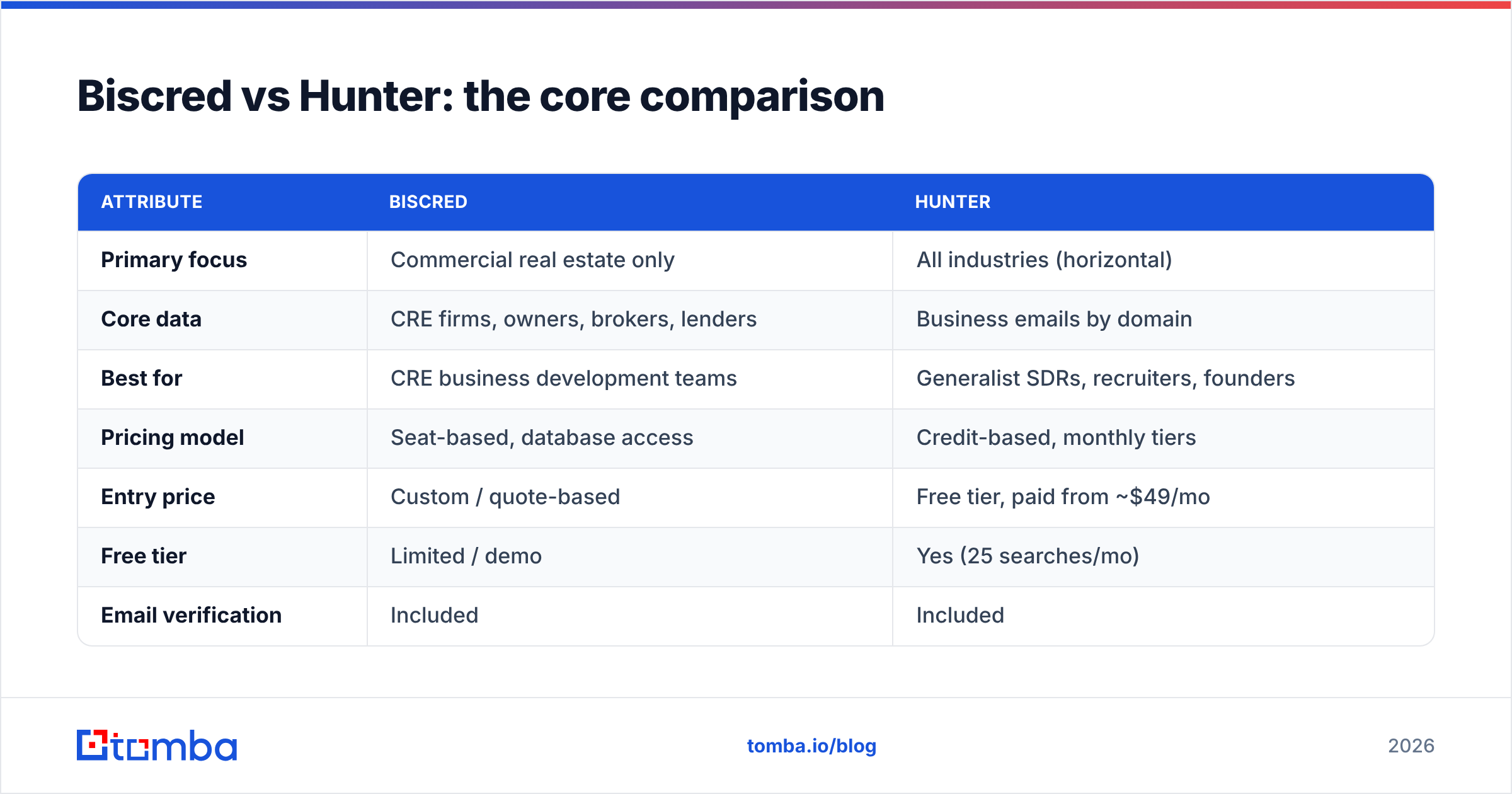
- Headline accuracy numbers are marketing. A "98% accuracy" badge usually describes a best-case sample, not your specific target list. Run a 100-contact pilot and measure your own bounce rate.
- Catch-all domains break naive checks. Many corporate domains accept every address, so a simple verification can't confirm a real inbox. You need a dedicated catch-all verifier to handle these.
- Freshness beats raw size. A smaller, recently re-verified list outperforms a giant stale one. Ask each vendor how often records are re-checked.
- Verify at the point of send. Even good data decays ~2-3% per month as people change jobs, so re-verify lists before any large campaign.
If your motion is CRE-only and you care most about reaching the right role, Biscred's curation has the edge. If you care most about clean, low-bounce sends across many industries, a strong email verifier paired with a horizontal finder wins.
How does pricing compare?#
The pricing philosophies are fundamentally different, which makes a flat "cheaper" verdict misleading.
Hunter uses a credit model. You pay a monthly fee for a bucket of searches and verifications. There's a free tier (25 searches/mo) to test the waters, and paid plans scale up from there. You can start small, prove ROI, and expand. Cost is predictable and easy to attribute to pipeline.
Biscred uses seat-based access to its CRE database, typically quoted per user rather than per credit. That model rewards teams that prospect heavily within commercial real estate every day — unlimited niche pulls beat metered credits once your volume is high enough. But it also means a higher floor and a sales conversation before you can even try it.
Here's the simple decision rule:
| Your situation | Lower effective cost |
|---|---|
| CRE-only team, high daily volume | Biscred (seat model amortizes) |
| Multi-industry or low volume | Hunter (pay only for what you use) |
| Just testing prospecting | Hunter or Tomba free tier |
| Need API at scale | Compare per-1,000-contact cost directly |
For most teams that aren't 100% CRE, a credit model is cheaper and lower-risk because you're not paying for a vertical you don't sell into.
When should you choose Biscred?#
Pick Biscred if commercial real estate is your business. Specifically:
- You're a brokerage, lender, proptech vendor, or investment firm selling into CRE.
- You need to filter by CRE-native attributes — asset class, transaction role, firm type — that no general database stores.
- Your team prospects the same vertical every day, so seat-based unlimited access pays off.
- Relevance matters more to you than raw contact volume.
In that world, Biscred's curation saves hours of manual research per rep. You're buying a map of an industry, not just email addresses.
When should you choose Hunter (or an alternative)?#
Pick a horizontal tool if your buyers span industries, or if you simply want to start fast and cheap:
- You sell across multiple verticals, not just CRE.
- You need emails for one-off targets — a recruiter sourcing candidates, a founder reaching investors, an agency building outreach lists.
- You want a free tier and self-serve onboarding with no sales call.
- You need a clean domain search to pull every address at a company in one shot.
Hunter fits all of these. But it's not the only horizontal option, and it's not always the cheapest per verified contact — which brings us to the alternative most comparisons skip.
)
Where does Tomba fit in this comparison?#
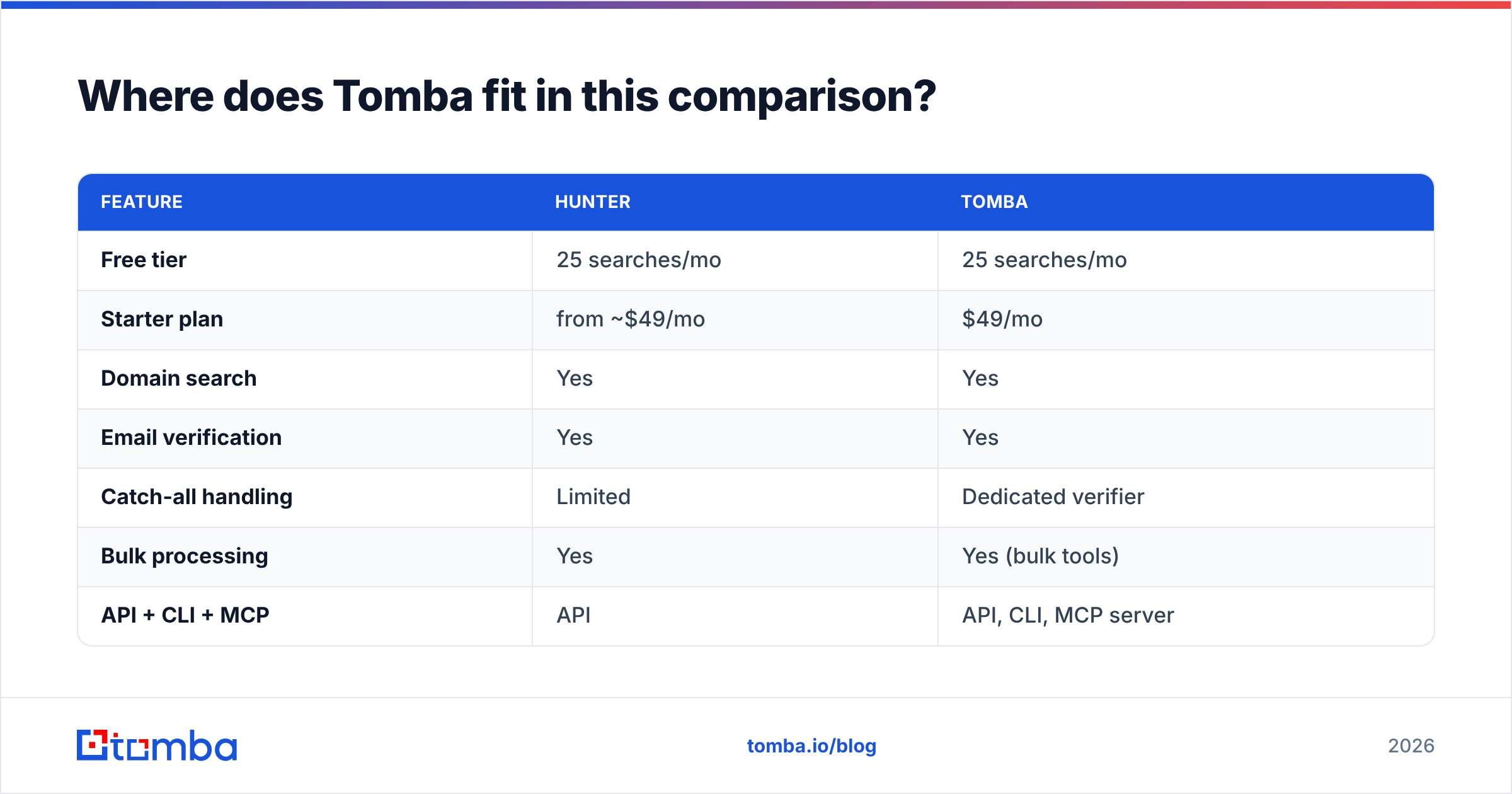
Tomba is the horizontal alternative that competes directly with Hunter's job-to-be-done, usually at a better cost-per-credit. If you've already decided you don't need CRE-only depth, the real question is "Hunter or a leaner equivalent?" — and Tomba is built for exactly that.
| Feature | Hunter | Tomba |
|---|---|---|
| Free tier | 25 searches/mo | 25 searches/mo |
| Starter plan | from ~$49/mo | $49/mo |
| Domain search | Yes | Yes |
| Email verification | Yes | Yes |
| Catch-all handling | Limited | Dedicated verifier |
| Bulk processing | Yes | Yes (bulk tools) |
| API + CLI + MCP | API | API, CLI, MCP server |
| Native integrations | Several | HubSpot, Salesforce, Sheets, Zapier |
Tomba mirrors the core finder-plus-verifier workflow you'd expect from Hunter, then adds tooling that matters for modern stacks: a bulk email finder for list building, a Tomba API for embedding lookups into your own product, and direct CRM connections. Pricing is transparent — Free, Starter at $49/mo, Growth at $99/mo, and Pro at $249/mo — so you can model cost before committing. You can see the full breakdown on the Tomba pricing page.
The honest framing: Tomba won't replace Biscred for a CRE-obsessed team that needs asset-class tagging. It will go head-to-head with Hunter for everyone else, and it tends to win on price and on catch-all accuracy.
Biscred vs Hunter vs Tomba: which should you pick?#
Three buyers, three answers:
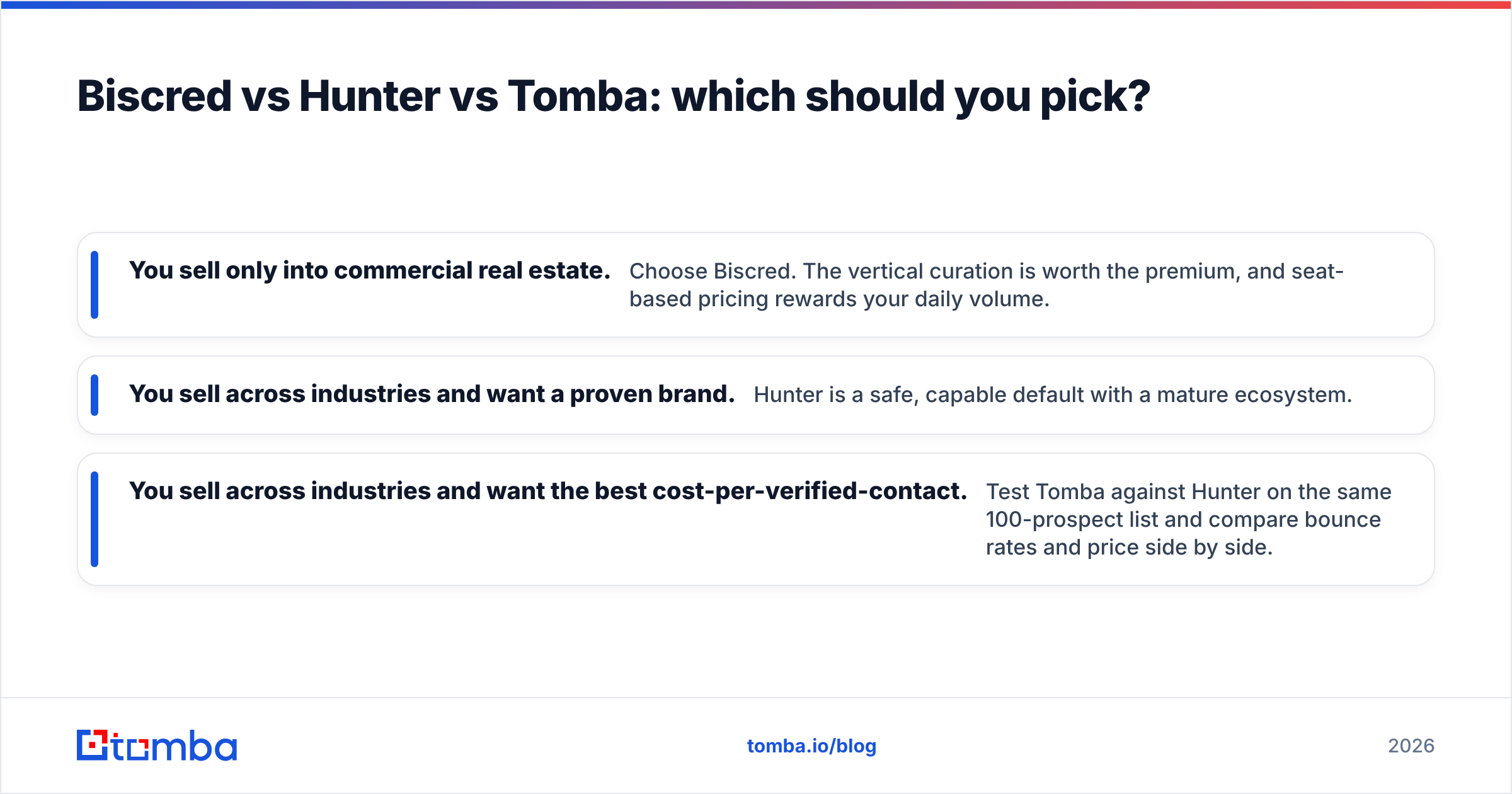
- You sell only into commercial real estate. Choose Biscred. The vertical curation is worth the premium, and seat-based pricing rewards your daily volume.
- You sell across industries and want a proven brand. Hunter is a safe, capable default with a mature ecosystem.
- You sell across industries and want the best cost-per-verified-contact. Test Tomba against Hunter on the same 100-prospect list and compare bounce rates and price side by side.
Whatever you choose, don't buy on a headline accuracy number. Run a small paid pilot, measure real bounce rates on your domains, and let the data decide. Vendor benchmarks are a starting point, not proof.
According to analyst coverage of the sales-intelligence category on G2, the tools that win long-term aren't the ones with the biggest database — they're the ones that keep records fresh and verified. That's the metric to anchor on.
Final verdict and next step#
Biscred and Hunter aren't really competitors; they're answers to different questions. Biscred wins if your entire world is commercial real estate. Hunter wins if you need email coverage across any industry with a low barrier to entry. And if you fall into that second camp, it's worth pressure-testing both against a leaner, lower-cost option before you sign anything.
If you want Hunter-style breadth with transparent pricing, strong catch-all handling, and a free tier to start today, try the Tomba Email Finder. Find and verify professional emails by name, domain, or company, scale it through the API, and only pay for the credits you actually use. Run it against your current tool on the same list — the cost-per-verified-contact will make the decision for you.
// get started
Find, verify and enrich your first contacts today
Start on the free plan with 25 searches a month, then scale when your team is ready.
Free plan · No credit card required · GDPR & CCPA
// about the author