Bizkonnect vs Goava: Sales Intelligence Compared (2026)
Bizkonnect pushes org charts and account intelligence; Goava leans on AI lead recommendations. Here's an honest 2026 breakdown of which fits your GTM motion — and where a data layer beats both.
TL;DR
- Bizkonnect is built around org charts and account intelligence — it maps decision-makers inside target accounts so you know who reports to whom before you reach out.
- Goava is an AI-driven sales intelligence platform (strong in the Nordics) that recommends which companies to prospect next based on firmographic and trigger signals.
- They solve different problems: Bizkonnect answers "who do I call inside this account?" while Goava answers "which account should I work at all?"
- Neither is primarily an email finder — both leave you needing verified contact data to actually reach the people they surface.
- Pair either tool (or skip both) with an accurate data layer like Tomba to turn account names and titles into deliverable, verified emails.
What are Bizkonnect and Goava?#
Bizkonnect and Goava both sit in the "sales intelligence" bucket, but they attack the prospecting funnel from opposite ends.
Bizkonnect is an account intelligence vendor known for automated, regularly refreshed organization charts. Think of it like a seating map for a building you're about to walk into: instead of guessing which door leads to the buyer, you get the hierarchy — who's the VP, who reports up, and which adjacent teams influence the deal. That makes it useful for account-based selling into large, complex enterprises where the "buying committee" is six to ten people deep.
Goava is a Swedish sales intelligence platform that focuses on lead recommendations. Its pitch is closer to a streaming service's "recommended for you" row: feed it your ideal customer profile and historical wins, and its engine suggests companies that look like your best accounts, complete with firmographics and buying signals. Goava is especially strong on Nordic company data, where it pulls from local registries most global tools cover thinly.
The honest framing: these are not direct competitors so much as two tools people shortlist together when they're trying to fix "we don't know who or where to prospect." Understanding B2B data and intelligence as a category helps here — the data you collect is only as good as your ability to act on it.
)
How do Bizkonnect and Goava compare head to head?#
Here's the core comparison across the attributes that actually change a buying decision.
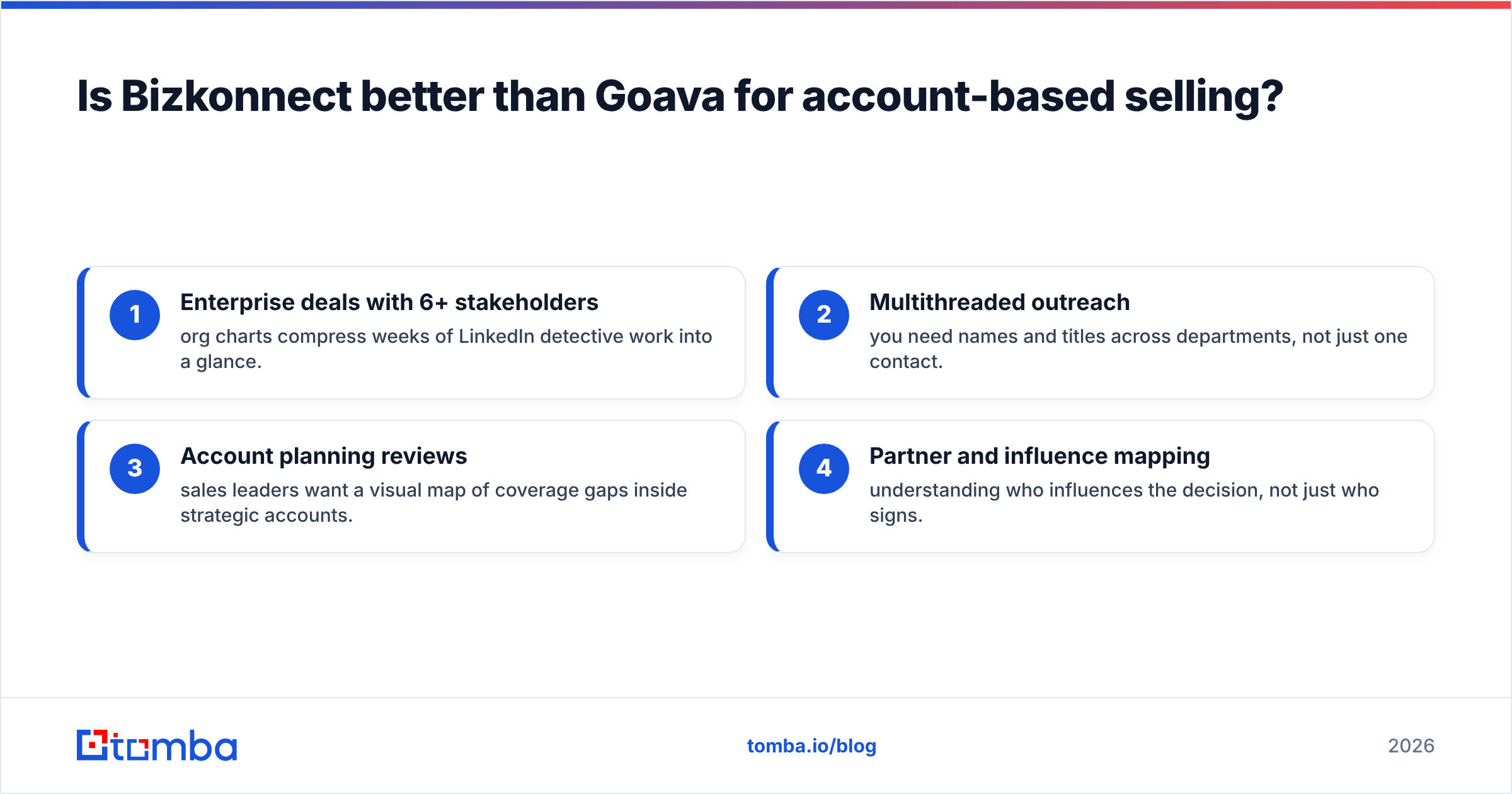
| Attribute | Bizkonnect | Goava |
|---|---|---|
| Primary job | Org charts + account intelligence | AI lead recommendations |
| Best for | ABM into large enterprises | Mid-market prospecting, Nordic focus |
| Core data unit | People + reporting lines | Companies + buying signals |
| Geographic strength | US + global enterprises | Nordics (Sweden, Norway, Denmark, Finland) |
| Contact emails included | Limited / not core | Limited / not core |
| Verification of emails | Not a focus | Not a focus |
| CRM integration | Salesforce, HubSpot | Salesforce, HubSpot, Pipedrive, Upsales |
| Pricing model | Quote-based (enterprise) | Tiered SaaS, quote-based |
| Free self-serve tier | No | No (trial/demo) |
Two takeaways stand out. First, both are company- and people-discovery tools, not contact-delivery tools — the "emails included" and "verification" rows are where each leaves a gap. Second, geography matters more than marketing pages admit: if your motion is Nordic mid-market, Goava's local data depth is a genuine advantage; if you're selling into Fortune 500 buying committees in North America, Bizkonnect's org-chart depth is the differentiator.
Is Bizkonnect better than Goava for account-based selling?#
For classic account-based selling, Bizkonnect usually wins — with a caveat.
ABM lives or dies on knowing the buying committee. When you've already chosen 50 named accounts and need to map every stakeholder, an org chart is worth more than a recommendation engine that tells you which accounts to choose. Bizkonnect's reporting-line data lets you build multithreaded plays: reach the champion, the economic buyer, and the blocker in parallel instead of serially discovering them.
That said, here are the four scenarios where Bizkonnect is the stronger pick:
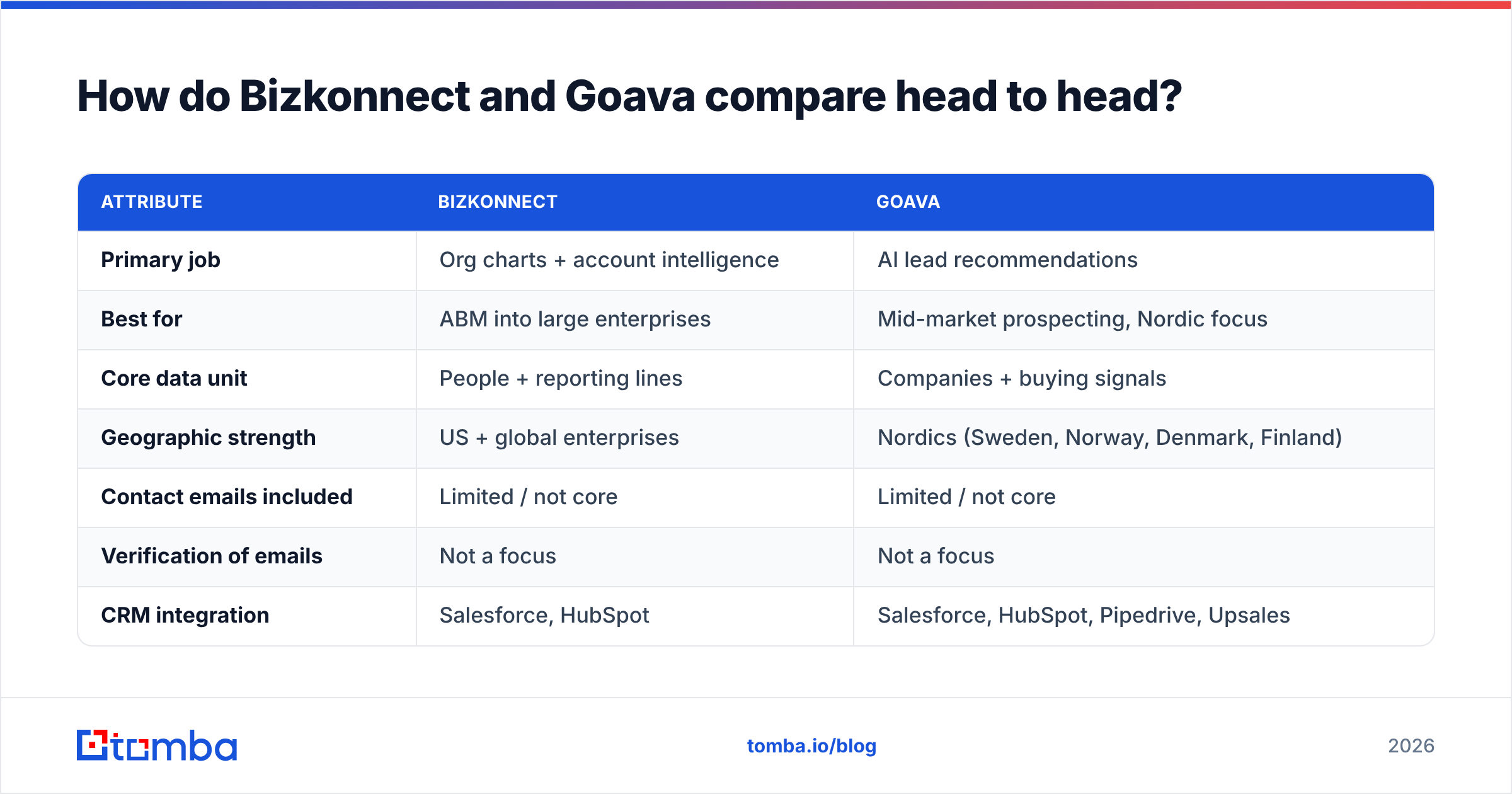
- Enterprise deals with 6+ stakeholders — org charts compress weeks of LinkedIn detective work into a glance.
- Multithreaded outreach — you need names and titles across departments, not just one contact.
- Account planning reviews — sales leaders want a visual map of coverage gaps inside strategic accounts.
- Partner and influence mapping — understanding who influences the decision, not just who signs.
Where Bizkonnect falls short: it tells you who, rarely how to reach them. The org chart gives you "Jane Doe, VP Operations" — but not Jane's verified work email. That's the handoff point where most teams bolt on an email finder to convert titles into deliverable addresses.
Is Goava better than Bizkonnect for finding new accounts?#
Yes — Goava is the better top-of-funnel tool when your problem is account selection, not account mapping.
If your reps are staring at a blank territory and asking "who should I even call?", Goava's recommendation engine earns its keep. It ranks companies by similarity to your closed-won deals and layers in buying signals (hiring, funding, tech adoption). For Nordic teams especially, the local registry data means firmographics like revenue, employee count, and ownership structure are accurate rather than estimated.
Goava shines in these cases:
- Greenfield territories where reps need a prioritized target list, not a database dump.
- Nordic GTM where global tools under-cover Swedish, Norwegian, Danish, and Finnish companies.
- Signal-based outbound triggered by hiring or funding events.
- Mid-market velocity where you can't afford to manually research every account.
The same limitation applies, though. Goava points you at a great-fit company and maybe a few contacts — but turning "Acme AB looks like a strong fit" into a verified inbox still needs a dedicated data step. A domain search against the recommended company fills that gap by returning the email patterns and known addresses on that domain.
Where do both tools leave a gap — and how do you fill it?#
Both Bizkonnect and Goava stop one step short of outreach: neither is a reliable, verified email source.
This is the quiet truth of the sales intelligence category. Discovery tools are excellent at finding and prioritizing, but the contact data they ship is often thin, stale, or unverified — and sending to unverified addresses is the fastest way to wreck your email deliverability and sender reputation. A 20% bounce rate from bad data doesn't just waste sends; it tells inbox providers you're a spammer.
That's why most mature GTM stacks treat account/people discovery and contact data as two separate layers:
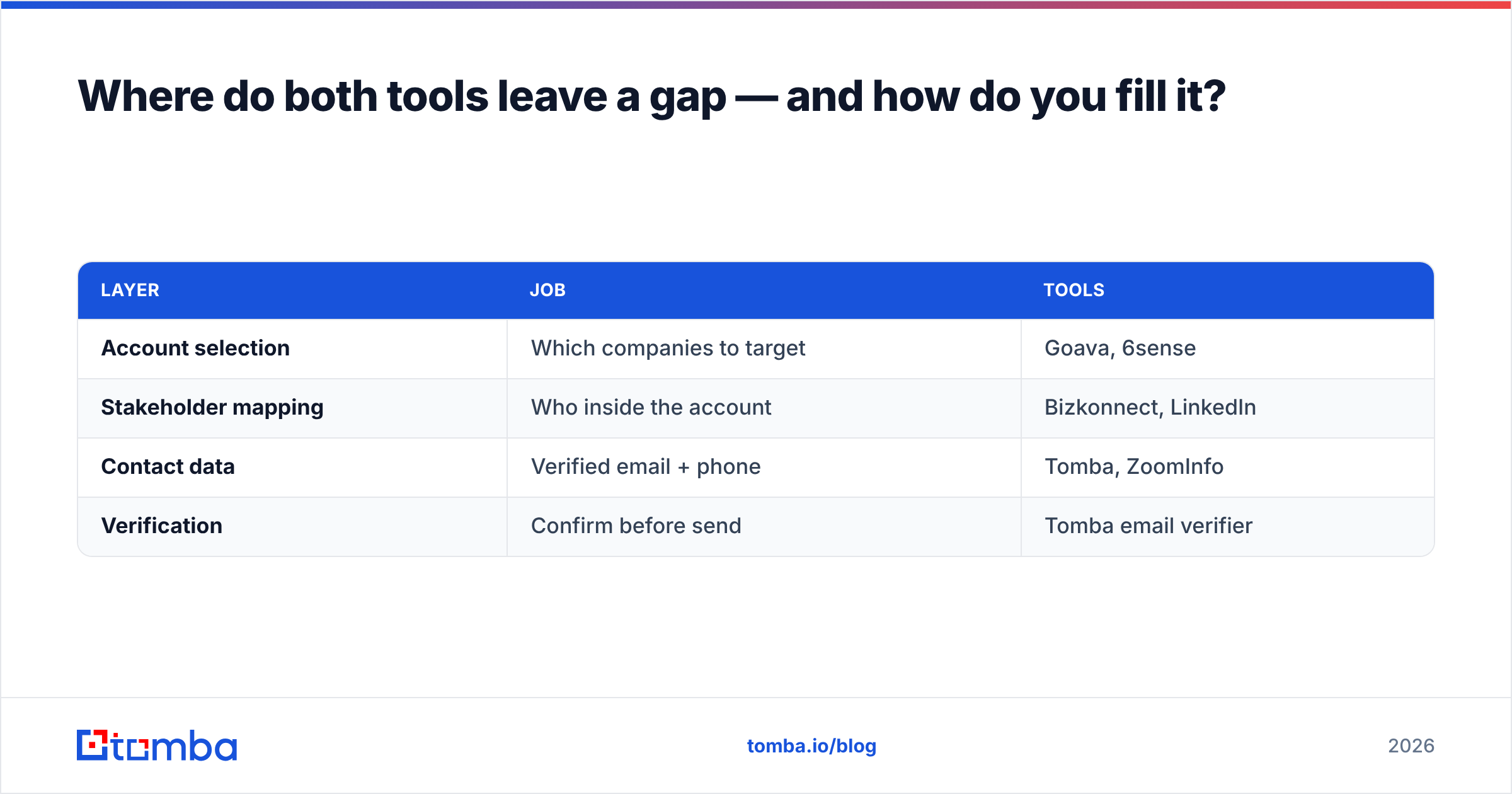
| Layer | Job | Tools |
|---|---|---|
| Account selection | Which companies to target | Goava, 6sense |
| Stakeholder mapping | Who inside the account | Bizkonnect, LinkedIn |
| Contact data | Verified email + phone | Tomba, ZoomInfo |
| Verification | Confirm before send | Tomba email verifier |
)
The contact-and-verification layer is where Tomba slots in. Once Bizkonnect hands you a name or Goava hands you a company, Tomba's email verifier confirms whether an address is deliverable before it ever hits your sequence — and its catch-all handling resolves the domains that trip up cheaper tools. For teams running at volume, the bulk email finder processes an entire exported account list in one pass instead of one lookup at a time.
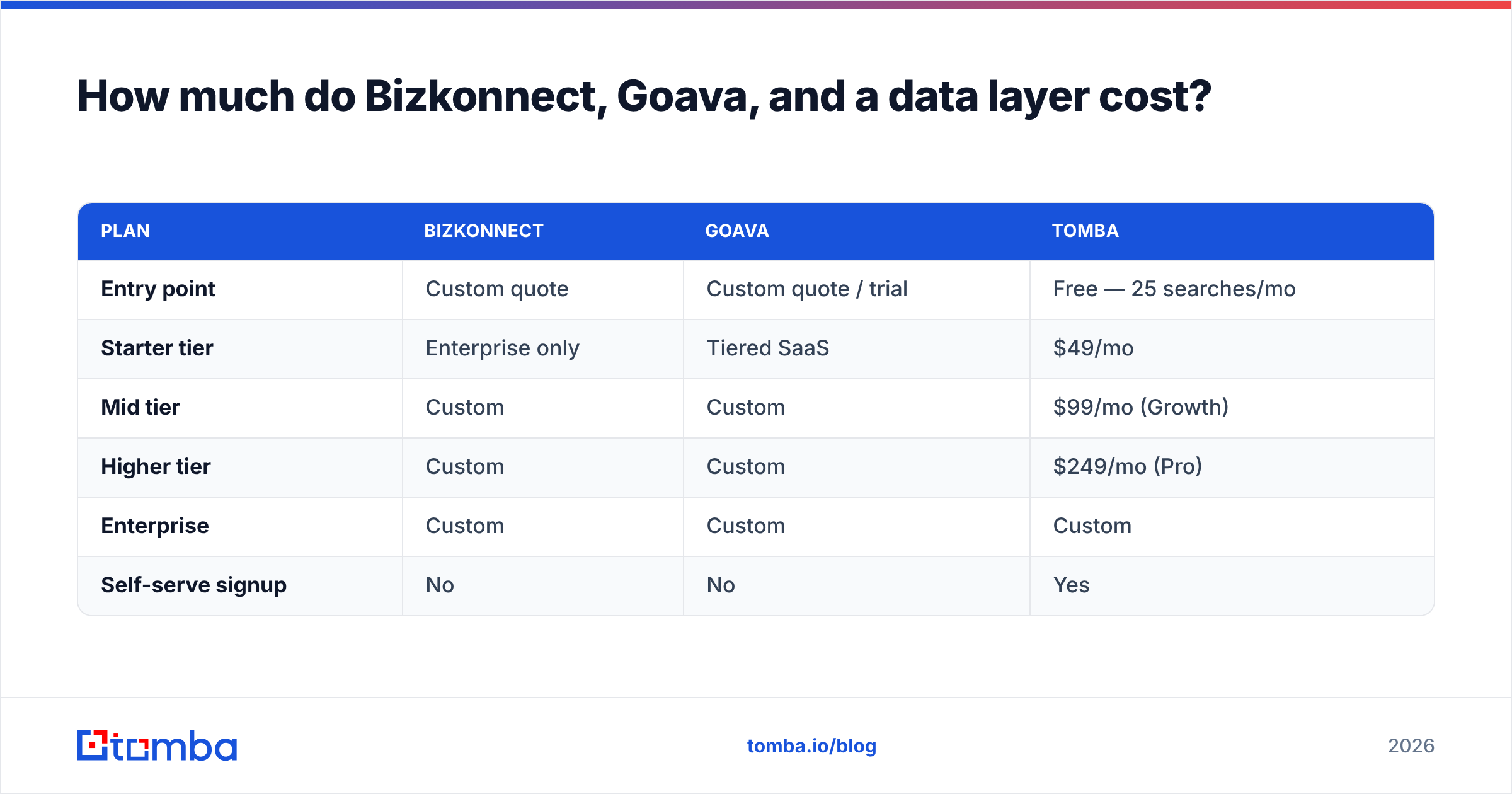
How much do Bizkonnect, Goava, and a data layer cost?#
Both Bizkonnect and Goava are quote-based, which means real numbers depend on seats and data volume — but here's how the cost structure compares to a transparent, self-serve data layer.
| Plan | Bizkonnect | Goava | Tomba |
|---|---|---|---|
| Entry point | Custom quote | Custom quote / trial | Free — 25 searches/mo |
| Starter tier | Enterprise only | Tiered SaaS | $49/mo |
| Mid tier | Custom | Custom | $99/mo (Growth) |
| Higher tier | Custom | Custom | $249/mo (Pro) |
| Enterprise | Custom | Custom | Custom |
| Self-serve signup | No | No | Yes |
The structural difference: sales intelligence platforms like Bizkonnect and Goava are typically annual, sales-led contracts. A pure data layer can be self-serve and usage-priced — you can start free and scale up. You can see full Tomba pricing without a sales call, which matters when you want to validate data quality before committing budget.
A practical budgeting note: don't treat these as either/or line items competing for the same dollar. Bizkonnect or Goava is your intelligence spend; the data layer is your execution spend. Cutting the verification layer to save money is a false economy — you pay it back in bounces, blocked domains, and burned rep hours.
Which tool should you actually choose?#
Match the tool to your bottleneck, not to a feature list.
- Choose Bizkonnect if your accounts are already chosen and your pain is mapping deep buying committees inside large enterprises. Its org-chart automation is the clearest reason to buy.
- Choose Goava if you're selling into the Nordics or need an AI engine to prioritize a fresh territory. Its local data depth and recommendation logic are hard to replicate with global tools.
- Choose neither (yet) if your real gap is contact data and deliverability. A lot of teams buy expensive intelligence platforms when what's actually breaking is a 30% bounce rate — that's a data-quality problem, solved by accurate finding and verification, not by another recommendation engine.
Most high-performing teams run a thin version of all three: one discovery tool for prioritization, optional org-chart data for enterprise accounts, and a verified data enrichment layer underneath everything. The discovery tools tell you where to dig; the data layer makes sure you can actually reach who you find.
If you're evaluating the broader category, it's worth comparing against alternatives in adjacent niches — an Apollo alternative or Clearbit alternative shortlist will show you how all-in-one platforms bundle discovery and data together versus the best-of-breed approach. Industry review sites like G2 and Capterra are useful for verified user sentiment, and analyst coverage from Gartner helps frame where each vendor sits in the wider revenue-tech landscape.
The bottom line on Bizkonnect vs Goava#
Bizkonnect and Goava are both strong at what they do — Bizkonnect for mapping who's inside an account, Goava for choosing which accounts deserve attention. Neither is wrong; they're just answering different questions. The mistake is expecting either to deliver verified, deliverable contact data, because that's not what they're built for.
Whichever you pick, plug in a data layer that turns names and company domains into emails your sequences can actually reach. Tomba's email finder finds professional addresses by name, domain, or company, then verifies them before you send — so the accounts your intelligence tools surface don't die at a bounced inbox. Start free with 25 searches a month, scale to the $49/mo Starter plan when you're ready, and keep your deliverability clean while Bizkonnect and Goava handle the discovery.
// get started
Find, verify and enrich your first contacts today
Start on the free plan with 25 searches a month, then scale when your team is ready.
Free plan · No credit card required · GDPR & CCPA
// about the author