Bounceban vs Cufinder 2026: Which B2B Data Tool Wins?
Bounceban verifies risky catch-all emails; Cufinder finds and enriches B2B leads. Here's a side-by-side breakdown of accuracy, pricing, and the best use case for each in 2026 — plus where a finder-plus-verifier stack beats both.
You are comparing two tools that solve two different problems, and that is the first thing to get straight. Bounceban is built to verify email addresses — especially the risky catch-all ones most validators skip. Cufinder is built to find and enrich B2B contacts and companies. Put plainly: one tells you whether an address is safe to mail, the other hands you the address in the first place.
This guide breaks down Bounceban vs Cufinder on accuracy, pricing, features, and use case, then shows where each one fits a real outbound workflow in 2026.
TL;DR — Bounceban vs Cufinder in 30 seconds#
- Bounceban is an email verification specialist. Its standout is real-time catch-all and role-account verification, where generic bulk validators tend to return "unknown."
- Cufinder is a B2B data platform — email finder, company enrichment, and a contact database with dozens of enrichment endpoints.
- They are not true competitors. You verify with one; you prospect with the other.
- If you only buy one, buy the tool that fixes your bottleneck: bad bounce rates → Bounceban; empty pipeline → Cufinder.
- The cleanest setup is a finder that also verifies in one place. That is where a combined platform like Tomba Email Finder earns its spot, and we cover it at the end.
)
What is Bounceban and who is it for?#
Bounceban is an email verification service. You feed it addresses — one at a time through an API or in bulk through a list upload — and it returns a deliverability verdict: valid, invalid, risky, or catch-all.
Its differentiator is catch-all handling. A catch-all domain accepts every address at the SMTP layer, so a normal verifier cannot tell a real mailbox from a typo. Most tools shrug and label these "unknown" or "accept-all," and you are left guessing. Bounceban runs deeper real-time checks to push more of those into a confident yes or no, which matters because catch-all domains are common at mid-market and enterprise companies.
Who it fits:
- Cold email senders protecting domain reputation and inbox placement.
- List owners scrubbing aging databases before a campaign.
- RevOps teams validating form-fill and signup emails in real time via API.
What Bounceban does not do is find emails. If your CRM row says "Jane Doe, VP Marketing, Acme" but has no email, Bounceban has nothing to verify yet. You need a finder first. For the mechanics of cleaning a list, our guide to the email verifier workflow walks through the same verdict categories.
What is Cufinder and who is it for?#
Cufinder is an AI-powered B2B lead generation and data enrichment platform. It starts from a company name, domain, or person and returns business data: work emails, phone numbers, company firmographics, technologies, and social profiles. It also exposes a large set of enrichment endpoints — company-to-email, name-to-email, domain-to-company, and so on — aimed at people building lists and enriching CRM records at scale.
Who it fits:
- SDRs and growth teams building targeted prospect lists from scratch.
- Data and ops teams enriching thin CRM records in bulk.
- Marketers appending firmographic and technographic fields for segmentation.
Cufinder includes basic email validation on its found addresses, but verification is a feature, not its core engineering focus. Its center of gravity is discovery and enrichment — populating the row, not stress-testing it. If you want the difference between finding by company and finding by person, the domain search pattern is the same concept Cufinder uses for its company-to-email endpoint.
Bounceban vs Cufinder: the core difference#
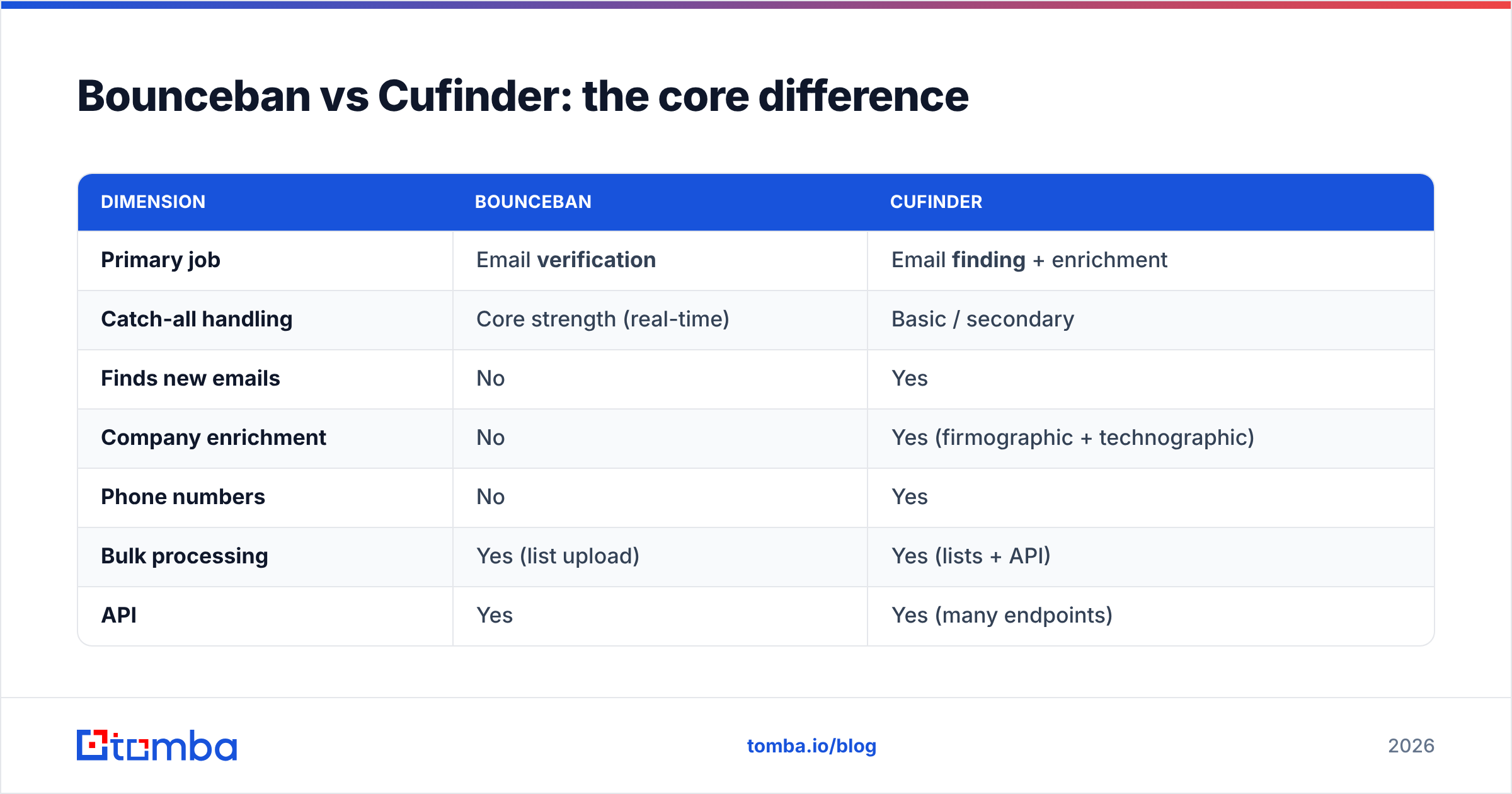
Here is the cleanest way to hold it in your head. Finding an email is like getting someone's phone number; verifying it is like calling once to confirm the line still rings before you schedule the real call. Cufinder gets you the number. Bounceban confirms the line is live. You usually want both steps, in that order.
| Dimension | Bounceban | Cufinder |
|---|---|---|
| Primary job | Email verification | Email finding + enrichment |
| Catch-all handling | Core strength (real-time) | Basic / secondary |
| Finds new emails | No | Yes |
| Company enrichment | No | Yes (firmographic + technographic) |
| Phone numbers | No | Yes |
| Bulk processing | Yes (list upload) | Yes (lists + API) |
| API | Yes | Yes (many endpoints) |
| Best fit | Protecting deliverability | Filling the pipeline |
| Weakness | Can't source contacts | Verification is secondary |
The table makes the trap obvious: buying one when you needed the other. A team with a full CRM and a 9% bounce rate does not need Cufinder — it needs verification. A team with a clean but empty database does not need Bounceban — it needs a finder. Diagnose the bottleneck first.
Which is more accurate?#
Accuracy means two different things here, so compare like with like.
For verification accuracy, the metric is how often the tool correctly classifies an address — and critically, how many catch-all and role-based addresses it resolves instead of dumping into "unknown." This is Bounceban's home turf. A verifier that confidently clears catch-all domains protects your bounce rate better than one that hedges, because every "unknown" you mail anyway is a coin flip against your sender reputation.
For finding accuracy, the metric is hit rate (what share of your input rows return an email) multiplied by the share of those emails that are actually valid. A finder can boast a high hit rate while quietly handing you stale or guessed addresses, which is why a finder's built-in verification matters so much. This is the axis Cufinder competes on, alongside the rest of the B2B data market.

The honest takeaway: you cannot rank these two on a single accuracy number because they measure different things. Bounceban wins on verification depth. Cufinder competes on data coverage. The mistake is assuming a high finder hit rate removes the need to verify — it does not. Even the best finders return addresses that were valid last quarter and bounce today, which is why the highest-deliverability teams always run a verification pass before send, no matter where the address came from.
Pricing: Bounceban vs Cufinder#
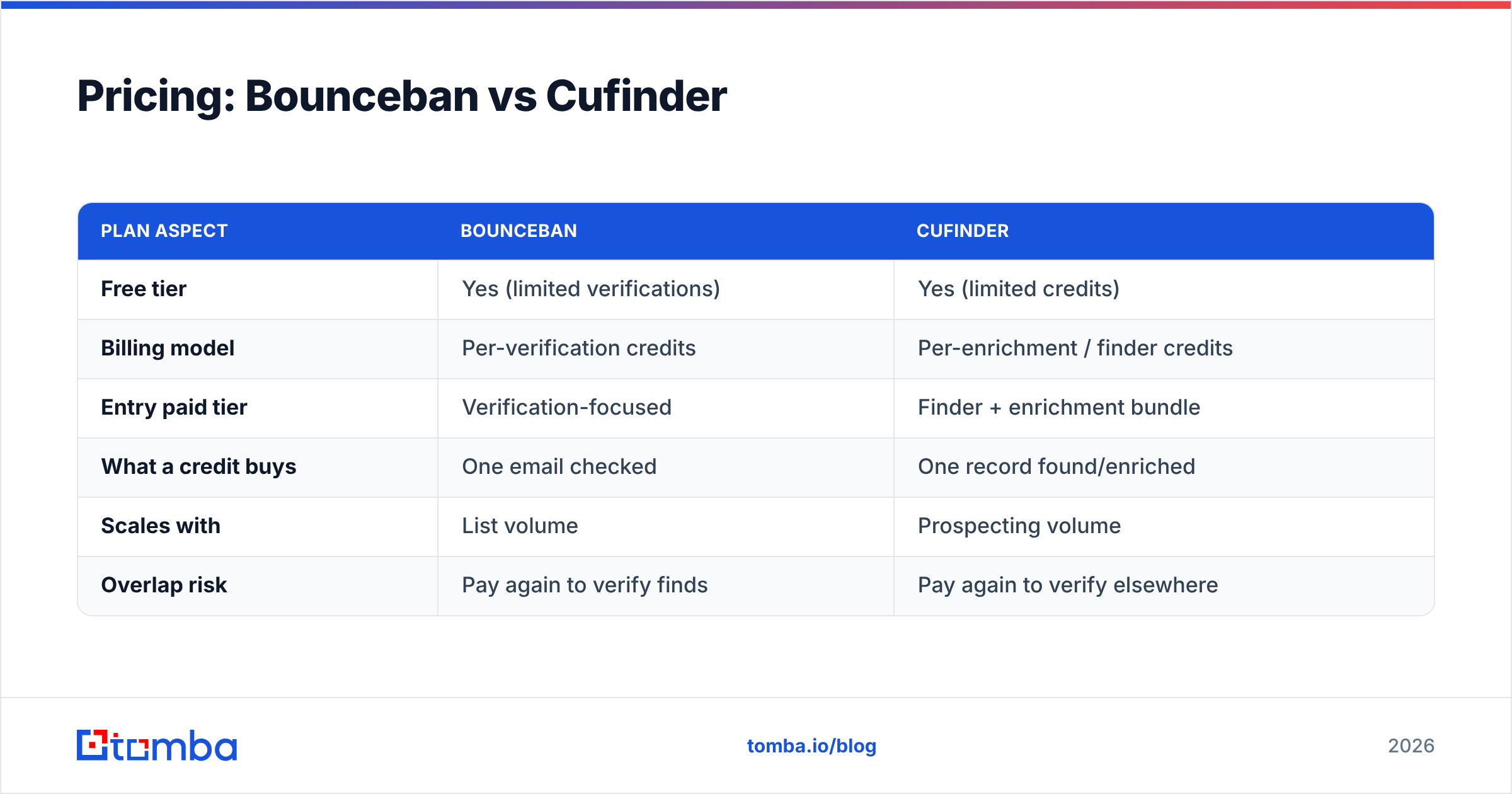
Both vendors use credit-based tiers with a free entry point, and both adjust pricing regularly, so treat the figures below as structure rather than exact quotes — confirm live numbers on each vendor's site before you buy.
| Plan aspect | Bounceban | Cufinder |
|---|---|---|
| Free tier | Yes (limited verifications) | Yes (limited credits) |
| Billing model | Per-verification credits | Per-enrichment / finder credits |
| Entry paid tier | Verification-focused | Finder + enrichment bundle |
| What a credit buys | One email checked | One record found/enriched |
| Scales with | List volume | Prospecting volume |
| Overlap risk | Pay again to verify finds | Pay again to verify elsewhere |
Notice the "overlap risk" row. If you run Cufinder to find and then Bounceban to verify, you are paying two vendors, reconciling two credit systems, and moving CSVs between two dashboards. For a small team that is real overhead. The math only favors two specialists when your volume is high enough that best-in-class depth on each side pays for the friction. Below that line, a single tool that finds and verifies together is cheaper and simpler — compare the bundled approach against these two on Tomba pricing.
)
Can you use Bounceban and Cufinder together?#
Yes, and for some teams it is the right call. The pipeline looks like this:
- Cufinder sources contacts from your target account list and enriches the firmographics.
- Export the found emails.
- Bounceban verifies the list, with special attention to catch-all domains.
- Suppress invalid and risky addresses.
- Load only the clean, verified contacts into your sequencer.
That stack works. The cost is operational: two subscriptions, two APIs, and a manual export-import step that someone has to own. If your prospecting runs at enterprise scale and you want the deepest specialist on each side, the friction is worth it.
If you are a lean team, every handoff between tools is a place data goes stale or a step gets skipped under deadline. That is the argument for consolidation — not because specialists are bad, but because most teams do not operate at the volume that justifies running two.
Where a combined finder-plus-verifier fits#
The reason "Bounceban vs Cufinder" is slightly the wrong question is that it assumes you must pick a side — find or verify — and then go buy the other half somewhere else. A platform that does both in one pass removes the seam entirely.
That is the lane Tomba sits in. You search by domain or by person, get the email, and the address is checked against the same verification layer before it lands in your export — no second tool, no CSV round-trip. The supporting pieces live under one roof too:
- Find: the email finder and domain search for person- and company-level lookups.
- Verify: the email verifier and a dedicated catch-all verifier for the exact risky-domain case Bounceban specializes in.
- Scale: bulk email finder and the Tomba API for programmatic find-and-verify in one call.
- Enrich: data enrichment to append the firmographic fields you would otherwise reach for Cufinder to get.

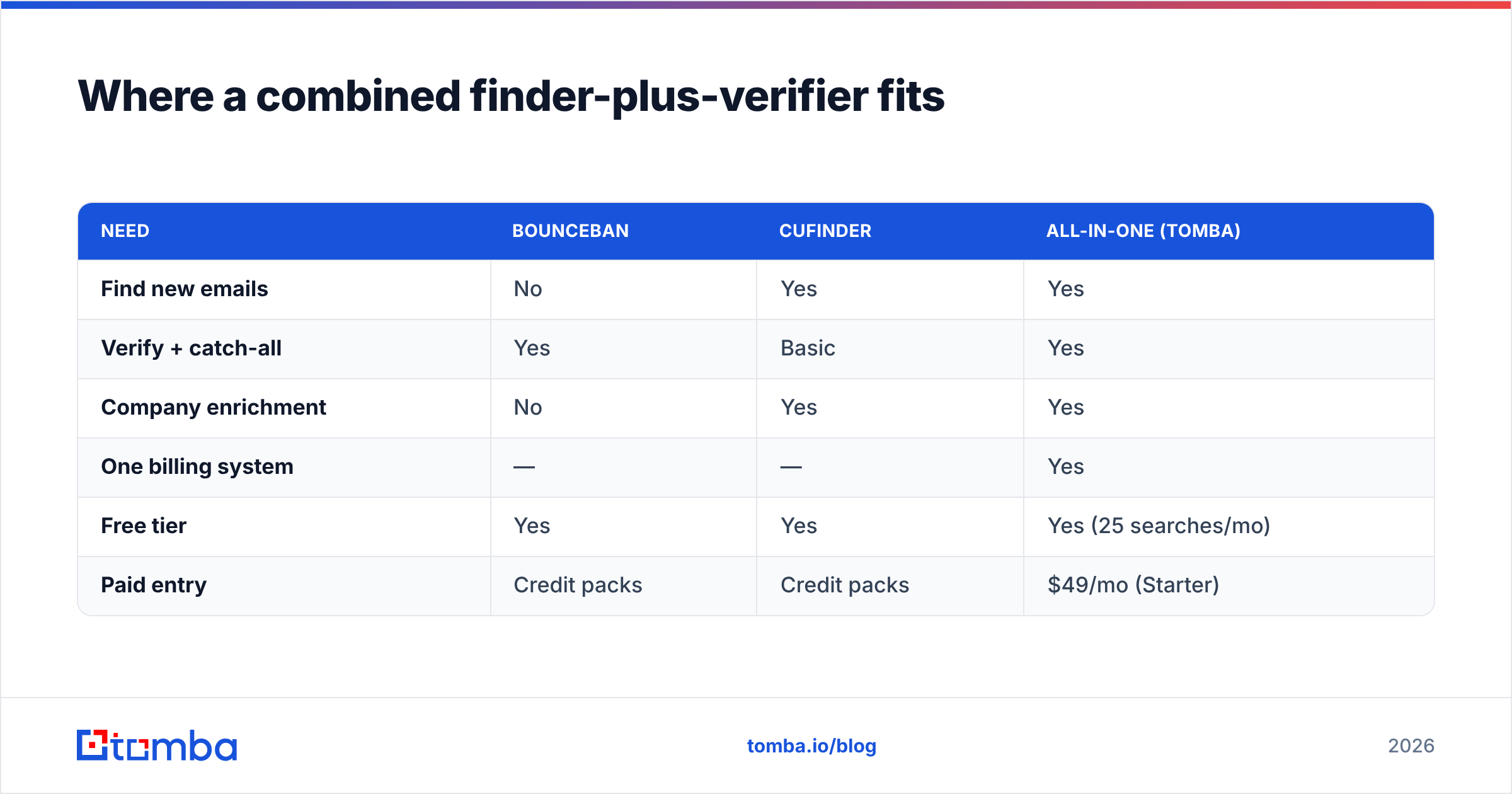
| Need | Bounceban | Cufinder | All-in-one (Tomba) |
|---|---|---|---|
| Find new emails | No | Yes | Yes |
| Verify + catch-all | Yes | Basic | Yes |
| Company enrichment | No | Yes | Yes |
| One billing system | — | — | Yes |
| Free tier | Yes | Yes | Yes (25 searches/mo) |
| Paid entry | Credit packs | Credit packs | $49/mo (Starter) |
This is not a claim that specialists never make sense. If verification depth is your single most important requirement and you process millions of addresses, a dedicated verifier may still edge out a bundled one. The point is narrower: most teams comparing these two are really looking for "find good emails and don't bounce," and that whole job can be one subscription instead of two.
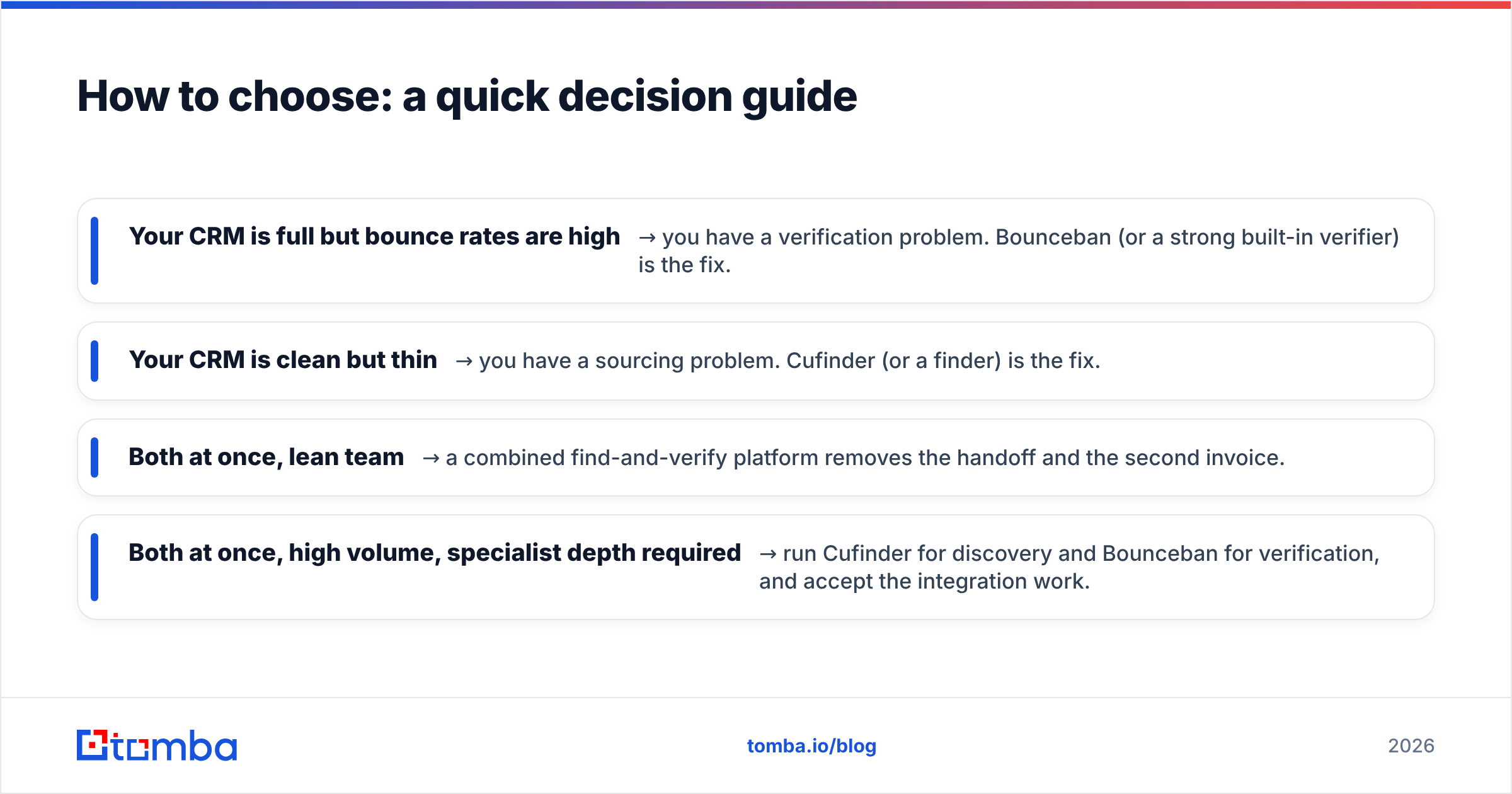
How to choose: a quick decision guide#
Match the tool to your actual bottleneck.
- Your CRM is full but bounce rates are high → you have a verification problem. Bounceban (or a strong built-in verifier) is the fix.
- Your CRM is clean but thin → you have a sourcing problem. Cufinder (or a finder) is the fix.
- Both at once, lean team → a combined find-and-verify platform removes the handoff and the second invoice.
- Both at once, high volume, specialist depth required → run Cufinder for discovery and Bounceban for verification, and accept the integration work.
For deeper context on why verification protects more than your bounce rate, read up on email deliverability and how sender reputation compounds over time. Both vendors are also listed with verified user reviews on G2 and Capterra if you want third-party signal before committing — and you can always sanity-check a vendor's own claims against its official Cufinder site directly.
The bottom line#
Bounceban and Cufinder are not rivals — they are two halves of the same job. Bounceban verifies, with real strength on catch-all domains. Cufinder finds and enriches. Pick the one that fixes your bottleneck, or, if your team is lean and wants to skip the two-vendor juggling act, choose a platform that does both in a single pass.
If that last option sounds right, start with the Tomba Email Finder. Find the address and verify it before it ever hits your sequencer — one tool, one bill, one clean list. The free tier gives you 25 searches a month to test it against your own data, and paid plans start at $49/mo when you are ready to scale.
// get started
Find, verify and enrich your first contacts today
Start on the free plan with 25 searches a month, then scale when your team is ready.
Free plan · No credit card required · GDPR & CCPA
// about the author