Brandnav vs RocketReach 2026: Which Email Finder Wins?
Brandnav vs RocketReach compared on accuracy, pricing, data coverage, and verification — plus where a leaner alternative beats both in 2026.
You are choosing between two email-finding tools, and the marketing pages all say the same thing: "highest accuracy," "billions of contacts," "trusted by teams worldwide." This post strips the slogans out and compares Brandnav vs RocketReach on the only things that move your pipeline — match rates, verification, pricing per credit, and how fast you can get verified emails into a sequence.
TL;DR#
- RocketReach has the bigger raw database and personal-email/phone coverage, but its accuracy is uneven on smaller domains and pricing climbs fast once you need exports.
- Brandnav is the cheaper, lighter option focused on B2B work email lookup, but its data depth and integrations trail RocketReach on enterprise use cases.
- Both bill by credits, and both make catch-all domains your problem — you pay for guesses unless you verify separately.
- If accuracy-per-dollar and built-in verification matter more than a giant consumer-data graph, a focused email finder like Tomba beats both on cost — $49/mo Starter vs RocketReach's higher export tiers.
- Pick by job: RocketReach for recruiter-style personal contact hunting, Brandnav for budget B2B lists, Tomba when you want verified work emails at scale with an API.
What are Brandnav and RocketReach?#
Both tools solve the same core problem: you have a name and a company, and you need a working email address. They differ in how they get there.
RocketReach is one of the older players in the contact-data space. It aggregates emails, personal phone numbers, and social profiles from a large web-scraped graph, and it's popular with recruiters and salespeople who need to reach people on personal channels, not just first.last@company.com. Its pitch is breadth — RocketReach claims hundreds of millions of professionals.
Brandnav is the newer, leaner entrant. It positions itself as an affordable B2B email finder and verifier, leaning on company-domain pattern matching and SMTP checks rather than a massive proprietary identity graph. The appeal is price: it undercuts the established names to win cost-sensitive teams.
The honest framing: RocketReach is a data graph you query; Brandnav is a lookup engine you point at domains. That distinction drives almost every difference below.
How accurate is each email finder?#
Accuracy is where the marketing and the reality diverge most, so be skeptical of any single number — including the ones vendors publish.
RocketReach's strength is coverage on well-known companies and senior people. If you're targeting VPs at Fortune 5000 firms, its hit rate is strong because those profiles appear across many public sources it can cross-reference. Its weakness is the long tail: small businesses, non-US domains, and recently-changed roles, where its data goes stale or returns a guess.
Brandnav, because it relies more on pattern inference plus SMTP verification, can actually do well on standard corporate domains with predictable formats (jane.doe@acme.com). But it struggles where there's no clean pattern, on catch-all domains, and on anyone whose email doesn't follow the company template.
The variable that wrecks both tools is the catch-all domain — a server that accepts every address, so an SMTP check can't tell a real inbox from a typo. Neither tool fully solves this, which is why a dedicated catch-all verifier matters if catch-alls are common in your market. For a deeper benchmark of how finders stack up on accuracy, this independent comparison is a useful reference point:

The takeaway: don't trust a vendor's headline accuracy figure. Run the same 50 test prospects through any tool's free tier and measure the verified-deliverable rate yourself, because accuracy is segment-specific.
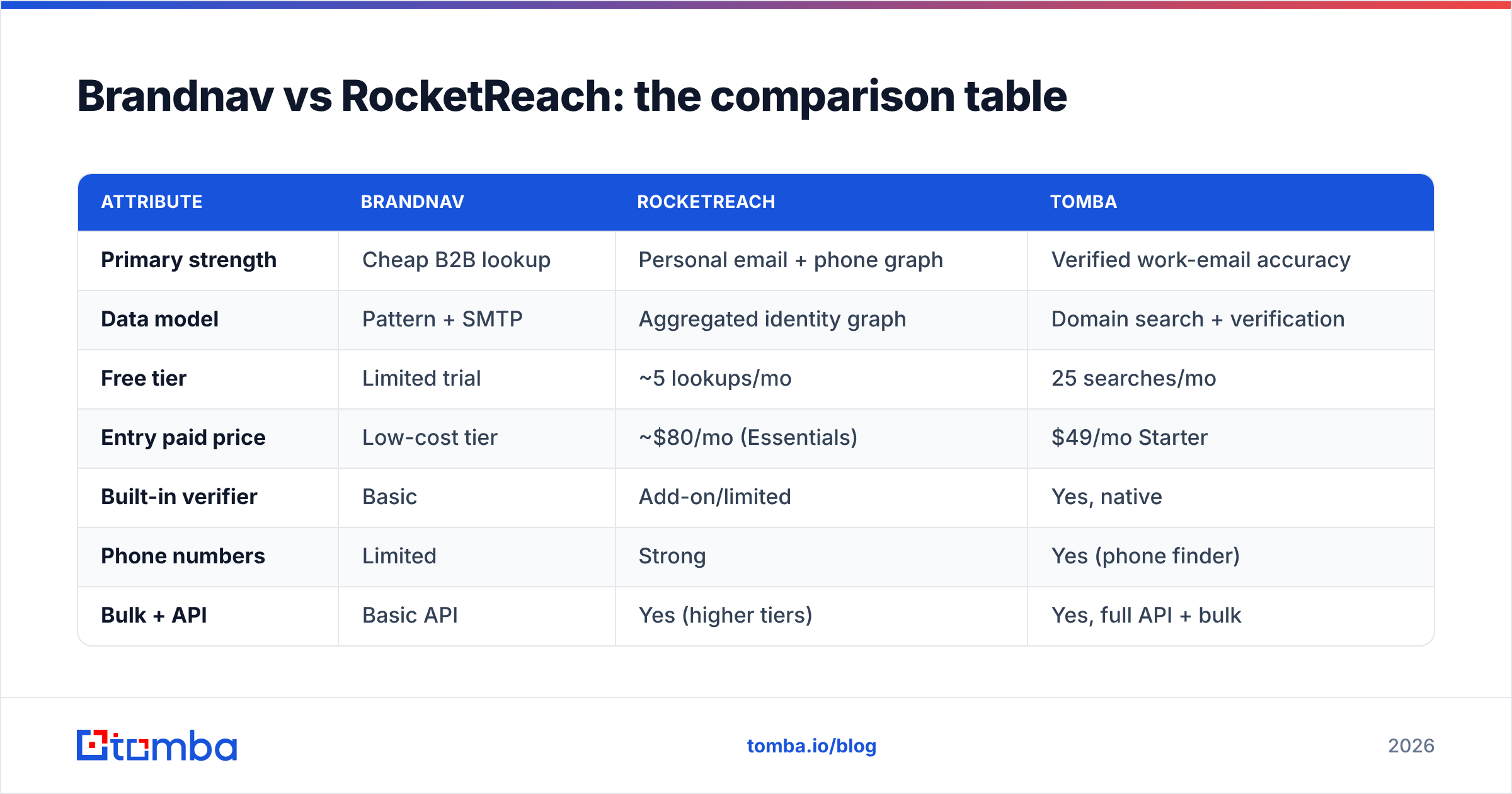
Brandnav vs RocketReach: the comparison table#
Here is the head-to-head on the attributes that actually affect cost and workflow. Treat published database sizes as directional, not gospel.
| Attribute | Brandnav | RocketReach | Tomba |
|---|---|---|---|
| Primary strength | Cheap B2B lookup | Personal email + phone graph | Verified work-email accuracy |
| Data model | Pattern + SMTP | Aggregated identity graph | Domain search + verification |
| Free tier | Limited trial | ~5 lookups/mo | 25 searches/mo |
| Entry paid price | Low-cost tier | ~$80/mo (Essentials) | $49/mo Starter |
| Built-in verifier | Basic | Add-on/limited | Yes, native |
| Phone numbers | Limited | Strong | Yes (phone finder) |
| Bulk + API | Basic API | Yes (higher tiers) | Yes, full API + bulk |
| Catch-all handling | Weak | Weak | Dedicated tooling |
| Best for | Budget B2B lists | Recruiters, personal reach | Scaled verified outreach |
A few notes on reading this table. RocketReach wins on personal channels — if you need someone's mobile or personal Gmail, it's built for that. Brandnav wins on floor price for plain B2B work emails. And both bill credits per lookup whether or not the result is deliverable, so your real cost is "price ÷ verified hit rate," not the sticker price.
How does pricing really compare?#
Conclusion first: RocketReach is more expensive but more capable; Brandnav is cheaper but thinner; and per verified email, a verification-native tool often beats both.
RocketReach's pricing tiers scale by lookup volume and by whether you need email-only or email-plus-phone, and exports/integrations are gated to higher plans. That's the classic gotcha — the affordable tier doesn't include the bulk export you actually need, so your effective price is a tier or two up from the advertised entry point.
Brandnav competes purely on being cheaper. That's a legitimate reason to pick it for a small, price-sensitive operation. But cheaper per credit isn't cheaper per result if more of those credits return unverified or bounced addresses — every bounce also taxes your sender reputation, which is a hidden cost that never shows on the invoice.
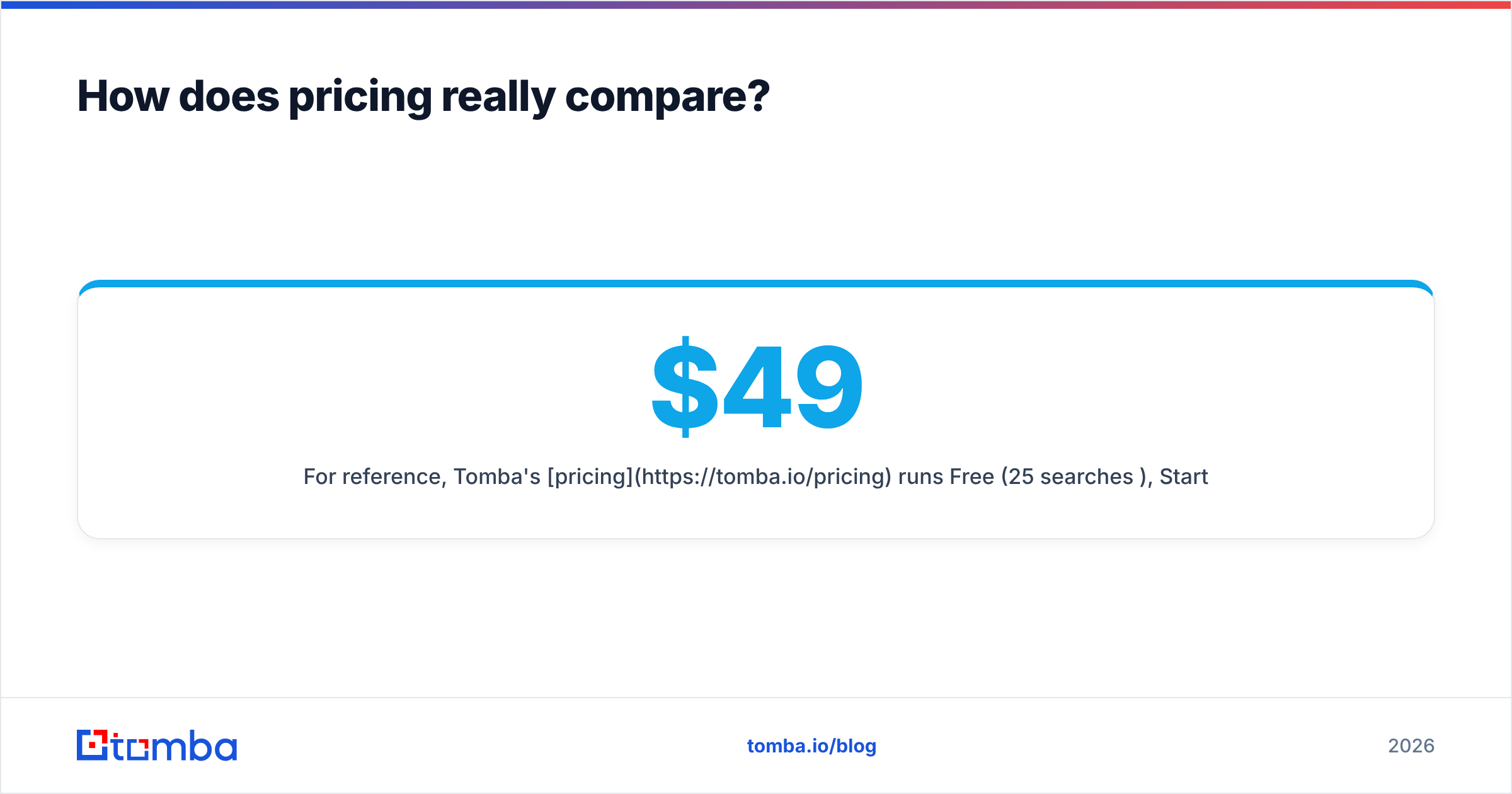
For reference, Tomba's pricing runs Free (25 searches/mo), Starter $49/mo, Growth $99/mo, and Pro $249/mo, with verification included rather than sold as a separate line item. When you compare, normalize everything to cost per verified, deliverable email — that single metric reorders the rankings more than any feature list.
Which has better data coverage and integrations?#
This is RocketReach's clearest win. Its integration list (CRM connectors, Chrome extension, Zapier, ATS tools) is broader, and its data spans personal contact info that Brandnav simply doesn't carry. If your workflow is "find a recruiter's mobile number and personal email from a LinkedIn profile," RocketReach is purpose-built for it and Brandnav isn't really competing in that lane.
Brandnav's coverage is narrower by design — work emails on identifiable company domains. For pure outbound B2B that's often enough, and you're not paying for a consumer-data graph you'll never query.
Where both leave gaps:
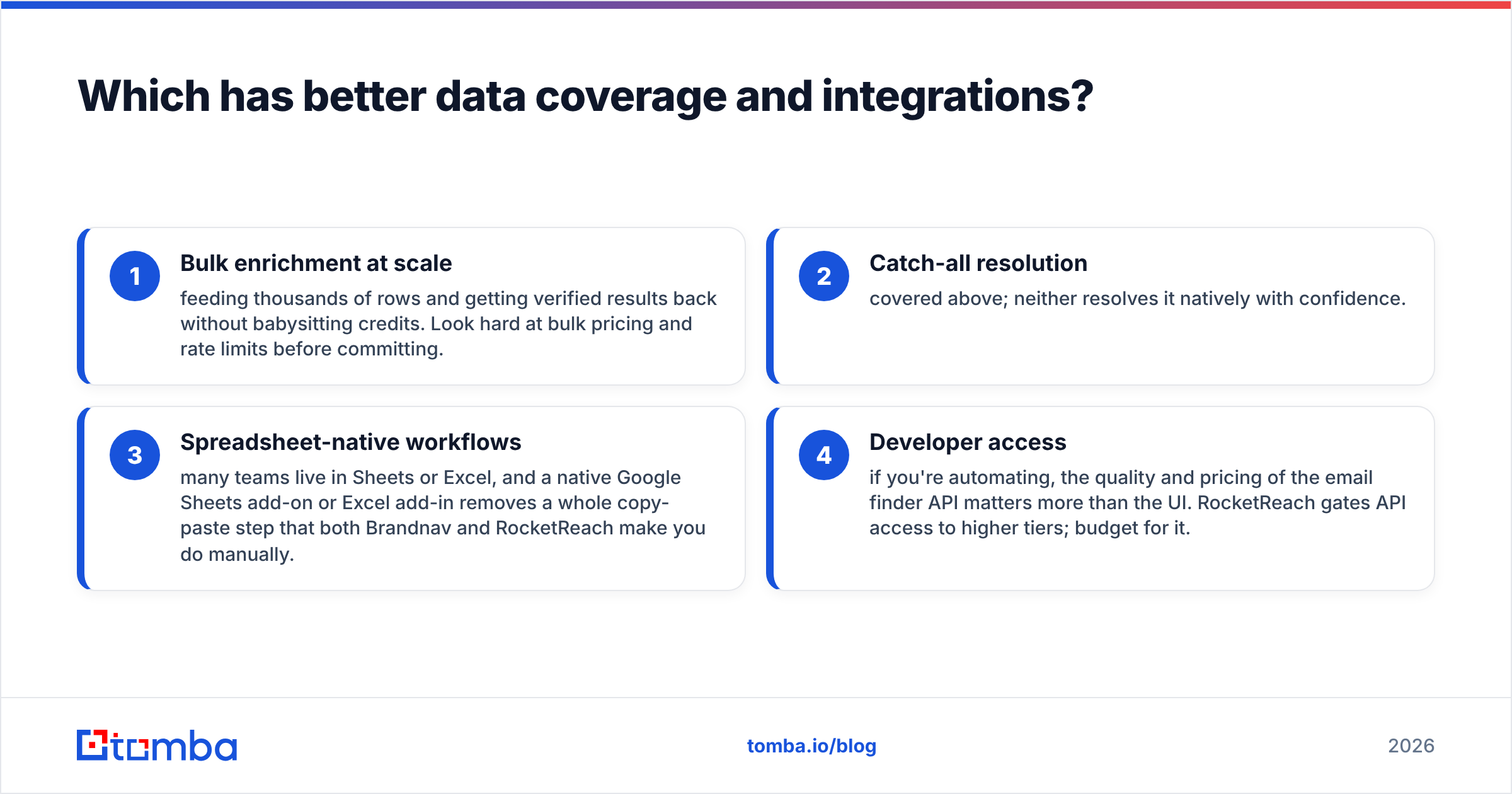
- Bulk enrichment at scale — feeding thousands of rows and getting verified results back without babysitting credits. Look hard at bulk pricing and rate limits before committing.
- Catch-all resolution — covered above; neither resolves it natively with confidence.
- Spreadsheet-native workflows — many teams live in Sheets or Excel, and a native Google Sheets add-on or Excel add-in removes a whole copy-paste step that both Brandnav and RocketReach make you do manually.
- Developer access — if you're automating, the quality and pricing of the email finder API matters more than the UI. RocketReach gates API access to higher tiers; budget for it.
Is there a better alternative to both?#
Maybe — it depends on what you optimize for. Here's the honest decision tree.
Choose RocketReach if you need personal emails and phone numbers, you target senior people at large companies, and your budget tolerates the higher tiers and export gating. Its identity graph is the product, and nothing on the budget end replicates it.
Choose Brandnav if you only need standard B2B work emails, you're cost-constrained, and you can tolerate weaker coverage on the long tail and catch-alls. It's a reasonable floor-price tool for small lists.
Choose a verification-native finder like Tomba if your priority is cost per verified email at scale with a real API, bulk processing, and integrations. Tomba pairs the email finder with a native email verifier and domain search, so you find and confirm in one workflow instead of paying two vendors. For teams replacing an incumbent, the RocketReach alternative breakdown maps feature parity directly.
Here's the side-by-side of finder tools in the broader market, which is useful when you're shortlisting beyond just these two:

What should you actually test before buying?#
Don't buy on the comparison table alone — including this one. Run a real bake-off:
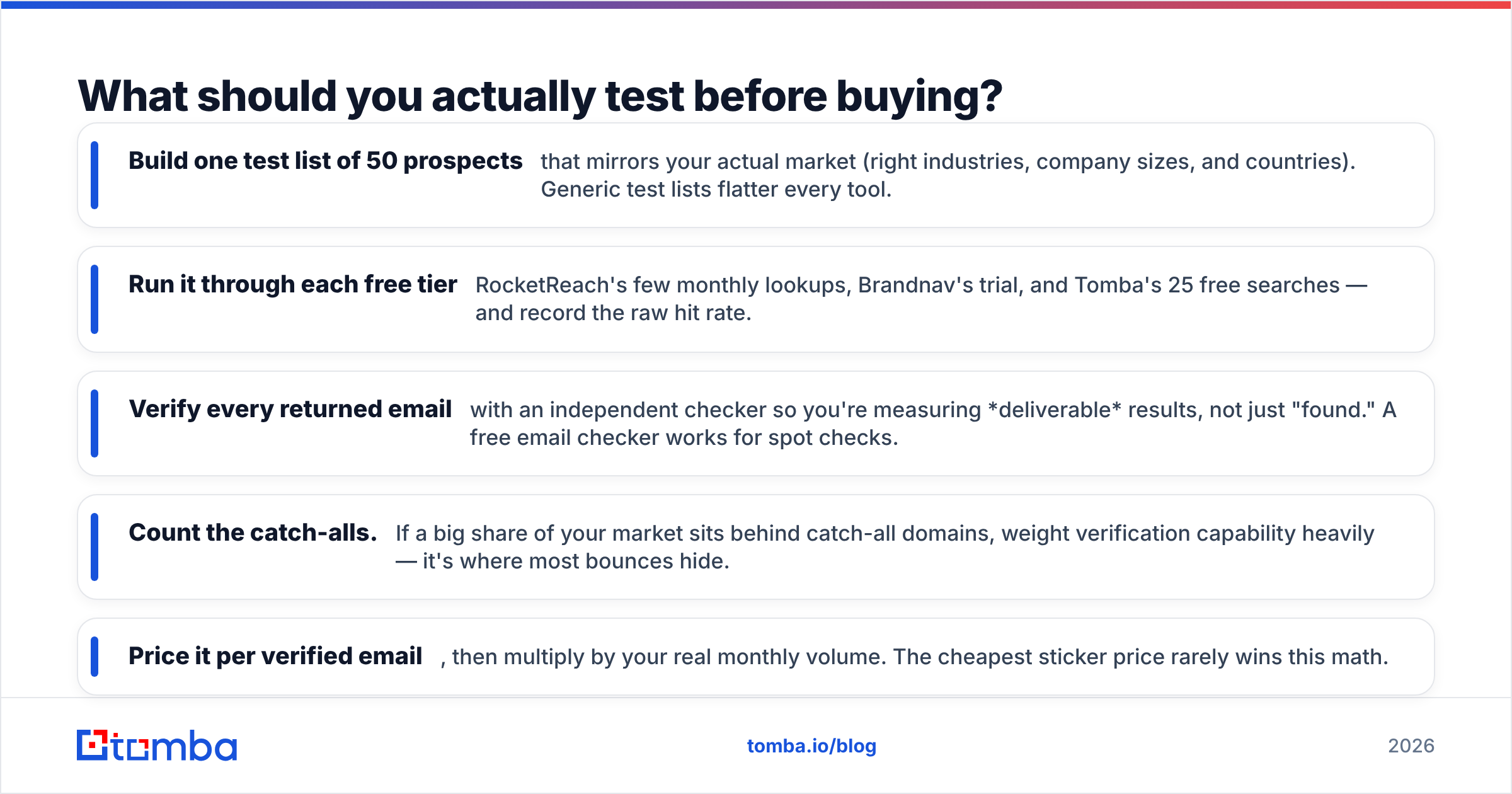
- Build one test list of 50 prospects that mirrors your actual market (right industries, company sizes, and countries). Generic test lists flatter every tool.
- Run it through each free tier — RocketReach's few monthly lookups, Brandnav's trial, and Tomba's 25 free searches — and record the raw hit rate.
- Verify every returned email with an independent checker so you're measuring deliverable results, not just "found." A free email checker works for spot checks.
- Count the catch-alls. If a big share of your market sits behind catch-all domains, weight verification capability heavily — it's where most bounces hide.
- Price it per verified email, then multiply by your real monthly volume. The cheapest sticker price rarely wins this math.
That five-step test takes an afternoon and tells you more than any review, because it measures the tools against your data, not a vendor's curated demo.
Final verdict#
There's no single winner — there's a winner for your job. RocketReach is the deepest data graph and the right pick for personal-contact and recruiter use cases, as long as you accept the price and export gating. Brandnav is the budget B2B option that's fine for small, simple lists but thins out on coverage and catch-alls. And if you're scaling verified B2B outreach and care about cost per deliverable email, a verification-native tool usually beats both on the metric that matters.
If that's you, start with Tomba's Email Finder — find professional email addresses by domain, name, or company, verify them in the same workflow, and run 25 searches free before you spend a credit. When you're ready to scale, the $49/mo Starter plan keeps your cost-per-verified-email low without gating exports behind an enterprise contract. Find the emails, verify them, and put your budget toward sending — not toward bounces.
// get started
Find, verify and enrich your first contacts today
Start on the free plan with 25 searches a month, then scale when your team is ready.
Free plan · No credit card required · GDPR & CCPA
// about the author