Buyer Behaviour Explained: The 2026 B2B Sales Playbook
Understand how B2B buyers actually decide in 2026 — the signals, stages, and data that let you reach the right people before your competitors do.
TL;DR
- Buyer behaviour is the set of decisions, triggers, and patterns that move a B2B buyer from "unaware" to "signed contract" — and in 2026 most of that journey happens before a rep is ever contacted.
- The modern B2B purchase involves 6–10 stakeholders, long anonymous research phases, and a buying committee that rarely raises its hand until it has already shortlisted vendors.
- Reading buyer behaviour means combining intent signals, stage awareness, and accurate contact data — guesswork loses to evidence every time.
- The biggest lever sellers control is timing: reach the committee while they are actively researching, not after they have decided.
- Tools that turn behavioural signals into verified contacts (like the Tomba Email Finder) shorten the gap between "they are in-market" and "we are in the conversation."
What is buyer behaviour in B2B sales?#
Buyer behaviour is the study of how and why organizations decide to purchase — the triggers, the people, the research habits, and the emotional and rational filters a buying committee runs every deal through. Think of it like watching customers move through a grocery store: you are not just tracking what lands in the cart, but which aisles they linger in, what they pick up and put back, and what made them walk in that day. In B2B, the "store" is mostly digital and the "cart" takes months to fill.
Technically, buyer behaviour spans three layers:
- Individual psychology — the personal motivations of each stakeholder (career risk, workload, status).
- Group dynamics — how a buying committee negotiates consensus, since B2B purchases are rarely a solo decision.
- Organizational drivers — budget cycles, compliance, growth targets, and competitive pressure.
What makes 2026 different is visibility. Buyers leave digital footprints — pricing-page visits, review-site research, community questions, repeat content downloads — long before they fill out a form. According to Gartner, B2B buyers spend only a small fraction of the buying journey actually talking to sales reps; the majority is independent research across digital and third-party channels. If you only react to inbound forms, you are seeing the last 10% of a story that started months earlier.
What are the stages of the B2B buyer journey?#
Buyer behaviour is easiest to act on when you map it to stages. The committee does not move in a clean line — they loop, regress, and revisit — but the phases below describe what is happening underneath.
- Problem identification. Something breaks, a target is missed, or a competitor moves. The buyer realizes the status quo is costing them. No vendor is in the room yet.
- Solution exploration. The buyer searches broadly, reads category content, and asks peers. This is where anonymous research peaks — and where most sellers are invisible.
- Requirements building. The committee writes down what "good" looks like. Features become checklists. Whoever shaped this list quietly controls the deal.
- Vendor selection. Shortlists form, demos happen, and references are checked on sites like G2. Price and risk dominate the conversation.
- Validation and purchase. Procurement, security, and legal stress-test the choice. Deals stall here more than anywhere else.
- Post-purchase behaviour. Onboarding, adoption, and renewal signals — the start of the next buying cycle.
Notice that two of the highest-leverage stages (exploration and requirements) happen before traditional sales engagement. That is why behavioural data beats waiting for a form fill: it lets you enter the conversation while the requirements are still being written.
Why does buyer behaviour matter more in 2026?#
Because the buyer moved, and most sales processes did not. Three shifts compound:
Bigger committees, more friction. A typical B2B deal now pulls in 6–10 decision-makers across functions — finance, security, the end users, an executive sponsor. Every added stakeholder is another set of motivations to read and another veto to neutralize. Selling to one champion and ignoring the committee is the fastest way to a "we decided to hold off" email.
Anonymous-first research. Buyers self-educate. They would rather read a response rate benchmark, scan a comparison page, and lurk in a Slack community than book a call. By the time they appear in your CRM, they have often already formed a preference.
Signal overload, attention scarcity. Buyers are flooded with outreach, so generic messaging is filtered out instantly. The only outreach that lands is the kind that reflects where the buyer actually is — which requires reading behaviour, not blasting a list.
The practical takeaway: the seller who reads buyer behaviour and reaches the committee early gets to frame the requirements. Everyone else competes on price at the end.
How do you read buyer behaviour signals?#
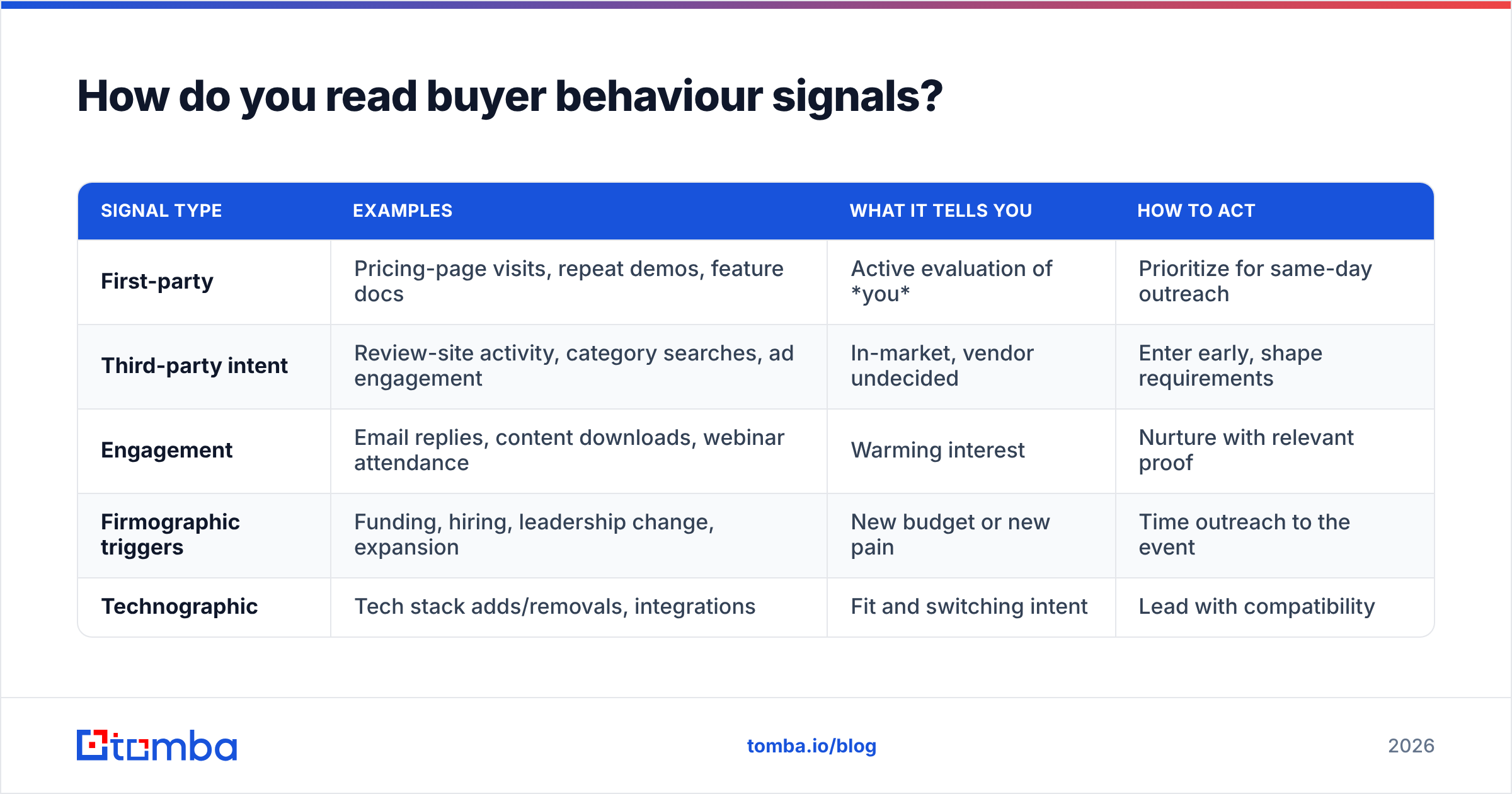
Signals are the observable evidence of intent. Grouping them by source makes them usable:
| Signal type | Examples | What it tells you | How to act |
|---|---|---|---|
| First-party | Pricing-page visits, repeat demos, feature docs | Active evaluation of you | Prioritize for same-day outreach |
| Third-party intent | Review-site activity, category searches, ad engagement | In-market, vendor undecided | Enter early, shape requirements |
| Engagement | Email replies, content downloads, webinar attendance | Warming interest | Nurture with relevant proof |
| Firmographic triggers | Funding, hiring, leadership change, expansion | New budget or new pain | Time outreach to the event |
| Technographic | Tech stack adds/removals, integrations | Fit and switching intent | Lead with compatibility |
The mistake is treating any single signal as a buying decision. A pricing-page visit alone is noise. A pricing-page visit plus a new VP of Sales plus three teammates downloading your comparison guide is a pattern. Behavioural reading is about stacking weak signals into a strong one.
This is also where data quality decides everything. A perfect signal is worthless if you cannot reach the human behind it. Identifying the in-market account is step one; getting verified contact details for the right committee members is step two — and the step most teams fumble with stale, scraped lists.
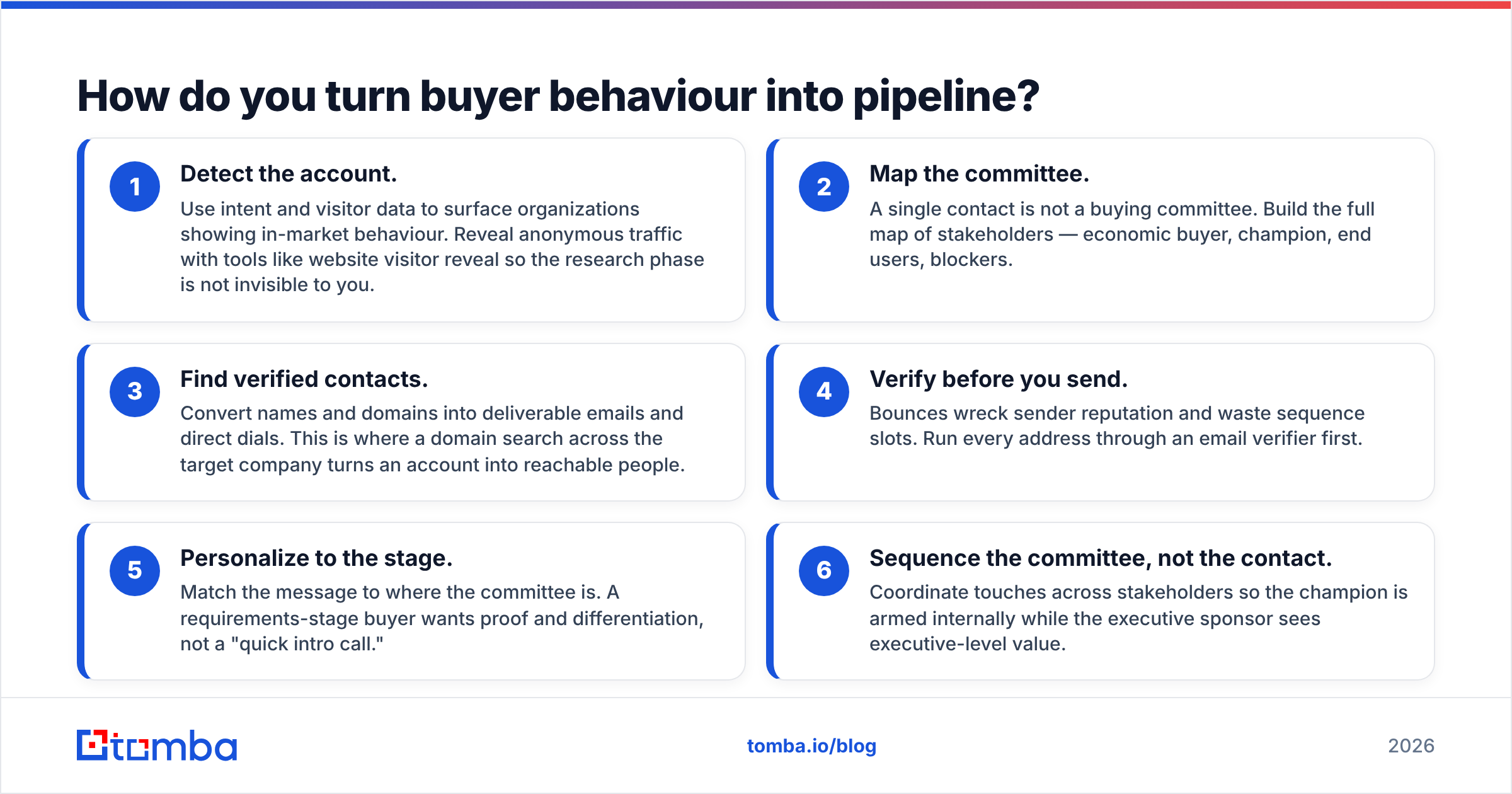
How do you turn buyer behaviour into pipeline?#
Reading behaviour is academic until it produces conversations. The workflow that consistently converts signal into pipeline looks like this:
- Detect the account. Use intent and visitor data to surface organizations showing in-market behaviour. Reveal anonymous traffic with tools like website visitor reveal so the research phase is not invisible to you.
- Map the committee. A single contact is not a buying committee. Build the full map of stakeholders — economic buyer, champion, end users, blockers.
- Find verified contacts. Convert names and domains into deliverable emails and direct dials. This is where a domain search across the target company turns an account into reachable people.
- Verify before you send. Bounces wreck sender reputation and waste sequence slots. Run every address through an email verifier first.
- Personalize to the stage. Match the message to where the committee is. A requirements-stage buyer wants proof and differentiation, not a "quick intro call."
- Sequence the committee, not the contact. Coordinate touches across stakeholders so the champion is armed internally while the executive sponsor sees executive-level value.
Each step compounds. Skip verification and your deliverability tanks; skip committee mapping and your champion gets overruled in a meeting you were not in.
Behavioural targeting vs spray-and-pray outreach#
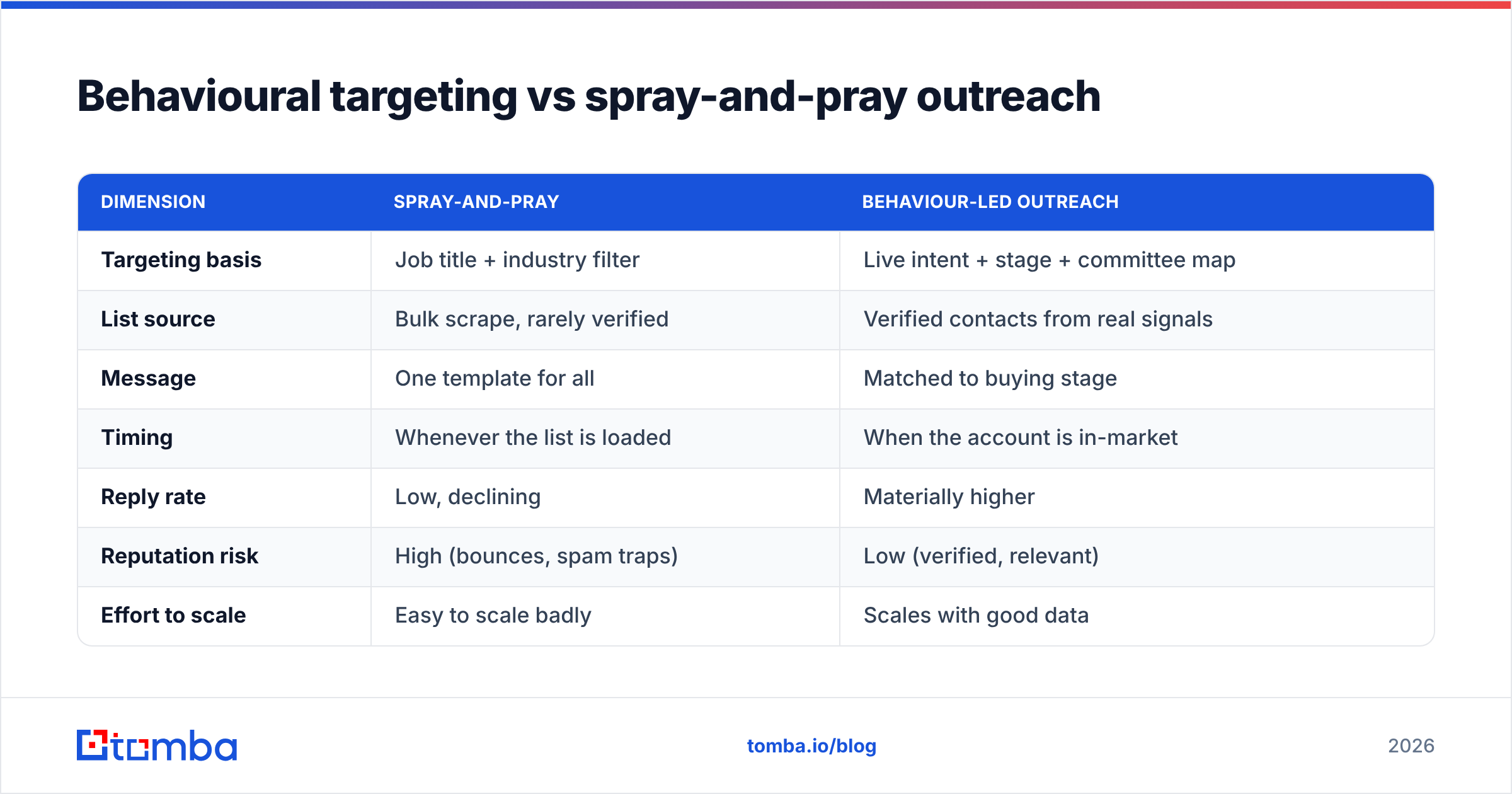
It helps to see the two operating models side by side, because the cost difference is not subtle.
| Dimension | Spray-and-pray | Behaviour-led outreach |
|---|---|---|
| Targeting basis | Job title + industry filter | Live intent + stage + committee map |
| List source | Bulk scrape, rarely verified | Verified contacts from real signals |
| Message | One template for all | Matched to buying stage |
| Timing | Whenever the list is loaded | When the account is in-market |
| Reply rate | Low, declining | Materially higher |
| Reputation risk | High (bounces, spam traps) | Low (verified, relevant) |
| Effort to scale | Easy to scale badly | Scales with good data |
Spray-and-pray feels productive because volume is easy to measure. But it burns your domain reputation and trains buyers to ignore you. Behaviour-led outreach trades raw volume for relevance, and relevance is the only thing that survives a crowded inbox. The constraint is data: behaviour-led only works if your contact data is accurate enough to act on signals quickly.
What role does data accuracy play in reading buyers?#
Data accuracy is the multiplier on every behavioural insight you collect. You can identify a perfect in-market account, map the entire committee, and time your outreach flawlessly — and still hit a wall if the emails bounce or the contact left the company eight months ago.
Three data problems quietly sabotage behavioural selling:
- Decay. B2B contact data degrades fast as people change roles. A list that was 95% accurate last year may be well below that today.
- Catch-all ambiguity. Many corporate domains accept all mail, so a naive verifier marks them "valid" when they may not be. A dedicated catch-all verifier resolves the uncertainty.
- Coverage gaps. Even strong tools miss segments. The fix is enrichment — filling missing fields so a thin signal becomes an actionable profile. That is what data enrichment is for.
Accuracy is also a deliverability issue, not just a convenience one. Every dead address you email chips at your sender reputation and pushes future messages toward spam. Reading buyer behaviour and then acting on dirty data is like spotting the perfect customer across the street and shouting the wrong name.
How does Tomba fit into a buyer-behaviour workflow?#
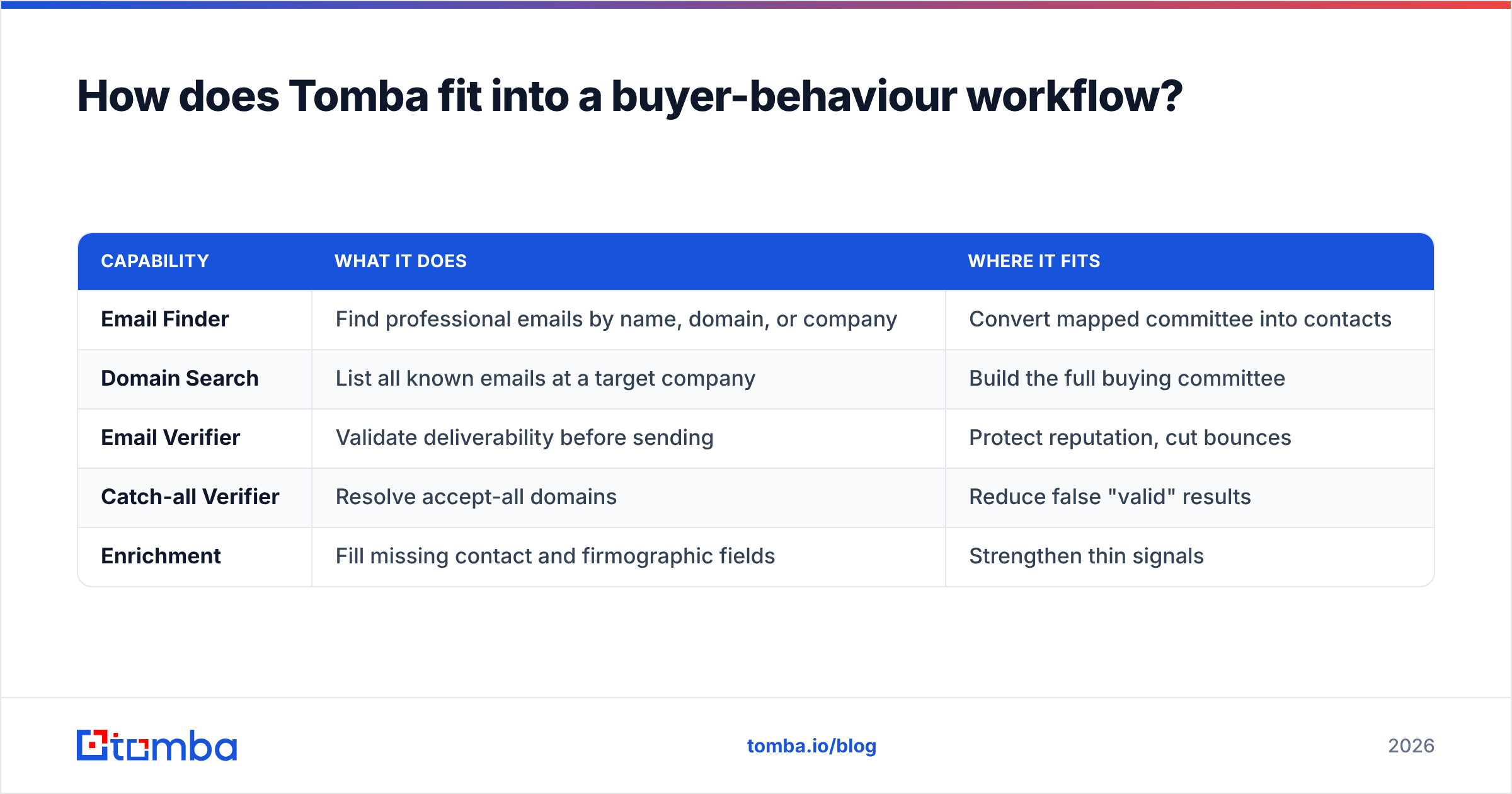
Tomba sits at the conversion point of the workflow — the moment a behavioural signal needs to become a real, reachable person. Once intent data tells you an account is in-market, Tomba turns the company and its committee into verified contacts you can sequence with confidence.
| Capability | What it does | Where it fits |
|---|---|---|
| Email Finder | Find professional emails by name, domain, or company | Convert mapped committee into contacts |
| Domain Search | List all known emails at a target company | Build the full buying committee |
| Email Verifier | Validate deliverability before sending | Protect reputation, cut bounces |
| Catch-all Verifier | Resolve accept-all domains | Reduce false "valid" results |
| Enrichment | Fill missing contact and firmographic fields | Strengthen thin signals |
Pricing is straightforward and scales with how much behaviour you are acting on. Tomba offers a Free tier (25 searches/mo), Starter at $49/mo, Growth at $99/mo, Pro at $249/mo, and a custom Enterprise plan. You can compare the full Tomba pricing tiers against your sending volume, but the practical point is this: behavioural targeting only pays off when the data layer underneath it is verified. For teams running outbound at scale, a bulk email finder workflow keeps the contact layer fresh as your signals refresh.
Common buyer-behaviour mistakes to avoid#
- Treating the champion as the committee. Win the champion, lose the security review — and the deal stalls. Map every stakeholder.
- Reacting only to forms. Form fills are the last 10% of the journey. If that is your only trigger, you are perpetually late.
- Confusing activity with intent. One click is not a buying decision. Stack signals before you spend a touch.
- Ignoring data decay. A "good" list six months ago is a liability today. Re-verify on a cadence.
- One message for every stage. A buyer building requirements does not want a closing pitch, and a validating buyer does not want a feature dump.
Each mistake has the same root cause: acting on assumptions instead of evidence. Buyer behaviour is observable. The teams that win in 2026 are the ones that bother to look — and that keep the contact data clean enough to act the moment a signal appears.
Turn buyer signals into booked conversations#
Reading buyer behaviour gives you the when and the who. The Tomba Email Finder gives you the verified, deliverable contact details to act on it before your competitors notice the same signal. Start on the free tier, map a single in-market account end to end, and feel the difference between guessing and knowing. When your behavioural data and your contact data finally line up, outbound stops being a numbers game and starts being a timing game — the one you can actually win.
// get started
Find, verify and enrich your first contacts today
Start on the free plan with 25 searches a month, then scale when your team is ready.
Free plan · No credit card required · GDPR & CCPA
// about the author