How to Reach C-Level Decision Makers: 2026 Sales Playbook
C-level decision makers ignore 95% of cold outreach. Here's the 2026 playbook for getting CEOs, CFOs, and CROs to actually reply — research, channels, timing, and the data that gets you past the gatekeeper.
How to Reach C-Level Decision Makers: The 2026 Sales Playbook
Selling to a CEO is not selling to a manager with a bigger title. The motivation is different, the attention span is shorter, and the cost of a generic email is total — one weak line and you are filtered forever. This guide breaks down how to reach c level decision makers in 2026 without spraying, begging, or burning your domain reputation.
TL;DR#
- C-level decision makers buy outcomes, not features. Lead with revenue, risk, or time — not your product tour.
- Research beats volume. A reply rate above 15% from executives comes from 20 well-built touches, not 2,000 blasted ones.
- Multi-threading wins. Pair the executive with a champion below them; most enterprise deals are decided by 6–10 people, not one.
- Bad data kills executive outreach first. A bounced email to a CFO does not just fail — it trains the spam filter against you. Verify before you send.
- Timing and channel matter as much as copy. Email + LinkedIn + a warm referral beats any single channel alone.
Who Counts as a C-Level Decision Maker?#
The short answer: anyone with "Chief" in their title and signing authority over your deal size. The longer answer is that the real decision maker is rarely the person who signs — it is the person who can say no without asking anyone.
C-level roles fall into a few recurring buying patterns. Knowing which one you are talking to changes your entire message.
- CEO — cares about growth, market position, and risk to the company's strategy. Reachable only with a thesis-level message, not a feature pitch. Usually delegates evaluation but blesses the budget.
- CFO — cares about ROI, payback period, and cost of inaction. Speaks in numbers; a vague "improve efficiency" line gets deleted. Owns the final yes on spend.
- CRO / CSO — cares about pipeline, quota attainment, and rep productivity. The easiest C-level buyer for sales tooling because they live your problem daily.
- CTO / CIO — cares about security, integration, and maintenance burden. Will block a deal on compliance grounds faster than approve it on features.
- COO — cares about process, scale, and operational risk. Often the hidden economic buyer in mid-market deals.
If you cannot name which of these you are emailing and what they personally lose by ignoring you, you are not ready to send.

Why Is It So Hard to Reach Executives?#
Three walls stand between you and a C-level inbox, and most reps only plan for the first one.
Wall 1 — The gatekeeper. Executive assistants, shared inboxes, and routing rules exist specifically to filter you out. They are very good at it.
Wall 2 — The spam filter. Executives sit on the most-targeted domains on earth. Their security stack is aggressive, and one cold blast from a cold domain lands you in quarantine before a human ever sees it. Protecting your sender reputation is a prerequisite, not an afterthought.
Wall 3 — The attention wall. Even if your email arrives, you have roughly two seconds and one line of preview text. A CEO reads the first sentence; a generic opener loses them in word three.
The reps who break through treat all three walls as a single system. They use accurate data to clear the spam filter, sharp research to clear the attention wall, and multi-threading to make the gatekeeper irrelevant.
What Does the Outreach Stack Look Like in 2026?#
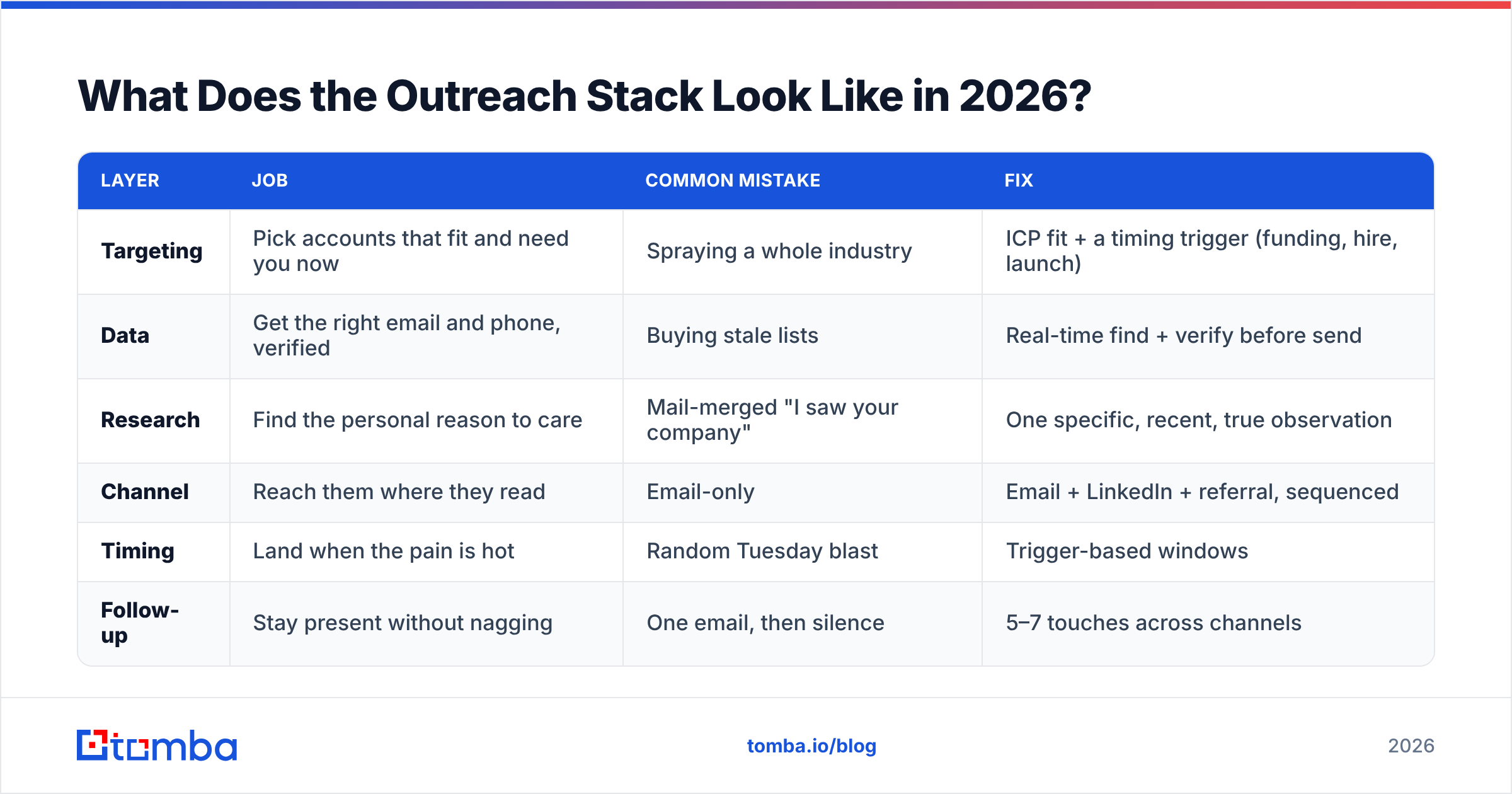
Reaching executives is a stack, not a single tactic. Each layer has a job, and skipping a layer is where most campaigns silently fail.
| Layer | Job | Common mistake | Fix |
|---|---|---|---|
| Targeting | Pick accounts that fit and need you now | Spraying a whole industry | ICP fit + a timing trigger (funding, hire, launch) |
| Data | Get the right email and phone, verified | Buying stale lists | Real-time find + verify before send |
| Research | Find the personal reason to care | Mail-merged "I saw your company" | One specific, recent, true observation |
| Channel | Reach them where they read | Email-only | Email + LinkedIn + referral, sequenced |
| Timing | Land when the pain is hot | Random Tuesday blast | Trigger-based windows |
| Follow-up | Stay present without nagging | One email, then silence | 5–7 touches across channels |
The expensive lesson most teams learn the hard way: the data layer breaks the rest. If your contact data is wrong, your research lands on the wrong person, your channels bounce, and your timing is moot. Get the data right first.
How Do You Find and Verify C-Level Contact Data?#
Conclusion first: never send to an executive address you have not verified. The cost of a wrong guess is higher at the C-level than anywhere else in the org.
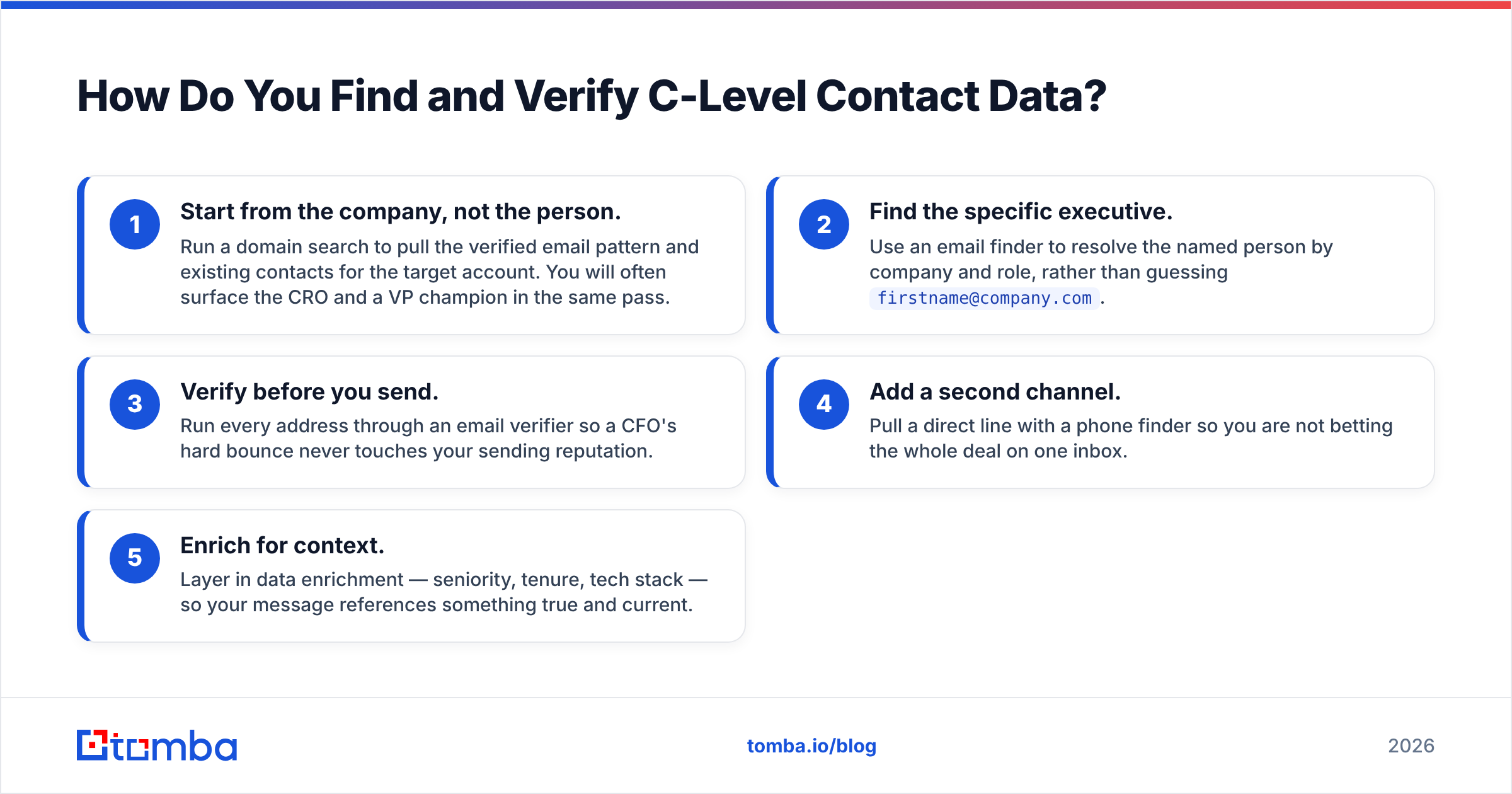
Here is the workflow that actually scales without trashing your domain:
- Start from the company, not the person. Run a domain search to pull the verified email pattern and existing contacts for the target account. You will often surface the CRO and a VP champion in the same pass.
- Find the specific executive. Use an email finder to resolve the named person by company and role, rather than guessing
firstname@company.com. - Verify before you send. Run every address through an email verifier so a CFO's hard bounce never touches your sending reputation.
- Add a second channel. Pull a direct line with a phone finder so you are not betting the whole deal on one inbox.
- Enrich for context. Layer in data enrichment — seniority, tenure, tech stack — so your message references something true and current.
This is the difference between "I think this is the CFO's email" and "this is verified, and I have a backup channel." At executive volume, that difference is your whole reply rate.
How Should You Write to a C-Level Decision Maker?#
Write less, and make every word earn its place. Executives reward brevity and punish padding.
The four-line structure that works:
- The trigger — one sentence proving you researched them, not their logo. "Saw you just moved cloud spend to the CFO's P&L line in the Q1 call."
- The thesis — the outcome you drive, in their language. CFO: payback. CRO: pipeline. CEO: growth or risk.
- The proof — one number or one peer, no paragraph. "We cut [peer]'s ramp time 40%."
- The ask — small and specific. "Worth a 15-minute look, or should I send this to [VP name]?"
That last line is the multi-threading trick: you give the executive an easy delegate-down option, which is what they were going to do anyway. You just made it frictionless and kept your name on it.
Avoid the three openers that get you deleted instantly: "I hope this finds you well," "Quick question," and "I'd love to pick your brain." Executives have seen each of them ten thousand times. For sharper subject lines, a subject line tester will tell you what reads as automated before you hit send.
Which Channels Reach Executives Best?#
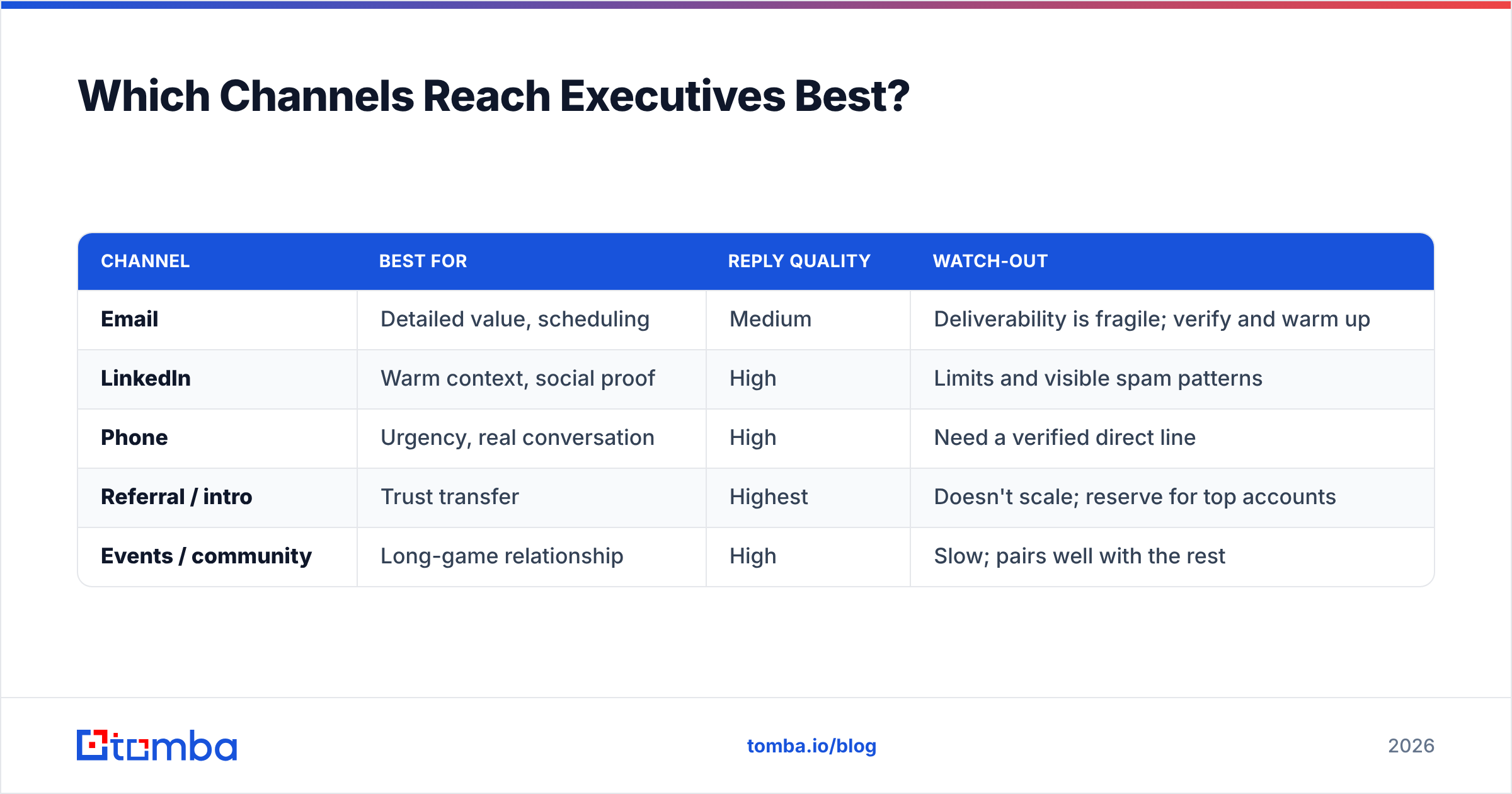
No single channel reaches a busy executive reliably. The teams with the highest response rate sequence channels deliberately instead of betting on one.
| Channel | Best for | Reply quality | Watch-out |
|---|---|---|---|
| Detailed value, scheduling | Medium | Deliverability is fragile; verify and warm up | |
| Warm context, social proof | High | Limits and visible spam patterns | |
| Phone | Urgency, real conversation | High | Need a verified direct line |
| Referral / intro | Trust transfer | Highest | Doesn't scale; reserve for top accounts |
| Events / community | Long-game relationship | High | Slow; pairs well with the rest |
The winning sequence for a tier-1 account usually looks like: a researched email, a LinkedIn connection that references the same trigger two days later, a phone touch the following week, and — for the accounts worth it — a path to a warm introduction. Each touch reinforces the others. The executive sees a coherent, persistent, relevant human, not a bot firing one channel into the void.
For the LinkedIn leg, you can connect emails to profiles with a LinkedIn finder so your messaging stays consistent across both channels rather than treating them as separate campaigns.
How Do You Get Past the Gatekeeper?#
Reframe the gatekeeper as an ally, not an obstacle. The executive assistant controls access precisely because the executive trusts their judgment — so earn that judgment.
Three approaches that work better than trying to dodge them:
- Be transparent. "I'm trying to reach [name] about [specific outcome relevant to their goals]. Is email or a call better, and is there a better time?" Assistants route serious, specific requests and block vague ones.
- Multi-thread below. A champion VP who forwards your note internally beats any gatekeeper trick. Internal referrals skip the front door entirely.
- Give them something to evaluate. A one-line, outcome-specific value prop lets the assistant make a fast yes/no. Ambiguity gets you a polite no.
The teams that "always get blocked by gatekeepers" are almost always sending messages so generic that blocking them is the correct decision. Fix the message and the gate opens.
When Is the Right Time to Reach Out?#
Timing beats persistence. The same email that gets ignored in March gets a same-day reply in May if you land on a trigger.
High-intent triggers worth building alerts around:
- New funding round — fresh budget, pressure to show growth, new initiatives. The single best window for a cold approach.
- New executive hire — a new CRO or CFO rebuilds their stack in the first 90 days. Reach them in week two, not month six.
- Public goal or earnings comment — a CEO who names a target on a call just handed you your thesis.
- Competitor or product news — launches, layoffs, and pivots all reset priorities.
- Org growth signals — a hiring spike in a department often signals the pain your product solves.
Building outreach around triggers also fixes your volume problem. You stop needing thousands of contacts because you are reaching the right 50 at the right moment. That is also far kinder to your email deliverability, since low-volume, high-relevance sending is exactly what inbox providers reward.
How Do You Measure Whether It's Working?#
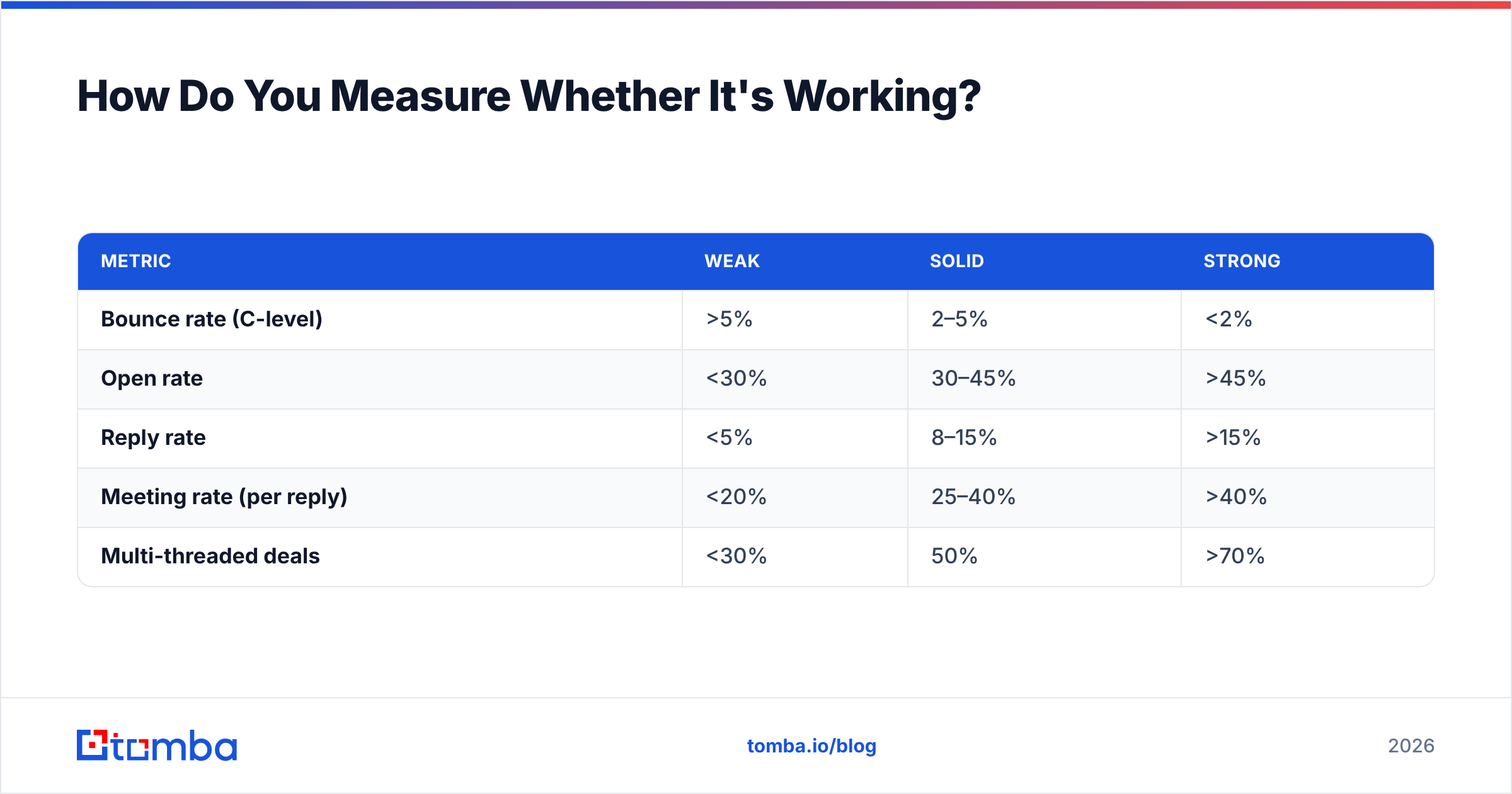
Track the executive funnel separately from your general outbound numbers — the benchmarks are different and mixing them hides the truth.
| Metric | Weak | Solid | Strong |
|---|---|---|---|
| Bounce rate (C-level) | >5% | 2–5% | <2% |
| Open rate | <30% | 30–45% | >45% |
| Reply rate | <5% | 8–15% | >15% |
| Meeting rate (per reply) | <20% | 25–40% | >40% |
| Multi-threaded deals | <30% | 50% | >70% |
If your bounce rate to executives is high, stop everything and fix data quality before you touch copy — bounces are a data problem masquerading as a messaging problem. If opens are fine but replies are flat, your research and thesis are too generic. If replies come but meetings do not, your ask is too big or too vague.
For the data layer specifically, weak numbers usually trace back to unverified addresses and catch-all domains. A catch-all verifier helps you separate genuinely riskable sends from addresses that will silently swallow your message — a common, invisible drain on executive outreach.
What's the Fastest Way to Build a Clean Executive List?#
You do not need a 50,000-row list to hit pipeline. You need 200 verified, well-researched, trigger-matched contacts and the discipline to work them properly.
The efficient build:
- Define your ICP and pick 50–100 target accounts with an active trigger.
- Use a bulk email finder to resolve the executive plus one champion per account.
- Verify the full list in one pass so nothing bounces.
- Enrich for the personal research hook.
- Sequence email + LinkedIn + phone over 2–3 weeks.
Compare that to the old way — buy a list, blast it, watch your domain reputation collapse, and wonder why no CEO replied. The math is not close. Clean and small beats dirty and large every time you are selling to people who can end the conversation in one click.
For reference on where contact data comes from and how it stays accurate, Tomba documents its data sources openly, and independent reviews on G2 and Capterra are worth reading before you commit to any vendor. If you want the broader context on executive buying behavior, HubSpot's sales research is a solid, vendor-neutral starting point.
Common Mistakes That Kill Executive Outreach#
- Treating the CEO like a feature buyer. They buy outcomes. Translate every feature into revenue, risk, or time.
- Single-threading. Betting a six-figure deal on one inbox is how deals die when that person changes jobs.
- Skipping verification. One CFO hard bounce can degrade your sending domain for weeks.
- Following up once. Most executive replies come on touch four through seven, not touch one.
- Generic research. "I see you're in fintech" is not research. The recent, specific, true detail is.
The Bottom Line#
Reaching c level decision makers in 2026 is not about volume, clever subject lines, or automation hacks. It is about reaching the right person, at the right moment, with a message that proves you understand their job — and reaching them on a verified address so the message actually lands. Get the data layer right and every other tactic in this guide starts working. Get it wrong and none of them do.
Start with accurate, verified contact data. The Tomba Email Finder resolves and verifies executive emails by name, role, or company so your outreach reaches real inboxes instead of bouncing off the spam filter — and the free tier gives you 25 searches to test it on your top accounts before you commit. Check the full Tomba pricing when you are ready to scale from a handful of targets to a real executive pipeline.
// get started
Find, verify and enrich your first contacts today
Start on the free plan with 25 searches a month, then scale when your team is ready.
Free plan · No credit card required · GDPR & CCPA
// about the author