Challenger Sale Choreography: A 2026 Playbook for Reps
The Challenger Sale wins deals when the conversation is choreographed, not improvised. Here is the move-by-move 2026 playbook for teaching, tailoring, and taking control.

Challenger Sale Choreography: The 2026 Move-by-Move Playbook
Most reps treat the Challenger Sale like a personality test: "Am I a Challenger or a Relationship Builder?" That misses the point. The Challenger advantage is not a personality — it is a choreography. A repeatable sequence of conversational moves, run in the same order, in every deal, by every rep on the team.
This guide breaks down that choreography step by step, shows where teams break the routine, and explains why the whole thing collapses without clean prospect data underneath it.
TL;DR#
- Challenger sale choreography is a fixed sequence, not a vibe — Warm-up, Reframe, Rational Drowning, Emotional Impact, New Way, Your Solution.
- The hardest move is the Reframe: leading with an insight that reshapes how the buyer sees their own problem, before you mention your product.
- Constructive tension is the engine. If the buyer is comfortable the whole call, you skipped the choreography.
- It only works at scale when reps reach the right person with accurate contact data — bad data turns a brilliant reframe into a voicemail.
- Pair the script with verified contacts from a tool like Tomba's email finder so the choreography reaches a decision-maker, not a dead inbox.
What is Challenger Sale choreography?#
The short answer: it is the staged, intentional order of moves a Challenger rep uses to teach the buyer something new, tailor that lesson to their world, and take control of the conversation toward a decision.
The Challenger Sale model came out of research by CEB (now part of Gartner) and was popularized in the book by Matthew Dixon and Brent Adamson. The finding that started it all: in complex B2B sales, the top performers were not the friendliest reps. They were the ones who pushed customers' thinking and brought provocative, commercially useful insight to the table.
Think of it like a stage play. A relationship-builder rep improvises and hopes the chemistry carries the scene. A Challenger rep runs a rehearsed sequence where every line sets up the next. The buyer feels the conversation is natural — but the rep knows exactly which beat comes next.
)
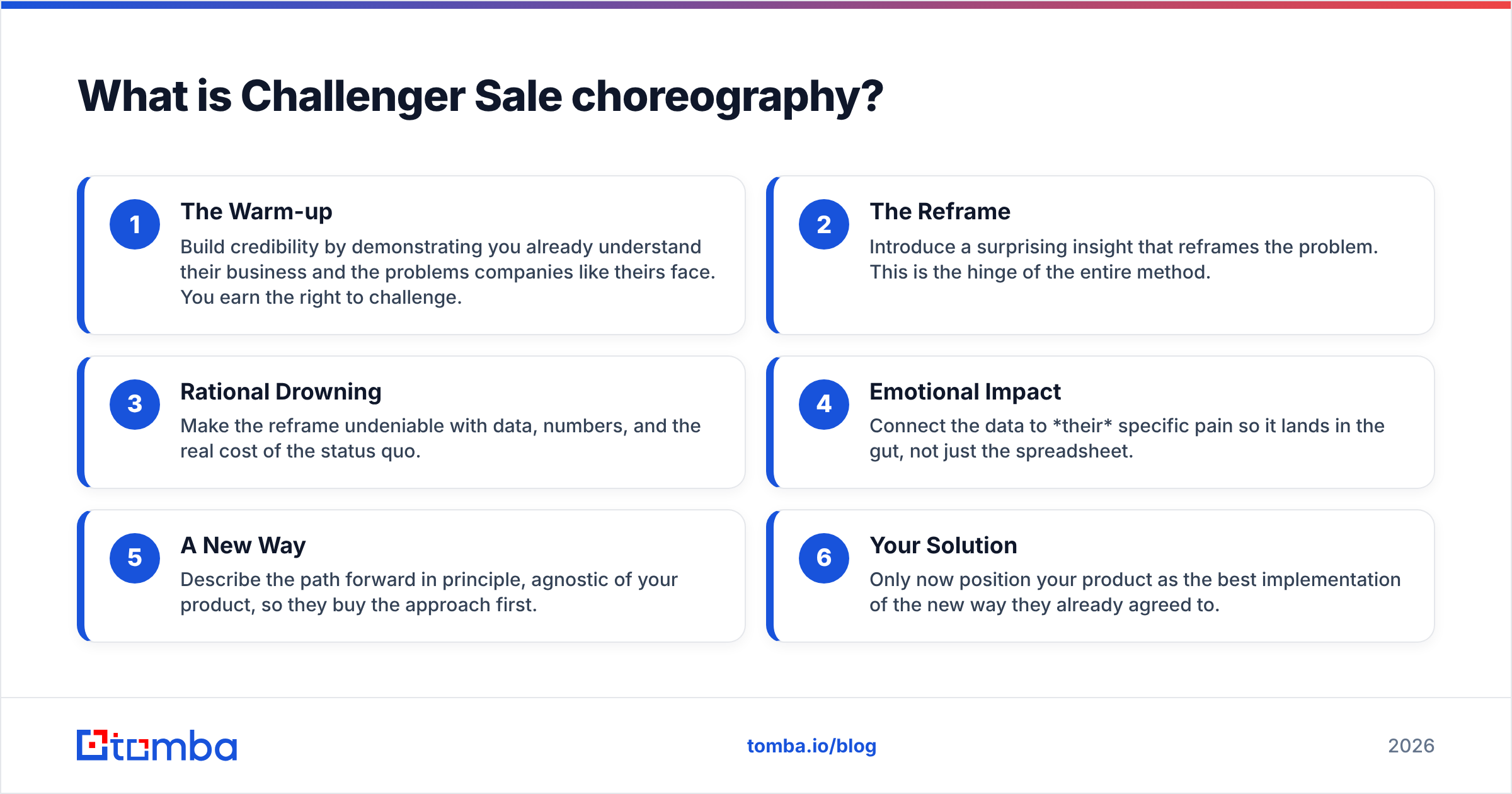
The choreography has six core movements:
- The Warm-up — Build credibility by demonstrating you already understand their business and the problems companies like theirs face. You earn the right to challenge.
- The Reframe — Introduce a surprising insight that reframes the problem. This is the hinge of the entire method.
- Rational Drowning — Make the reframe undeniable with data, numbers, and the real cost of the status quo.
- Emotional Impact — Connect the data to their specific pain so it lands in the gut, not just the spreadsheet.
- A New Way — Describe the path forward in principle, agnostic of your product, so they buy the approach first.
- Your Solution — Only now position your product as the best implementation of the new way they already agreed to.
Skip a movement and the dance falls apart. Lead with movement six — your product — and you are just another vendor pitching features.
Why does the Reframe matter more than the pitch?#
Because the buyer's existing mental model is your real competitor. Not the other vendor.
Most prospects already have a story about their problem and roughly what a solution should cost. If you sell inside that story, you compete on price and features. The Reframe rewrites the story. You show them the problem is bigger, different, or more expensive than they assumed — and suddenly your "expensive" solution looks like a bargain against the new, larger problem.
A good Reframe has three properties:
- It is counterintuitive. "You think your churn problem is a product problem. Our data says it's an onboarding problem that starts in week one."
- It is backed by evidence. Insight without proof is just an opinion, and buyers discount opinions.
- It leads to you. The reframe should make your differentiated capability the obvious answer — not by accident, but by design.
Get the Reframe right and the rest of the choreography almost runs itself. The buyer leans in, asks questions, and starts selling themselves on the new way. Get it wrong and you are back to feature-bashing.
How do the six moves fit together in one call?#
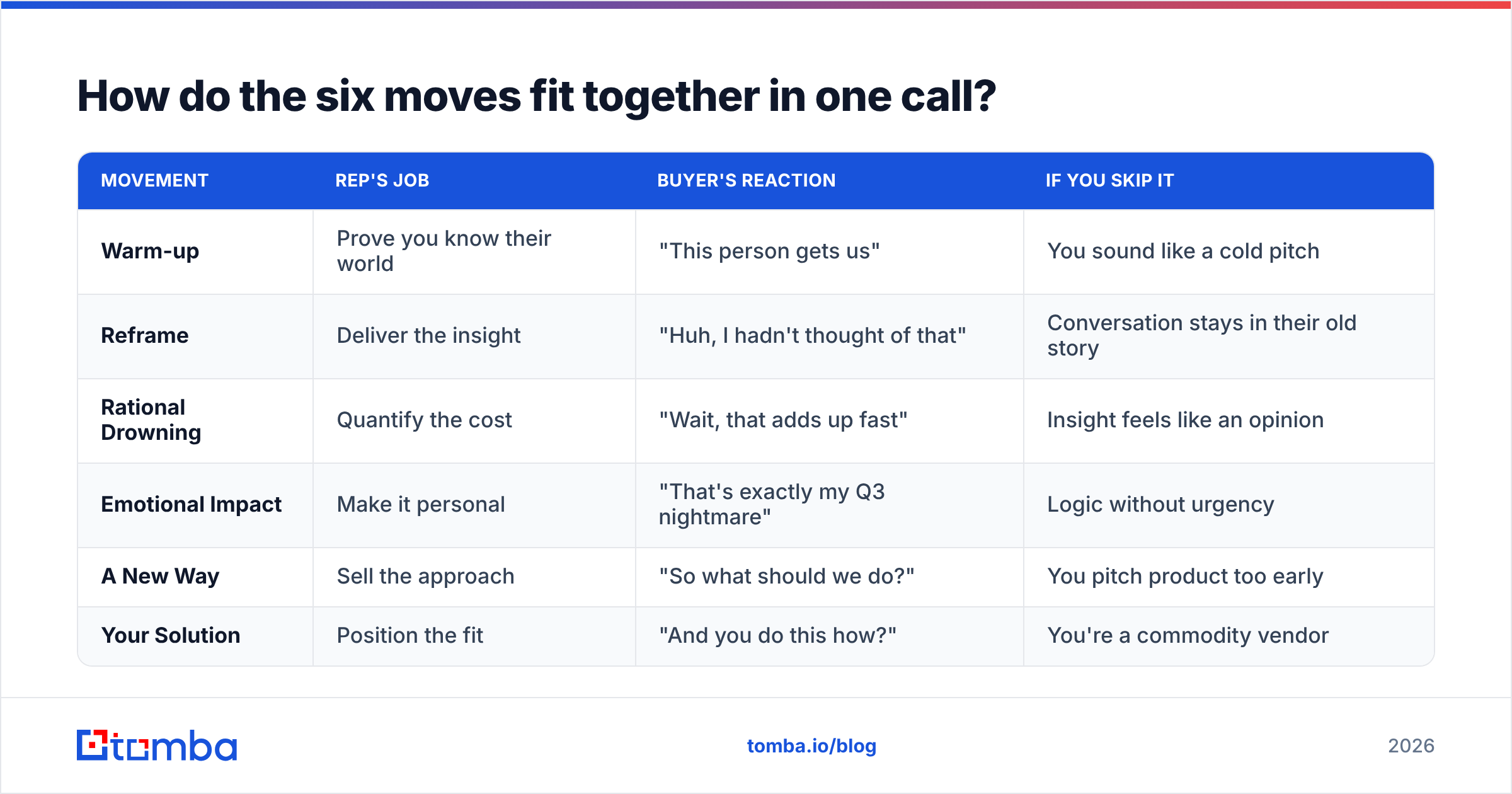
Here is the choreography mapped against what the rep does, what the buyer feels, and the failure mode if you rush the beat.
| Movement | Rep's job | Buyer's reaction | If you skip it |
|---|---|---|---|
| Warm-up | Prove you know their world | "This person gets us" | You sound like a cold pitch |
| Reframe | Deliver the insight | "Huh, I hadn't thought of that" | Conversation stays in their old story |
| Rational Drowning | Quantify the cost | "Wait, that adds up fast" | Insight feels like an opinion |
| Emotional Impact | Make it personal | "That's exactly my Q3 nightmare" | Logic without urgency |
| A New Way | Sell the approach | "So what should we do?" | You pitch product too early |
| Your Solution | Position the fit | "And you do this how?" | You're a commodity vendor |
Notice the product shows up last. Reps who are nervous, untrained, or chasing a quota deadline collapse the whole sequence into "let me show you a demo." That is the single most common way the choreography breaks.
Is the Challenger Sale better than consultative or solution selling?#
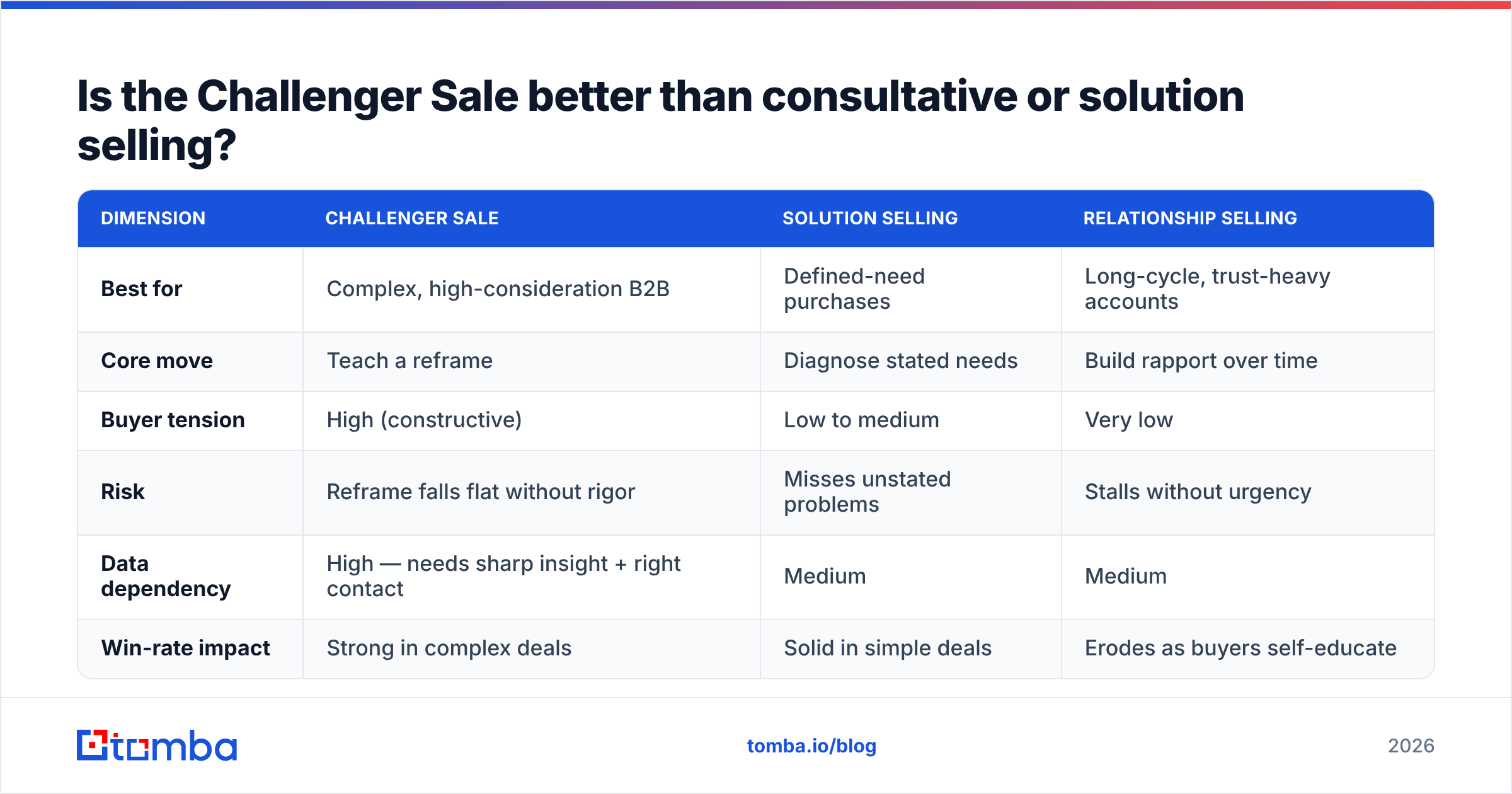
It depends on deal complexity and how informed your buyer already is. Here is an honest comparison.
| Dimension | Challenger Sale | Solution Selling | Relationship Selling |
|---|---|---|---|
| Best for | Complex, high-consideration B2B | Defined-need purchases | Long-cycle, trust-heavy accounts |
| Core move | Teach a reframe | Diagnose stated needs | Build rapport over time |
| Buyer tension | High (constructive) | Low to medium | Very low |
| Risk | Reframe falls flat without rigor | Misses unstated problems | Stalls without urgency |
| Data dependency | High — needs sharp insight + right contact | Medium | Medium |
| Win-rate impact | Strong in complex deals | Solid in simple deals | Erodes as buyers self-educate |
The model shines when buyers are sophisticated and have access to information — which describes nearly every B2B buyer in 2026. When prospects research most of the buying journey before they talk to you, the rep who merely answers questions adds little. The rep who reframes the question adds enormous value. For more on how this affects pipeline math, it is worth understanding your sales win rate before and after adopting the method.
What does constructive tension actually look like?#
Constructive tension is the deliberate, respectful discomfort that pushes a buyer out of complacency. It is the difference between "Makes sense, let me check with the team" (death) and "I need to fix this now" (movement).
A few concrete moves that create it:
- Name the elephant. "Most teams in your position assume this is a budget issue. It usually isn't, and here's why that distinction costs you six figures."
- Challenge the timeline. "Waiting until next quarter feels safe, but the cost of inaction compounds monthly. Let me show the math."
- Politely disagree. "I hear you, but I'd push back — the data we see across 200 accounts points the other way."
Tension is not aggression. The Challenger is assertive about the idea and warm about the person. If your buyer feels attacked, you have crossed the line. If your buyer feels nothing, you never approached it.
)
Why does the choreography fail without clean data?#
Because a perfect reframe delivered to the wrong inbox is worth exactly zero. This is the part most Challenger training ignores, and it is where deals quietly die.
The choreography assumes three things about your data that are frequently false:
- You reached a decision-maker, not a gatekeeper or a long-departed employee.
- The contact details are current, so your teaching email actually lands instead of bouncing.
- You know enough about the account to tailor the reframe to their specific situation.
When any of these break, your rep runs a flawless script into a void. That is why high-performing Challenger teams treat prospect data as part of the methodology, not an afterthought. Reaching the right person with a verified address is the precondition for every other move — and it directly affects your email response rate.
This is also where research feeds the Reframe. The "I already understand your world" warm-up is only credible if you actually did the homework. Contact and company enrichment gives reps the firmographic detail — headcount, tech stack, role — that makes a tailored insight land instead of sounding generic.
How do you build a repeatable Challenger motion across a team?#
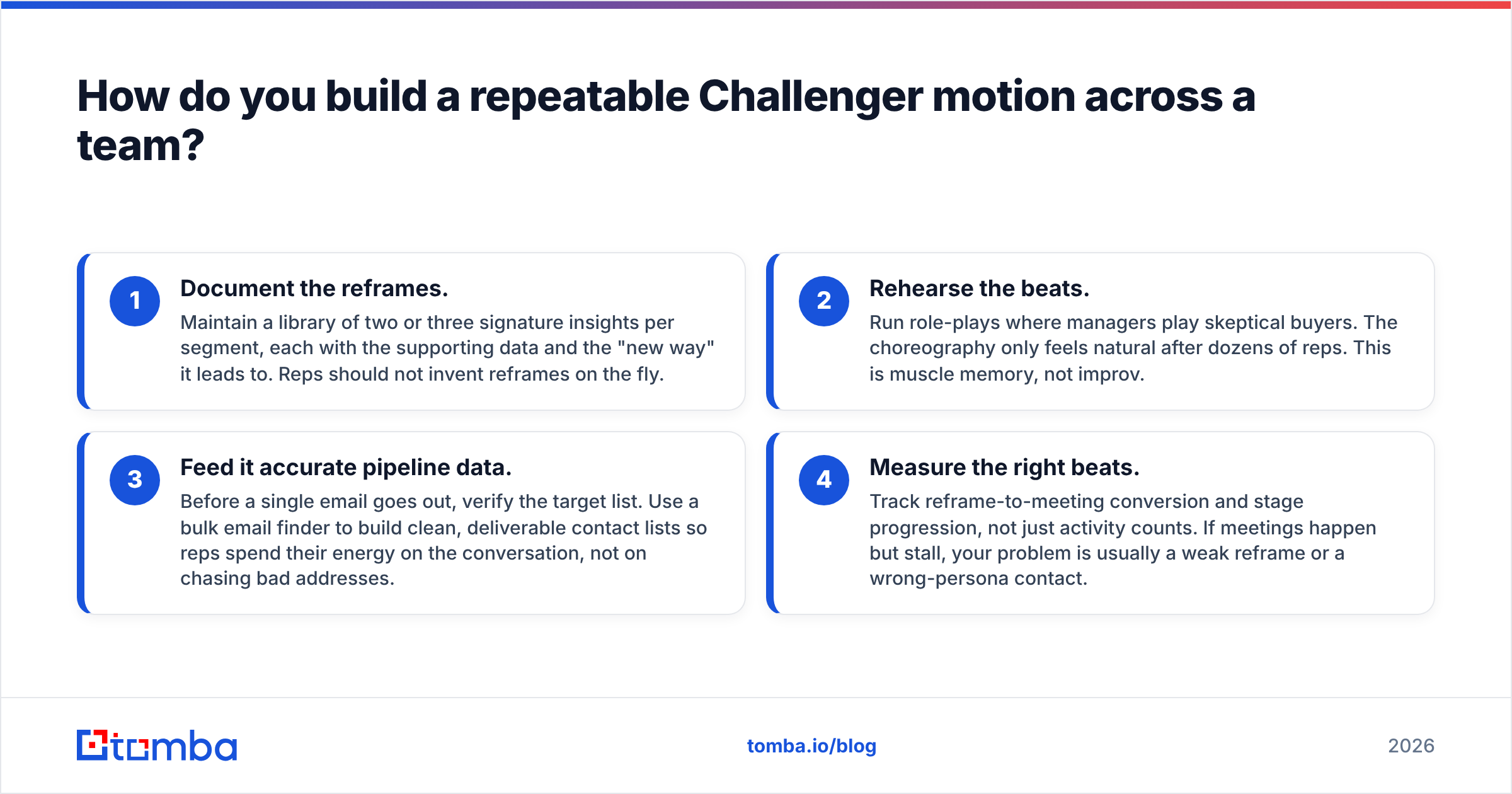
One brilliant Challenger rep is luck. A whole team running the choreography is a system. Building that system takes four things.
- Document the reframes. Maintain a library of two or three signature insights per segment, each with the supporting data and the "new way" it leads to. Reps should not invent reframes on the fly.
- Rehearse the beats. Run role-plays where managers play skeptical buyers. The choreography only feels natural after dozens of reps. This is muscle memory, not improv.
- Feed it accurate pipeline data. Before a single email goes out, verify the target list. Use a bulk email finder to build clean, deliverable contact lists so reps spend their energy on the conversation, not on chasing bad addresses.
- Measure the right beats. Track reframe-to-meeting conversion and stage progression, not just activity counts. If meetings happen but stall, your problem is usually a weak reframe or a wrong-persona contact.
A quick analogy: you would not let a surgical team improvise the order of operations. You standardize the sequence so the variable that changes is the patient, not the procedure. Challenger choreography is the same — the script is fixed so reps can focus all their judgment on the customer in front of them.
What are the most common choreography mistakes in 2026?#
These are the breakdowns that show up most often in deal reviews:
- Pitching during the warm-up. Reps so eager to talk product that they never earn the right to challenge.
- A reframe with no proof. A provocative claim that crumbles the moment the buyer asks "how do you know?"
- Skipping emotional impact. All spreadsheet, no stakes. The buyer agrees intellectually and does nothing.
- Tailoring to the wrong person. A flawless reframe aimed at a champion who has zero budget authority — usually a data problem, not a skill problem.
- Releasing tension too early. Reps who feel awkward and rush to reassure, dissolving the very tension that drives action.
Most of these are coachable. The data-driven ones — wrong person, dead inbox, generic tailoring — are fixable at the source, before the rep ever opens their mouth. As the Harvard Business Review coverage of the original research noted, the Challenger approach is a learnable, teachable discipline, not an inborn trait. You can read more on the model's origins via Challenger's own resources.
Put the choreography to work#
The Challenger Sale rewards teams that treat the conversation as a rehearsed sequence and the prospect list as a precision instrument. Nail the reframe, sustain the tension, and lead with your solution last — but only after you have confirmed you are talking to the right person at the right account.
That last part is where Tomba's email finder earns its place in your stack. Build verified, deliverable contact lists by name, role, or domain, enrich them with the firmographic detail your reframes depend on, and start every Challenger conversation with confidence that it will actually reach a decision-maker. Plans start free with 25 searches a month and scale from $49/mo — see Tomba pricing and give your choreography an audience worth performing for.
// get started
Find, verify and enrich your first contacts today
Start on the free plan with 25 searches a month, then scale when your team is ready.
Free plan · No credit card required · GDPR & CCPA
// about the author